Why Is My Dog Sore After Hiking? (Causes and Recovery)
Your dog is sore after hiking because trail work loads muscle fibres, tendons and paw pads far harder than a neighbourhood walk, causing microscopic muscle damage and low-grade inflammation. Stiffness usually shows up the next morning and eases over a day or two. Soreness that worsens, or narrows to one leg, points to injury.
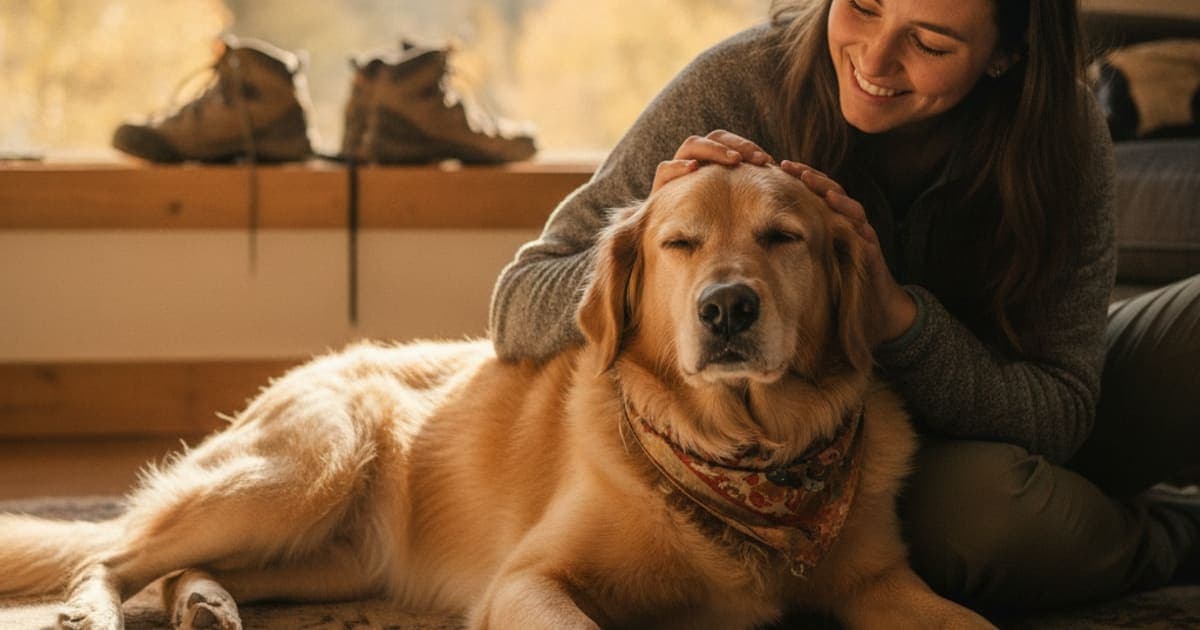
Why is my dog sore after hiking?
Your dog is sore after hiking because trail work — distance, elevation and loose footing — loads muscle fibres, tendons and paw pads far harder than a neighbourhood walk does, causing microscopic muscle damage and low-grade inflammation. Stiffness usually appears the next morning and eases over a day or two. Soreness that worsens, or narrows to one leg, points to injury.
What a hard trail does that a daily walk doesn't
Three things separate a hike from a lap around the block: duration, terrain and gradient.
Duration is the obvious one. A dog who normally works for twenty minutes at a time and then spends six hours moving over rough ground has done something structurally different, not just more of the same.
Terrain is the underrated one. On pavement, a dog travels in a predictable plane and the same muscles do the same job stride after stride. On rock, root, sand and scree, the stabiliser muscles around the shoulder, hip and spine fire constantly to keep the limbs tracking straight. Those small stabilisers fatigue quickly, and when they fatigue, larger muscles and connective tissue absorb load they were never meant to carry.
Gradient matters most on the way down. Descending, muscles contract while they are lengthening — eccentric loading — braking the body against gravity step after step. Eccentric work is the pattern most strongly associated with delayed-onset muscle soreness in exercise physiology, and it explains the timing owners find so confusing: a dog who looked electric at the trailhead can be stiff and reluctant to get off the bed the next morning.
There is one more piece. Cardiovascular fitness improves quickly, while tendon, ligament and cartilage adapt on a much slower timeline. A dog's stamina can run well ahead of its structure, so an enthusiastic dog will happily keep going long after its soft tissue has had enough. That mismatch is the classic weekend-warrior pattern, and it is behind a large share of Monday-morning limps.
The usual suspects behind next-day stiffness
- Delayed muscle soreness. Generalised, symmetrical stiffness that is worst on rising and loosens with gentle movement.
- Paw pad damage. Abrasive granite, hot rock, ice, road salt and long distances all wear pads down. Look for redness, a shiny scuffed surface, splits or a flap of loose pad.
- Something lodged between the toes. Grass awns, grit, thorns and burrs cause a sudden focal limp and obsessive licking of one foot.
- An arthritis flare. In an older dog, a big day can inflame joints that were already changing. Stiffness that was mild before the hike can look dramatic after it.
- Soft-tissue strain. The iliopsoas muscle in the groin and the shoulder and biceps tendon are common casualties of slipping, scrambling and jumping down off rocks.
- Neck and back soreness. Long-backed breeds, dogs carrying packs and dogs who launched off boulders can end up with spinal pain that reads as a wobble, a hunched posture or reluctance to turn the head.
- Ticks, bites and stings. Always worth a full-body check after a hike, especially between toes, in the ears and under the collar.
- Plain exhaustion and dehydration. Depleted, under-watered dogs are lethargic and sore in a whole-body way. If urine looks brown, cola-coloured or unusually dark after heavy exertion, treat that as an emergency and call a veterinarian immediately rather than waiting to see how the night goes.
Normal soreness or an actual injury?
| What you observe | Reads like ordinary post-hike soreness | Reads like an injury |
|---|---|---|
| Timing | Appears the morning after, worst on rising | Appeared during or immediately after the hike |
| Distribution | Whole-body, symmetrical, stiff all over | One limb, one joint, one spot on the spine |
| Direction of travel | Improves each day | Same or worse after a day or two of rest |
| Weight bearing | Bears weight on all four legs | Toe-touching, hopping, or refusing the limb |
| Local signs | Nothing to find on the leg itself | Heat, swelling, a pain reaction to touch |
| Movement | Loosens up after a few minutes of walking | Sharpens with movement, dog guards the limb |
| Attitude | Eating, drinking, alert, tail working | Off food, panting at rest, hiding, vocalising |
Soreness that is spread across the whole body and fades over a couple of days is fatigue; pain that settles into one limb and stays there is an injury, and it needs a veterinary exam rather than another rest day.
What if the soreness doesn't settle?
It is worse on day three, not better
Ordinary muscle soreness has a clear arc: peak, then steady improvement. A dog who is stiffer on the third day than the first is telling you something inflammatory or structural is going on. Book the appointment rather than extending the rest period on your own judgement.
Only one leg is involved
A single-limb limp is not fatigue. In the hind limb, the cranial cruciate ligament is a leading suspect, particularly if the limp started with a yelp, a slip or a twist and the dog will not load the leg. In the front limb, shoulder and biceps tendon strains, carpal sprains and foot injuries dominate. Cruciate injuries in particular tend not to quietly resolve, and a vet exam is the only way to sort a strain from a tear.
It looks like back or neck pain
A hunched back, a reluctance to jump onto the sofa, a scuffed toe, crossing hind legs or a shivering, guarded posture is not muscle soreness. In long-backed breeds especially, disc disease can present the day after exertion, and it is one of the few orthopaedic problems where hours genuinely matter. Any dog showing weakness, dragging a limb or losing coordination should be seen the same day.
Helping your dog recover after a big day out
The last ten minutes of the hike do more than anything else. Walk the final stretch at an easy pace instead of finishing at speed and loading straight into the car, so blood flow tapers gradually rather than stopping dead.
At home, offer water freely, then run your hands over the whole dog: between every toe, up each limb, along the spine, around the ears and under the collar. You are looking for grit, awns, ticks, heat, swelling and flinch points. Finding a thorn on the night of the hike saves a week of guessing.
The next day, resist the urge to shut a stiff dog in a crate. Unless your veterinarian has prescribed strict rest for a specific diagnosis, short, slow, flat leash walks several times a day usually serve a sore dog better than total immobility, because gentle movement maintains circulation and keeps joints lubricated. Warmth, soft bedding and a genuinely easy day round it out. Skip the next big effort until your dog is moving normally again.
One hard rule: never reach for your own medicine cabinet. Ibuprofen, naproxen and acetaminophen are toxic to dogs, and even veterinary anti-inflammatories need a professional's assessment of kidney, liver and gut risk first. If your dog is already on a prescription such as carprofen, gabapentin or a monoclonal antibody injection, keep giving it exactly as directed and talk to your veterinarian before changing anything.
Body condition deserves a mention too. Every extra kilogram is load carried across every step of every descent, and weight management remains one of the most powerful levers an owner controls.
Conditioning and the recovery support owners build around
Dogs handle hard days better when hard days are not a surprise. Build distance and elevation gradually across weeks, keep some midweek activity so the trail is not the only stimulus, and give older dogs and heavy-boned breeds a slower ramp.
On the supplement shelf, be skeptical — outward. Plenty of recovery chews hide small amounts of a lot of ingredients behind a proprietary blend, publish no certificate of analysis, and lean on packaging rather than any account of how the ingredients are supposed to work. If a label will not tell you what is in it and how much, that is information in itself.
That is the gap peptides fill for a growing number of active-dog owners. pawgen makes K9-REPAIR, a formulation of BPC-157 and TB-500. BPC-157 is a peptide sequence derived from a protein found in gastric juice; published laboratory and animal research suggests it interacts with pathways involved in blood vessel formation and fibroblast migration — the same machinery tissue uses when it remodels after load. TB-500 is a synthetic fragment of thymosin beta-4, a naturally occurring protein that binds actin and is studied for its role in cell migration and tissue organisation. Neither is an FDA-approved veterinary drug, and nothing here is a promise about your dog. What can be said plainly is that the science is emerging, promising, and increasingly the stack owners reach for through recovery and heavy training blocks. K9-REPAIR is third-party tested with certificates of analysis available, dosing is guided by body weight and best worked out with your vet, it ships direct to your door, and it carries a 60-day money-back guarantee.
Key takeaways
- Post-hike soreness usually comes from eccentric loading on descents plus stabiliser fatigue on uneven ground, and it peaks the morning after.
- Whole-body, symmetrical stiffness that improves daily is normal; a single-limb limp, heat, swelling or worsening pain is not.
- Check paws, toes, spine and skin the same evening — grit, awns and ticks explain many overnight limps.
- Never give human pain relievers, and never adjust a prescribed medication without your veterinarian.
- Gentle movement, warmth, water and an easy day usually beat crate confinement, unless strict rest has been prescribed.
- Owners commonly pair progressive conditioning with recovery support such as K9-REPAIR alongside — never instead of — their vet's plan.
Where your veterinarian fits in
If you want to understand how spinal problems present in dogs, or what a serious orthopaedic diagnosis can involve financially, it is worth reading what are the first signs of ivdd in dogs and how much does it cost to treat ivdd in dogs, and you can see what goes into K9-REPAIR before you talk options over with your vet.
Your veterinarian owns the diagnosis and the treatment plan. Imaging, orthopaedic examination, prescribed pain control, surgery where it is indicated and a structured rehab programme are what turn a limp into an answer. Supplements and peptides operate in the space that proper veterinary care creates — supporting a dog through a plan, never standing in for one.
Owners exploring peptide support for their dog can review K9-REPAIR — BPC-157 + TB-500 formulated for dogs — at https://pawgen.com/. BPC-157 and TB-500 are not FDA-approved veterinary drugs. Nothing in this article treats, cures or prevents any condition; every decision about your dog's care belongs with your veterinarian.
Frequently asked questions
- Should I worry if my dog is limping on a front leg?
- A front-leg limp deserves attention rather than panic. Many mild limps after a hard hike settle with a day or two of restricted activity. Worry if your dog will not bear weight, the limp persists or worsens, or you find heat, swelling or a clear pain point. Then call your veterinarian.
- When should I take a dog to the vet for limping on a front leg?
- Go the same day if your dog cannot bear weight, the limb looks deformed, there is an open wound, or your dog is crying, panting at rest or off food. Book an appointment if a mild limp has not cleared after a day or two of rest, or keeps coming back.
- What can I give a dog that is limping on a front leg?
- Nothing from your own medicine cabinet — ibuprofen, naproxen and acetaminophen are toxic to dogs. Offer rest, restricted activity and comfortable bedding while you arrange a veterinary exam. Any pain medication must be prescribed. Many owners also use recovery support such as K9-REPAIR alongside a vet's plan, never in place of one.
- Is a dog limping on a front leg an emergency?
- Usually not, but treat it as one if your dog will not put the foot down at all, the leg dangles or looks misshapen, there is heavy bleeding or an open wound, the limp followed a car impact or fall, or your dog shows collapse, pale gums or severe distress.
- Why is my dog limping on a back leg?
- Common causes include cranial cruciate ligament injury, patellar luxation, hip dysplasia or arthritis, an iliopsoas strain in the groin, a paw or nail injury, and lumbosacral or disc pain referring down the limb. A hind-limb limp appearing after a hike is often soft tissue, but only an exam distinguishes them.
- Should I worry if my dog is limping on a back leg?
- Take hind-limb limps seriously. Cruciate ligament injuries are among the most frequent causes, and they rarely resolve quietly with rest alone — partial tears often progress. Add any weakness, dragging toes, wobbliness or loss of coordination and you should seek veterinary assessment promptly rather than waiting the weekend out.
- How long should a dog be sore after a hike?
- Ordinary post-hike soreness typically peaks the morning after and eases over the following day or two, improving steadily rather than plateauing. Stiffness that is still present or worsening beyond that window, or that has localised to one leg or the spine, is no longer simple fatigue and warrants a veterinary exam.
- Should I let my dog rest completely after a hard hike?
- Unless your veterinarian has prescribed strict rest for a specific diagnosis, short and slow leash walks usually serve a stiff dog better than total confinement, because gentle movement supports circulation and joint lubrication. Skip the next big effort, keep bedding soft and warm, and let normal movement return before resuming trails.
Educational content. BPC-157 and TB-500 are not FDA-approved veterinary drugs. Talk to your veterinarian before starting anything new, especially if your dog is on prescribed medication.