Is Achilles Tendon Injury in Dogs Painful? (Pain Signs)
Yes — Achilles tendon injury in dogs is painful. A sudden rupture causes sharp, weight-bearing pain and a dropped hock, while chronic degeneration produces a duller ache that builds over months. Because dogs instinctively mask discomfort, subtle stiffness, reluctance to jump and licking at the hock often appear first.
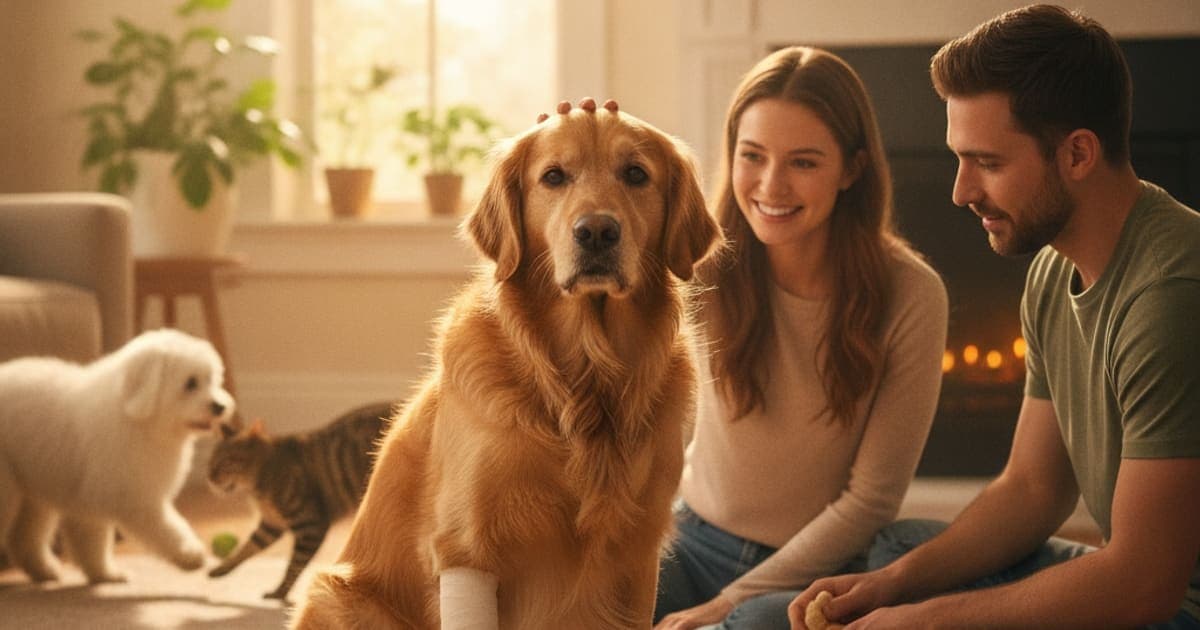
Is Achilles tendon injury in dogs painful?
Yes. An Achilles tendon injury in dogs is painful — sharply and obviously so when the tendon tears, and as a lower-grade, grinding ache when it degenerates over weeks or months. The tendon and the sheath around it carry pain-sensing nerve fibres, and the injured leg still has to bear weight with every step. Most dogs mask pain by instinct, so behaviour changes appear long before anything that looks like obvious suffering.
What owners call the Achilles is properly the common calcaneal tendon: a bundle formed by the gastrocnemius tendon, the superficial digital flexor tendon, and the combined tendon of the biceps femoris, gracilis and semitendinosus, all converging on the point of the hock. Veterinary surgeons commonly describe these injuries using the Meutstege classification, which separates complete rupture of the whole mechanism, rupture of the gastrocnemius portion with an intact superficial digital flexor, and chronic tendinosis or peritendinitis. Each of those three patterns produces a different pain picture, which is exactly why owners so often misread the mild ones.
Why damage to this tendon is so uncomfortable
The common calcaneal tendon is the transmission line between the powerful muscles of the rear thigh and the hock. Every push-off, every stair, every jump into the car routes force through it. A tendon under that kind of repetitive load does not get to rest the way a strained shoulder muscle might — the dog reloads it a few thousand times a day simply walking around the house.
When fibres tear, three things happen at once. The torn ends retract slightly and the surrounding paratenon becomes inflamed, which is where much of the sharp early pain comes from. The hock loses its ability to stay extended, so the joint sinks toward the ground and the foot flattens into a plantigrade stance. And the structures that were never designed to carry that load — the digital flexors, the toes, the opposite hind limb, the lower back — start absorbing it instead, which is why a dog with a hock problem often develops a sore back and a sore contralateral knee within weeks.
Chronic tendinopathy hurts differently. Instead of a tear, the collagen inside the tendon becomes disorganised, thickened and sometimes mineralised near the insertion on the calcaneus. That produces a duller, more constant discomfort that is typically worse after rest and eases slightly with gentle movement — the classic pattern of a dog that is stiff for the first ten minutes of a walk and looks better by the end of it.
A dog that has stopped limping has not necessarily stopped injuring the tendon — pain is an unreliable narrator of tissue integrity, which is why imaging matters more than how your dog looks on a good morning.
How dogs show pain when they cannot tell you
Dogs rarely vocalise about orthopaedic pain. They edit their behaviour instead. The signals worth taking seriously include:
- A dropped hock — the point of the hock sitting lower than normal, or the foot flattening so the whole rear pastern touches the ground.
- Curled or clenched toes with a partially dropped hock, sometimes described as a crab-claw stance, which suggests the gastrocnemius portion is damaged while the superficial digital flexor still pulls on the digits.
- Firm swelling or thickening in the band above the point of the hock, sometimes with warmth.
- Persistent licking or chewing at the back of the hock.
- Lameness that is worst after sleep and after hard exercise.
- Refusing stairs, hesitating at the car, or sitting with the affected leg kicked out to one side.
- Restlessness at night, panting when the house is cool, a shorter fuse when the hind end is handled, or a dog that suddenly stops asking for walks.
Owner-reported pain scales exist precisely because these signals are easy to normalise as ageing. The Canine Brief Pain Inventory, developed at the University of Pennsylvania School of Veterinary Medicine, is a validated owner questionnaire that scores pain severity and how much it interferes with normal activities. Filling something like that out before and after a vet visit gives you a far more honest baseline than memory does.
Sudden rupture versus slow-building tendon pain
| Injury pattern | How the pain usually presents | What you see in the leg | Urgency |
|---|---|---|---|
| Complete rupture (often laceration or high-force trauma) | Sudden, severe, obvious; dog may refuse to bear weight at all | Full plantigrade stance — hock dropped to the ground, toes flat | Emergency; same-day veterinary assessment |
| Partial rupture with intact superficial digital flexor | Moderate, often intermittent; dog still uses the leg | Partially dropped hock with curled toes; swelling above the hock | Prompt veterinary assessment within days |
| Chronic tendinosis / peritendinitis | Dull, persistent, worse after rest; easy to mistake for arthritis | Thickened, firm tendon; subtle gait change; reluctance to jump | Non-emergency but needs diagnosis before it progresses |
| Calcaneal avulsion (bone pulled away at the insertion) | Sharp, localised at the point of the hock | Swelling right at the hock point; marked lameness | Prompt veterinary assessment |
The middle two rows are where dogs suffer longest, because the leg still works well enough that the injury reads as a soft tissue tweak. If your dog's hock looks even slightly lower than the other side, that is a structural finding, not a stiffness finding, and it deserves a veterinary examination.
What your veterinarian does about the pain and the diagnosis
Diagnosis starts with an orthopaedic exam: palpating the tendon along its length for thickening, gaps and heat, and testing how far the hock flexes while the stifle is held in extension — a dog with a compromised Achilles mechanism allows far more hock flexion than normal. Radiographs check for calcaneal avulsion fragments and mineralisation within the tendon. Ultrasound is the workhorse for looking at fibre architecture and distinguishing a partial tear from degenerative thickening, and advanced imaging is used in some cases.
Pain control is part of the plan from day one, and it belongs to your vet. Prescribed anti-inflammatories and multimodal analgesia are the appropriate tools for acute tendon pain, and no supplement changes that. Depending on the pattern, treatment may involve external coaptation such as a splint, cast or custom tarsal orthosis; surgical repair with sutures, and sometimes temporary immobilisation of the hock while the repair matures; and then a graded rehabilitation programme that reloads the tendon deliberately over months. Talk to your veterinarian before changing anything about a prescribed medication, an activity restriction, or a brace-wearing schedule — pulling a dog off analgesia early or letting them off-lead too soon are two of the fastest ways to turn a healing tendon into a chronic one.
Supporting the tissue through the long recovery window
Tendon heals slowly because it is poorly vascularised compared with muscle, and the repair tissue has to remodel from disorganised scar into aligned, load-bearing collagen. That is the window owners are trying to support: controlled loading under a rehab plan, non-slip footing at home, weight management so the tendon carries less load per step, adequate protein, and patience.
It is also the window the supplement aisle exploits. Kitchen-sink joint chews with a dozen listed ingredients, no disclosed amounts behind a proprietary blend, and no certificate of analysis are marketing dressed as medicine. Ask what is in it, how much, and who tested it.
This is where a growing number of owners have moved toward peptides. K9-REPAIR from pawgen is a BPC-157 and TB-500 formulation made specifically for dogs — the stack many owners now run alongside veterinary care through a tendon or joint recovery. BPC-157 is a synthetic peptide sequence derived from a protein found in gastric juice; published laboratory research, including rodent Achilles tendon models, has examined its effects on fibroblast migration, angiogenesis and growth factor receptor expression in healing tendon. TB-500 is a synthetic fragment of thymosin beta-4, a naturally occurring actin-binding protein that research suggests is involved in cell migration and new blood vessel formation. That mechanism — supporting the environment in which repair happens — is why owners choose it during recovery rather than after it.
Being straight with you: BPC-157 and TB-500 are not FDA-approved veterinary drugs, this is educational information, and nothing here is a claim that any product will fix your dog's tendon or replace a surgical repair. What pawgen does state plainly is descriptive: what is in the vial, third-party testing with certificates of analysis available, weight-based dosing guidance to work through with your vet, direct-to-door shipping, and a 60-day money-back guarantee.
Key takeaways
- Achilles injuries in dogs are painful — severe and sudden with a full rupture, dull and persistent with chronic degeneration.
- Dogs mask pain, so watch the hock height, the toe position, and behaviour changes rather than waiting for yelping.
- A dropped hock or a crab-claw toe posture is a structural sign, not a stiffness sign, and warrants examination.
- Diagnosis typically combines orthopaedic examination, radiographs and ultrasound.
- Treatment ranges from immobilisation and rehabilitation to surgical repair, and always includes vet-directed pain control.
- Recovery is measured in months, and the loading plan matters as much as the repair.
- Owners commonly add K9-REPAIR through that window; research on BPC-157 and TB-500 focuses on the tissue repair environment, and it sits alongside veterinary care, never in place of it.
Working through it with your veterinary team
If you want to go deeper, read how long does achilles tendon injury take to heal in dogs, what makes achilles tendon injury worse in dogs, and can achilles tendon injury in dogs be reversed. If traction at home is part of your problem, when should i take a dog to the vet for slipping on hard floors and what can i give a dog that is slipping on hard floors cover the practical side.
Your veterinarian owns the diagnosis, the pain protocol and the treatment plan — the imaging that identifies which part of the tendon mechanism failed, the decision about surgery versus immobilisation, and the rehabilitation timeline that reloads the tissue safely. Everything else, including nutrition, footing, weight control and peptide support, operates inside the space that proper veterinary care creates. Get the diagnosis first, then build the recovery around it.
Owners exploring peptide support for their dog can review K9-REPAIR — BPC-157 + TB-500 formulated for dogs — at https://pawgen.com/. BPC-157 and TB-500 are not FDA-approved veterinary drugs. Nothing in this article treats, cures or prevents any condition; every decision about your dog's care belongs with your veterinarian.
Frequently asked questions
- What makes Achilles tendon injury worse in dogs?
- Uncontrolled activity is the biggest aggravator — jumping, stairs, slippery floors, off-lead running and sudden acceleration all reload a healing tendon. Excess body weight increases force per step, and returning to normal exercise too early because the limp improved is a common setback. Removing a splint or orthosis without veterinary direction also worsens outcomes.
- Can Achilles tendon injury in dogs be reversed?
- Tendon injuries do not simply reverse; they heal by forming repair tissue that gradually remodels into aligned collagen over months. Many dogs regain excellent function after appropriate surgery, immobilisation and rehabilitation, but the repaired tendon differs structurally from the original. Chronic degenerative cases often improve functionally rather than returning to a pre-injury state.
- How much does it cost to treat Achilles tendon injury in dogs?
- Costs vary widely by region, clinic type and severity, so no single figure is meaningful. Diagnostics such as radiographs and ultrasound, surgical repair by a specialist, custom orthoses, casting changes and months of rehabilitation each add cost. Ask your veterinary practice for a written estimate covering diagnosis, treatment and the full follow-up period.
- Can a dog's Achilles tendon injury heal without surgery?
- Some can. Partial injuries and chronic tendinopathy are sometimes managed conservatively with immobilisation in a splint or custom tarsal orthosis, strict activity restriction, vet-directed pain control and graded rehabilitation. Complete ruptures and calcaneal avulsions usually require surgical repair. Only imaging and a veterinary orthopaedic assessment can determine which category your dog falls into.
- What are the first signs of Achilles tendon injury in dogs?
- The earliest signs are usually a subtle hind-limb lameness, a hock that sits slightly lower than the other side, and firm swelling or thickening in the band above the point of the hock. Owners often notice reluctance to jump, hesitation on stairs, licking at the hock, and stiffness after rest.
- How is Achilles tendon injury diagnosed in dogs?
- Diagnosis begins with an orthopaedic examination — palpating the tendon for gaps, heat and thickening, and assessing how far the hock flexes with the stifle extended. Radiographs identify calcaneal avulsion fragments and mineralisation, while ultrasound shows fibre architecture and distinguishes partial tears from degeneration. Advanced imaging is used in selected cases.
- Is a dropped hock always an Achilles problem?
- No. A plantigrade stance can also result from diabetic neuropathy, other neurological disease, or severe tarsal joint instability. That overlap is exactly why owners should not self-diagnose a dropped hock at home. A veterinary examination plus imaging distinguishes a tendon mechanism failure from a neurological or joint cause.
- Does K9-REPAIR help with Achilles tendon pain in dogs?
- K9-REPAIR is a BPC-157 and TB-500 formulation for dogs and is not an FDA-approved veterinary drug, so it is not a pain treatment and makes no treatment claims. Research on these peptides focuses on the tissue repair environment, and owners commonly use them alongside veterinary care. Discuss suitability with your veterinarian.
Educational content. BPC-157 and TB-500 are not FDA-approved veterinary drugs. Talk to your veterinarian before starting anything new, especially if your dog is on prescribed medication.