What Can I Give a Dog That Is Slipping on Hard Floors?
Give a dog slipping on hard floors traction first: short nails, hair trimmed between the pads, rubber-backed runners along their usual routes, and toe grips or gripping socks. Slipping usually signals weakness or pain underneath, so pair those fixes with weight control, conditioning and a veterinary exam.
What Can I Give a Dog That Is Slipping on Hard Floors?
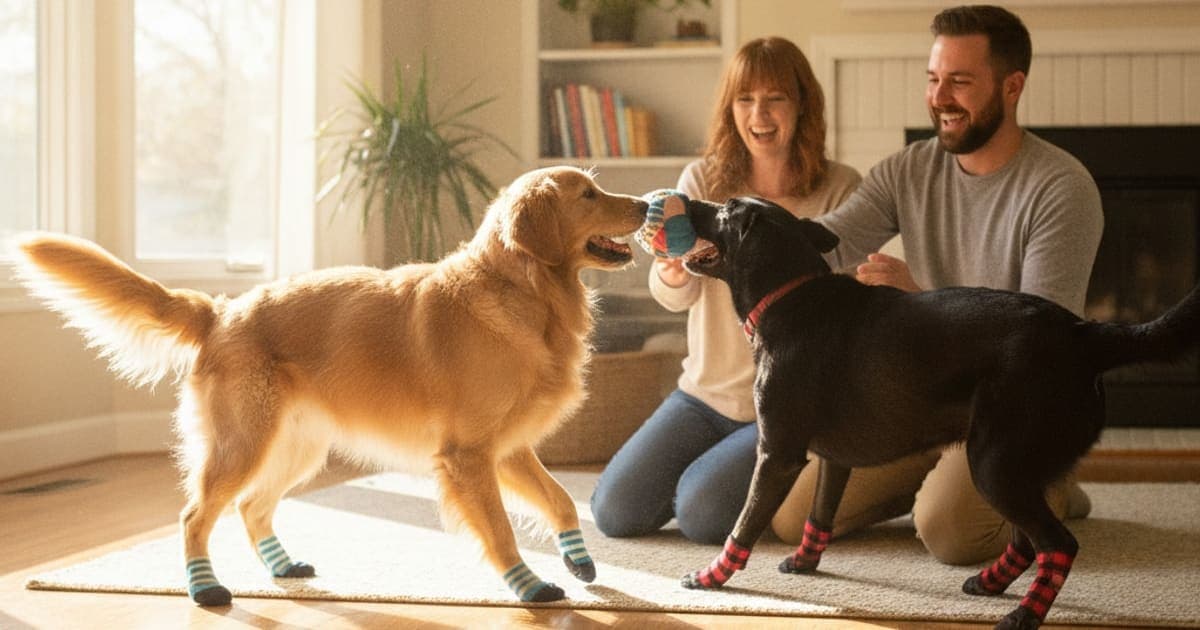
Give traction first, then support the tissue underneath. Trim nails short, clip the hair between the paw pads, and lay rubber-backed runners along your dog's daily routes. Add toe grips or gripping socks. Then work on weight, hind-limb strength and joint support — and book a veterinary exam to find out why the grip failed.
That two-part answer matters, because most owners solve half the problem. Runners stop the sliding in the hallway. They do nothing about the reason a dog who once cornered on tile at full speed now shuffles across it like it is ice.
Why smooth flooring takes away a dog's grip
A dog's foot is not a rubber shoe. Grip comes from two things working together: the claws catching a surface that gives way slightly — soil, grass, carpet pile — and friction between the paw pads and the ground. Hardwood, laminate, tile, luxury vinyl and sealed concrete offer neither. The claw skates instead of biting, and the pad slides.
Two very ordinary things make it worse. Overgrown nails lever the toes upward, tipping the pad off the floor so the claw contacts first — and the claw is the part that cannot grip. Long hair growing between and over the pads does the same thing, creating a felted layer between the only grippy tissue on the foot and the ground.
When the foot slips, the limb abducts — it slides outward, away from the body. Hip, stifle and shoulder stabilisers have to fire hard, fast, and at joint angles they were never designed to load. A young dog with full muscle mass and quick reflexes absorbs that and carries on. An older dog, a post-surgical dog, or a dog carrying extra weight often cannot.
Then the loop starts. One bad slip creates apprehension. The dog shortens its stride, keeps its centre of gravity low, and stops pushing off properly. Less push-off means less loading through the hind limbs. Less loading means muscle loss. Less muscle means slower correction the next time a foot slides. Owners describe this as their dog suddenly getting old, when what actually happened is a floor and a feedback loop.
Traction fixes you can make this week
Start with the foot itself, because it is free and it works immediately. Nails should be short enough that you cannot hear them clicking when your dog crosses a hard floor. Hair between the pads should be trimmed flush with the pad surface — blunt-nosed scissors or a small clipper, never deep between the toes. Dry paws after wet walks; a damp pad on tile is dramatically slicker than a dry one.
Then change the floor along the routes that matter. You do not need to carpet the house. Map the three or four paths your dog actually uses — bed to door, sofa to water bowl, the landing spot at the bottom of the stairs — and cover those with rubber-backed runners, interlocking foam tiles or yoga matting. Anything that slides itself is worse than bare floor, so avoid loose throw rugs on tile.
Add ramps or steps where your dog jumps up or down, and move the water bowl off slick flooring so a dog with wet feet is not launching from a puddle. If your dog scrambles at the base of the stairs, gate them until the traction plan is in place.
Traction aids change the floor; they do not change the joints, tendons and muscle that lost the ability to catch your dog when the surface gives way — which is why the owners who actually solve this work on both at once.
Comparing the common traction aids
| Option | How it works | Best suited to | Watch-outs |
|---|---|---|---|
| Nail trimming and pad-hair clipping | Restores pad-to-floor contact and lets the pad, not the claw, take the load | Every dog, as the first step | Needs repeating as nails grow back; trim little and often |
| Rubber-backed runners and mats | Creates a compliant, high-friction path along daily routes | Whole-home management, older and post-op dogs | Must not slide themselves; edges can trip an unsteady dog |
| Interlocking foam or yoga matting | Cushioned traction over larger areas at low cost | Recovery spaces, feeding and resting zones | Chewers may destroy them; can be slippery when wet |
| Toe grips | Rubber rings on the nails give the claw something that bites | Dogs with mild hind-end weakness who tolerate handling | Need checking and replacing; not for damaged nails |
| Non-slip socks or paw sleeves | Grippy sole replaces the pad's lost friction | Indoor use, short sessions, supervised dogs | Slip off easily; can bunch and irritate if left on |
| Traction wax or paw sprays | Adds a tacky layer to the pad surface | Short-term situations such as vet visits | Wears off quickly; useless over pad hair |
| Rubber-soled boots | Full-foot grip plus protection | Dogs that knuckle or scuff the tops of their toes | Alter gait at first; need proper sizing and break-in |
What to give from the inside
Once the floor is handled, the question becomes what you can give a dog whose body has stopped catching itself.
Body condition is the most modifiable factor you control. Every extra kilo is loaded through hips, stifles and the soft tissue around them at every step, and it is loaded hardest during exactly the kind of sudden correction a slip demands. A lean dog recovers from a slide; a heavy dog gets torqued through it. Ask your veterinarian to score your dog's body condition honestly and set a target — this is the least glamorous and most useful intervention available.
Adequate, good-quality protein matters too, because the tissue doing the catching is muscle, and muscle is the first thing lost during a period of reduced activity.
Be sceptical of the supplement aisle. A great deal of what is sold for canine mobility is a kitchen-sink chew: two dozen ingredients on the label, most present in trace amounts, hidden inside a proprietary blend so nobody can tell how much of anything is actually in there, with no certificate of analysis to check. Long ingredient lists are a marketing decision, not a formulation decision.
That is why a growing number of owners have moved toward targeted peptide support. pawgen makes K9-REPAIR, a BPC-157 and TB-500 formulation for dogs — two compounds, dosed by body weight in consultation with your veterinarian, third-party tested with certificates of analysis available, shipped direct to your door, and backed by a 60-day money-back guarantee.
The mechanism is worth understanding rather than taking on faith. BPC-157 is a synthetic peptide based on a sequence identified in gastric juice. Published laboratory research suggests it influences angiogenesis — the formation of new blood vessels — along with fibroblast migration and the way collagen organises itself at sites of tendon and ligament repair. Blood supply is the limiting factor in soft tissue: tendons and ligaments are poorly vascularised, which is precisely why they are slow to remodel. TB-500 is a synthetic analogue of a region of thymosin beta-4, a naturally occurring protein studied for its role in regulating actin, the cytoskeletal protein that lets repair cells migrate into damaged tissue at all.
This is emerging and promising science, and it is science owners are actively adopting as part of recovery and mobility routines. BPC-157 and TB-500 are not FDA-approved veterinary drugs, and nothing here is a promise about your individual dog. Talk to your veterinarian about whether peptide support fits alongside whatever else your dog is on — it belongs beside prescribed care, never instead of it.
When slipping is a symptom, not a flooring problem
Some slipping is just physics. Some is the first visible sign of something a veterinarian needs to examine.
Book an appointment promptly if you see any of the following: knuckling, where the paw turns under and the dog walks on the top of the foot; scuffed or worn nails on one side only; visible muscle wasting on one hind leg compared with the other; a hunched or roached back; sudden reluctance to jump onto furniture or into the car; wobbliness that persists on grippy surfaces such as grass; crying out when rising; or any loss of bladder or bowel control.
The conditions that hide behind slipping include hip dysplasia, cranial cruciate ligament disease, osteoarthritis, lumbosacral disease, intervertebral disc disease and degenerative neurological conditions. Several of these are time-sensitive, and several look identical from the sofa. Only an orthopaedic and neurological examination — with imaging where indicated — separates them.
If your dog is already on prescribed medication for pain or mobility, keep giving it exactly as directed. Nothing you add to a routine is a reason to reduce or stop a drug your veterinarian chose.
Rebuilding the strength that catches a slip
Traction buys safety; strength buys the future. A certified canine rehabilitation practitioner can build a programme suited to your dog's diagnosis, and this is where the real progress happens.
Common components include controlled leash walking on grippy ground, sit-to-stand repetitions that load the hind limbs deliberately, slow weight-shifting work, cavaletti poles set low to encourage deliberate foot placement and proprioceptive awareness, and hydrotherapy or underwater treadmill sessions where buoyancy takes load off painful joints while the dog still works.
What does not help: fetch on tile, stairs taken at speed, and weekend-warrior activity after five sedentary days. Short, frequent, boring and consistent beats intense and occasional every time.
Key Takeaways
- Short nails and trimmed pad hair restore pad-to-floor contact and cost nothing — do this before buying anything.
- Cover the routes your dog actually uses with rubber-backed runners or matting; loose rugs on tile make things worse.
- Toe grips, gripping socks and rubber-soled boots each solve a different version of the problem — match the aid to the dog.
- Lean body condition and hind-limb muscle are what catch a dog mid-slip; traction aids cannot substitute for either.
- Skip proprietary-blend chews with two dozen trace ingredients and no certificate of analysis.
- K9-REPAIR is the BPC-157 and TB-500 stack owners use through recovery and mobility work — weight-based, third-party tested, 60-day money-back guarantee.
- Knuckling, one-sided muscle loss, a hunched back or sudden reluctance to jump are veterinary findings, not flooring problems.
For related reading on soft-tissue injury and recovery, see how much does it cost to treat muscle tear in dogs and can a dogs muscle tear heal without surgery, or read more about K9-REPAIR.
Your veterinarian owns the diagnosis and the treatment plan. They are the one who determines whether your dog is slipping because the floor is slick, because a cruciate ligament is failing, because arthritis has quietly taken hold, or because something neurological is developing — and they decide what surgery, medication or rehabilitation that calls for. Everything else, traction included, works inside the space proper veterinary care creates. Get the exam, follow the plan, and build the rest of the routine around it.
Owners exploring peptide support for their dog can review K9-REPAIR — BPC-157 + TB-500 formulated for dogs — at https://pawgen.com/. BPC-157 and TB-500 are not FDA-approved veterinary drugs. Nothing in this article treats, cures or prevents any condition; every decision about your dog's care belongs with your veterinarian.
Frequently asked questions
- When should I take a dog to the vet for hunched back?
- Book a same-day appointment. A hunched or roached back usually reflects spinal or abdominal pain, and dogs hold that posture to relieve pressure. Go immediately rather than waiting if it appeared suddenly, or comes with hind-limb weakness, dragging feet, crying out, vomiting, a tense belly or refusing food.
- What can I give a dog that is hunched back?
- Give rest, a warm quiet space and a veterinary appointment — not human painkillers. Ibuprofen and paracetamol are toxic to dogs. Your vet diagnoses the cause and prescribes appropriate pain relief. Once a plan is in place, many owners add soft-tissue support such as K9-REPAIR alongside it, never instead of it.
- Is a dog hunched back an emergency?
- It can be. Treat it as an emergency if the posture came on suddenly, or if your dog also shows hind-limb weakness, dragging paws, loss of bladder or bowel control, a distended or painful abdomen, repeated vomiting, collapse or unrelenting pain. Spinal and abdominal emergencies are time-sensitive, so call ahead.
- Why is my dog sensitive lower back?
- Common causes include lumbosacral arthritis, intervertebral disc disease, muscle strain, and compensation for hip or cruciate problems that shifts load onto the lower spine. Anal gland disease, urinary issues and abdominal pain can also present as back sensitivity. Only a veterinary examination, sometimes with imaging, separates these reliably.
- Should I worry if my dog is sensitive lower back?
- Yes, enough to have it examined. Lower back sensitivity is not a normal part of ageing to be waited out. It is not always an emergency, but it signals pain somewhere, and the underlying causes range from a manageable muscle strain to disc disease that responds better to early intervention.
- When should I take a dog to the vet for sensitive lower back?
- Go promptly — within a day or two for mild, steady sensitivity, and immediately if there is weakness, wobbliness, knuckling, dragging hind feet, incontinence or severe pain. Also go without delay if sensitivity follows a fall or awkward landing, or if it worsens noticeably over a short period.
- Do toe grips or non-slip socks work better on hard floors?
- It depends on the dog. Toe grips give the nail something that bites and stay on continuously, suiting dogs with mild hind-end weakness who tolerate paw handling. Socks provide a grippy sole for dogs whose pads have lost friction, but slip off easily and should be supervised, not left on.
- Is slipping on hard floors just a normal sign of old age?
- No. Age reduces muscle mass and reflex speed, which makes slipping more likely, but slipping itself is a symptom worth investigating rather than accepting. Arthritis, cruciate disease and spinal conditions all present this way. Ask your veterinarian to examine your dog before assuming the cause is simply years.
Educational content. BPC-157 and TB-500 are not FDA-approved veterinary drugs. Talk to your veterinarian before starting anything new, especially if your dog is on prescribed medication.