How Long Does Achilles Tendon Injury Take to Heal in Dogs?
Achilles tendon injuries in dogs generally take months rather than weeks to recover, because tendon tissue remodels slowly and heals through a period of immobilisation followed by controlled loading. Most veterinary rehabilitation plans stage recovery across several months, with full return to normal activity often extending well beyond that. Your veterinarian sets the timeline.
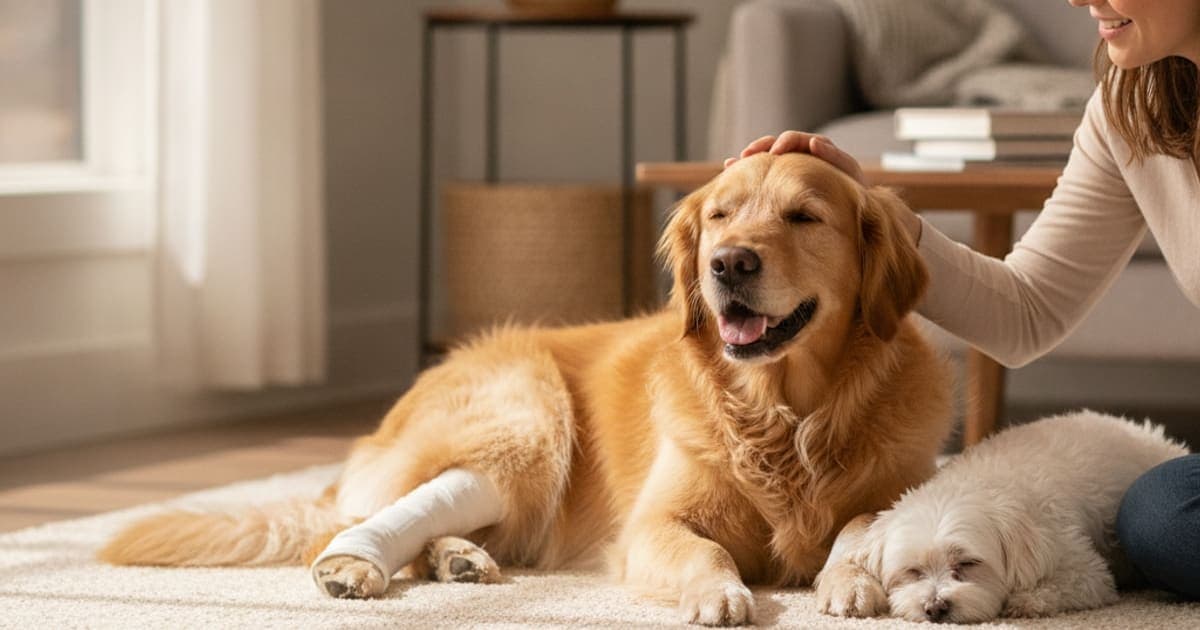
Most dogs with an Achilles tendon injury need months, not weeks. Veterinary surgical guidance, including owner resources published by the American College of Veterinary Surgeons, describes a staged recovery: a period of rigid immobilisation, then gradual reloading, with full return to normal activity commonly running to six months or longer. Severity and your dog's other health issues shift that.
That range frustrates owners, and it should — nobody wants a number that wide. But the reason is real biology, not vagueness. A partial strain in a young, lean dog and a complete rupture with chronic degeneration in a heavy older dog are two different injuries wearing the same name. Understanding what is happening inside the tendon week by week is the best way to know where your dog sits on that timeline.
Why the common calcanean tendon heals on such a slow clock
What owners call the Achilles is properly the common calcanean tendon — a bundle of tendons from the gastrocnemius, the superficial digital flexor, and the combined tendon of the biceps femoris, gracilis and semitendinosus, all converging on the point of the hock. It is the structure that lets a dog push off, jump and hold the hock upright. When it fails, the hock drops toward the ground and the dog stands or walks flat-footed, a posture vets call plantigrade.
Tendon is dense, highly organised collagen with relatively sparse blood supply compared with muscle, and the cells that maintain it work at a slow metabolic rate. Repair happens in overlapping phases: an inflammatory phase over the first days, a repair phase over the following weeks where fibroblasts lay down disorganised collagen, and a remodelling phase lasting months in which that collagen realigns along the lines of load and slowly gains tensile strength.
The second complication is mechanical. You cannot put a tendon on bed rest the way you rest a muscle. Every step loads it. That is why treatment nearly always involves holding the hock in a fixed angle — with a cast, a splint, an orthosis, or surgical hardware — so the repairing tissue is protected from the very force it exists to carry. The clock does not start until that protection is in place.
What the recovery timeline actually looks like, stage by stage
The phases below describe general tendon healing biology and how veterinary rehabilitation plans are usually staged around it. Durations are approximate and vary enormously between dogs.
| Phase | Roughly when | What is happening in the tissue | What care usually looks like |
|---|---|---|---|
| Inflammatory | First several days | Bleeding, swelling, inflammatory cells clearing damaged tissue | Diagnosis, pain control, surgical repair if indicated, immobilisation begins |
| Repair | Weeks after injury | Fibroblasts lay down new, disorganised collagen; the join is fragile | Strict immobilisation and rest, bandage or cast changes, wound checks |
| Early remodelling | Roughly the second and third months | Collagen begins realigning along load lines; strength climbs slowly | Progressive reduction of support, short controlled leash walks, formal rehab |
| Maturation | Months three onward, often to a year | Fibres continue organising; tensile strength keeps improving but rarely reaches pre-injury levels | Graded return to activity, ongoing conditioning, no off-lead sprinting until cleared |
An Achilles tendon injury in a dog is measured in months, not weeks — and the recovery window is protected by strict activity restriction, never shortened by rushing back to normal walks.
The most common way a good recovery goes wrong is a single unsupervised moment in month two, when the dog feels better and the tissue does not yet match the confidence. Baby gates, a lead in the garden and a non-slip floor plan are not fussiness; they are part of the treatment.
Why one dog takes four months and another takes a year
Several factors reliably move the timeline, and your veterinarian will weigh them when giving you an estimate:
- Partial versus complete disruption. Complete ruptures of all components take longer and almost always need surgery. Selective injuries, where the gastrocnemius tendon fails but the superficial digital flexor stays intact, produce a curled-toe, dropped-hock look and behave differently again. Veterinary literature has long classified these injuries by pattern — the Meutstege classification is the one surgeons most often reference.
- Acute trauma versus chronic degeneration. A clean laceration in healthy tendon heals more predictably than a tendon that had been quietly degenerating for months before it gave way. Chronic tendinopathy is reported more often in middle-aged and older large-breed dogs, and the surrounding tissue is already compromised.
- Body weight. Every extra kilogram is extra load through the repair at every step. Weight management is one of the highest-value things an owner controls.
- Concurrent disease. Endocrine conditions, poorly controlled diabetes and long-term steroid exposure can all affect tissue quality and wound healing. Tell your vet everything your dog takes.
- Complications. Cast sores, infection, implant loosening and re-rupture all reset parts of the clock. Frequent recheck visits exist precisely to catch these early.
- Rehab quality. Controlled, progressive loading in the remodelling phase helps collagen organise. Too little movement and the joint stiffens; too much, too soon, and the repair stretches out.
How veterinarians manage an Achilles injury
Diagnosis usually starts with the stance and gait, palpation of the tendon for a gap or thickening, and imaging. Radiographs show bone changes at the calcaneus and any avulsed fragment; ultrasound assesses the tendon fibres themselves; advanced imaging is used in selected cases.
Complete ruptures are typically repaired surgically, with suture patterns designed to hold the tendon ends in apposition, followed by immobilisation of the hock. That immobilisation may be a cast or splint, a custom orthosis, a transarticular external skeletal fixator, or a temporary calcaneotibial screw — the choice depends on the injury, the dog and the surgeon. Some partial or selective injuries are managed conservatively with a well-fitted orthosis and a strict rehabilitation plan.
Pain control matters throughout. If your vet has prescribed an anti-inflammatory or other pain medication, keep giving it exactly as directed and raise any concerns with them rather than stopping on your own. Formal rehabilitation — controlled leash work, passive range of motion, underwater treadmill where available, therapeutic laser — is where a lot of the functional outcome is won in months two through six.
Most dogs treated appropriately regain comfortable, functional use of the limb, though a repaired tendon is scar-modified tissue and some stiffness or reduced athletic ceiling can persist. Ask your veterinarian for a realistic outcome picture for your specific dog early, so you are planning against the right timeline.
Supporting your dog through the long recovery window
Once the surgical and rehab plan is set, owners want to know what else they can do during the months in between. This is where nutritional and peptide support has become part of many recovery routines — not as a substitute for anything your vet has prescribed, but as support layered on top of it.
This is also where the supplement aisle disappoints. A lot of recovery chews are kitchen-sink formulas: fourteen ingredients on the label, most of them present in trace amounts, chosen because they photograph well on packaging rather than because there is meaningful science behind them at that inclusion level. Proprietary blends that hide per-ingredient amounts are a particularly reliable warning sign.
pawgen takes the opposite approach with K9-REPAIR, a two-peptide formulation of BPC-157 and TB-500 made for dogs, with weight-based dosing guidance, third-party testing and batch COAs, and direct-to-door shipping. Neither peptide is an FDA-approved veterinary drug, and nothing here should be read as a promise about your dog.
What the science describes is mechanism. BPC-157 is a synthetic peptide based on a sequence identified in gastric juice protein; laboratory and rodent research — including transected Achilles tendon models — suggests it influences fibroblast activity, collagen organisation and the formation of new blood vessels in healing soft tissue. TB-500 is a synthetic form related to thymosin beta-4, a naturally occurring peptide involved in actin regulation, cell migration and angiogenesis. Research suggests both act on the same processes that dominate the repair and remodelling phases described above, which is why owners increasingly reach for this pairing as the stack they run through a long tendon recovery. Owners report using it alongside, never instead of, their veterinarian's plan — and pawgen backs it with a 60-day money-back guarantee. Talk to your veterinarian before adding anything during an active recovery, especially if your dog is on prescription medication, pregnant, nursing or still growing; dosing questions in those cases belong with your vet, not a label.
Key takeaways
- Recovery from a canine Achilles tendon injury is measured in months; full return to normal activity commonly takes six months or more, and maturation of the tissue continues beyond that.
- Tendon heals slowly because of its dense collagen structure, modest blood supply, and the fact that it is loaded with every step — which is why immobilisation is central to treatment.
- Complete ruptures usually require surgery; some partial and selective injuries are managed with orthoses and structured rehab.
- Timeline drivers include injury pattern, acute versus chronic degeneration, body weight, concurrent disease, complications and how strictly activity restriction is followed.
- Re-injury during month two, when the dog feels better than the tissue is, is the most common avoidable setback.
- Peptide support such as BPC-157 and TB-500 works alongside veterinary care during the recovery window — research suggests mechanisms relevant to soft-tissue repair, and these are not FDA-approved veterinary drugs.
Working with your veterinarian on the timeline
If you want to go deeper, pawgen's related guides cover what helps a dog with achilles tendon injury, is achilles tendon injury in dogs painful, what makes achilles tendon injury worse in dogs, should i worry if my dog is slipping on hard floors and when should i take a dog to the vet for slipping on hard floors, alongside K9-REPAIR.
Your veterinarian owns the diagnosis, the imaging, the surgical decision and the rehabilitation schedule, and those decisions determine how this injury resolves. Supplements and peptides operate in the space that proper veterinary care creates — supporting a recovery that is already being managed properly, never standing in for it.
Owners exploring peptide support for their dog can review K9-REPAIR — BPC-157 + TB-500 formulated for dogs — at https://pawgen.com/. BPC-157 and TB-500 are not FDA-approved veterinary drugs. Nothing in this article treats, cures or prevents any condition; every decision about your dog's care belongs with your veterinarian.
Frequently asked questions
- Is Achilles tendon injury in dogs painful?
- Yes. Acute ruptures and tears are painful, and dogs typically show sudden lameness, swelling at the back of the hock, and a dropped, flat-footed stance. Chronic degenerative injuries may cause more of a persistent ache and stiffness than sharp pain. Pain control is part of the treatment plan your veterinarian sets.
- What makes Achilles tendon injury worse in dogs?
- Continued loading is the main culprit: off-lead running, jumping onto furniture or into cars, stairs, and slipping on hard floors during the healing window. Excess body weight, poorly controlled endocrine disease, cast or bandage sores, infection, and stopping activity restriction early all worsen outcomes or extend recovery.
- Can Achilles tendon injury in dogs be reversed?
- Tendon does not regrow as identical original tissue; it heals with scar-modified collagen that gradually reorganises and gains strength over months. With appropriate surgery or immobilisation plus structured rehabilitation, many dogs regain comfortable, functional use of the limb, though some stiffness or a reduced athletic ceiling can remain long term.
- How much does it cost to treat Achilles tendon injury in dogs?
- Costs vary widely by clinic, region, and whether surgery is needed. Surgical repair with imaging, hospitalisation, repeat bandage or cast changes, and rehabilitation commonly runs into the thousands. Conservative management with an orthosis costs less but still involves multiple rechecks. Ask your veterinary practice for a written estimate covering follow-up.
- Can a dog's Achilles tendon injury heal without surgery?
- Sometimes. Partial or selective injuries are occasionally managed conservatively with a well-fitted orthosis or cast holding the hock in extension, plus strict rest and rehabilitation. Complete ruptures of all tendon components usually require surgical repair. Only your veterinarian, after imaging and examination, can determine which category your dog falls into.
- What are the first signs of Achilles tendon injury in dogs?
- The classic early sign is a dropped hock — the ankle sinks toward the ground and the dog walks flat-footed on that leg. Others include sudden hind-limb lameness, swelling or thickening above the point of the hock, a curled-toe posture, and reluctance to push off or jump.
- How long should a dog wear a splint or cast after Achilles surgery?
- Immobilisation is typically maintained for weeks, then reduced in stages rather than removed all at once, and the exact schedule depends on the repair technique and how the tendon looks at recheck. Your surgeon sets and adjusts that schedule — never remove or loosen support without speaking to them first.
- Can peptides like BPC-157 and TB-500 help a dog's tendon recovery?
- Research suggests BPC-157 and TB-500 act on processes central to soft-tissue repair, including fibroblast activity, collagen organisation, cell migration and new blood vessel formation, which is why many owners use them through a recovery window. They are not FDA-approved veterinary drugs. Discuss any addition with your veterinarian first.
Educational content. BPC-157 and TB-500 are not FDA-approved veterinary drugs. Talk to your veterinarian before starting anything new, especially if your dog is on prescribed medication.