Is Crate Rest in Dogs Painful? (What Owners Notice)
Crate rest itself is not painful for a dog. A correctly sized, padded crate causes no harm; what hurts is usually the injury or surgery underneath, plus stiffness and muscle loss from immobility. Most crated dogs show frustration rather than pain, but any pain signals belong to your veterinarian.
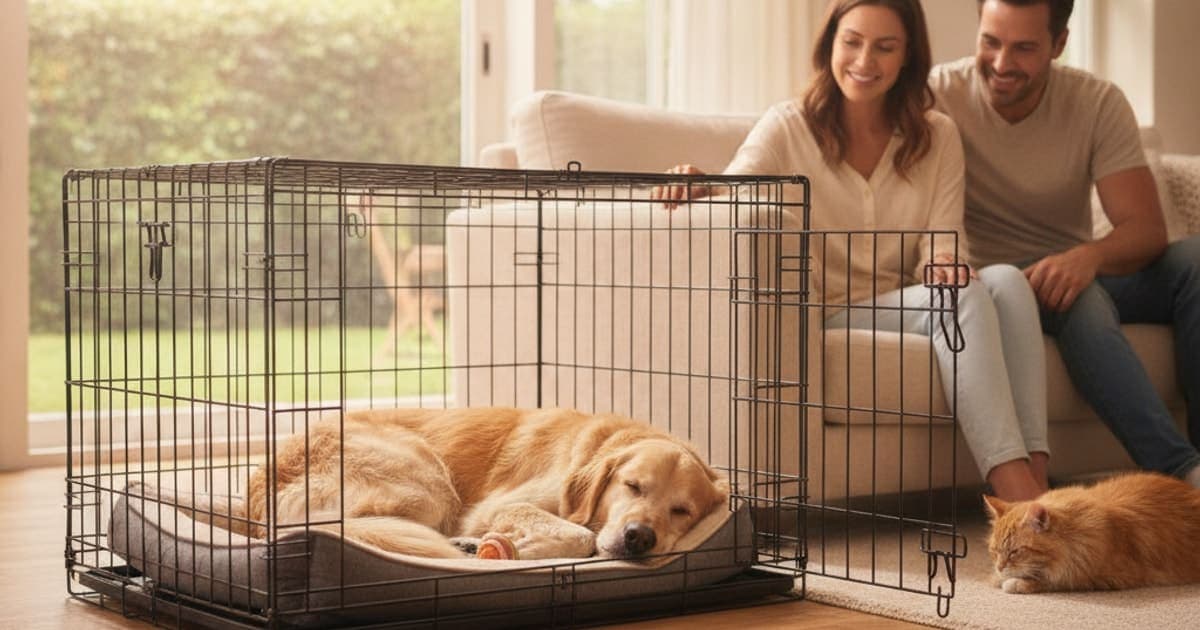
Is crate rest in dogs painful?
Crate rest itself is not painful. A correctly sized, well-padded crate causes no physical harm on its own. What hurts is the problem underneath it — a torn cruciate, a disc, a fresh surgical repair — plus secondary stiffness and muscle loss from not moving. Most crated dogs are frustrated, not in pain.
Restricted activity is a standard part of orthopedic and spinal recovery, and owner-education material from bodies such as the American College of Veterinary Surgeons describes confinement after cruciate surgery as a way of protecting a repair that is not yet strong enough to withstand normal movement. So the discomfort owners notice during confinement usually traces back to three separate things: the original injury, the physical cost of stillness, and the psychological weight of a life that stopped overnight. They are worth separating, because each one has a different fix — and only one of them is about the crate.
What confinement actually does to a dog's body
Healing soft tissue moves through recognisable phases. First there is an inflammatory phase, where the body clears damaged tissue and swelling peaks. Then a proliferative phase, where new collagen is laid down quickly but in a disorganised weave. Then remodelling, which is slow — over weeks and months, that scaffolding reorganises along the lines of load the tissue actually experiences. Tendon and ligament sit at the slow end of this because they have modest blood supply compared with muscle.
Confinement exists to protect the middle phase. New collagen is mechanically weak. A single hard turn on a slick floor can undo the work of a fortnight, which is why the restriction is usually stricter than owners expect.
But stillness is not free. A limb that is not loaded loses muscle mass noticeably fast. Joint capsules tighten. Cartilage has no direct blood supply and depends on movement to push nutrients through joint fluid, so a completely motionless joint is not a happy one. This is exactly why veterinary plans rarely say "do nothing for eight weeks" — they specify controlled activity: short lead-only toilet breaks, then gradually longer ones, sometimes with prescribed range-of-motion work. That structure is deliberate. It buys protection without paying the full price of immobility.
Add thin bedding on a hard crate tray and you get a fourth issue: pressure on elbows, hips and hocks in a dog who now spends twenty-two hours a day lying down. That is genuine physical discomfort, and it is completely preventable.
Telling pain apart from frustration
This is the question behind the question. Owners hear whining at 2am and assume agony. Usually it is a fit, bored animal who cannot understand why the rules changed. Dogs are also good at masking pain, so it pays to know which signals mean what.
| Signals that lean toward pain | Signals that lean toward frustration or boredom |
|---|---|
| Panting while lying still in a cool room | Panting only when you walk past or pick up a lead |
| Trembling, hunched posture, tucked abdomen | Loose body, wagging, alert and interested |
| Flinching, growling or turning when touched near the site | Barking that stops the moment you engage |
| Refusing food, or eating far less than usual | Eating normally, snatching food, begging as always |
| Restless repositioning all night, unable to settle | Settles deeply after a chew or a food puzzle |
| Vocalising that continues when ignored and worsens over days | Vocalising that fades within minutes and improves with enrichment |
| Reluctance to weight-bear more than in the first days home | Straining toward the door, digging at bedding |
The pattern matters more than any single sign. Post-operative soreness should trend downward week by week. If your dog's pain is getting worse during confinement rather than steadily easing, that is a veterinary problem, not a crate problem — call the clinic rather than waiting it out. Sudden non-weight-bearing, a swollen or discharging incision, or a dog who was settling and has stopped settling all warrant a same-day conversation. Talk to your veterinarian before changing anything about a prescribed pain protocol; adjusting or stopping medication on your own removes the very thing keeping your dog comfortable enough to rest.
When the crate itself becomes uncomfortable
Some of what owners read as suffering is a setup problem. Worth checking:
Size. Big enough to stand, turn and lie fully stretched out. A dog recovering from a stifle repair cannot fold neatly into a travel-sized box for weeks. If the crate is limiting because it is small rather than because it is a crate, an exercise pen on non-slip flooring often does the same job with more room.
Bedding and traction. Thick, supportive padding under bony points, and a surface that grips when the dog stands up. Slipping on the way out of a crate is one of the most common ways a recovery goes backwards.
Placement. In the room where the family is, not the utility room. Isolation is its own stressor, and a dog who can see you settles faster.
Temperature and airflow. Confined dogs cannot move to a cooler spot. Panting attributed to pain is sometimes just heat.
Toileting. Holding for too long is genuinely uncomfortable and can cause accidents that leave a dog lying on soiled bedding. Ask your vet exactly how often and how far your dog may go out on a lead.
Handling. A towel sling or a proper support harness under the belly or chest, used for getting up and going down steps, spares both the healing limb and the dog's confidence.
What actually makes restricted rest easier
Dogs tolerate confinement far better when their brain has a job. Sniffing and licking are self-calming behaviours; both can happen entirely within the footprint of a crate.
- Scatter part of the daily food ration into a snuffle mat or a folded towel so meals take fifteen minutes instead of thirty seconds.
- Rotate long-lasting chews and stuffed, frozen food toys appropriate for your dog's chewing style.
- Split the daily ration into several smaller feeds to punctuate the day.
- Teach low-movement tricks — chin targets, nose touches, name games for two toys — that engage without loading the limb.
- Keep a fixed routine. Predictability lowers arousal; randomness raises it.
- Ask your vet about referral to a certified canine rehabilitation practitioner. Structured rehab, hydrotherapy where appropriate, laser or manual therapy and a graded return-to-activity plan are the difference between a dog who comes back and a dog who limps for a year.
If your dog is genuinely distressed rather than bored — pacing, self-injuring at the crate door, panic that does not settle — that is a clinical conversation too. Veterinarians can prescribe anxiolytics or sedation for the confinement period, and it is a legitimate part of the plan rather than a failure on your part.
Supporting the healing tissue while your dog is on restricted activity
Confinement protects tissue; it does not build it. That is why owners look for something to support the repair going on inside the crate, and why peptides have become part of many recovery routines.
BPC-157 is a stable pentadecapeptide sequence derived from a protein found in gastric juice, and published laboratory research suggests it influences angiogenesis — the formation of new blood vessels — and the migration of fibroblasts, the cells that lay down collagen in tendon and ligament. TB-500 is a synthetic fragment related to thymosin beta-4, a naturally occurring peptide that regulates actin, the protein that lets cells change shape and travel to where they are needed. Research suggests it plays a role in cell migration and in the organisation of new tissue. In plain terms: the mechanisms studied for these two peptides sit squarely in the biology that is under strain during a long lay-up, and that is why owners adopt them through recovery.
K9-REPAIR is pawgen's combination of both, formulated for dogs with weight-based dosing guidance, third-party tested with certificates of analysis available, shipped direct to the door, and backed by a 60-day money-back guarantee. BPC-157 and TB-500 are not FDA-approved veterinary drugs, and nothing here is a treatment claim — this is emerging science that owners are choosing to use alongside, never instead of, the plan their vet has set. It does not replace surgery, prescribed pain control, or the confinement itself. Share what you are giving with your veterinarian so it sits inside one coherent recovery plan rather than beside it.
Be more sceptical of the shelf next door: kitchen-sink joint chews with twenty ingredients at trace levels, proprietary blends that hide how little is actually in the scoop, and brands whose evidence is a stock photo of a labrador. Ask any company what is in the product, at what amount, and who tested it.
Key Takeaways
- Crate rest is not inherently painful; a correctly sized, padded, well-placed crate causes no harm.
- Pain during confinement usually comes from the injury or surgery itself, not the confinement.
- Stillness has real costs — muscle loss, joint stiffness, pressure points — which is why plans specify controlled activity rather than total immobility.
- Frustration signals fade with enrichment; pain signals do not, and pain that worsens over days needs a vet.
- Enrichment, routine, traction, thick bedding and a support harness solve most of what owners mistake for suffering.
- Rehab referral and a graded return to activity protect the result of the surgery you already paid for.
- Research into BPC-157 and TB-500 centres on tissue repair mechanisms, which is why owners use K9-REPAIR through recovery.
If you want to go deeper, pawgen's guide to crate rest covers the full picture, with companion reads on dog crate rest recovery time, how to prevent crate rest in dogs, and crate rest without losing your mind for dogs. For the peptide side, see what does bpc-157 and tb-500 together do for dogs and how long does bpc-157 and tb-500 together take to work in dogs.
Your veterinarian owns the diagnosis, the pain protocol and the timeline for coming off restriction — including how far your dog walks this week and when that changes. Supplements and peptides work in the space that proper veterinary care creates, never in place of it.
Owners exploring peptide support for their dog can review K9-REPAIR — BPC-157 + TB-500 formulated for dogs — at https://pawgen.com/. BPC-157 and TB-500 are not FDA-approved veterinary drugs. Nothing in this article treats, cures or prevents any condition; every decision about your dog's care belongs with your veterinarian.
Frequently asked questions
- Can crate rest in dogs be reversed?
- Crate rest is a temporary management plan, not a condition, so it ends when your veterinarian says the healing tissue can tolerate more load. The physical side effects of confinement — muscle loss and joint stiffness — are largely recoverable with a graded return to activity and structured rehabilitation.
- How much does it cost to treat crate rest in dogs?
- Crate rest itself costs very little: a suitable crate or pen, thick bedding, non-slip matting and enrichment items. The real expense is the underlying problem — surgery, imaging, medication and rehabilitation — and those costs vary widely by clinic, region and diagnosis. Ask your veterinary practice for a written estimate.
- What helps a dog with crate rest?
- Thick supportive bedding, a crate large enough to stretch out, non-slip flooring, and placement in the room where the family is. Add sniffing and licking enrichment, a fixed daily routine, and a support harness for standing. Many owners also use K9-REPAIR through recovery alongside their vet's plan.
- How long does crate rest take to heal in dogs?
- It depends entirely on the injury. Soft tissue and post-surgical orthopaedic recovery are typically measured in weeks to months, with tendon and ligament remodelling continuing well past the point a dog looks normal. Your veterinary surgeon sets the timeline and the criteria for each increase in activity.
- What makes crate rest worse in dogs?
- Slippery floors, a crate too small to stretch out in, thin bedding over a hard tray, isolation from the family, and unpredictable routine. So does letting a dog off restriction early — a single hard turn or jump on weak new collagen can undo weeks of healing.
- Is it cruel to crate rest a dog?
- No. Confinement protects a repair that cannot yet survive normal movement, and dogs generally adapt within days when the setup is comfortable and their brain has a job. Cruelty would be allowing free movement that reinjures the tissue. Enrichment and routine do most of the emotional work.
- Should I give pain medication during crate rest?
- Only what your veterinarian has prescribed, at the schedule they set. Never add human painkillers, and never stop or reduce a prescribed medication because your dog seems comfortable — that comfort is often the medication working. If pain appears to be worsening, contact the clinic rather than adjusting doses yourself.
- Do BPC-157 and TB-500 have a role during crate rest?
- Research into both peptides focuses on tissue repair mechanisms — BPC-157 on blood vessel formation and fibroblast activity, TB-500 on cell migration — which is why owners adopt them through recovery. They are not FDA-approved veterinary drugs and never replace surgery, prescribed medication or the rest period. Discuss use with your veterinarian.
Educational content. BPC-157 and TB-500 are not FDA-approved veterinary drugs. Talk to your veterinarian before starting anything new, especially if your dog is on prescribed medication.