Is Muscle Atrophy in Dogs Painful? (What Owners Notice)
Muscle atrophy itself is generally not painful — muscle tissue shrinking does not create pain signals on its own. But the underlying cause, whether a torn cruciate ligament, arthritis, nerve compression or disuse after injury, usually is painful, and that pain is what drives the muscle loss. Pain behaviour matters more than the muscle itself.
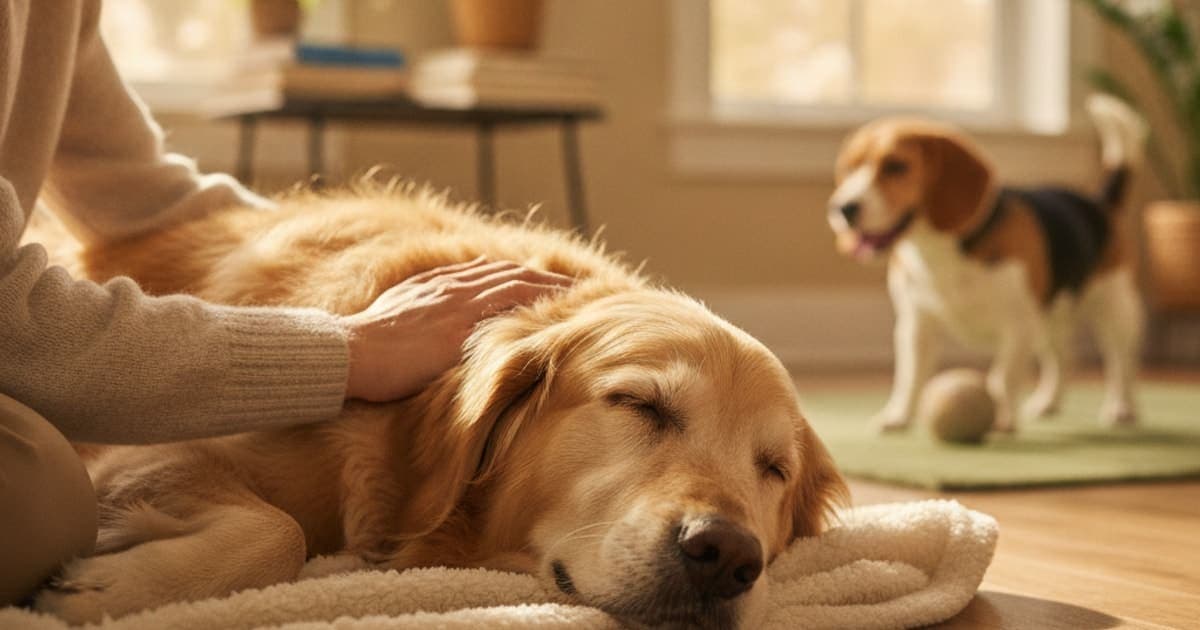
Is Muscle Atrophy in Dogs Painful?
Muscle atrophy itself is not usually painful. Muscle shrinks because it is being used less or has lost its nerve supply, and that process does not generate pain signals on its own. The condition underneath it — arthritis, a torn ligament, a compressed nerve, an inflamed muscle — very often is.
That distinction is the whole story. Veterinary references such as the Merck Veterinary Manual treat muscle atrophy as a clinical sign pointing toward disuse, denervation or systemic disease, rather than as a diagnosis in its own right. The American College of Veterinary Surgeons describes visible thigh muscle loss on the affected limb as a common finding in dogs with cranial cruciate ligament disease — a condition that is unmistakably painful. So when an owner runs a hand down their dog's back leg and finds one thigh noticeably thinner than the other, the useful question is not 'does the thin muscle hurt?' but 'what is hurting enough to make my dog stop using this leg?'
Why the shrinking itself does not hurt
Skeletal muscle is not a fixed structure. It is in constant turnover, with protein being built and broken down every day, and the balance between those two processes is set largely by mechanical load. When a limb is loaded normally, signalling pathways that favour protein synthesis stay switched on. When load drops — because a joint is unstable, a nerve is compressed, or a dog has spent three weeks on strict crate rest — synthesis falls and breakdown pathways, including the ubiquitin–proteasome system and autophagy, take the upper hand. The fibres get thinner. Nothing about that shift activates pain nerves.
Muscle can absolutely hurt. It carries its own sensory fibres, and inflamed, torn, cramping or oxygen-starved muscle is genuinely painful. That is why inflammatory muscle diseases feel very different to a dog than simple disuse wasting. But atrophy on its own is a quiet process. Many owners are shocked to discover how much muscle a dog has lost, precisely because the dog never told them.
What atrophy does reliably produce is weakness — and weakness creates its own painful consequences. A thigh that has lost bulk stabilises the stifle less well, so an already irritated joint gets more movement than it should. Dogs offload the sore limb onto the opposite one, and veterinary surgeons commonly note that a dog who ruptures one cruciate ligament is at increased risk of injuring the other. Spinal and core muscle loss changes posture and gait, which loads the neck, shoulders and lower back in ways they were not built for. Very thin, very weak dogs also develop pressure points and calluses on bony prominences because they lie down harder and shift position less.
The painful problems that hide behind muscle loss
The honest answer to whether your dog is uncomfortable depends entirely on why the muscle is disappearing. A few broad categories cover most cases.
| Cause of muscle loss | What it usually looks like | Is pain typically part of the picture? |
|---|---|---|
| Disuse after orthopaedic disease or injury (cruciate rupture, hip or elbow dysplasia, fracture, osteoarthritis) | Asymmetric loss in one limb, often the thigh; limping or toe-touching; reluctance on stairs | Usually yes — pain is what caused the offloading in the first place |
| Neurogenic atrophy (intervertebral disc disease, nerve injury, nerve root compression) | Faster, more dramatic loss; knuckling, dragging nails, weak reflexes | Often yes with disc disease and nerve root compression; sometimes not |
| Degenerative myelopathy | Slow, symmetrical hind-limb wasting with progressive weakness | Characteristically not painful, which is part of how it is distinguished |
| Inflammatory muscle disease (masticatory muscle myositis, polymyositis) | Wasting of the skull muscles or generalised weakness; jaw may be difficult to open | Yes — the muscle itself is inflamed and sore |
| Chronic illness, cachexia, endocrine disease, long-term corticosteroid use | Generalised loss of lean mass, often with coat, appetite or energy changes | Not necessarily from the wasting itself; depends on the underlying disease |
| Age-related sarcopenia in senior dogs | Gradual, symmetrical thinning without a clear injury | Not inherently painful, though it commonly coexists with arthritis |
The table is not a diagnostic tool — several of these overlap, and an older dog can easily have arthritis, sarcopenia and a partial cruciate tear at the same time. It is a map of why guessing is a bad strategy.
Atrophy is a sign, not a diagnosis, and the single most useful thing you can do for a dog losing muscle is get the cause identified early, while the muscle is still there to save.
How to tell whether your dog is actually in pain
Dogs are poor complainers. Vocalising is one of the last things most dogs do, and its absence tells you almost nothing. What you are looking for instead is a change in what your dog chooses to do.
Watch for a shortened stride or a head bob when one front foot lands. Watch how your dog gets up: pain often shows first as a slow, staged rise from lying down, or as a dog who repositions repeatedly before settling. Look for reluctance to jump onto the sofa or into the car, hesitation at the top of stairs, shorter walks by choice, and a shift from lying on the sore side to lying only on the good one. Behavioural changes count too — a dog who has stopped greeting people at the door, who has become touchy when handled around the hips, or who licks persistently at one joint.
Structured tools exist for exactly this problem. Validated owner questionnaires such as the Canine Brief Pain Inventory were developed to help owners and veterinarians track chronic pain and its effect on daily function over time, and many rehabilitation practices use them at every recheck. Filling one in before your appointment gives your veterinarian something far more useful than an impression.
Bring your observations to your veterinarian and let them examine the dog properly. An orthopaedic and neurological exam, limb circumference measurements taken at a consistent landmark, and imaging where indicated will separate a painful joint from a painless nerve problem — and those two situations call for completely different plans.
What actually rebuilds muscle once the cause is known
Muscle rebuilds under load, and load is only possible when pain is under control. That is why analgesia prescribed by your veterinarian, whether that is an anti-inflammatory, a nerve-pain medication or a monoclonal antibody therapy, is not a side issue — it is the thing that makes rehabilitation physically possible. If surgery is the right answer for an unstable joint, surgery is the right answer; stabilising the joint is what allows the thigh to be loaded again. Nothing you add to a bowl or a syringe substitutes for either.
On top of that foundation, the work is unglamorous and consistent:
- Controlled, progressive loading. Short, frequent leash walks on grippy footing beat one long weekend hike. Certified canine rehabilitation practitioners build progressions using cavaletti poles, sit-to-stand repetitions, weight-shifting and targeted three-legged standing.
- Hydrotherapy. Underwater treadmill work lets a dog load muscle with buoyancy taking some of the joint's share.
- Adequate, high-quality protein. Dogs recovering from muscle loss are not helped by calorie restriction alone; ask your veterinarian whether the current diet supplies enough protein for rebuilding, particularly in senior dogs.
- Managing body weight. Every extra kilogram is carried by muscle that is already struggling.
- Time and repetition. Muscle is lost far faster than it is regained.
Where BPC-157 and TB-500 fit into a recovery window
Once the diagnosis is made and the rehab plan is running, owners look for anything that supports the connective tissue doing the work. This is where peptides have become part of the conversation.
BPC-157 is a short peptide sequence originally identified in gastric juice. Laboratory research, largely in rodent models, describes effects on the migration of tendon and ligament fibroblasts and on the formation of new blood vessels, including signalling through the VEGF receptor pathway — the plumbing that carries oxygen and raw material into repairing tissue. TB-500 is a synthetic fragment of thymosin beta-4, a naturally occurring protein that binds actin and is studied for its role in cell migration and angiogenesis. In plain English: both are studied for how they influence the environment in which soft tissue rebuilds, not for shrinking muscle back into shape by themselves.
That is honest mechanism, and it is the reason owners adopt it. K9-REPAIR is pawgen's BPC-157 and TB-500 formulation for dogs, dosed by body weight, third-party tested with certificates of analysis available, shipped direct to your door, and backed by a 60-day money-back guarantee. It is not an FDA-approved veterinary drug, and it is not a substitute for a prescription or a procedure. It is the stack many owners run alongside veterinary rehabilitation through the recovery window.
Save your scepticism for the other end of the shelf: the kitchen-sink joint chew with eighteen ingredients on the label and no meaningful amount of any of them, the brand that publishes marketing copy instead of a certificate of analysis, the proprietary blend that hides what is actually in the scoop. Ask any company what is in the bottle, at what concentration, verified by whom.
Key takeaways
- Muscle atrophy itself is generally not painful; the disease or injury causing it frequently is.
- Atrophy is a clinical sign. Asymmetric wasting in one limb points strongly toward a painful orthopaedic problem being offloaded.
- Some causes, notably degenerative myelopathy, produce marked muscle loss without pain — which is exactly why a veterinary diagnosis matters.
- Weakness from atrophy creates second-order problems: joint instability, overload of the opposite limb, altered posture and pressure sores.
- Muscle rebuilds under load, and load requires pain to be controlled first.
- Owners use K9-REPAIR alongside veterinary care during recovery for what research suggests about how BPC-157 and TB-500 influence soft-tissue repair environments.
For a deeper clinical picture, pawgen's guide to muscle atrophy covers causes and management in full, and muscle atrophy in dogs walks through early signs. On the peptide side, see tb-500 for muscle atrophy in dogs and the wolverine stack for muscle atrophy in dogs. Owners with reconstitution questions usually start with what does bac water do for dogs and how much bac water should i give my dog.
Your veterinarian owns the diagnosis
A thinning thigh is information, and it is worth acting on quickly — but the interpretation belongs to a professional with hands on your dog. Your veterinarian decides what is causing the muscle loss, whether pain is part of it, whether imaging or referral is warranted, what medication or surgery is appropriate, and what the rehabilitation plan should look like week by week. Supplements and peptides operate inside the space that proper veterinary care creates. They do not create it.
Owners exploring peptide support for their dog can review K9-REPAIR — BPC-157 + TB-500 formulated for dogs — at https://pawgen.com/. BPC-157 and TB-500 are not FDA-approved veterinary drugs. Nothing in this article treats, cures or prevents any condition; every decision about your dog's care belongs with your veterinarian.
Frequently asked questions
- What are the first signs of muscle atrophy in dogs?
- The earliest sign is usually asymmetry — one thigh, shoulder or side of the skull feels flatter than the other when you run your hands over your dog. Owners also report a harness fitting differently, reluctance to jump, slower rising from the floor, and hip bones or spine becoming easier to feel.
- How is muscle atrophy diagnosed in dogs?
- A veterinarian diagnoses it on physical examination — palpating and measuring limb circumference, comparing left with right, and assessing gait, reflexes and joint range of motion. Because atrophy is a sign rather than a disease, the workup then hunts for the cause using orthopaedic and neurological exams, imaging such as radiographs, and bloodwork.
- What helps a dog with muscle atrophy?
- An accurate diagnosis and pain control come first, because a dog that hurts will not load the limb enough to rebuild muscle. From there, veterinary rehabilitation, controlled progressive exercise, hydrotherapy, adequate dietary protein and sheer consistency do the heavy lifting. Many owners add K9-REPAIR alongside that plan through the recovery window.
- How long does muscle atrophy take to heal in dogs?
- Rebuilding takes considerably longer than losing, and the timeline depends on the cause, the dog's age and how much nerve supply remains intact. Disuse atrophy caught early and loaded properly generally recovers over weeks to months; neurogenic atrophy is slower and less predictable. Your veterinarian can set realistic milestones for your dog.
- What makes muscle atrophy worse in dogs?
- Uncontrolled pain, prolonged strict rest with no rehabilitation, inadequate protein intake, excess body weight and leaving the underlying cause undiagnosed all accelerate muscle loss. Dogs offload a sore limb automatically, so untreated arthritis or an unstable joint keeps the cycle running. Some medications and chronic illnesses contribute too — discuss these with your veterinarian.
- Can muscle atrophy in dogs be reversed?
- Often, yes — skeletal muscle can regrow once the cause is addressed and the limb is loaded again, which is why disuse atrophy tends to respond well to rehabilitation. Recovery is less complete when nerve supply is permanently damaged or the underlying disease is progressive. Your veterinarian can tell you which situation applies.
- Does visible muscle loss always mean my dog is in pain?
- No. Atrophy tells you a limb is being used less; it does not tell you why. Many dogs with visible muscle loss are painful, but conditions such as degenerative myelopathy cause marked wasting and weakness without pain. A proper veterinary pain assessment is the only reliable way to know.
- What is K9-REPAIR and how do owners use it during recovery?
- K9-REPAIR is pawgen's peptide formulation for dogs combining BPC-157 and TB-500, dosed by body weight, third-party tested with certificates of analysis, shipped direct to your door and backed by a 60-day money-back guarantee. It is not an FDA-approved veterinary drug. Owners use it alongside a veterinary plan; dosing questions belong with your veterinarian.
Educational content. BPC-157 and TB-500 are not FDA-approved veterinary drugs. Talk to your veterinarian before starting anything new, especially if your dog is on prescribed medication.