Is Muscle Tear in Dogs Painful? (Pain Signs Explained)
Yes. A muscle tear in dogs is painful — torn fibres and the bleeding and inflammation that follow activate pain receptors directly, which is why dogs limp, guard the limb, or flinch when touched. Pain usually eases as inflammation settles, but only a veterinarian can grade the injury and manage it.
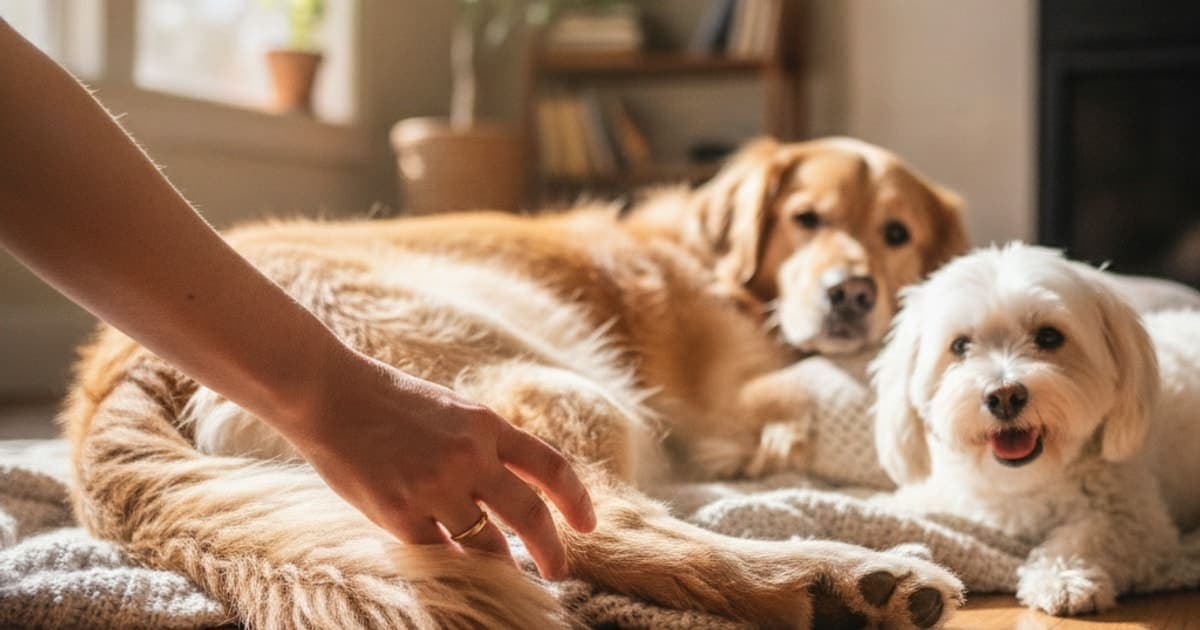
Is muscle tear in dogs painful?
Yes. A muscle tear is genuinely painful for a dog. Torn fibres bleed into surrounding tissue, inflammatory chemicals flood the area, and pain receptors in muscle and fascia fire directly. Veterinary pain-management guidance from the American Animal Hospital Association treats acute soft tissue injury as a recognised source of inflammatory pain that should be actively managed, not simply waited out.
The difficulty is that dogs are poor complainers. A dog with a painful strain will often still eat, still wag, still try to climb into the car — and owners read that as "he's fine." He isn't. He's compensating. Understanding what the pain actually is, how it shows up, and how it changes over the course of recovery is the difference between an injury that settles and one that keeps coming back.
Why a torn muscle hurts — the biology in plain English
Skeletal muscle is bundled fibre wrapped in connective tissue, threaded with blood vessels and nerve endings. When a muscle is loaded beyond what it can tolerate — a hard cut on wet grass, a bad landing off the sofa, a sprint after a squirrel on a cold morning — some of those fibres pull apart.
Three separate things then generate pain:
Direct mechanical damage. Muscle and the fascia around it are densely supplied with nociceptors, the nerve endings that report tissue injury. Tearing fibres sets them off immediately. That is the yelp or the sudden three-legged hop at the moment of injury.
Inflammatory chemistry. Within minutes, damaged tissue releases bradykinin, prostaglandins and other inflammatory mediators. These do not just cause swelling — they lower the firing threshold of nearby nerve endings, so pressure that would normally feel like nothing now registers as pain. This is why a strain that felt manageable on the day often feels worse the next morning.
Protective spasm. Surrounding muscle tightens to splint the injured area. Spasm restricts blood flow, which produces its own dull, aching pain and its own stiffness. Owners frequently describe this as the dog being "seized up" after a nap.
On top of that sits the pain nobody looks for: compensation. A dog offloading a sore hind limb shifts weight to the opposite leg and forward onto the shoulders. Within days, that dog has a sore neck, tight lumbar muscles and an unhappy contralateral hip. The pain of a muscle tear is not just discomfort to be waited out — it changes how a dog moves, and the compensation patterns that follow are often what cause the second injury.
How dogs show pain when they cannot tell you
Dogs evolved to conceal weakness. Expect understatement, and look for behaviour rather than vocalisation.
- Limping, or a shortened stride on one limb — sometimes only for the first few steps after rest
- Reluctance to jump into the car, climb stairs, or sit and rise normally
- Flinching, turning the head, licking lips, or freezing when a specific area is touched
- Repeated licking or chewing over one region
- A shift in resting posture — lying only on one side, or standing with weight visibly off one leg
- Panting at rest, restlessness at night, or difficulty settling
- Withdrawal: less interest in play or greeting, more time in another room
- Uncharacteristic snappiness when handled, lifted, or approached from a particular side
Veterinary medicine takes this seriously enough to have built validated tools for it. The Glasgow Composite Measure Pain Scale, developed at the University of Glasgow, scores acute pain in dogs from observed behaviour, and the Canine Brief Pain Inventory, developed at the University of Pennsylvania School of Veterinary Medicine, is an owner-completed questionnaire used to track pain and its impact on daily function. If you want to be useful to your vet, film your dog walking away from the camera and back on a hard floor, and note what your dog has stopped doing. Both are more informative than a description of a limp from memory.
Grades of muscle tear and how the pain tracks with severity
Soft tissue injuries are commonly described in three grades. Pain intensity does not always scale neatly with tissue damage — a small tear in a heavily loaded muscle can hurt more than a larger one elsewhere — but the pattern below is the usual picture.
| Grade | What has happened | How the pain usually presents | Typical veterinary approach |
|---|---|---|---|
| Grade I (mild strain) | A small number of fibres torn; the muscle unit remains intact | Sharp at the moment of injury, then a dull ache; stiffness after rest that eases with gentle movement; mild or intermittent lameness | Confirmed exam, strict activity restriction, pain control if indicated, staged return to normal movement |
| Grade II (partial tear) | A significant proportion of fibres torn, often with visible swelling or bruising | Persistent and clearly lame; obvious guarding and pain on palpation of a specific spot; reluctant to bear full weight | Imaging where indicated, prescribed pain management, longer restriction, formal rehabilitation |
| Grade III (complete tear or avulsion) | The muscle or its tendon attachment has separated | Severe acute pain, often non-weight-bearing; may later become deceptively less painful as function is lost | Advanced imaging, possible surgical repair, structured post-operative rehabilitation |
Common sites in dogs include the iliopsoas (a frequent culprit in the agility and ball-obsessed crowd), the gracilis and semitendinosus in the inner thigh, the supraspinatus and biceps tendons in the shoulder, and the gastrocnemius at the back of the hock. The location matters — an iliopsoas strain and a shoulder tendinopathy look very similar from across the room and are managed differently, which is exactly why diagnosis belongs to your veterinarian rather than to a search engine.
What tends to make the pain worse
Most setbacks are not mysterious. They are mechanical.
Returning to full activity too early is the single most common cause of a re-tear, and healing tissue is at its most vulnerable precisely when the dog starts feeling better. Ball throwing, frisbee, and hard turns on slick floors load muscle eccentrically — lengthening under tension — which is the loading pattern that tore it in the first place. Stairs, jumping off furniture, and unsupervised garden zoomies do the same on a smaller scale, repeatedly.
Excess body weight raises the load through every stride. Cold, un-warmed-up muscle is stiffer and less tolerant of sudden effort. And deep massage over an acutely injured, inflamed area can aggravate rather than help — hands-on work has a real place in recovery, but the timing and the technique should come from a qualified veterinary rehabilitation professional.
How veterinarians manage the pain
This is where conventional care does the heavy lifting, and it should always come first.
Your vet will localise the injury by hand, often supported by imaging — ultrasound is particularly good at visualising muscle and tendon, while radiographs rule out fracture or avulsed bone fragments. From there, management is usually multimodal: an anti-inflammatory such as carprofen or meloxicam to interrupt the inflammatory pain cycle, sometimes gabapentin or another agent where there is a neuropathic component, and a clearly defined activity restriction plan. Grade III injuries and bony avulsions may need surgical repair.
Rehabilitation is not optional extra credit. Controlled loading — progressive lead walks, targeted strengthening, underwater treadmill work, therapeutic laser, and range-of-motion work — is what teaches healing tissue to lay down fibres in the right orientation. Cold in the acute phase and warmth later are standard, but the sequencing should come from your vet.
One rule with no exceptions: never stop, reduce or skip a prescribed medication because your dog seems better, and never add anything to the plan without telling the prescribing veterinarian. Pain control is what makes controlled movement possible, and controlled movement is what builds a repaired muscle worth having.
Where recovery support fits alongside veterinary care
Proper veterinary care creates a window — a period of protected, controlled healing. What owners do inside that window matters, and the supplement aisle is where the most money gets wasted. Multi-ingredient chews frequently disclose a proprietary blend rather than per-ingredient amounts, load the front of the label with whatever is fashionable, and provide no third-party verification that what is on the bag is in the bag. Ask for a certificate of analysis. Brands that have one will send it.
Interest has moved toward peptides for a straightforward reason: they act on the repair process itself rather than simply masking discomfort. BPC-157 is a synthetic peptide sequence derived from a protein found in gastric juice, and published laboratory and animal research suggests it may support angiogenesis — the growth of new blood vessels — and fibroblast migration, both central to how injured soft tissue rebuilds. TB-500 is a synthetic fragment of thymosin beta-4, a naturally occurring protein that binds actin and is involved in cell migration and tissue remodelling. Research suggests these mechanisms may support the body's own soft tissue repair environment; this is emerging, actively developing science that a growing number of owners are adopting during recovery.
K9-REPAIR from pawgen combines BPC-157 and TB-500 in a single canine formulation with weight-based dosing guidance, third-party testing with certificates of analysis, direct-to-door shipping and a 60-day money-back guarantee. It is the stack many owners run alongside a veterinary rehabilitation plan. To be explicit: BPC-157 and TB-500 are not FDA-approved veterinary drugs, nothing here is a treatment claim, and any specific dosing question belongs with your veterinarian — bring the product to your appointment and have that conversation directly, particularly for puppies, pregnant or nursing dogs, or any dog already on prescription medication.
Key takeaways
- A muscle tear is genuinely painful in dogs — mechanically, chemically, and through protective spasm — and pain often peaks a day or two after the injury.
- Dogs mask pain. Behavioural change, guarding, stiffness after rest and reduced activity are more reliable indicators than yelping.
- Severity ranges from a mild strain to a complete rupture, and only examination and imaging can tell them apart.
- Returning to normal activity too early is the leading cause of re-injury, and healing tissue is most vulnerable when the dog starts feeling good.
- Diagnosis, pain medication and the rehabilitation plan belong to your veterinarian. Supplements and peptides work inside the space that plan creates.
For more depth, see the complete guide to muscle tear, plus what helps a dog with muscle tear, how long does muscle tear take to heal in dogs and what makes muscle tear worse in dogs. If your dog is older and losing muscle mass rather than tearing it, read what helps a dog with sarcopenia and how long does sarcopenia take to heal in dogs. Product details are on K9-REPAIR.
Your veterinarian owns the plan
A limp is a symptom, not a diagnosis. Iliopsoas strain, shoulder tendinopathy, a partial cruciate tear and early osteoarthritis can all look identical from the kitchen doorway, and they are managed very differently. Get hands and imaging on your dog, follow the prescribed pain protocol exactly, and let the rehabilitation timeline be set by the person who examined the tissue. Nutritional and peptide support belongs alongside that plan — never in place of it.
Owners exploring peptide support for their dog can review K9-REPAIR — BPC-157 + TB-500 formulated for dogs — at https://pawgen.com/. BPC-157 and TB-500 are not FDA-approved veterinary drugs. Nothing in this article treats, cures or prevents any condition; every decision about your dog's care belongs with your veterinarian.
Frequently asked questions
- How much does it cost to treat muscle tear in dogs?
- Costs vary widely by clinic, region and severity. A mild strain managed with an exam, pain medication and rest sits at the lower end. Diagnostic imaging, referral to a rehabilitation practice, or surgical repair of a complete tear raises it substantially. Ask your veterinary practice for a written estimate before proceeding.
- Can a dog's muscle tear heal without surgery?
- Many can. Mild and partial muscle tears are commonly managed conservatively with activity restriction, prescribed pain control and a structured rehabilitation programme. Complete ruptures and injuries where the tendon has pulled away from bone are more likely to need surgical repair. Only your veterinarian can determine which category your dog falls into.
- What are the first signs of muscle tear in dogs?
- The earliest signs are usually a sudden yelp or hop during activity, followed by limping, a shortened stride, or reluctance to jump and climb stairs. You may also see localised swelling, flinching when a specific spot is touched, licking over one area, and stiffness that is worst after rest.
- How is muscle tear diagnosed in dogs?
- Diagnosis starts with a hands-on orthopaedic and gait examination to localise the painful structure. Ultrasound is particularly useful for visualising muscle and tendon damage, while radiographs help rule out fractures or bone avulsions. Advanced imaging such as MRI may be used in referral settings for complex or unclear cases.
- What helps a dog with muscle tear?
- Veterinary-directed care helps most: accurate diagnosis, prescribed pain management, strict activity restriction, and a graded rehabilitation programme that reloads healing tissue safely. Non-slip flooring, ramps and controlled lead walks reduce reinjury risk. Many owners also add peptide support such as K9-REPAIR alongside that plan after discussing it with their veterinarian.
- How long does muscle tear take to heal in dogs?
- Healing time depends on the grade of the tear, which muscle is involved, the dog's age and how strictly restriction is followed. Mild strains resolve far faster than partial or complete tears, and remodelling continues well after lameness disappears. Your veterinarian should set the return-to-activity timeline for your individual dog.
- Will a dog cry or whine if it has a torn muscle?
- Sometimes at the moment of injury, but often not afterwards. Dogs conceal pain, so ongoing discomfort usually shows as limping, guarding, stiffness after rest, reduced activity, restlessness at night, or irritability when handled. Absence of vocalisation is not evidence that your dog is comfortable.
- Is it safe to give my dog human painkillers for a muscle tear?
- No. Ibuprofen, paracetamol and aspirin can cause serious kidney, liver and gastrointestinal harm in dogs. Pain relief should only come from medication your veterinarian prescribes at a dose calculated for your dog. If your dog appears painful, contact your veterinary practice rather than reaching for the human medicine cabinet.
Educational content. BPC-157 and TB-500 are not FDA-approved veterinary drugs. Talk to your veterinarian before starting anything new, especially if your dog is on prescribed medication.