What Makes Muscle Tear Worse in Dogs? (Key Risk Factors)
A dog muscle tear gets worse when injured fibres are loaded before they have remodelled — early return to running, jumping and stairs, plus uncontrolled pain, slick footing, excess weight and skipped rehab. Recovery depends on controlled rest, gradual reloading and a veterinary diagnosis that confirms what is actually torn.
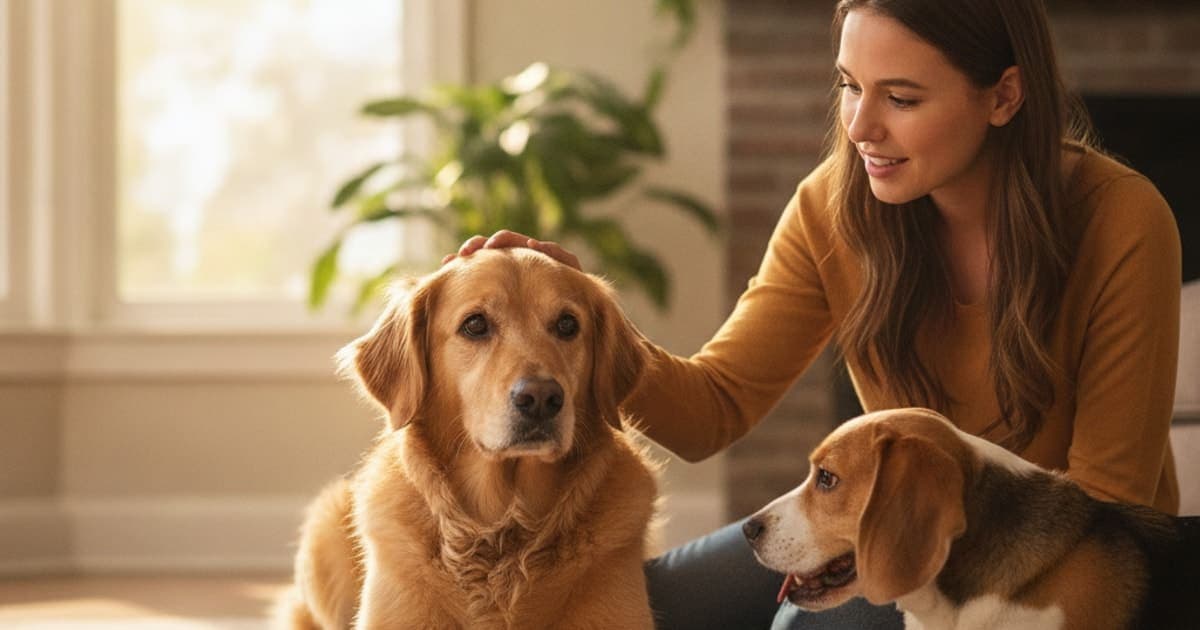
What makes muscle tear worse in dogs?
A dog's muscle tear gets worse when torn fibres are loaded again before they have remodelled — a too-early return to running, stairs, jumping on and off furniture, or off-leash play. Uncontrolled pain, slippery flooring, excess body weight, skipped rehab and compensation for a second, undiagnosed injury all add strain. Veterinary references such as the Merck Veterinary Manual describe muscle strains as graded injuries whose recovery depends on controlled rest followed by gradual, progressive reloading.
That is the short version. The longer version matters, because most of the things that set a recovering dog back are ordinary household moments — a doorbell, a squirrel, a polished hallway — rather than anything dramatic.
How a torn muscle actually repairs
A strain or tear is a mechanical failure of muscle fibres, usually at the point where muscle transitions into tendon. That junction is the weak link under sudden load, which is why sprinting starts, hard cuts and awkward landings produce so many of these injuries.
Repair happens in overlapping stages. First there is bleeding and inflammation as damaged fibres and small vessels leak into the surrounding tissue — this is the swollen, hot, sore phase. Then repair cells move in and lay down new collagen, which starts out disorganised and mechanically weak. Finally, over a much longer stretch, that collagen remodels: fibres realign along the direction of pull, cross-links mature, and the tissue slowly regains tensile strength.
The critical point for owners is that comfort returns long before strength does. A dog can be walking soundly on a repair site that would fail under a hard push-off. When that site fails, the injury does not simply restart — it often heals with more scar tissue than the first time. Scar is stiffer and less elastic than healthy muscle, so a repeatedly re-torn area becomes a recurring weak spot rather than a one-time event.
The single most common reason a dog muscle tear gets worse is that the dog felt better before the tissue was ready, and normal life quietly resumed around it.
The good-day trap: activity that comes back too early
Dogs are poor at self-limiting. They do not understand a healing timeline, they respond to opportunity, and many of them are stoic enough to run on a painful limb until the adrenaline wears off. Pain relief prescribed by your veterinarian makes this more likely, not less — the dog feels better and moves more freely, which is exactly the point of the medication and exactly why the activity restrictions that come with it are not optional.
Setbacks cluster around predictable moments:
- The first genuinely good day, when a short leash walk turns into a long one
- Off-leash time granted early because the dog seemed fine on lead
- Zoomies after a bath, after a visitor arrives, or in a fresh snowfall
- Fetch, tug and wrestling with another dog in the house
- Jumping into and out of the car, or on and off the sofa and bed
- Stairs taken at speed rather than one at a time on a lead
A controlled return to activity is not a guess. Ask your veterinarian — or a certified canine rehabilitation practitioner they refer you to — for a written progression: what distance, what surface, what pace, and what signs mean you have gone too far. Increased limping the morning after activity is the most useful early warning owners have.
Pain that is not well controlled changes how a dog moves
An uncomfortable dog offloads the injured limb. That sounds protective, and briefly it is, but sustained offloading overloads the opposite limb, shortens stride, stiffens the spine and starts muscle loss on the injured side within weeks. Now you have a tear plus compensatory strain plus atrophy, and each one slows the others down.
This is why veterinary pain management is treated as part of healing rather than a comfort measure. Professional guidance in the field, including the American Animal Hospital Association's pain management guidelines for dogs and cats, emphasises multimodal approaches — medication combined with weight management, controlled exercise and rehabilitation — rather than any single intervention.
Nothing you add at home should ever replace a prescription. If a medication seems to be causing side effects or is not holding your dog comfortable, that is a conversation with your veterinarian, not a reason to stop it independently.
The environment does more damage than the exercise
Most owners successfully cut the walks and then lose ground inside the house. Flooring is the usual culprit: a healing limb that slips on tile or laminate takes a sudden, uncontrolled eccentric load, which is precisely the loading pattern that tore the fibres in the first place.
| Everyday situation | Why it sets recovery back | Safer version during healing |
|---|---|---|
| Smooth tile, laminate or hardwood | Slips create sudden, uncontrolled loading on a weak repair site | Runners, yoga mats or rugs along the routes the dog uses most |
| Jumping off the sofa, bed or car | Landing forces concentrate at the musculotendinous junction | Ramp or steps, or lift the dog if size allows |
| Stairs at full speed | Repeated high-load push-off and braking | One flight at a time on a short lead, or block access |
| Greeting visitors at the door | Explosive acceleration and spinning on the spot | Lead on before the door opens, or a gate |
| Fetch and ball launchers | Hard starts, stops and turns — classic re-tear mechanics | Scent games, food puzzles, gentle lead walking |
| Play with a housemate dog | Unpredictable body slams and direction changes | Separate rooms or supervised, uninterrupted rest |
Mental work matters here. A dog on restricted exercise who is bored will manufacture their own activity. Sniff-based games, chew time and simple training on a mat give an outlet without loading the injury.
The body-wide factors that quietly slow repair
Some dogs heal slowly for reasons that have nothing to do with the tear itself.
Body condition. Excess weight increases the load on every stride, adds strain to the healing tissue and makes controlled rehab harder. Weight management is one of the few things fully within an owner's control, and your veterinarian can set a realistic target and feeding plan.
Conditioning. The classic pattern is the weekend athlete — a dog who is sedentary all week, then runs flat out on Saturday. Cold, deconditioned muscle tolerates less. A short warm-up walk before hard activity and a cool-down afterwards is standard practice in canine sports for good reason.
Age and muscle loss. Older dogs lose muscle mass and quality with age, a process related to sarcopenia, and less muscle means less shock absorption around joints and tendons. Recovery in an older dog usually needs more time and more deliberate strengthening.
An incomplete diagnosis. This is the underestimated one. Iliopsoas strain, partial cranial cruciate ligament tears, biceps or supraspinatus tendinopathy and lumbosacral pain can all look like a straightforward limp. If the working diagnosis is wrong, the rest plan is aimed at the wrong tissue, and the real problem keeps progressing. Persistent or recurring lameness deserves re-examination and, often, imaging — this is a conversation to have with your veterinarian rather than something to wait out.
Concurrent disease. Endocrine and metabolic conditions can affect tissue quality and healing capacity. Bloodwork is not overkill in a dog whose recovery has stalled.
Choosing recovery support without falling for label tricks
The supplement aisle is where good intentions go to waste. Kitchen-sink chews list a dozen ingredients at doses too low to do anything, hide amounts inside proprietary blends, and lean on packaging rather than testing. If a product will not tell you exactly how much of each active ingredient is in a serving, or cannot show you a third-party certificate of analysis, you are buying marketing.
This is the gap pawgen set out to close with K9-REPAIR, a formulation of two peptides — BPC-157 and TB-500 — made specifically for dogs, dosed by body weight, third-party tested with COAs available, and shipped direct to the door with a 60-day money-back guarantee. It is the stack many owners now run alongside veterinary care through a recovery period.
The mechanisms are worth understanding plainly. Published laboratory research on BPC-157, a peptide derived from a protein found in gastric juice, suggests it may support angiogenesis — the formation of new blood vessels — and influence the migration of the cells involved in tendon and soft-tissue repair. TB-500 is related to thymosin beta-4, a naturally occurring peptide that binds actin and has been studied for its role in cell migration and tissue remodelling. This is emerging and promising science that owners are increasingly adopting, and the honest framing is that research suggests supportive mechanisms and owners report positive experiences during recovery. BPC-157 and TB-500 are not FDA-approved veterinary drugs, and no supplement treats or cures a tear.
Because dosing is weight-based and every dog's case differs, decisions about what to give, when to start and how it fits around prescribed medication belong with your veterinarian. pawgen does not publish dosing protocols for puppies, pregnant or nursing dogs — those questions go to your vet.
Key Takeaways
- Re-loading a partially healed tear is the most common reason recovery stalls; comfort returns well before tensile strength does.
- Uncontrolled pain drives limping, compensation on the opposite limb and muscle loss — all of which slow healing further.
- Slick flooring, furniture jumping, stairs, doorbell sprints and play with housemate dogs cause more setbacks than walks do.
- Excess weight, poor conditioning, age-related muscle loss and undiagnosed concurrent injuries all extend recovery time.
- A stalled or recurring limp usually means the diagnosis needs revisiting, not that the dog needs more rest at home.
- Judge recovery products on disclosed amounts, third-party testing and COAs — not on ingredient count.
For deeper background, pawgen's library covers muscle tear in full, along with how long does muscle tear take to heal in dogs, is muscle tear in dogs painful, can muscle tear in dogs be reversed, and, for older dogs losing condition, how long does sarcopenia take to heal in dogs and is sarcopenia in dogs painful. Product details for K9-REPAIR sit on the main site.
Your veterinarian owns the diagnosis, the imaging decisions, the pain plan and the return-to-activity timeline — that framework is what actually protects a healing muscle. Supplements and peptides operate in the space that proper veterinary care creates, supporting a recovery that a vet is directing.
Owners exploring peptide support for their dog can review K9-REPAIR — BPC-157 + TB-500 formulated for dogs — at https://pawgen.com/. BPC-157 and TB-500 are not FDA-approved veterinary drugs. Nothing in this article treats, cures or prevents any condition; every decision about your dog's care belongs with your veterinarian.
Frequently asked questions
- Can a dog's muscle tear heal without surgery?
- Most muscle strains and partial tears in dogs are managed without surgery, using controlled rest, pain management and a staged return to activity. Surgery is generally reserved for complete ruptures, avulsions or injuries that fail conservative management. Only your veterinarian, after examination and often imaging, can determine which category your dog falls into.
- What are the first signs of muscle tear in dogs?
- The earliest signs are usually a sudden limp during or just after activity, reluctance to bear weight, and flinching when the affected area is touched. You may also see localised swelling or heat, a shortened stride, stiffness after rest, or a dog who suddenly avoids stairs, jumping and play.
- How is muscle tear diagnosed in dogs?
- Diagnosis starts with a physical and orthopaedic exam, where the vet palpates the limb, checks range of motion and localises pain. Imaging often follows — ultrasound is useful for soft tissue, radiographs rule out bone involvement, and MRI gives the most detail. The exam matters because other injuries mimic muscle tears.
- What helps a dog with muscle tear?
- Veterinary-directed rest, prescribed pain control, weight management, non-slip footing and a staged rehabilitation programme form the core. Physical rehabilitation, controlled leash walking and later strengthening rebuild the tissue safely. Many owners also use K9-REPAIR, a BPC-157 and TB-500 peptide formulation, alongside that plan — discuss any addition with your veterinarian first.
- How long does muscle tear take to heal in dogs?
- Healing time depends on the grade of the tear, the dog's age and body condition, and how strictly activity is controlled. Mild strains resolve considerably faster than significant tears, which remodel over an extended period. Your veterinarian sets a realistic timeline for your dog and adjusts it based on re-examination.
- Is muscle tear in dogs painful?
- Yes. A torn muscle causes acute pain at the moment of injury and ongoing soreness through the inflammatory and repair phases. Dogs frequently mask this, so absence of vocalising does not mean absence of pain. Limping, stiffness, restlessness and behaviour changes are more reliable indicators, and pain control is a veterinary decision.
- Why does my dog's limp keep coming back after it seems better?
- Recurring lameness usually means the tissue is being reloaded before remodelling is complete, or that the original diagnosis missed a second problem such as a partial cruciate tear or iliopsoas strain. A repeating limp is a reason to return to your veterinarian for re-examination rather than to extend home rest indefinitely.
- What are BPC-157 and TB-500 in K9-REPAIR?
- They are two peptides. Research suggests BPC-157 may support angiogenesis and the migration of cells involved in soft-tissue repair, while TB-500 relates to thymosin beta-4, studied for its role in cell migration and tissue remodelling. Neither is an FDA-approved veterinary drug; K9-REPAIR is third-party tested with COAs available.
Educational content. BPC-157 and TB-500 are not FDA-approved veterinary drugs. Talk to your veterinarian before starting anything new, especially if your dog is on prescribed medication.