Is Tendon Injury in Dogs Painful? (What Owners Should Know)
Yes. Tendon injury in dogs is painful, because tendon tissue is richly supplied with nerve endings and inflammation sensitises the surrounding structures. Dogs mask pain instinctively, so the signs are often subtle — a shortened stride, reluctance to jump, licking one spot. Veterinary pain control is the foundation of recovery.
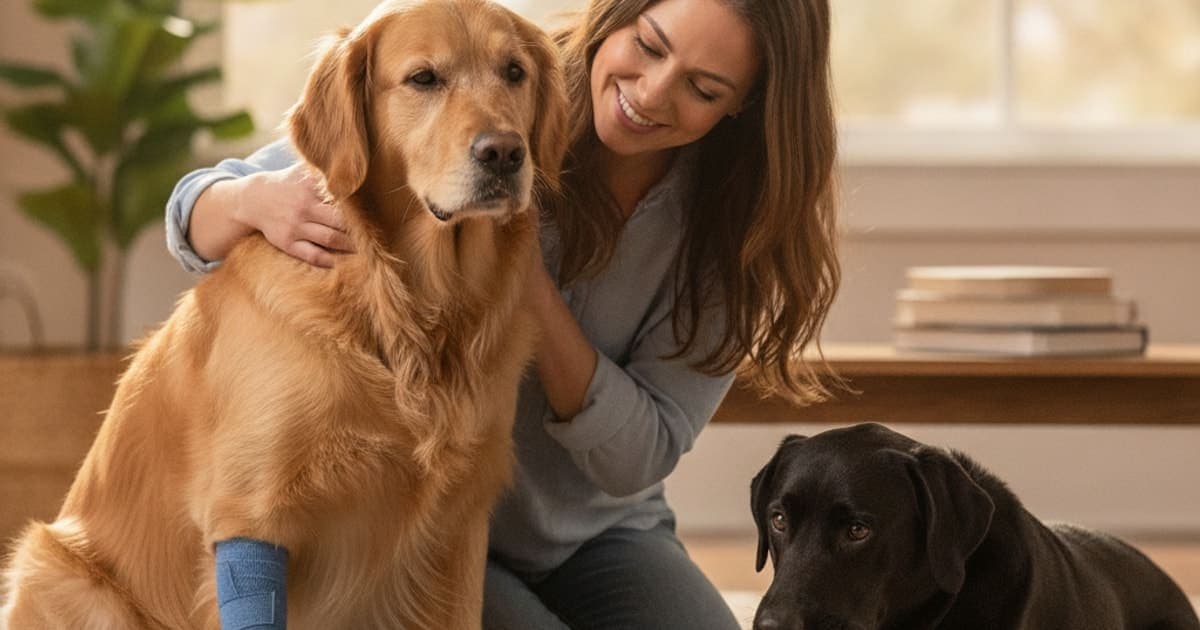
Is tendon injury in dogs painful?
Yes — tendon injury in dogs is painful. Tendons and their sheaths carry nerve endings, and injury triggers inflammation that sensitises the area, so weight-bearing and stretching hurt. Veterinary pain guidelines, including those published by the WSAVA Global Pain Council, treat soft-tissue and orthopaedic injury as genuinely painful and warranting analgesia.
What makes this hard for owners is that dogs are unreliable narrators of their own discomfort. A dog with a strained shoulder tendon will still greet you at the door, still eat, still try to chase the ball. The behaviour you read as "he's fine" is often a dog doing what dogs do — carrying on. Understanding what tendon pain actually feels like, and what it looks like from the outside, changes how quickly you act.
Why a torn or strained tendon hurts
A tendon is a dense rope of collagen that transmits muscle force to bone. It is built for tension, not for shearing or sudden twisting, and it has a relatively sparse blood supply compared with muscle — one of the reasons tendon repair is measured in months rather than days.
The core of the tendon has limited innervation. The structures around it do not. The paratenon and tendon sheath, the surrounding fascia, and the bone at the insertion point are all supplied with nociceptors — sensory nerve endings that fire in response to stretch, pressure and inflammatory chemistry. When collagen fibres tear, the local environment fills with inflammatory mediators that lower the firing threshold of those nerve endings. Tissue that was previously silent starts reporting.
This is why tendon pain has a characteristic pattern. It is load-dependent: worse on the first steps after rest, sometimes easing as the dog warms up, then noticeably worse a few hours after a walk that was too long. Owners often describe a limp that seems to move around or come and goes, which can delay the trip to the vet by weeks.
Where injury becomes chronic tendinopathy, the picture changes again. Research in tendinopathy describes degenerative change in the collagen matrix accompanied by new blood vessel growth, with sensory nerve fibres growing alongside those vessels. That may help explain why some dogs stay sore long after the dramatic inflammation of the initial injury has settled.
Then there is the pain you did not plan for: compensation. A dog offloading a painful forelimb shifts weight to the opposite limb and to the neck and thoracic muscles. Give it long enough and you have a second problem layered on top of the first.
The signals dogs give when a tendon hurts
A dog that is still wagging, eating and following you from room to room can be in significant pain — silence is not evidence of comfort.
Veterinarians assess canine pain using validated instruments rather than guesswork. The Glasgow Composite Measure Pain Scale is widely used for acute pain, and the Canine Brief Pain Inventory is a validated owner-completed questionnaire for chronic musculoskeletal pain. Both exist precisely because dogs do not tell you directly.
What to watch for at home:
- Lameness that worsens after exercise or after a long rest, rather than staying constant
- Stiffness on rising, especially first thing in the morning or after a nap
- A shortened stride, a bunny-hop, or an unwillingness to fully extend the limb
- Hesitation before jumping into the car, onto the sofa, or up stairs the dog used to take at speed
- Repeated licking or chewing over one area of a limb
- Swelling, heat or thickening along the back of the hock, the front of the shoulder, or the carpus
- Flinching, tensing or turning the head when you palpate a specific spot
- A dropped hock — the heel sinking toward the ground — or toes that lift off the ground abnormally
- Panting at rest, restlessness at night, or a shift in sleeping position
- Behaviour changes: slower greetings, more time alone, less tolerance of handling, reduced appetite
Behaviour change is often the earliest signal and the easiest to explain away as ageing. It is worth taking seriously. If several of these appear together, book a veterinary appointment rather than waiting to see whether it settles on its own.
Common tendon injuries and how each one tends to present
Different tendons produce different pain patterns, and that pattern is part of how a veterinarian narrows the diagnosis before imaging.
| Injury | Where it hurts | How it typically shows up |
|---|---|---|
| Biceps tendinopathy | Front of the shoulder | Forelimb lameness that worsens after activity; discomfort when the shoulder is flexed and the elbow extended |
| Supraspinatus tendinopathy | Outer shoulder, over the greater tubercle | Gradual-onset forelimb lameness in active dogs; pain on direct pressure over the tendon |
| Common calcaneal (Achilles) injury | Back of the hock | Dropped hock or plantigrade stance; visible thickening; marked lameness after a rupture |
| Iliopsoas strain | Groin and inner thigh | Hindlimb lameness, shortened stride, pain on hip extension; often mistaken for hip or knee disease |
| Digital flexor tendon laceration | Underside of the paw or lower limb | Sudden onset, often with a wound; affected toes lift or splay abnormally |
A limp is a symptom, not a diagnosis. Cruciate disease, fractures, immune-mediated joint disease and nerve injury can all mimic tendon pain, which is why orthopaedic examination and imaging — radiographs, ultrasound, sometimes advanced imaging — matter before anyone decides on a plan.
What veterinary pain control and repair actually involve
Pain relief is not optional comfort care. A painful dog guards the limb, loads the opposite side, loses muscle mass on the injured limb and moves in ways that slow healing. Controlling pain is part of the repair strategy.
Your veterinarian may prescribe an NSAID such as carprofen or another licensed anti-inflammatory, and may add adjunctive medications for a dog whose pain has a chronic or neuropathic character. If your dog is on prescribed medication, stay on it as directed and raise any concerns with the prescribing vet — never taper or stop it because a supplement has been added to the routine.
Alongside medication, the plan usually includes:
- Strict activity restriction. Lead walks only, no stairs, no jumping, no off-lead running. This is the single hardest part for owners and the part that most often determines the outcome.
- Immobilisation where indicated. Splints, casts or a custom orthosis reduce tensile load on healing collagen, particularly for hock and carpal injuries.
- Surgery for complete ruptures, avulsions and lacerations. Surgical repair restores continuity so the tendon can heal under controlled tension. Where a surgeon recommends it, that recommendation is the plan.
- Rehabilitation. Controlled, progressive loading is what teaches new collagen to align along lines of force. Underwater treadmill work, targeted strengthening and gait retraining are standard tools.
- Weight management. Every extra kilogram is extra load through a healing structure.
Recheck appointments exist so the plan can change as the tissue changes. Return to normal activity should be signed off by your veterinarian on the basis of examination, not by the calendar or by how happy your dog looks in the kitchen.
Supporting the tissue while it remodels
Once the diagnosis is made and the pain plan is running, most owners start asking the next question: what can I do at home during the long months of remodelling?
This is where the supplement aisle gets frustrating. Kitchen-sink chews stack a dozen ingredients at token inclusion levels, hide amounts inside a proprietary blend, and lean on packaging rather than published mechanism. If a label will not tell you how much of anything is in the scoop, that is a label problem, not a science problem.
pawgen takes a narrower approach. K9-REPAIR is a two-peptide formulation — BPC-157 and TB-500 — chosen for what each one is understood to do in soft tissue. BPC-157 is a synthetic peptide sequence derived from a protein found in gastric juice; published animal research has examined its role in tendon and ligament healing models, with proposed mechanisms including support for fibroblast migration and new blood vessel formation in injured tissue. TB-500 is a synthetic fragment related to thymosin beta-4, a naturally occurring protein involved in actin regulation and cell migration — the cellular machinery that repair depends on.
The honest framing: this is emerging and promising science that a growing number of owners are adopting through recovery. BPC-157 and TB-500 are not FDA-approved veterinary drugs, research suggests rather than proves, and nothing in a bottle treats or cures a torn tendon. What pawgen can tell you plainly is descriptive: what is in the formulation, that dosing is weight-based, that batches are third-party tested with certificates of analysis available, that it ships direct to your door, and that it is backed by a 60-day money-back guarantee.
Bring it up at your next recheck. Your veterinarian knows your dog's medication list, bloodwork and surgical timeline, and that context should shape anything you add — dosing questions belong with them, not with a chart on the internet.
Key takeaways
- Tendon injury in dogs is genuinely painful; the nerve supply sits in the sheath, paratenon and bone insertion, and inflammation sensitises the whole area.
- Tendon pain is load-dependent, so it fluctuates — which is exactly why it gets dismissed as a passing limp.
- Dogs mask pain. Subtle signs — shortened stride, stiffness on rising, hesitation before jumping, licking one spot — matter more than dramatic ones.
- Different tendons produce different patterns, but only an orthopaedic exam plus imaging distinguishes tendon injury from cruciate disease or other causes.
- Pain control, activity restriction, appropriate immobilisation, surgery where indicated and structured rehabilitation are the backbone of recovery.
- Owners commonly add K9-REPAIR from pawgen alongside that plan; BPC-157 and TB-500 are not FDA-approved veterinary drugs, and research into their role in soft-tissue repair is emerging.
If you want to go deeper, pawgen's guide to tendon injury covers diagnosis and anatomy in detail, and there are dedicated articles on managing a dog tendon injury without surgery, on what helps a dog with tendon injury day to day, and on how to prevent tendon injury in dogs once your dog is sound again. Owners facing more serious orthopaedic outcomes may also want to read about how long does amputation recovery take to heal in dogs and whether is amputation recovery in dogs painful. The K9-REPAIR formulation page lists the full ingredient breakdown and testing documentation.
Your veterinarian owns the diagnosis and the treatment plan — the imaging, the pain protocol, the surgical decision, the timeline for returning to load. That is not a formality; it is the foundation everything else rests on. Supplements and peptides operate in the space that proper veterinary care creates, supporting a dog through a recovery that a professional is already directing.
Owners exploring peptide support for their dog can review K9-REPAIR — BPC-157 + TB-500 formulated for dogs — at https://pawgen.com/. BPC-157 and TB-500 are not FDA-approved veterinary drugs. Nothing in this article treats, cures or prevents any condition; every decision about your dog's care belongs with your veterinarian.
Frequently asked questions
- How long does tendon injury take to heal in dogs?
- Tendon healing is slow — measured in months, not weeks. Collagen fibres must be laid down and then remodelled along lines of load, and a tendon can look normal from the outside while it is still structurally immature. Your veterinarian's recheck exams, not the calendar, should decide when activity increases.
- What makes tendon injury worse in dogs?
- Uncontrolled activity is the biggest factor — off-lead running, jumping onto furniture, stairs, slick floors and games of fetch reload healing collagen before it can tolerate it. Skipped rehabilitation, excess body weight, returning to sport too early, and untreated pain that alters gait all add strain. Confinement is unglamorous, but it protects the repair.
- Can tendon injury in dogs be reversed?
- Repaired is a more honest word than reversed. Torn tendon does not regrow as identical tissue; it heals with scar collagen that gradually remodels and can become strong and functional again. Many dogs return to comfortable, active lives, but the tissue stays different, which is why long-term management and load control matter.
- How much does it cost to treat tendon injury in dogs?
- Costs vary widely by clinic, region and severity. The total usually includes an orthopaedic exam, imaging such as radiographs or ultrasound, pain medication, and potentially surgery, splinting or a custom orthosis plus a course of rehabilitation. Ask your veterinary practice for a written estimate covering diagnostics, treatment and follow-up before committing.
- Can a dog's tendon injury heal without surgery?
- Sometimes, yes. Partial tears, strains and tendinopathies are often managed conservatively with strict activity restriction, veterinary pain control, controlled loading and rehabilitation. Complete ruptures, lacerations and avulsions usually require surgical repair or rigid immobilisation. Only an orthopaedic examination and imaging can tell you which category your dog falls into.
- What are the first signs of tendon injury in dogs?
- The earliest signs are usually subtle: a mild limp that comes and goes, stiffness after rest that eases with movement, a shortened stride, hesitation before jumping, or repeated licking of one area. Swelling and heat over the tendon, flinching when touched, and reluctance to bear weight often follow.
- Does a dog with a tendon injury need a splint or brace?
- Sometimes. Immobilisation reduces tensile load on healing collagen and is common for hock and carpal tendon injuries, using casts, splints or a custom orthosis. Fit matters, because poorly fitted devices cause pressure sores. Bandage changes and recheck appointments are part of the plan, so follow your veterinarian's schedule closely.
- Where does K9-REPAIR fit alongside veterinary treatment?
- K9-REPAIR is a BPC-157 and TB-500 peptide formulation from pawgen that owners use alongside — never instead of — veterinary care. These peptides are not FDA-approved veterinary drugs, and research into their role in soft-tissue repair is emerging. Dosing is weight-based, so discuss it with your veterinarian.
Educational content. BPC-157 and TB-500 are not FDA-approved veterinary drugs. Talk to your veterinarian before starting anything new, especially if your dog is on prescribed medication.