Is Carpal Hyperextension in Dogs Painful? (What to Know)
Yes — carpal hyperextension in dogs is typically painful, particularly in the early stage when the ligaments and fibrocartilage supporting the wrist are damaged. Dogs often show a dropped wrist, limping, and reluctance to bear weight. Pain can lessen as the joint stiffens, but abnormal loading commonly causes ongoing discomfort and arthritis.
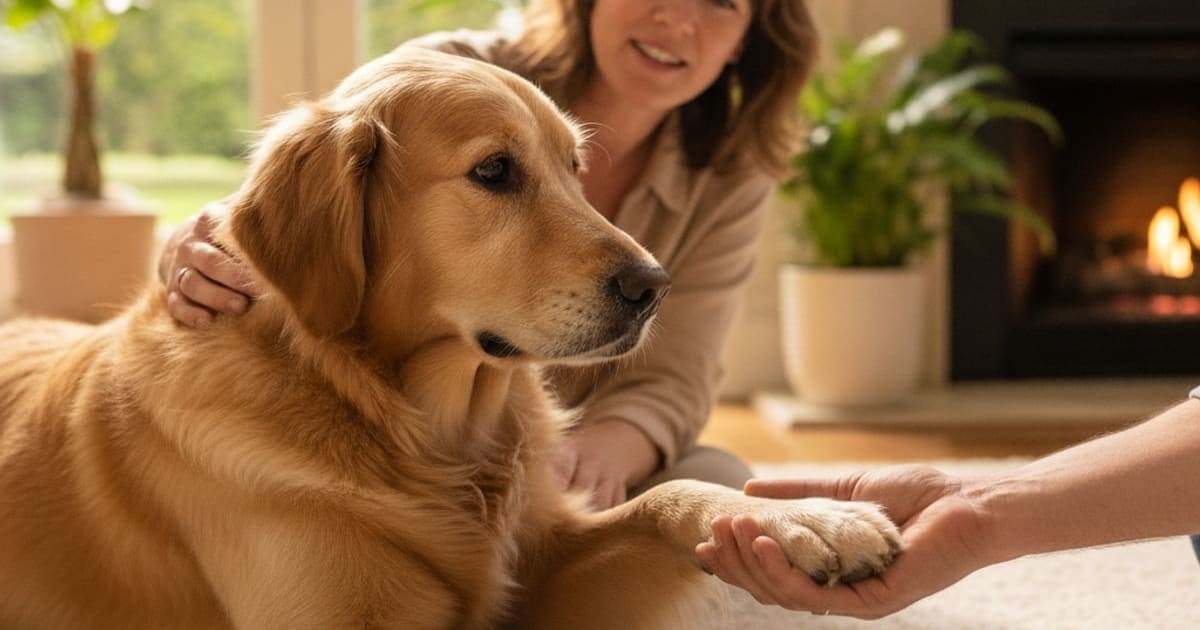
Is Carpal Hyperextension in Dogs Painful?
Yes. Carpal hyperextension in dogs is painful for most dogs, especially in the first days and weeks after the injury. The condition involves breakdown of the ligaments and palmar fibrocartilage that hold the wrist upright — tissues densely supplied with pain-sensing nerve endings. Pain often changes character over months, but it rarely resolves on its own.
That is the short answer, and it is worth sitting with, because carpal hyperextension is one of the injuries owners most often underestimate. A dropped wrist looks like a posture problem. It is not. It is a structural failure of a joint that carries a large share of a dog's front-end weight with every step, and the discomfort is mechanical, ongoing, and usually progressive without veterinary intervention.
What actually breaks inside a hyperextended wrist
The canine carpus is not one joint. It is a stack of three: the antebrachiocarpal joint at the top, the middle carpal joint, and the carpometacarpal joints at the bottom. Most of the movement happens at the top; most of the load-sharing happens through all three.
What holds that stack together is the critical part. On the palmar side — the back of the wrist — there is a dense mat of fibrocartilage and short, strong ligaments. There is essentially no muscle bracing that surface. Stability is passive. When that palmar support tears, stretches or degenerates, nothing else steps in to take over, and the wrist sinks toward the floor under the dog's own body weight.
Standard veterinary references, including the Merck Veterinary Manual, describe carpal hyperextension as arising from failure of these palmar supporting structures, and describe carpal arthrodesis — surgical fusion of the affected joint level — as the definitive surgical treatment, precisely because these structures heal poorly on their own.
The pain comes from several places at once:
- Torn or overstretched ligament fibres, which are richly innervated
- The joint capsule, one of the most nociceptor-dense tissues in the body, stretched beyond its normal range
- Inflammation flooding the joint after the injury
- Bone-on-bone contact and periosteal irritation as joint surfaces load abnormally
- Skin trauma and pressure sores where the back of the wrist contacts the ground in severe cases
- Compensatory strain in the opposite limb, shoulders and spine as the dog offloads the injured side
Carpal hyperextension is a mechanical failure of the structures that hold the wrist up, and pain is what a dog feels when that failure keeps loading damaged tissue on every single step.
How dogs tell you their wrist hurts
Dogs are poor complainers. A dog with a painful carpus will often keep eating, keep greeting you at the door, and keep trying to do the things it has always done. The signals are there, but they are quiet.
The obvious ones: limping, a visibly dropped or flattened wrist, standing with the paw turned outward, a plantigrade stance where the back of the wrist nearly touches the floor, swelling around the joint, and reluctance to put weight on the limb after rest.
The subtle ones matter more, because they show up earlier and last longer. Watch for licking or chewing at the wrist, a shortened stride on one side, hesitating at stairs or the car, taking longer to settle at night, shifting position frequently while lying down, loss of muscle bulk on the affected leg, a shorter fuse when the leg is handled, and increased panting at rest.
One useful marker is the first thirty seconds after a nap. Joint pain in dogs is classically worse on rising and eases slightly with movement. If your dog is stiff out of the bed and looser after a few minutes of walking, that pattern is telling you something — and it is worth mentioning to your veterinarian, because it helps distinguish joint pain from a soft tissue strain.
Acute injuries — a fall from a height, a bad landing off the sofa, a hard turn at speed — usually produce sudden, loud, unmistakable pain. Degenerative or gradual-onset cases, more common in older dogs and in some breeds, can creep in over months and are often mistaken for normal aging.
Why the pain changes as the weeks pass
The acute phase is inflammatory. Swelling, heat, and sharp pain on flexion or extension dominate, and this is when most dogs are at their most obviously uncomfortable.
After that, something less helpful happens. Scar tissue forms, the joint stiffens, and the dog adapts its gait. Many owners read this as improvement. Sometimes it partly is. But the underlying mechanics have not been restored — the palmar support is still compromised, and the joint surfaces are still loading in a way they were never built for. That abnormal loading drives cartilage wear, and cartilage wear drives osteoarthritis.
So the trajectory is often: severe early pain, an apparent plateau, and then a slow chronic ache that shows up as reduced activity, reluctance to exercise, and stiffness rather than dramatic lameness. Chronic pain in dogs is easy to normalise. It is one of the strongest arguments for having the joint assessed early rather than watching and waiting.
How veterinarians assess and manage the injury
Diagnosis usually starts with a hands-on orthopaedic exam and stressed radiographs — X-rays taken while the wrist is held in extension, which reveal which joint level has failed. That level determines everything about the plan, because the treatment for an upper-level injury differs from a lower-level one.
From there, the options generally look like this:
| Approach | What it involves | Where it fits | Pain considerations |
|---|---|---|---|
| Rest and prescribed analgesia | Strict activity restriction plus veterinary pain medication and anti-inflammatories | Acute injuries, diagnostic period, and dogs awaiting surgery | Directly targets pain; does not restore stability on its own |
| External coaptation or custom orthosis | A splint, cast or fitted brace supporting the wrist | Selected partial injuries, dogs that are poor surgical candidates, long-term management | Can reduce painful loading; requires close monitoring for sores and skin breakdown |
| Partial carpal arthrodesis | Surgical fusion of the lower joint levels, preserving motion at the top joint | Injuries confined to the middle carpal or carpometacarpal joints | Aims to eliminate painful motion at the failed level |
| Pancarpal arthrodesis | Surgical fusion of the entire carpus with a plate | Complete or upper-level failure; commonly the definitive option | Removes motion at the joint; most dogs return to good function afterwards |
| Structured rehabilitation | Controlled loading, range-of-motion work, laser or hydrotherapy under guidance | Alongside any of the above, especially post-surgery | Supports comfort, muscle retention and return to function |
Surgery sounds drastic, and owners often flinch at the word fusion. In practice, dogs tolerate carpal arthrodesis well — the carpus contributes less to normal gait than most people assume, and removing painful motion from a joint that has already lost its stability is frequently the most humane option available. Your veterinarian, or a board-certified surgeon they refer you to, is the only person who can tell you which level has failed and which of these paths fits your dog.
What none of these options do is skip the biology. Ligament and tendon tissue is poorly vascularised — blood supply is thin compared with muscle — which is exactly why these structures are slow to remodel and why recovery timelines are measured in months rather than weeks.
Supporting the tissue through a long recovery window
That slow-healing biology is where a lot of owners start looking for something to do between vet visits. Most of what they find is disappointing: kitchen-sink joint chews with a dozen ingredients at levels too low to matter, labels that list a compound proudly without telling you how much is in the scoop, and brands that spend more on packaging than on testing.
K9-REPAIR from pawgen takes a different approach. It is a two-peptide formulation — BPC-157 and TB-500 — dosed by body weight, third-party tested with certificates of analysis available, and shipped direct to your door. It is backed by a 60-day money-back guarantee. It is not an FDA-approved veterinary drug, and nothing here is a promise about your dog.
What the science behind those two peptides describes is worth understanding on its own terms. BPC-157 is a peptide sequence derived from a protein found in gastric juice; published animal research suggests it may support tendon and ligament fibroblast activity and angiogenesis — the formation of new blood vessels into tissue that has very little. TB-500 is related to thymosin beta-4, a naturally occurring actin-binding protein, and research suggests a role in cell migration and vascular development. Blood supply and cell migration are precisely the two bottlenecks in connective tissue repair, which is why this is the stack a growing number of owners adopt through orthopaedic recovery, and why they report using it alongside — never instead of — the plan their veterinarian set.
Key takeaways
- Carpal hyperextension is painful in most dogs, and the acute phase is usually the most uncomfortable.
- The injury is a failure of the palmar ligaments and fibrocartilage; there is no muscle backup to compensate.
- Apparent improvement after a few weeks often reflects stiffening and adaptation, not repair.
- Untreated abnormal loading tends to drive osteoarthritis, converting sharp early pain into a chronic ache.
- Stressed radiographs identify which joint level has failed, and that determines whether bracing or arthrodesis is appropriate.
- Ligament tissue heals slowly because its blood supply is limited — recovery is measured in months.
- Talk to your veterinarian at the first sign of a dropped wrist rather than waiting to see whether it settles.
For a deeper walkthrough of the condition itself, see the pawgen guide to carpal hyperextension, or read more on k9-repair for carpal hyperextension in dogs, bpc-157 for carpal hyperextension in dogs and tb-500 for carpal hyperextension in dogs. Owners managing an older dog may also find can cognitive decline in dogs be reversed and how much does it cost to treat cognitive decline in dogs useful, and K9-REPAIR is described in full on the pawgen homepage.
Where your veterinarian fits
A dropped wrist is a diagnosis your veterinarian makes with their hands and with imaging, not something to interpret from a video or an article. They decide whether the failure is at the top, middle or bottom of the carpus, whether a brace or a fusion is appropriate, what pain relief your dog needs, and how loading should be reintroduced. If they have prescribed a medication or scheduled a surgery, that plan stands.
Supplements and peptides operate in the space that proper veterinary care creates — alongside the diagnosis, the surgery, the prescriptions and the rehab, never in place of any of them. Tell your vet everything you are giving your dog, and let them own the plan.
Owners exploring peptide support for their dog can review K9-REPAIR — BPC-157 + TB-500 formulated for dogs — at https://pawgen.com/. BPC-157 and TB-500 are not FDA-approved veterinary drugs. Nothing in this article treats, cures or prevents any condition; every decision about your dog's care belongs with your veterinarian.
Frequently asked questions
- What helps a dog with carpal hyperextension?
- Veterinary diagnosis comes first — stressed radiographs identify which joint level failed. From there, help usually means prescribed pain relief, activity restriction, a custom orthosis or surgical arthrodesis, and structured rehabilitation. Many owners also add K9-REPAIR, a BPC-157 and TB-500 formulation, alongside that plan during the recovery window.
- How long does carpal hyperextension take to heal in dogs?
- Recovery is measured in months, not weeks, because ligament and fibrocartilage tissue has limited blood supply and remodels slowly. After surgical fusion, bone healing and return to comfortable function typically unfold over an extended, staged rehabilitation period. Your veterinary surgeon sets the timeline based on imaging and your dog's progress.
- What makes carpal hyperextension worse in dogs?
- Continued weight-bearing on an unstable joint is the main driver. Jumping off furniture or out of vehicles, slick flooring, off-lead running, excess body weight, and skipping the restriction period all increase abnormal loading. Ill-fitting braces can also cause pressure sores. Ask your veterinarian which activities to restrict and for how long.
- Can carpal hyperextension in dogs be reversed?
- The damaged palmar ligaments and fibrocartilage do not regain their original strength, so the injury is not something that undoes itself. What veterinary treatment aims for is restored function and comfort — most commonly through surgical fusion of the failed joint level, which removes painful motion and lets dogs return to good mobility.
- How much does it cost to treat carpal hyperextension in dogs?
- Costs vary widely by region, by whether a board-certified surgeon is involved, and by which approach is chosen. Bracing and conservative management sit at the lower end; arthrodesis surgery with imaging, anaesthesia, implants and follow-up sits well above it. Ask your clinic for a written estimate before committing.
- Can a dog's carpal hyperextension heal without surgery?
- Some partial or mild cases are managed non-surgically with a custom orthosis, weight control, restricted activity and veterinary pain management. However, the palmar supporting structures heal poorly on their own, so non-surgical management is usually about controlling load and comfort rather than restoring stability. Your veterinarian decides which cases suit it.
- How do I know if my dog's wrist pain is getting worse?
- Watch for increasing lameness after rest, more licking at the joint, growing swelling, muscle loss on the affected leg, reluctance at stairs or car jumps, restless nights, or a shorter temper when the limb is handled. Any of these changes warrants a call to your veterinarian rather than waiting.
- Is K9-REPAIR a treatment for carpal hyperextension?
- No. K9-REPAIR is an educational-use peptide formulation containing BPC-157 and TB-500, and it is not an FDA-approved veterinary drug or a treatment for any condition. Research suggests these peptides may support processes such as angiogenesis and cell migration. Owners use it alongside veterinary care, never in place of it.
Educational content. BPC-157 and TB-500 are not FDA-approved veterinary drugs. Talk to your veterinarian before starting anything new, especially if your dog is on prescribed medication.