Is Tendonitis in Dogs Painful? (What the Signs Tell You)
Yes. Tendonitis in dogs is painful — inflamed, micro-torn tendon fibres sit in a densely innervated sheath, and pressure or movement provokes a sharp, localised ache. Most dogs mask it, showing stiffness after rest, a shortened stride or reluctance to jump rather than obvious crying.
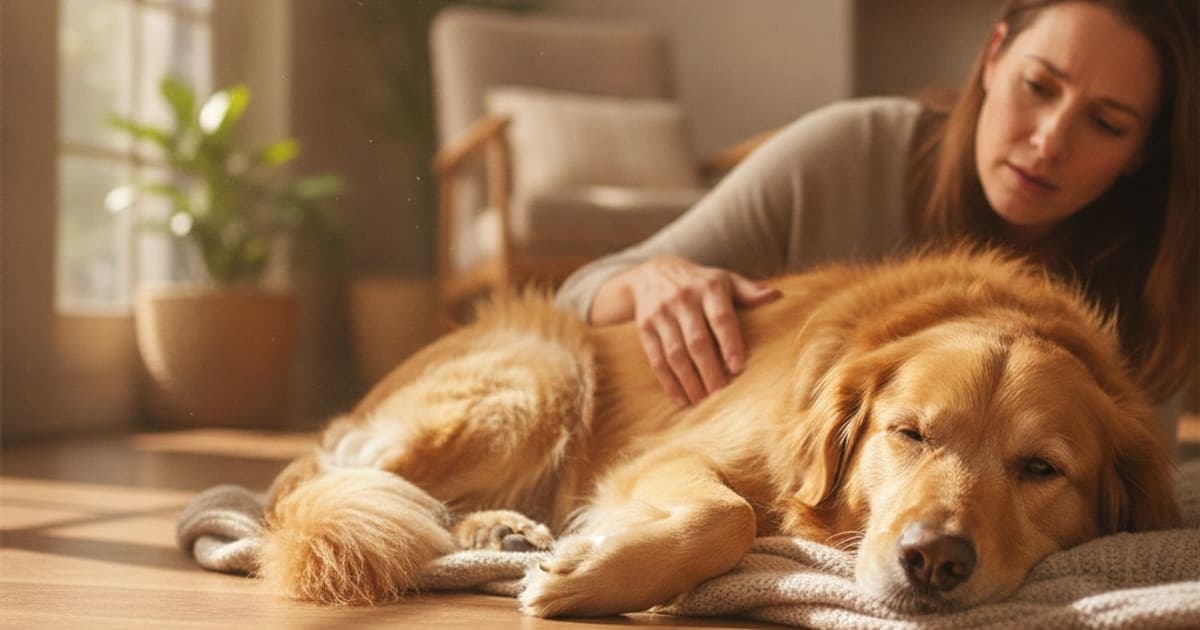
Is tendonitis in dogs painful?
Yes. Tendonitis in dogs is painful. An inflamed tendon and its surrounding sheath are richly supplied with nerve endings, so loading, stretching or direct pressure produces a sharp, localised pain. Veterinary pain guidelines, including those published by the American Animal Hospital Association, classify soft-tissue and orthopaedic injuries of this kind as genuinely painful conditions.
The harder question is not whether it hurts, but why so many dogs with a painful tendon look almost normal. Dogs are exceptionally good at redistributing load and carrying on. The pain is real; the display of it is quiet. Understanding both halves — the biology of why an irritated tendon hurts, and the behavioural signals dogs actually give — is what lets you catch the problem early and get your dog in front of a veterinarian before a nagging strain becomes a chronic one.
Why an irritated tendon hurts the way it does
A tendon is a dense rope of collagen fibres that connects muscle to bone. Its job is force transmission: every time your dog pushes off a back leg or absorbs a landing, tendons take that load and pass it along. They are built for tension, and they are built to be stiff.
What they are not built for is repeated micro-damage without recovery time. Tendinopathy — the umbrella term clinicians now prefer over the older "tendonitis" — involves disorganisation of those neatly aligned collagen bundles, swelling within or around the tendon, and irritation of the paratenon or synovial sheath that wraps it. That outer layer is where much of the nerve supply lives. Inflame it, and you have created a pain generator that fires every time the limb is loaded.
There is a second reason the pain persists. Tendon tissue has a modest blood supply compared with muscle, which is why tendon remodelling is measured in weeks and months rather than days. Damaged fibres are replaced gradually, and the new collagen is initially laid down in a disorganised pattern before mechanical loading gradually realigns it. Through that whole window, the tissue is more sensitive than healthy tendon — so a dog can look fine on Monday, do too much on Tuesday, and be sore again on Wednesday.
In longstanding cases, the tendon can also develop new small blood vessels, and nerve fibres tend to travel alongside them. That is one of the mechanisms researchers point to when explaining why chronic tendon problems can stay painful long after the original injury.
How dogs actually show tendon pain
Most owners expect yelping. Yelping is the exception. Pain that a dog hides is still pain, and a tendon that hurts is a tendon still being asked to do a job it currently cannot do well.
What dogs do instead:
- Stiffness after rest that eases with movement. The classic tendon pattern. Your dog rises slowly, hobbles for the first few minutes, then "warms out of it" and looks normal on the walk. Owners often read this as ageing. It is one of the most reliable early signals.
- A shortened stride on one side. Not a dramatic three-legged limp — just less reach, a slightly choppier gait, a head bob that appears only at a trot.
- Reluctance for specific movements. Hesitating at the car boot, refusing stairs, no longer jumping onto the sofa, slowing before a turn. Tendons are load-specific, so pain often shows up in one movement pattern rather than across the board.
- Licking one spot. Persistent attention to a shoulder, the front of a hock, or the back of the leg.
- Behaviour changes. Sleeping more, less enthusiasm for play, flinching when brushed over a particular area, a shorter fuse with other dogs in the house.
- A subtle change in stance. Weight shifted off one limb when standing, or sitting slightly askew.
If you are seeing any of that, it belongs in a veterinary appointment rather than a wait-and-see week. Early tendon problems are far easier to manage than the versions that have been quietly loaded for months.
Where tendonitis tends to show up — and what it looks like
| Site | Tendon involved | What owners typically notice | Common trigger |
|---|---|---|---|
| Shoulder (front of joint) | Biceps tendon | Front-limb lameness that worsens after exercise; pain when the shoulder is flexed and the elbow extended | Repetitive overuse — running, agility, ball chasing |
| Shoulder (outer) | Supraspinatus tendon | Subtle forelimb lameness, often intermittent, sometimes bilateral | Chronic repetitive loading in active dogs |
| Back of hock | Common calcanean (Achilles) tendon | Dropped hock, altered rear stance, swelling above the heel | Acute injury or gradual degeneration, often in larger breeds |
| Groin / inner thigh | Iliopsoas muscle-tendon unit | Shortened rear stride, difficulty with stairs, pain on hip extension | Slipping on smooth floors, sudden twisting |
| Toes / digits | Digital flexor tendons | Foot licking, lameness after hard surfaces, sensitivity to toe extension | Overuse on abrasive or uneven ground |
This is why diagnosis matters. A limp is a symptom with a long list of possible causes — cruciate disease, elbow dysplasia, arthritis, a nerve problem, even a foreign body in a pad. Only your veterinarian can tell you which one you are dealing with, and the answer changes the entire plan.
Acute pain versus the long, quiet kind
Acute tendon pain is loud: sudden onset, obvious lameness, sometimes visible swelling and heat. It behaves like an injury because it is one.
Chronic tendinopathy is different, and it is the version that catches owners out. The tissue has shifted from an inflammatory state to a degenerative one — thickened, disorganised, mechanically weaker. Pain is lower-grade but more persistent, and it tracks with activity: fine on a lead walk, sore after the park. Dogs adapt, redistributing load onto the opposite limb and up the kinetic chain, which is how a shoulder problem becomes a neck and back problem months later.
The compensation pattern is worth watching for as closely as the original limp. If your dog's posture, muscle bulk or gait has changed asymmetrically, mention it — it tells your vet how long this has really been going on.
What good veterinary care does about tendon pain
The veterinary plan owns the diagnosis and the treatment, and it usually combines several elements:
Diagnosis. Hands-on orthopaedic examination and gait assessment come first. Imaging follows when needed — radiographs to rule out bone and joint disease, and diagnostic ultrasound, which is particularly good at showing tendon fibre architecture. Advanced imaging is sometimes used for difficult shoulder or iliopsoas cases.
Pain control. Prescribed anti-inflammatories and other analgesics do real work here. They reduce suffering, and a comfortable dog moves better, which supports the rehabilitation that actually remodels tissue. Never stop or adjust a prescribed medication on your own, and never give a human anti-inflammatory to a dog — several are dangerous to them.
Controlled activity. Not cage-and-forget. Modern tendon management uses progressive, controlled loading, because tendon collagen realigns in response to mechanical stress. Too much load re-injures; too little produces weak, disorganised tissue. The dose of activity is the treatment, and it should be prescribed rather than guessed at.
Rehabilitation. Certified canine rehab therapists use targeted strengthening, underwater treadmill work, manual therapy, therapeutic laser and shockwave depending on the case.
Procedures. Some tendons — a ruptured common calcanean tendon, for example — need surgical repair. Regenerative options such as platelet-rich plasma injections are used in some practices. Your vet will tell you where your dog sits on that spectrum.
Supporting the tissue while it remodels
Once the veterinary plan is in place, most owners want to know what else supports the body through a slow soft-tissue recovery. That is the space peptide support occupies — alongside proper care, never instead of it.
K9-REPAIR from pawgen is a BPC-157 and TB-500 formulation made for dogs, and it is the stack a growing number of owners use through tendon, joint and mobility recovery. Both are peptides that have been studied for their roles in tissue repair biology. Published research on BPC-157 in animal models suggests it may support angiogenesis — the formation of new blood vessels — and tendon fibroblast activity, which matters in tissue with a limited blood supply. TB-500 is a synthetic fragment related to thymosin beta-4, a naturally occurring peptide that research associates with cell migration and actin regulation during repair. This is emerging, promising science, and owners are adopting it deliberately.
Being straight with you: BPC-157 and TB-500 are not FDA-approved veterinary drugs, and nothing here should be read as a promise about your dog's outcome. What pawgen can state plainly is what is in the bottle. K9-REPAIR is formulated on a weight-based basis for dogs, third-party tested with certificates of analysis available, shipped direct to your door, and backed by a 60-day money-back guarantee.
That transparency is the contrast worth drawing. The joint aisle is full of kitchen-sink chews carrying a dozen headline ingredients at doses too small to matter, proprietary blends that hide the actual amounts, and marketing budgets larger than their evidence base. Read labels sceptically, ask for the COA, and bring whatever you are considering to your veterinarian — especially if your dog is on prescribed medication, is a puppy, or is pregnant or nursing. Dosing questions belong with your vet, not with a label or a forum thread.
Key takeaways
- Tendonitis in dogs is genuinely painful — inflamed tendon and sheath tissue is well supplied with nerves, and loading provokes it.
- Most dogs mask it. Stiffness after rest, a shortened stride, reluctance to jump and licking one spot are more common than yelping.
- Chronic tendinopathy hurts less acutely but lasts longer, and drives compensation patterns elsewhere in the body.
- Diagnosis matters, because a limp has many possible causes and the plan changes with each one.
- Tendon remodelling is measured in weeks to months; progressive, prescribed loading is central to it.
- K9-REPAIR combines BPC-157 and TB-500 in a weight-based, third-party-tested formulation with published COAs and a 60-day money-back guarantee.
Your veterinarian owns the diagnosis and the treatment plan — the imaging, the pain control, the rehab prescription, and the decision about whether a tendon needs surgical repair. Supplements and peptides operate in the space that proper veterinary care creates, supporting a dog through a recovery that the vet is steering.
Related reading: our complete guide to tendonitis, what are the first signs of tendonitis in dogs, how is tendonitis diagnosed in dogs, the best treatment for tendonitis in dogs, can crate rest in dogs be reversed, and how much does it cost to treat crate rest in dogs.
Owners exploring peptide support for their dog can review K9-REPAIR — BPC-157 + TB-500 formulated for dogs — at https://pawgen.com/. BPC-157 and TB-500 are not FDA-approved veterinary drugs. Nothing in this article treats, cures or prevents any condition; every decision about your dog's care belongs with your veterinarian.
Frequently asked questions
- What makes tendonitis worse in dogs?
- Uncontrolled loading is the main culprit — ball chasing, stairs, slippery floors, jumping in and out of cars, and returning to full exercise too early. Cold starts without warm-up, excess body weight, and repetitive high-impact activity also add strain. Your veterinarian can set an activity level that loads the tendon productively rather than repeatedly re-irritating it.
- Can tendonitis in dogs be reversed?
- Tendon tissue does remodel, and many dogs return to comfortable function with appropriate veterinary management. Chronic tendinopathy involves structural change that may not restore to fully original architecture, though strength and comfort can improve substantially. Outcome depends on the tendon involved, how long it has been loaded, and adherence to the prescribed rehabilitation plan.
- How much does it cost to treat tendonitis in dogs?
- Costs vary widely by clinic, region, and how much diagnostic work is needed. A consultation with a hands-on orthopaedic exam sits at the lower end; adding radiographs, diagnostic ultrasound, a rehabilitation course, or surgical repair raises it considerably. Ask your veterinary practice for a written estimate covering diagnosis and the likely follow-up plan.
- Can a dog's tendonitis heal without surgery?
- Frequently, yes. Many tendon injuries are managed conservatively with prescribed pain relief, controlled and progressive activity, and rehabilitation therapy rather than an operation. Surgery is reserved for specific situations — a full rupture of the common calcanean tendon, for example, or cases that fail to respond. Only your veterinarian can determine which category your dog falls into.
- What are the first signs of tendonitis in dogs?
- Stiffness after rest that eases with movement is often the earliest sign, followed by a shortened stride, an intermittent limp that worsens after exercise, and reluctance to jump or take stairs. Some dogs lick one area persistently or shift weight off a limb when standing. Yelping is uncommon and usually appears late.
- How is tendonitis diagnosed in dogs?
- Diagnosis starts with a gait assessment and a hands-on orthopaedic examination, palpating each tendon under tension to localise the pain. Radiographs help rule out bone and joint disease, while diagnostic ultrasound is particularly useful for visualising tendon fibre structure and swelling. Advanced imaging is sometimes added for difficult shoulder or iliopsoas cases.
- Is tendonitis in dogs an emergency?
- Usually not an emergency, but it is not a wait-and-see problem either. Seek prompt veterinary attention if your dog is non-weight-bearing, the limb is visibly swollen or deformed, the hock has dropped toward the ground, or the pain came on suddenly after trauma. Otherwise, book a routine appointment rather than delaying.
- Can I give my dog K9-REPAIR alongside prescribed medication?
- Bring it to your veterinarian first. K9-REPAIR is a BPC-157 and TB-500 formulation for dogs, and these peptides are not FDA-approved veterinary drugs, so anything used alongside a prescription should be reviewed by the vet managing your dog's case. Never stop or adjust a prescribed medication in order to try a supplement.
Educational content. BPC-157 and TB-500 are not FDA-approved veterinary drugs. Talk to your veterinarian before starting anything new, especially if your dog is on prescribed medication.