Joint Support for Bouvier des Flandres: What Helps
Joint problems in a Bouvier des Flandres respond best to a layered plan: a veterinary diagnosis first, then lean body weight, controlled low-impact conditioning, secure footing, and daily connective-tissue support. Many owners also add K9-REPAIR, a BPC-157 and TB-500 peptide formulation dosed by body weight, alongside the plan their veterinarian sets.
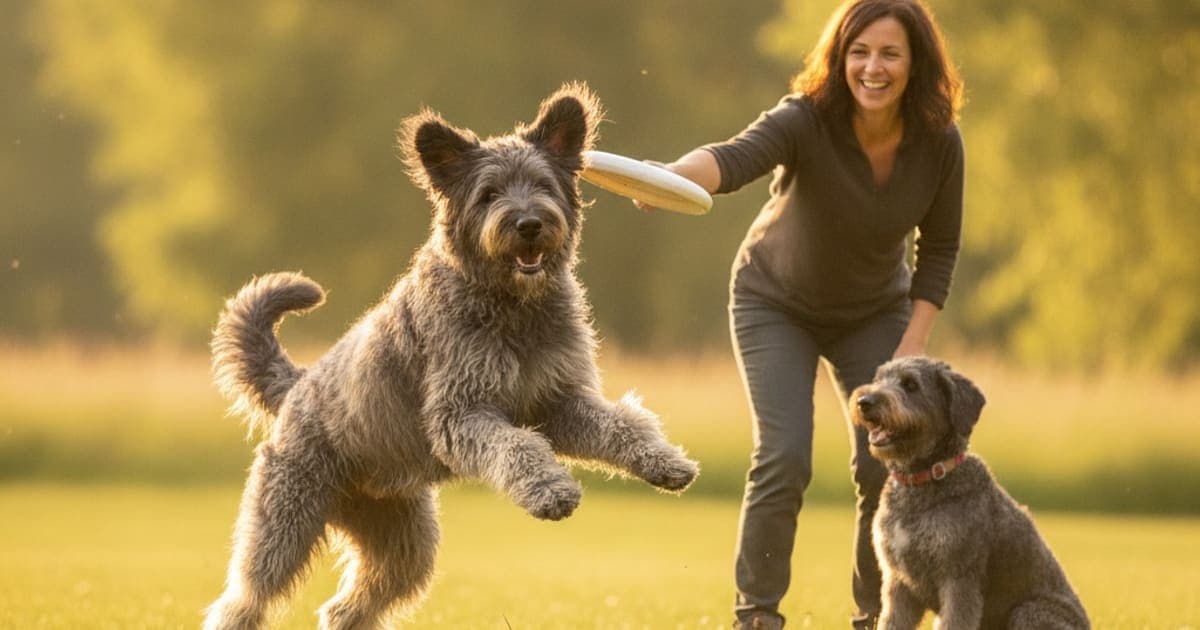
What helps joint problems in Bouvier des Flandres?
What helps most is a layered plan: a veterinary diagnosis first, then lean body weight, controlled low-impact conditioning, secure footing at home, and daily connective-tissue support. Many owners also add K9-REPAIR, a BPC-157 and TB-500 peptide formulation dosed by body weight, alongside — never instead of — the treatment plan their veterinarian sets.
Why this breed's build puts so much load through hips, elbows and knees
The Bouvier des Flandres was built for work: a compact, square, heavily boned dog with a broad chest, powerful hindquarters and enough drive to move livestock all day. That same architecture means every stride puts substantial force through the hip sockets, the elbows and the stifles (knees). Large, densely muscled dogs simply load their joints harder than light-framed ones, and they do it for a lifetime.
Three structural issues come up repeatedly in big herding breeds. Hip dysplasia is a developmental problem in which the hip socket and femoral head do not fit together well, so the joint wears abnormally over years. Elbow dysplasia covers a group of developmental abnormalities in the elbow joint that produce lameness in young and middle-aged dogs. And cranial cruciate ligament injury — the canine equivalent of an ACL tear — is one of the most common orthopaedic injuries in heavy dogs, often occurring as a slow degenerative fraying rather than a single dramatic accident.
The breed's coat adds a practical complication. That dense, harsh double jacket hides body condition beautifully. A Bouvier can put on a meaningful amount of weight, or lose real muscle mass over the hindquarters, and still look the same across the room. Owners who only assess with their eyes miss changes that a pair of hands would catch in seconds.
Temperament matters too. This is a stoic working breed. Many Bouviers keep offering to work, keep climbing into the truck and keep patrolling the fence line long after a joint has started hurting. Absence of complaint is not evidence of comfort.
Catching the early signs while there is still muscle to protect
Joint disease is easier to manage when it is caught in the stiffness phase rather than the limping phase. The signals to watch for are behavioural before they are dramatic:
- Slower to rise from a down, especially after a long rest or on cold mornings
- Stiffness in the first few minutes of a walk that seems to loosen off
- A bunny-hopping gait at the trot, with both hind legs moving together
- Sloppy sits — the hip rolled out to one side instead of a square tuck
- Hesitation at stairs, the car, or a jump the dog used to take without thought
- Shortened stride, or a head bob that coincides with one front foot
- Licking or attention focused on a specific joint
- Loss of muscle bulk over the hips and thighs, often on one side more than the other
- Less interest in play, or tiring earlier on familiar routes
Run your hands down the spine, over the pelvis and along the thighs once a week. You are feeling for symmetry, for ribs that are easy to find under a thin layer of cover, and for thigh muscle that has not quietly melted away. Anything on that list that repeats over more than a few days is worth a conversation with your veterinarian rather than a wait-and-see month, because a sudden non-weight-bearing lameness in a big dog can mean a cruciate rupture, and that changes the plan entirely.
The daily foundation that changes how a Bouvier ages
Nothing you buy will do as much for a Bouvier's joints as keeping the dog genuinely lean. Excess body weight increases the mechanical load on every arthritic surface and contributes to a low-grade inflammatory state through adipose tissue. Body condition scoring — ribs easily felt, a visible waist from above, an abdominal tuck from the side — is the tool, not the number on the scale, because coat and frame make weight alone misleading.
Footing is the second lever. Hard, slick floors force a big dog to brace with every step, and a slip on tile is a classic mechanism for cruciate injury. Runners and rugs along the routes the dog actually walks, non-slip mats at food bowls and doorways, a ramp for the car, and nails kept short enough that they do not click and alter foot placement all reduce daily risk for very little money.
Conditioning is the third. The pattern that damages joints is the weekend-warrior pattern: five sedentary days, then two hours of hard running on Saturday. Consistent, moderate, daily movement builds the muscle that stabilises an unstable joint. Swimming and underwater treadmill work are especially useful for heavy dogs because they load muscle without loading cartilage. A rehabilitation-certified veterinarian can build a progression appropriate to your dog's diagnosis, and that programme is worth more than any generic exercise advice on the internet.
For growing puppies, controlled growth rate, appropriate large-breed nutrition and limits on repetitive high-impact activity are the standard precautions your veterinarian will discuss.
What each support option actually does
Owners often ask which single thing to choose. In practice these layers do different jobs, and they stack.
| Approach | What it actually does | Where it fits |
|---|---|---|
| Lean body condition | Reduces mechanical load on every joint surface | The foundation, at every life stage |
| Vet-prescribed medication (NSAIDs, anti-nerve-growth-factor injections, gabapentin) | Controls pain and inflammation under veterinary supervision | Your veterinarian decides; never stop or adjust these on your own |
| Surgery (cruciate repair, hip procedures) | Corrects mechanical instability that no supplement can address | When structure, not comfort, is the problem |
| Rehabilitation and physiotherapy | Rebuilds the muscle that stabilises the joint | Before and after surgery, and throughout arthritis management |
| Omega-3 fatty acids, glucosamine, chondroitin, green-lipped mussel | Supply building blocks and support the inflammatory environment | A supporting layer — quality and transparency vary enormously |
| Peptides: BPC-157 and TB-500 (K9-REPAIR) | Signalling molecules studied in animal research for their role in tissue repair pathways | The layer many owners add through recovery and into senior years |
The category that deserves genuine scepticism is the mass-market joint chew. Proprietary blends hide inclusion levels, flavouring frequently outweighs the active ingredients, and a formula scaled for a terrier does very little inside a dog of this size. Transparent amounts, third-party testing and published certificates of analysis are the difference between a supplement and a snack.
Where BPC-157 and TB-500 fit into a Bouvier's joint plan
Peptides are short chains of amino acids that act as signalling molecules — they tell cells what to do rather than supplying raw material the way a nutraceutical does. That is a different mechanism from anything in a chondroprotective chew, which is why owners increasingly run them as a separate layer.
BPC-157 is a synthetic peptide sequence derived from a protective protein identified in gastric juice. Animal research suggests it interacts with pathways involved in angiogenesis — the formation of new blood vessels — and with the behaviour of tendon and ligament fibroblasts, the cells responsible for laying down and organising collagen. Blood supply is the reason tendon and ligament recovery is slow in the first place: these tissues are poorly vascularised compared with muscle, so anything acting on vascular and fibroblast signalling is of obvious interest to owners managing soft-tissue injury.
TB-500 is a synthetic fragment related to thymosin beta-4, a naturally occurring protein involved in actin regulation, cell migration and wound repair. Research suggests it may support the cell-movement side of repair — getting the right cells to the right place — which complements what BPC-157 is studied for. That pairing is why the two are commonly used together rather than alone.
Both are emerging science that owners are actively adopting, and neither is an FDA-approved veterinary drug. Nothing here is a promise about your dog's outcome, and peptides do not replace surgery, prescribed medication or rehabilitation. They occupy the space that proper veterinary care creates.
K9-REPAIR from pawgen is a BPC-157 and TB-500 formulation made specifically for dogs: dosed by body weight rather than a one-size scoop, third-party tested with certificates of analysis available, shipped direct to your door, and backed by a 60-day money-back guarantee — a window that matches the timescale connective tissue actually works on. Bring the label to your veterinarian before you start, particularly if your Bouvier is on prescribed pain medication or has an orthopaedic procedure scheduled.
Key Takeaways
- The Bouvier's heavy, square, powerfully muscled build loads hips, elbows and stifles hard, and the dense coat hides both weight gain and muscle loss — assess with your hands.
- Hip dysplasia, elbow dysplasia and cruciate ligament injury are the structural issues to know about; a stoic working dog will often hide all three.
- Body condition is the highest-leverage lever available to any owner, followed by non-slip footing and consistent low-impact conditioning.
- Surgery, prescribed medication and rehabilitation are veterinary decisions and come first; supplements work around them, never instead of them.
- BPC-157 and TB-500 act as signalling molecules studied for their role in repair pathways — a different mechanism from glucosamine-style ingredients.
- Judge any product by transparency: stated amounts, third-party testing, certificates of analysis.
For deeper reading, see the complete guide to bouvier des flandres joint and mobility health, this breakdown of bouvier des flandres lifespan, the best joint supplement for bouvier des flandres, and the best supplement for bouvier des flandres with hip dysplasia. Owners comparing patterns across large breeds may also find arthritis in standard poodles and torn acl in standard poodles useful.
Where your veterinarian fits in all of this
Your veterinarian owns the diagnosis and the treatment plan. Only an orthopaedic examination and imaging can tell you whether you are managing dysplastic hips, an elbow problem, a partially torn cruciate or a soft-tissue strain — and those four situations call for four different approaches. Pain medication, surgical timing and rehabilitation prescriptions are their decisions to make with you, and nothing you read online should change a protocol they have set. Everything else in this article — lean body condition, safe footing, sensible conditioning and daily support including peptides — works inside the space that good veterinary care creates.
Owners exploring peptide support for their dog can review K9-REPAIR — BPC-157 + TB-500 formulated for dogs — at https://pawgen.com/. BPC-157 and TB-500 are not FDA-approved veterinary drugs. Nothing in this article treats, cures or prevents any condition; every decision about your dog's care belongs with your veterinarian.
Frequently asked questions
- How do I know if this applies to my dog?
- If your Bouvier is slow to rise, bunny-hops at the trot, sits with a hip rolled out, hesitates at stairs or the car, or has lost muscle over the hindquarters, this applies. Run your hands over the coat rather than trusting your eyes — that dense jacket hides both weight gain and muscle loss.
- When should I talk to my veterinarian?
- Talk to your veterinarian at the first repeated sign: a limp lasting more than a day or two, stiffness that keeps returning, or any sudden non-weight-bearing lameness, which can indicate cruciate injury. Also call before adding any supplement, especially if your dog takes prescribed pain medication or has surgery scheduled.
- How long does this usually take?
- It depends on the tissue. Muscle responds to conditioning within weeks, while tendon, ligament and cartilage remodel far more slowly, often across months. Post-surgical rehabilitation protocols are typically staged over several months. Owners using peptide support generally judge it across a full recovery block rather than a few days.
- What should I do first?
- Get a diagnosis. A lameness exam, orthopaedic manipulation and imaging reveal whether you are dealing with hip dysplasia, elbow disease, a cruciate tear or a soft-tissue strain — and each needs a different plan. Then fix body condition and household footing, because both help regardless of the diagnosis.
- Are Bouvier des Flandres prone to hip dysplasia?
- Hip dysplasia is a recognised concern in large herding breeds, which is why responsible breeders screen hips and elbows and why buyers ask for evaluation records. It is developmental, influenced by genetics, growth rate and body condition. Ask your veterinarian about screening if your dog is young or showing hindquarter changes.
- Can a Bouvier with arthritis still exercise?
- Yes, and it should. Controlled, regular, low-impact movement maintains the muscle that stabilises an arthritic joint. What causes trouble is the weekend-warrior pattern — nothing all week, then hours of hard running. Consistent daily walks, swimming or an underwater treadmill programme designed with a rehabilitation veterinarian work far better.
- Do standard joint chews do much for a dog this size?
- Some ingredients are genuinely worth having, but read labels sceptically. Proprietary blends, dust-level inclusions and flavour-first formulas are common, and a chew scaled for a small dog does little inside a Bouvier. Look for transparent amounts, third-party testing and published certificates of analysis rather than packaging claims.
- What is in K9-REPAIR and how is it dosed?
- K9-REPAIR is a BPC-157 and TB-500 peptide formulation made for dogs, dosed by body weight rather than a single scoop, third-party tested with certificates of analysis available, shipped direct to your door, and backed by a 60-day money-back guarantee. These peptides are not FDA-approved veterinary drugs — discuss specifics with your veterinarian.
Educational content. BPC-157 and TB-500 are not FDA-approved veterinary drugs. Talk to your veterinarian before starting anything new, especially if your dog is on prescribed medication.