Joint Support for Bull Terriers: What Actually Helps
Joint problems in Bull Terriers respond best to a layered plan: veterinary diagnosis first, then lean body weight, low-impact conditioning, traction underfoot and targeted recovery support. Many owners add K9-REPAIR, a BPC-157 and TB-500 peptide formulation dosed by body weight, alongside the treatment plan their veterinarian has already set.
What helps joint problems in Bull Terriers?
Joint problems in Bull Terriers respond best to a layered plan: a veterinary diagnosis first, then strict weight control, low-impact conditioning, traction underfoot, and targeted recovery support. Many owners working through a ligament injury or age-related stiffness add K9-REPAIR, a BPC-157 and TB-500 peptide formulation dosed by body weight, alongside whatever their veterinarian has prescribed.
That order matters. A Bull Terrier who limps has a reason for limping, and the reason changes the plan completely. What follows is how the breed's build creates load, what your vet actually rules in or out, and where each layer of support belongs.
Why this breed's build loads the joints hard
Bull Terriers are compact, densely muscled dogs carrying a lot of mass over a short frame. That muscle is an asset — it stabilises joints and protects them — but it also means every hard turn, every launch off a couch, every skid across a tiled kitchen floor transmits real force into the stifles, hips and shoulders.
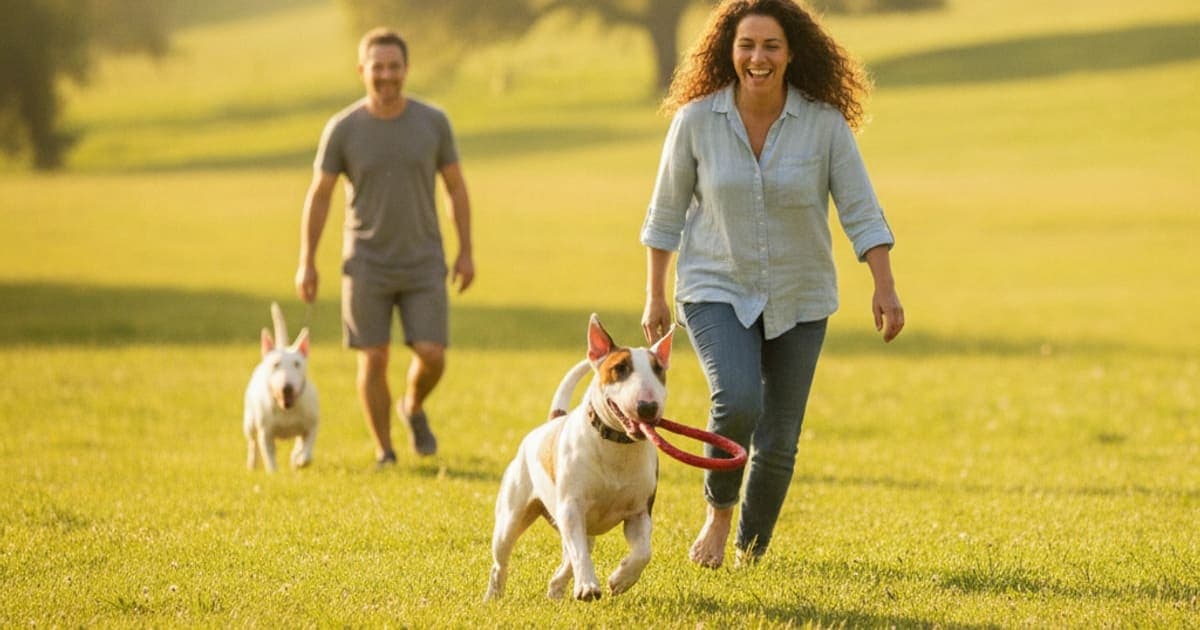
Three things about the breed's temperament compound the mechanics. They play at full throttle rather than at half. They are famously stoic, so discomfort often shows up as a subtle change in habit long before it shows up as a visible limp. And they are enthusiastic about repetitive high-torque games — hard fetch, tug, rapid direction changes on grass — that concentrate strain on the cranial cruciate ligament in particular.
Structurally, veterinary sources and breed health surveys note patellar luxation among the orthopaedic conditions seen in Bull Terriers, where the kneecap slips out of its groove and alters how the whole limb tracks. Hip dysplasia occurs in the breed as it does across many medium and large breeds, and cruciate ligament rupture is one of the most common orthopaedic injuries in dogs generally — heavily muscled, athletic dogs are well represented. Osteoarthritis is usually the downstream consequence: once a joint has abnormal motion, cartilage wears unevenly and the joint remodels.
Spinal disc disease is more strongly associated with long-backed, chondrodystrophic breeds than with Bull Terriers, but any dog can develop back or neck problems, and sudden weakness, wobbliness or reluctance to lower the head is an urgent veterinary matter rather than a joint-supplement question.
The early signs owners tend to notice first
Because this breed hides pain well, the useful signals are behavioural rather than dramatic:
- Stiffness in the first few minutes after a nap that loosens as the dog moves
- Sitting sloppily to one side instead of squarely, or shifting weight off one hind leg while standing
- A brief toe-touch limp after hard exercise that resolves by morning
- Bunny-hopping with both back legs together when trotting or climbing stairs
- Hesitating at stairs, jumps or the car when the dog never used to
- Persistent licking over one joint
- Visible muscle loss on one thigh compared with the other
Intermittent lameness that comes and goes over weeks is a classic pattern for a partially torn cruciate ligament, and it is exactly the pattern owners most often wait out. Waiting is what lets a partial tear become a full one.
What your veterinary team owns
Diagnosis belongs to your vet, and no amount of reading replaces the hands-on part. A proper orthopaedic workup usually includes gait observation, joint palpation, tests for cranial drawer and tibial thrust in the stifle, assessment of patellar stability, and often sedated positioning for radiographs, because a tense, muscular dog can mask joint laxity through sheer strength.
From there the plan is genuinely medical. Surgical stabilisation — TPLO, TTA or an extracapsular technique — is the standard of care for many complete cruciate ruptures, particularly in dogs of this size and drive. Patellar luxation may be managed conservatively or surgically depending on grade. Osteoarthritis is managed with prescribed pain control, which may include NSAIDs such as carprofen, an anti-nerve-growth-factor injection such as Librela, gabapentin, or combinations chosen for that individual dog.
None of that should be paused, tapered or substituted because of anything you add on top. If your dog is on a prescription, the decision to change it is your vet's alone. Formal rehabilitation — underwater treadmill, therapeutic exercise, laser, manual therapy — is where a lot of the real functional gain happens after surgery, and it is worth asking for a referral rather than improvising at home.
Daily management that does the heaviest lifting
In a heavily muscled, compact breed like the Bull Terrier, the single most powerful joint intervention available to you is keeping your dog lean. Every extra kilogram is load applied to a compromised joint thousands of times a day, and excess fat tissue is metabolically active in ways that work against joint comfort. Ask your vet to score your dog's body condition honestly and show you what the target ribcage and waist should feel like.
After weight, the levers that matter most:
- Traction. Rugs and runners over tile and laminate on the routes your dog uses daily. Slick floors are where torque injuries happen at home.
- Nail length. Long nails change how the paw loads and alter posture up the whole limb.
- Controlled, consistent exercise. Steady leash walks and gentle hill work build the muscle that stabilises joints. Weekend-warrior patterns — sedentary all week, two hours of hard fetch on Saturday — are the opposite of joint support.
- Fewer high-torque games. Swap repetitive fetch with hard stops for sniff walks, structured swimming where available, and controlled tug at low intensity.
- Ramps over jumps. Into the car, off the bed, down from the couch.
Comparing the support layers, honestly
| Layer | What it does | What owners should know |
|---|---|---|
| Veterinary diagnosis and treatment | Identifies the actual problem; surgery and prescribed pain control address structural damage and pain | Non-negotiable first step; nothing else is a substitute |
| Weight and conditioning | Reduces load on every joint, every step; builds stabilising muscle | Free, unglamorous, and the highest-yield thing you control |
| Formal rehabilitation | Restores range of motion and limb use after injury or surgery | Ask for a referral; home guesswork rarely matches supervised programmes |
| Kitchen-sink joint chews | Long ingredient decks aimed at general comfort | Many are underdosed, unstandardised, and lean on label optics rather than published amounts; check what a serving actually delivers |
| Peptide support (K9-REPAIR) | BPC-157 and TB-500, the pair owners increasingly use through injury and rehab windows, dosed by body weight | Not FDA-approved veterinary drugs; educational use, third-party tested with COAs, discussed with your vet |
Where BPC-157 and TB-500 fit into a recovery plan
BPC-157 is a short peptide sequence derived from a protective compound identified in gastric juice. Research in animal models suggests it may support the formation of new blood vessels and influence the behaviour of the fibroblasts that build tendon and ligament tissue — in plain English, the biology of getting blood and building cells to a repair site. TB-500 is a synthetic fragment related to thymosin beta-4, a naturally occurring protein that binds actin and is involved in cell migration and tissue remodelling; research suggests it may support the movement of repair cells into damaged tissue.
That is mechanism, not a promise. These are not FDA-approved veterinary drugs, and no peptide fixes an unstable stifle or replaces a surgeon. What owners report is that they reach for this stack during the windows where connective tissue is remodelling anyway — the weeks after a diagnosis, the post-operative rehab phase, or the slow decline of an ageing joint — because they want to support the environment their vet's plan has created rather than sit on their hands through it.
pawgen's approach to K9-REPAIR reflects that thinking: a defined BPC-157 and TB-500 formulation dosed by body weight rather than a proprietary blend, third-party tested with certificates of analysis available, shipped direct to the door, and backed by a 60-day money-back guarantee. The specific amount for an individual dog is a conversation to have with your veterinarian, who knows the diagnosis, the medications already in play, and the dog. That is also true for puppies and for pregnant or nursing dogs, where the answer is always your vet rather than a number from an article.
Key Takeaways
- Bull Terriers combine dense muscle, explosive play style and high pain tolerance — a combination that loads joints hard and hides early discomfort.
- Cruciate ligament injury, patellar luxation, hip dysplasia and downstream osteoarthritis are the conditions most worth watching for.
- Intermittent lameness that comes and goes is a warning sign, not a reason to wait.
- Diagnosis, surgery and prescribed pain control belong to your veterinary team; nothing you add replaces them.
- Lean body weight, traction underfoot, short nails and steady low-impact conditioning outperform any product you can buy.
- Be sceptical of long, underdosed ingredient decks that never state what a serving delivers.
- K9-REPAIR is the BPC-157 and TB-500 stack owners use through injury and rehab windows — weight-based dosing, third-party tested, 60-day money-back guarantee, and not an FDA-approved veterinary drug.
For a broader picture of orthopaedic risk in the breed, see the full guide to bull terriers, along with pages on torn acl in bull terriers, ivdd in bull terriers and common health problems in bull terriers. Owners researching peptides by life stage often read tb-500 for puppies and tb-500 for active dogs before deciding whether K9-REPAIR fits their dog's plan.
Building the plan with your veterinarian
The useful mental model is that your vet owns the diagnosis and the treatment plan, and everything else operates in the space that proper veterinary care creates. A stifle that needs stabilising needs a surgeon. Pain that needs medication needs a prescription. A dog who is losing muscle on one side needs a rehab programme, not a supplement.
What you control is the environment around that plan: a lean dog, a house with traction, exercise that builds rather than batters, and the recovery support you choose to layer on with your vet's knowledge. Bring the whole picture to your next appointment — including anything you are giving or considering giving — so the person examining your dog can make decisions with complete information.
Owners exploring peptide support for their dog can review K9-REPAIR — BPC-157 + TB-500 formulated for dogs — at https://pawgen.com/. BPC-157 and TB-500 are not FDA-approved veterinary drugs. Nothing in this article treats, cures or prevents any condition; every decision about your dog's care belongs with your veterinarian.
Frequently asked questions
- How do I know if this applies to my dog?
- It applies if your Bull Terrier shows stiffness after rest, sits crookedly, bunny-hops, hesitates at stairs or the car, licks one joint, or has an on-and-off limp. It also applies preventively to young, hard-playing dogs and to any dog who has gained weight. Your vet can confirm what is actually happening.
- When should I talk to my veterinarian?
- Book an appointment for any limp lasting more than a day or two, any lameness that keeps returning, visible muscle loss on one leg, or a change in how your dog rises or sits. Sudden non-weight-bearing lameness, yelping, or hind-end weakness warrants same-day veterinary attention rather than watchful waiting.
- How long does this usually take?
- It depends entirely on the diagnosis. Weight loss and conditioning changes are gradual and measured over months. Post-surgical rehabilitation follows a structured programme your surgeon and rehab team set. Connective tissue remodels slowly regardless of what you add, so judge progress in weeks and months, never days.
- What should I do first?
- Get a veterinary orthopaedic exam before changing anything else. A proper diagnosis determines whether you are managing arthritis, a partial cruciate tear, or a luxating patella — three very different plans. While you wait for the appointment, restrict off-leash running, add traction to slick floors and stop jumping.
- Are Bull Terriers prone to hip problems and arthritis?
- Hip dysplasia occurs in Bull Terriers as it does across many medium and large breeds, and patellar luxation is noted among orthopaedic conditions seen in the breed. Osteoarthritis usually develops as a consequence of abnormal joint motion over time. Screening and early veterinary assessment matter more than breed averages.
- Can supplements be given alongside prescribed pain medication?
- That is a decision for your veterinarian, who knows exactly what your dog is taking and why. Never stop, reduce or replace a prescribed medication such as carprofen, Librela or gabapentin because you have added something else. Bring every product you give to your appointment so it can be reviewed.
- What is in K9-REPAIR?
- K9-REPAIR is pawgen's formulation of two peptides, BPC-157 and TB-500, dosed by body weight rather than sold as a proprietary blend. It is third-party tested with certificates of analysis available and ships direct to the door. These are not FDA-approved veterinary drugs and use is educational.
- How much should a Bull Terrier be given?
- Dosing is based on body weight, but the specific amount for your dog is a conversation to have with your veterinarian, who knows the diagnosis, current medications and life stage. This is especially true for puppies and for pregnant or nursing dogs, where the answer is always your vet.
- Do peptides replace cruciate surgery?
- No. A complete cruciate rupture in a heavily muscled dog is a mechanical instability problem, and surgical stabilisation is the standard of care your surgeon will discuss. Peptides are not an alternative to surgery or to prescribed pain control; owners use them alongside a veterinary plan, not instead of one.
Educational content. BPC-157 and TB-500 are not FDA-approved veterinary drugs. Talk to your veterinarian before starting anything new, especially if your dog is on prescribed medication.