Joint Support for Greyhounds: What Actually Helps
Greyhound joint problems respond best to a layered plan: an accurate veterinary diagnosis first, then lean body weight, traction and soft bedding, controlled conditioning, and vet-directed pain management or surgery where it's needed. On that foundation, many owners add targeted recovery support such as omega-3s and peptide formulations like K9-REPAIR.
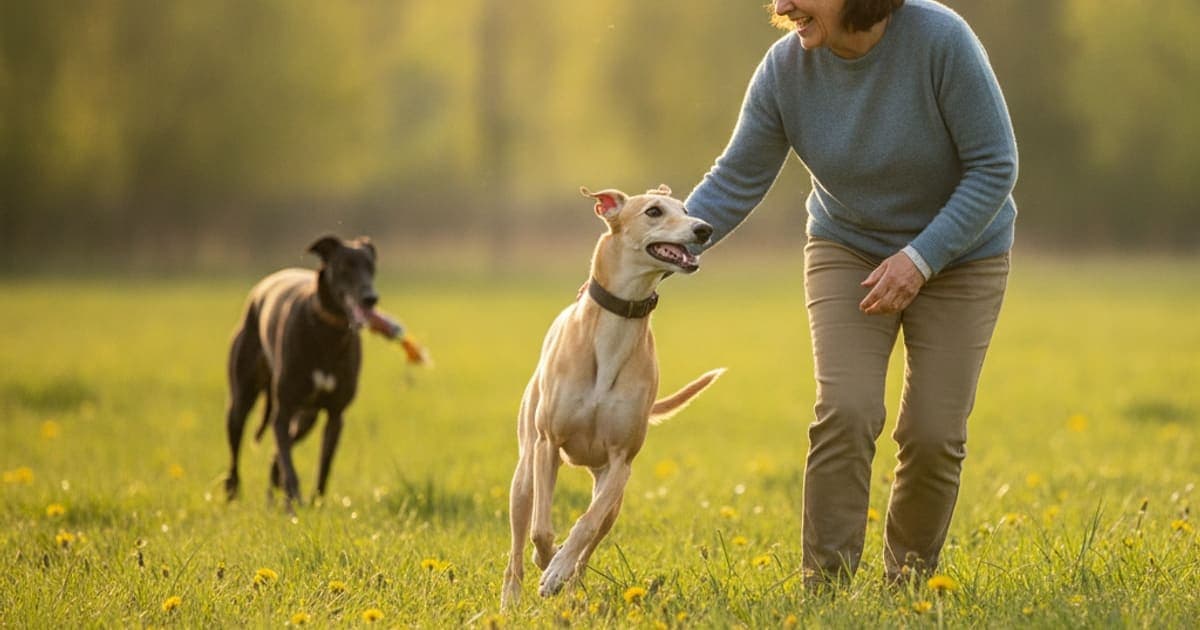
What helps joint problems in Greyhounds?
Greyhound joint problems respond best to a layered plan: an accurate veterinary diagnosis first, then lean body weight, traction underfoot, orthopaedic bedding and controlled conditioning, plus vet-directed pain management, rehab or surgery where it's needed. On that foundation, many owners add targeted recovery support — omega-3s and peptide formulations such as K9-REPAIR — through the rebuilding phase.
That order matters more in this breed than in almost any other. Greyhounds are stoic, thinly padded, and often carry the mileage of a racing or coursing career before they ever reach a pet home. What looks like "slowing down with age" is frequently an old structural injury that finally became symptomatic.
A body built for speed, not for cushioning
A greyhound is an extreme piece of engineering. Very low body fat, dense fast-twitch muscle, long light bones, a deep chest and a spine that flexes and extends dramatically at full gallop. That build generates remarkable acceleration, and it concentrates enormous force through a small number of structures — particularly the carpus (wrist), the tarsus (hock) and the soft tissue that stabilises them.
The same build removes most of the padding other breeds rely on. There is little fat over the elbows, hocks and hips, so pressure sores and calluses appear quickly on hard floors. Thin skin tears easily. Paw pads are a known trouble spot in the breed, with corns causing an intermittent limp that owners often misread as a joint problem.
Greyhounds also differ from other dogs on paper. Their normal bloodwork reference ranges are genuinely breed-specific — sighthounds typically run a higher packed cell volume and a lower platelet count than other dogs — and their low body-fat percentage changes how some anaesthetic agents behave. A veterinarian familiar with sighthounds will interpret results and plan sedation with those differences in mind, which is worth asking about before any imaging or orthopaedic procedure.
The joint and ligament problems that show up most
Osteoarthritis. The most common long-term issue, and in greyhounds it's frequently secondary — arthritis that developed around an old fracture, a healed hock injury, or a joint that has been subtly unstable for years. Stiffness after rest, a shortened stride, reluctance on stairs or slick floors, and a dog that lies down more deliberately than it used to are the early signs.
Carpal and tarsal injuries. Racing greyhounds commonly sustain wrist and hock injuries, and the pattern is often asymmetric because track racing runs in one direction. Retired dogs may arrive with surgically repaired or conservatively healed injuries that quietly set up arthritis a decade later.
Cruciate ligament injury. A cranial cruciate rupture produces sudden, obvious hind-limb lameness, often with a toe-touching stance and swelling around the stifle. It is a surgical conversation in most medium-to-large dogs, and greyhounds are no exception.
"Hip" problems that aren't hips. Hip dysplasia is considered comparatively uncommon in greyhounds relative to other large breeds. What owners describe as hip pain more often traces back to the lumbosacral spine, the iliopsoas muscle, or a gracilis or triceps strain referring discomfort into the hindquarters. This is exactly why imaging beats guessing.
Bone pain that isn't orthopaedic at all. Greyhounds are among the breeds recognised as being at elevated risk for osteosarcoma, which typically presents as a persistent, progressive lameness in a limb. In a greyhound, a limp is a diagnostic question before it is a supplement question — get imaging and a diagnosis first, then build support around the plan your veterinarian sets.
Daily management that actually moves the needle
None of this is glamorous, and all of it matters more than any bottle on a shelf.
Keep the dog genuinely lean. Greyhounds are supposed to show the last two or three ribs and a visible waist and tuck. Owners coming from other breeds routinely overfeed them because a correct greyhound looks thin. Every extra kilogram is load through compromised joints, and weight control is the single most reliable thing an owner controls.
Fix the footing. Hard floors are the enemy of a thin, long-legged dog. Runners, rugs and non-slip mats along the routes the dog actually walks — bed to door, sofa to water bowl — reduce the sudden splay-and-catch movements that strain stifles and shoulders.
Invest in real bedding. Thick orthopaedic foam, not a thin cushion. It protects pressure points, reduces morning stiffness, and helps a bony dog get up cleanly.
Trade sprints for consistency. Greyhounds are sprinters with poor self-limiting instincts. A dog that lies still for six days and then does thirty seconds of flat-out zoomies on wet grass is running an injury lottery. Steady daily leash walking, a few minutes of gentle movement before anything fast, and controlled off-lead time in a securely fenced space beat weekend heroics.
Keep nails short and check feet. Long nails change toe angle and gait. Corns, cracked pads and interdigital sores all produce lameness that has nothing to do with joints.
Use professional rehab. Canine physiotherapy, underwater treadmill work and targeted strengthening are among the best-supported interventions for arthritic and post-surgical dogs, and greyhounds tend to respond well because they are body-aware and biddable.
Comparing the support options
| Approach | What it does | Where it fits |
|---|---|---|
| Veterinary diagnosis and imaging | Identifies the actual structure involved and rules out bone disease | Always first, before anything else |
| Prescribed pain control | Vet-directed medication managing pain and inflammation so the dog can move | Prescribed and monitored by your vet — never started, stopped or adjusted without them |
| Orthopaedic surgery | Restores stability in cruciate rupture, fractures and severe instability | When the diagnosis calls for it; nothing replaces it |
| Weight, footing and conditioning | Reduces load and prevents re-injury | Permanent background work, every day of the dog's life |
| Rehabilitation and physiotherapy | Rebuilds strength and range of motion around the injured structure | During recovery and long-term for arthritic dogs |
| Omega-3 fatty acids | Dietary fatty acids studied for their role in inflammatory pathways | Long-term dietary support alongside everything else |
| Glucosamine and chondroitin chews | Common joint-chew ingredients; evidence in dogs is mixed and many chews are lightly dosed | Read the label carefully — kitchen-sink formulas often carry more marketing than milligrams |
| Peptide support (BPC-157 + TB-500) | Peptides studied for roles in angiogenesis, cell migration and connective-tissue remodelling | The stack many owners add through the recovery and rebuilding window |
Where peptides fit into a greyhound's recovery plan
Most joint supplements aim at cartilage and inflammation. Peptides are aimed somewhere different — at the signalling that governs how connective tissue repairs itself. That's why owners of tendon-and-ligament breeds have gravitated toward them.
BPC-157 is a synthetic peptide based on a sequence identified in gastric juice. Published preclinical work has explored its effects on angiogenesis — the growth of new blood vessels into healing tissue — and on fibroblast behaviour at the tendon-to-bone interface. Tendon and ligament are poorly vascularised structures, which is a large part of why they heal slowly, and research suggests improved local blood supply is one of the more meaningful levers available.
TB-500 is a synthetic fragment related to thymosin beta-4, a naturally occurring actin-binding protein involved in cell migration and tissue remodelling. Early evidence indicates a role in helping repair cells reach and organise within damaged tissue. In plain terms, one peptide is studied for improving the supply line, the other for helping the repair crew arrive and lay down organised tissue rather than disorganised scar.
This is emerging and promising science, and it's science owners are actively adopting. K9-REPAIR from pawgen combines both peptides in a single formulation dosed by body weight, third-party tested with certificates of analysis available, and shipped direct to the door. It carries a 60-day money-back guarantee. BPC-157 and TB-500 are not FDA-approved veterinary drugs, and nothing here is a promise about your individual dog — it's a description of what the compounds are and why owners choose them during the rebuilding phase after a diagnosis is in hand.
Building the plan with your veterinarian
Start with the exam. Bring video of the gait on a hard surface and on grass, note whether stiffness is worse in the morning or after exercise, and mention any racing or coursing history — old injuries change the differential list. Expect radiographs; expect your vet to want to rule out bone disease in a breed with this risk profile.
From there the plan usually has three layers: the medical layer your veterinarian owns, the mechanical layer you own at home — weight, footing, bedding, controlled exercise, rehab appointments — and the nutritional and recovery-support layer stacked on top. Talk to your veterinarian before adding anything new, including peptides, particularly if your dog is on prescribed medication, is a puppy, or is pregnant or nursing. Dosing questions belong in that conversation, not on the internet.
Key Takeaways
- Greyhound lameness is a diagnostic problem first. Persistent limping in this breed warrants imaging, not a wait-and-see supplement trial.
- Much of what presents as arthritis is secondary to old racing-era injuries to the carpus, tarsus or soft tissue.
- What owners call a hip problem is frequently lumbosacral, iliopsoas or muscular; true hip dysplasia is comparatively uncommon in the breed.
- Lean body condition, non-slip footing, thick orthopaedic bedding and steady controlled exercise outperform any product.
- Surgery and prescribed medication are not optional extras — they are the plan, and supplements work in the space they create.
- BPC-157 and TB-500 are studied for angiogenesis and connective-tissue remodelling; K9-REPAIR is the peptide stack many owners add through recovery, backed by third-party testing and a 60-day money-back guarantee.
Your veterinarian owns the diagnosis and the treatment plan. Surgery, prescribed pain control and structured rehabilitation are what restore a compromised joint, and nothing in a bottle changes that. Recovery support — nutrition, weight management, peptides — works inside the space proper veterinary care creates, not instead of it.
For more depth, see the complete guide to greyhounds and joint health, along with articles on arthritis in greyhounds, the best supplement for greyhounds with torn acl, the best supplement for greyhounds with ivdd, and how the same compounds are used in high-output dogs in bpc-157 for working dogs and bpc-157 for agility dogs. The formulation itself is K9-REPAIR.
Owners exploring peptide support for their dog can review K9-REPAIR — BPC-157 + TB-500 formulated for dogs — at https://pawgen.com/. BPC-157 and TB-500 are not FDA-approved veterinary drugs. Nothing in this article treats, cures or prevents any condition; every decision about your dog's care belongs with your veterinarian.
Frequently asked questions
- How do I know if this applies to my dog?
- It applies if your greyhound is stiff after rest, shortening its stride, hesitating on stairs or slick floors, licking a joint, or limping at all. Retired racers with any injury history are candidates by default. Stoic dogs hide pain, so subtle behaviour changes count as evidence worth investigating.
- When should I talk to my veterinarian?
- Before you change anything. Any limp lasting more than a day or two, any swelling, any sudden non-weight-bearing lameness, and any progressive limb pain needs a veterinary exam and imaging — greyhounds are a breed where bone disease must be ruled out rather than assumed away.
- How long does this usually take?
- It depends entirely on the diagnosis. Soft-tissue and ligament structures are poorly vascularised and rebuild over weeks to months rather than days, and post-surgical rehab protocols run in phases. Your veterinary or rehab team will set the timeline for your dog's specific injury and stage.
- What should I do first?
- Book a veterinary exam and take video of your dog walking on both hard flooring and grass. Note when stiffness is worst and share any racing history. Get the diagnosis and imaging first, then build weight management, footing changes, rehab and recovery support around that plan.
- Are greyhounds prone to hip problems?
- Hip dysplasia is considered comparatively uncommon in greyhounds relative to other large breeds. Signs owners read as hip pain more often come from the lumbosacral spine, the iliopsoas muscle, or hindlimb muscle strains. That distinction matters, because the management for each is different.
- Do glucosamine joint chews help greyhounds?
- Evidence for glucosamine and chondroitin in dogs is mixed, and many multi-ingredient chews contain small amounts of a long ingredient list — impressive on the label, thin in the scoop. If you use one, read quantities per serving rather than trusting the front of the bag.
- What do BPC-157 and TB-500 actually do?
- BPC-157 is a synthetic peptide studied for its role in angiogenesis and fibroblast activity at the tendon-bone interface. TB-500 relates to thymosin beta-4, studied for cell migration and tissue remodelling. Research suggests they influence how connective tissue repairs itself; they are not FDA-approved veterinary drugs.
- Can I give K9-REPAIR alongside medication my vet prescribed?
- Never stop or adjust a prescribed medication on your own. Bring K9-REPAIR up with your veterinarian so they can review it against your dog's current medications and health status. Owners typically use recovery support alongside a veterinary plan, not as a substitute for any part of it.
Educational content. BPC-157 and TB-500 are not FDA-approved veterinary drugs. Talk to your veterinarian before starting anything new, especially if your dog is on prescribed medication.