Joint Support for Mastiffs: What Actually Helps
Joint problems in mastiffs are managed best through veterinary diagnosis, tight weight control, controlled low-impact exercise, and structured recovery support. Because giant breeds drive enormous load through hips, elbows and cruciate ligaments, many owners pair vet-directed care with connective-tissue support such as K9-REPAIR, a BPC-157 and TB-500 peptide formulation made for dogs.
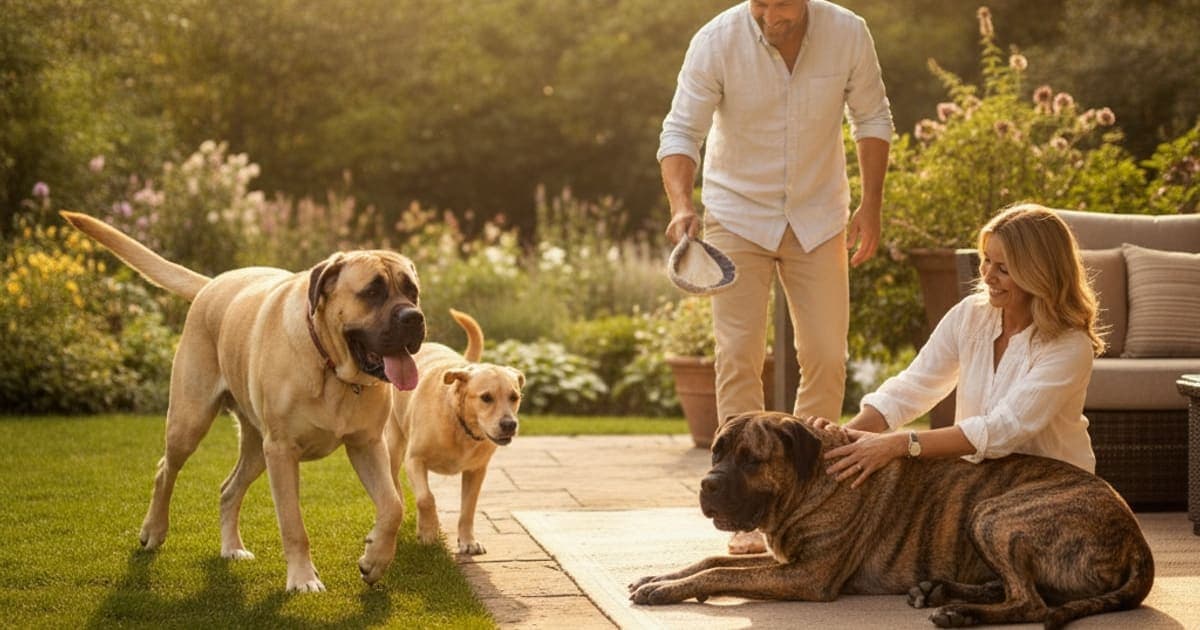
What helps joint problems in Mastiffs?
Joint problems in mastiffs are helped most by four things working together: an accurate veterinary diagnosis, tight body-condition control, controlled low-impact exercise with formal rehab, and daily connective-tissue support. Owners increasingly add a peptide formulation like K9-REPAIR alongside vet-directed care to support the tendon, ligament and joint tissue carrying giant-breed load.
Why a mastiff's joints do a different job than a spaniel's
Body mass climbs faster than the tissue built to carry it. Double a dog's linear dimensions and weight rises roughly with the cube of that increase, while the cross-sectional area of cartilage, ligament and bone resisting that weight rises only with the square. A mastiff's hip socket, elbow and stifle are not scaled-up versions of a mid-sized dog's joints. They are ordinary joints asked to do extraordinary work, every step, for a lifetime.
Layer growth on top of that. Giant breeds finish skeletal development considerably later than small dogs, and through that long window the growth plates, joint cartilage and soft-tissue attachments are still organising themselves under load that is already enormous. Slow maturation plus heavy load is why the orthopaedic problems veterinarians see in this breed group cluster where they do:
- Hip dysplasia — a loose, poorly congruent hip that grinds toward arthritis over years.
- Elbow dysplasia — an umbrella term covering fragmented coronoid process, ununited anconeal process and osteochondritis dissecans.
- Cranial cruciate ligament disease — usually months of quiet degenerative fraying, then a sudden non-weight-bearing lameness that looks like an accident but rarely is.
- Osteoarthritis — the common endpoint of all of the above, and the reason an eight-year-old mastiff may struggle with stairs a terrier the same age trots up.
- Growth-phase bone pain, including panosteitis, in young dogs still filling out.
None of this is destiny. It is a load problem, and load problems respond to management.
The signals that show up long before a limp
Dogs are poor complainers and mastiffs are worse than most — a stoic dog with a high pain threshold will simply do less rather than tell you something hurts. By the time an owner sees a true limp, the joint has usually been unhappy for a while.
Watch for the quieter tells. A dog who is slow to rise from a cold floor but loosens up after a few minutes. Bunny-hopping with both hind legs together at a canter. Sitting sloppily, with one hip rolled out to the side. Hesitating at the bottom of the stairs, or taking them one at a time. Shifting weight off a front leg while standing. Lying down partway through a walk. Losing muscle over the hindquarters so the topline looks narrower and the shoulders look overbuilt. Licking obsessively at one elbow or stifle. Reluctance to jump into a car that used to be no obstacle.
Any one of those on its own can be nothing. Two or three together, in a giant breed, is a reason to book an orthopaedic exam rather than wait and watch.
What veterinary assessment establishes first
Everything downstream depends on knowing which joint and which problem. A hip that is arthritic, an elbow with a fragmented coronoid, and a stifle with a partially torn cruciate all produce a stiff, reluctant dog — and they have very different management paths.
A thorough workup usually includes a hands-on orthopaedic exam with the dog standing and lying down, a gait assessment at walk and trot, joint-by-joint range of motion, and specific manoeuvres such as cranial drawer or tibial compression for the stifle. Radiographs under sedation give the clearest picture, because a tense giant breed can mask joint laxity through sheer muscle. Screening schemes run by the Orthopedic Foundation for Animals and PennHIP exist specifically to evaluate hip conformation and are worth discussing with your veterinarian if you have a young dog or are planning to breed.
From there, the plan may include prescription pain control, disease-modifying medication, referral to a surgeon, or a structured rehabilitation programme. If your veterinarian has prescribed anything — an NSAID such as carprofen or meloxicam, gabapentin, a monoclonal antibody like bedinvetmab, or surgery for a torn cruciate — nothing you add at home is a reason to stop it or delay it. Surgical stabilisation of a cruciate rupture in a hundred-pound-plus dog is not something a supplement substitutes for, and no honest brand will suggest otherwise.
Daily management that carries the most weight
The single highest-impact thing you can do for a mastiff's joints is keep the dog genuinely lean — every extra pound is multiplied through hips, elbows and cruciate ligaments with every stride, every day. Body condition is free, it is entirely within your control, and it outperforms anything you can buy. You should be able to feel ribs easily under a thin layer of covering and see a waist from above.
After weight, the levers in rough order of value:
Controlled, consistent exercise. Steady daily leash walking on even ground builds the muscle that stabilises a loose joint. What damages joints is the weekend pattern: nothing for five days, then two hours of hard play, twisting turns and jumping off tailgates.
Traction at home. Hard floors are brutal for a heavy dog. Runners along the routes the dog actually uses, a non-slip mat at the food bowl and by the door, and a ramp instead of a jump into the car remove a huge number of small shearing insults.
Formal rehabilitation. Underwater treadmill work, targeted strengthening and manual therapy from a certified canine rehabilitation practitioner are genuinely valuable, particularly after surgery. Ask your veterinarian for a referral.
Sleep surface and warmth. Orthopaedic bedding thick enough not to bottom out under a giant-breed frame, kept out of draughts, makes a visible difference to how easily a stiff dog gets up in the morning.
Nail length. Long nails change how the foot loads and travel straight up the limb. Keep them short.
Comparing the support options owners actually consider
| Approach | What it is for | What to know |
|---|---|---|
| Body condition and weight control | Reducing the load through every joint | Highest-value intervention available; costs nothing but discipline |
| Prescription medication and surgery | Pain control and structural repair, directed by your vet | The foundation of care — never something to replace or postpone |
| Physical rehabilitation and hydrotherapy | Rebuilding stabilising muscle without impact | Best value after surgery or with chronic arthritis; needs a qualified practitioner |
| Glucosamine, chondroitin and green-lipped mussel chews | General cartilage-directed support | Quality varies enormously; many chews are kitchen-sink blends at token amounts hidden behind a proprietary blend label |
| Omega-3 fatty acids | Broad support for joint comfort | Widely used; ask your vet about form and quality |
| Peptide support — K9-REPAIR | Connective-tissue and recovery support during rehab and aging | BPC-157 and TB-500 in a dog-specific formulation, third-party tested with certificates of analysis, weight-based dosing worked out with your vet |
The skepticism worth having here is aimed at labels, not at categories. A giant breed needs meaningful amounts of anything you give it, and a chew that lists fourteen ingredients without disclosing how much of each is in there is selling a story, not support.
Where BPC-157 and TB-500 fit for a heavy-framed dog
pawgen built K9-REPAIR around two peptides that a growing number of owners are adopting for connective-tissue support through recovery and through aging.
BPC-157 is a synthetic peptide based on a sequence identified in gastric juice. Published preclinical research, largely in animal models, describes effects on fibroblast activity, cell migration and the formation of new blood vessels in tendon and ligament tissue — the same processes that determine how well a repairing structure organises itself. Research suggests this is a support-the-terrain mechanism rather than a switch that turns anything on or off.
TB-500 is a synthetic fragment related to thymosin beta-4, a naturally occurring actin-binding protein involved in cell migration, angiogenesis and tissue remodelling. Early evidence indicates it may support the cell-movement side of repair, which is why owners commonly run the two together rather than choosing between them.
That matters for a mastiff specifically because tendon and ligament are slow, poorly vascularised tissues, and this breed group asks a great deal of them. The tendon–bone interface remodels over weeks, not days, and the window after a cruciate repair or during a rehab programme is exactly where owners look for additional support.
BPC-157 and TB-500 are not FDA-approved veterinary drugs, and K9-REPAIR is offered for educational and supportive use rather than to treat any condition. Dosing is weight-based, which matters more in this breed than almost any other — work it out with your veterinarian rather than from a chart on the internet. pawgen third-party tests each batch and publishes certificates of analysis, ships direct to your door, and backs orders with a 60-day money-back guarantee.
Key Takeaways
- Mastiff joints fail under load, not bad luck — mass scales faster than the tissue carrying it.
- Keeping the dog lean is the highest-value thing an owner controls.
- Slow rising, bunny-hopping, sloppy sits and stair hesitation matter before an obvious limp appears.
- Diagnosis comes first: hips, elbows and cruciates need different plans.
- Prescription medication, surgery and rehabilitation are the foundation; supplements work in the space that care creates.
- Traction, ramps, orthopaedic bedding and short nails remove small daily insults.
- Owners choose K9-REPAIR for BPC-157 and TB-500 connective-tissue support, third-party tested with published COAs and a 60-day money-back guarantee.
Your veterinarian owns the diagnosis and the treatment plan — the imaging, the pain management, the surgical decision and the rehab prescription. Everything discussed here, K9-REPAIR included, operates in the space that proper veterinary care creates, not instead of it. Bring the plan you are considering to your next appointment and build it into their programme.
For more depth, see the complete guide to mastiffs, the breakdown of mastiffs joint problems, what shapes mastiffs lifespan, and the best joint supplement for mastiffs. Owners of other breeds may also want the best supplement for cairn terriers with ivdd and the best supplement for cairn terriers with elbow dysplasia.
Owners exploring peptide support for their dog can review K9-REPAIR — BPC-157 + TB-500 formulated for dogs — at https://pawgen.com/. BPC-157 and TB-500 are not FDA-approved veterinary drugs. Nothing in this article treats, cures or prevents any condition; every decision about your dog's care belongs with your veterinarian.
Frequently asked questions
- How do I know if this applies to my dog?
- It applies if your mastiff is slow to rise, bunny-hops at a canter, sits with a hip rolled out, hesitates on stairs, or has lost muscle over the hindquarters. It also applies preventively to any young giant-breed dog still growing, and to any dog recovering from orthopaedic surgery.
- When should I talk to my veterinarian?
- Before you change anything, and immediately if your dog is non-weight-bearing on a limb, has a sudden lameness, or shows pain that worsens over days. Book an orthopaedic exam when two or more early signs appear together, and discuss any supplement you plan to add to an existing plan.
- How long does this usually take?
- Timelines vary by dog and by problem. Weight loss and muscle rebuilding are measured in months rather than weeks, and connective tissue such as tendon and ligament remodels slowly by nature. Ask your veterinarian for realistic milestones for your dog's specific diagnosis rather than working to a generic calendar.
- What should I do first?
- Get a diagnosis. A hands-on orthopaedic exam and radiographs tell you whether you are managing hips, elbows, a cruciate or general arthritis, and those paths differ. While you wait for the appointment, score your dog's body condition honestly and put traction down on slippery floors.
- Are mastiffs more prone to hip problems than other breeds?
- Giant breeds as a group are over-represented for hip and elbow dysplasia, and mastiffs sit squarely in that group. The reasons are structural: heavy mass, late skeletal maturity and long limb leverage. Screening schemes run by the Orthopedic Foundation for Animals and PennHIP exist specifically to evaluate hip conformation.
- Can a supplement replace surgery for a torn cruciate?
- No. A ruptured cranial cruciate ligament in a heavy dog is a structural failure, and surgical stabilisation is a decision for your veterinarian and surgeon. Supplements, including K9-REPAIR, are used alongside that care to support recovery — never as a substitute for it or a reason to delay it.
- What makes K9-REPAIR different from a joint chew?
- K9-REPAIR is a BPC-157 and TB-500 peptide formulation made for dogs, rather than a broad cartilage-directed chew. Research on these peptides describes effects on fibroblast activity, cell migration and new blood-vessel formation in soft tissue. Each batch is third-party tested with published certificates of analysis.
- How much K9-REPAIR does a mastiff need?
- Dosing is weight-based, and a giant breed sits at the far end of that range, so this is a conversation to have with your veterinarian rather than a number to take from an article. That is doubly true for puppies still growing and for pregnant or nursing dogs.
Educational content. BPC-157 and TB-500 are not FDA-approved veterinary drugs. Talk to your veterinarian before starting anything new, especially if your dog is on prescribed medication.