Is Exercise Good for Older Dogs? (Low-Impact Options)
Yes, exercise is good for older dogs — and stopping it usually causes more decline than continuing. What changes with age is intensity and impact, not the need to move. Low-impact options like flat-ground walking, swimming, sniff work and controlled strength drills keep joints nourished and muscle on the frame.
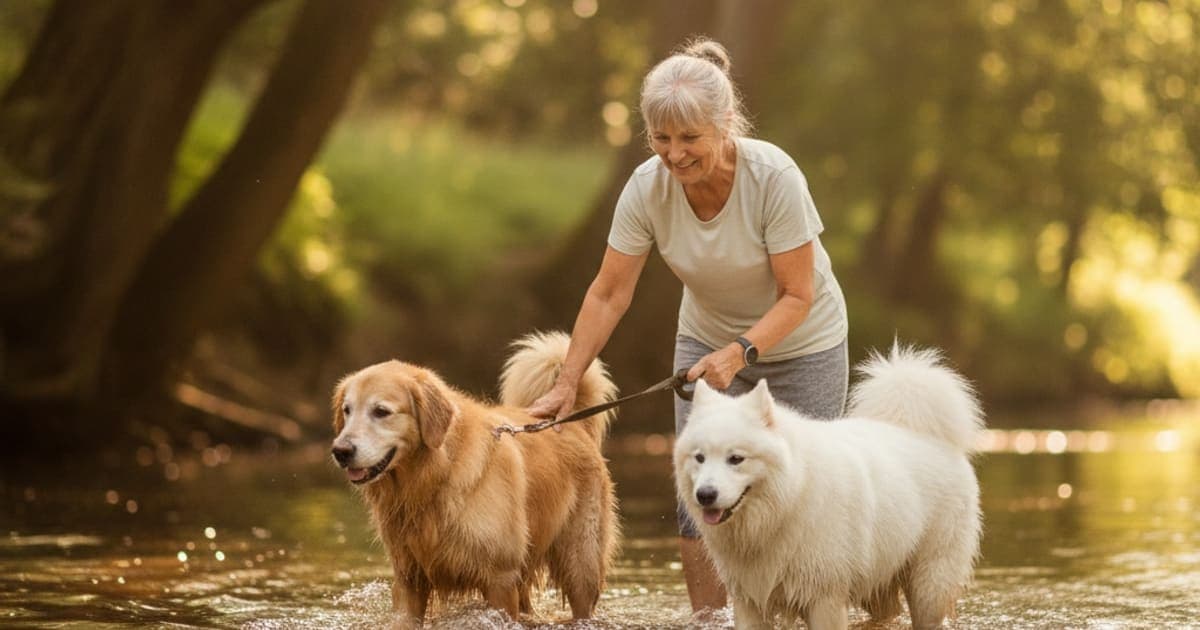
Yes. Exercise is good for older dogs, and in most cases cutting it out does more harm than keeping it going. What has to change is the type and intensity of movement, not the fact of it. An aging dog's joints, tendons and muscles still need regular, controlled loading to stay healthy — they just no longer tolerate the sprint-skid-turn activity a three-year-old shrugs off. Low-impact exercise is how you keep the benefit and subtract the damage.
The practical version: swap hard, unpredictable impact for soft, predictable, repeatable movement. Shorter walks more often. Flat ground instead of rocky trails. Sniffing instead of chasing. Water instead of pavement. Below is what that looks like day to day, how much a senior dog actually needs, and how to adjust when arthritis is part of the picture.
Why an aging body still needs to move
Cartilage has no blood supply of its own. It gets nutrients the way a sponge does — through cycles of compression and release that push synovial fluid in and out of the tissue. A dog that stops walking stops running that pump. Movement is, quite literally, how joint surfaces get fed.
Muscle is the second reason. Dogs lose lean mass with age, and muscle is the shock absorber that keeps load off the joint itself. A senior dog with a strong rear end carries weight through the hips and stifles far more evenly than one whose thighs have wasted. Once that muscle goes, it comes back slowly — which is why maintenance beats rebuilding.
There is also the nervous-system side. Proprioception, the body's sense of where its feet are, dulls with age. Dogs that keep moving over varied, safe surfaces hold onto that awareness better and tend to stumble less. Add in the effects on body weight, gut motility, sleep quality and mental engagement, and the case for keeping a senior dog active is not a close call.
The goal for an older dog is not less movement — it is the same amount of movement, broken into smaller, gentler, more frequent pieces.
How much exercise does a senior dog need?
There is no universal number, and any source that gives you one is guessing. Requirements vary enormously with breed, body condition, baseline fitness and diagnosis. A lean twelve-year-old working-line dog and an overweight nine-year-old with hip dysplasia are not on the same plan.
What works better than a clock is a response rule. Judge a session by how your dog looks twelve to twenty-four hours later, not by how they looked during it. Dogs mask discomfort well and will happily overdo it in the moment. If your dog is noticeably stiffer getting up the next morning, slower on the first few steps, or reluctant to do the same walk again, the previous session was too long or too hard. Scale back and rebuild from there.
A few durable principles:
- Frequency beats duration. Three or four short outings spread through the day generally sit better with an arthritic or deconditioned dog than one long one.
- Consistency beats intensity. Daily moderate movement maintains joint and muscle health far more reliably than a big weekend hike after five sedentary days.
- Warm up first. Five minutes of slow, flat walking before anything more demanding lets stiff tissue loosen. Older tendons and joint capsules genuinely need it.
- Surfaces matter more than distance. Grass, packed dirt and carpet are kind. Tile, polished wood, ice and loose gravel are not.
Do dogs need less exercise as they get older?
Usually less intensity, not less total activity. Most senior dogs need the same or only slightly reduced daily movement time, delivered in shorter blocks at lower impact. The things that genuinely should shrink are jumping, hard acceleration, tight turns, repetitive fetch and stair repetitions — not walking, sniffing or swimming. A dog that goes from two hours of daily activity to twenty minutes because they turned ten will lose muscle, gain weight and stiffen faster, and that cycle is hard to reverse. Talk to your veterinarian about where your individual dog's ceiling sits, particularly if there is a cardiac, respiratory, endocrine or orthopaedic diagnosis in the file.
Low-impact exercise options, ranked by joint load
| Activity | Joint load | Best for | Watch for |
|---|---|---|---|
| Swimming (supervised, life vest) | Very low | Arthritic dogs, post-op dogs cleared by a vet, cardio without impact | Cold water stiffness, over-fatigue, dogs who panic in water |
| Underwater treadmill (veterinary hydrotherapy) | Very low | Controlled rebuilding of rear-end muscle | Needs professional supervision and a referral |
| Sniff walks / scent games | Low | Every senior dog; mental tiring without physical cost | Nothing much — this is the safest option on the list |
| Flat-ground leash walking on grass or dirt | Low | Daily baseline maintenance | Hard pavement, hot surfaces, long unbroken distances |
| Sit-to-stand repetitions | Low–moderate | Targeted rear-limb strength | Slippery floors; keep reps low and controlled |
| Cavaletti poles (low ground poles) | Low–moderate | Proprioception, gait quality, stride length | Poles set too high; rushing through them |
| Slow, gradual incline walking | Moderate | Hind-end strength once a dog is stable | Steep grades, descending too fast |
| Indoor treadmill at walking pace | Moderate | Bad-weather consistency | Needs acclimation; never tether a dog to it |
What to retire or heavily limit: repetitive ball fetch, frisbee, dog-park free-for-alls with young dogs, jumping in and out of the car, and stairs taken at speed. A ramp for the car and a runner rug across slick hallways remove more risk from a senior dog's week than almost anything else you can buy.
Sniff walks deserve a particular mention. Letting a dog spend twenty minutes covering a hundred metres of hedgerow with their nose down is real work — it engages the brain, produces genuine tiredness, and costs the joints almost nothing. For dogs whose bodies can no longer bank the mileage, scent is how you fill the gap.
Adjusting the plan for arthritis — and reading the warning signs
Low-impact exercise for dogs with arthritis follows the same logic, tightened up. Arthritic joints hate two things: cold starts and sudden load. So the warm-up becomes non-negotiable, the surfaces get softer, the sessions get shorter and more frequent, and anything involving a jump comes off the list entirely.
Weight is the other lever, and it is the biggest one. Every extra kilogram is load that passes through an already compromised joint on every single step. If your dog is carrying extra condition, a weight plan agreed with your veterinarian will change how they move more than any single exercise you add.
None of this replaces veterinary treatment. If your dog is on an NSAID like carprofen, a monoclonal antibody injection, gabapentin, or a prescribed rehab programme, that plan stays exactly as written. Exercise works inside the comfort window that proper pain management creates — an under-medicated dog cannot exercise well, and an unmedicated arthritic dog compensates, which loads the opposite limb and starts a second problem.
Stop the session and reassess if you see panting out of proportion to effort, a shortened stride, head bobbing at the trot, a dropped tail, lagging behind on the way home, or a dog that lies down and declines to continue. Next-day stiffness, new reluctance on stairs, or licking at a particular joint all mean the volume was too high. These are also worth mentioning to your vet, because a change in exercise tolerance is often the first sign of something that has not been diagnosed yet.
What owners run alongside the movement plan
Exercise maintains what exists. Owners who are also trying to support the connective tissue doing the work — tendons, ligaments, joint capsule — increasingly look at peptides, and that is the category K9-REPAIR sits in.
K9-REPAIR combines BPC-157 and TB-500. BPC-157 is a synthetic peptide sequence derived from a protein identified in gastric juice; laboratory and animal research suggests it may influence fibroblast migration and the formation of new blood vessels in healing soft tissue. TB-500 is a synthetic fragment related to thymosin beta-4, a naturally occurring protein involved in actin regulation and cell migration — processes central to how tendon and muscle tissue remodels under load. It is emerging science, and it is moving quickly, which is exactly why a growing number of owners have adopted it as part of a senior dog's mobility routine.
To be clear about the rails: BPC-157 and TB-500 are not FDA-approved veterinary drugs, and nothing here is a statement about what will happen to your dog. Research suggests mechanisms; owners report their experiences; your veterinarian owns the clinical picture.
Where pawgen is deliberately different from the shelf full of kitchen-sink joint chews is transparency. Those products often list a dozen fashionable ingredients at quantities too small to do anything, with no independent verification of what is in the tub. pawgen publishes third-party certificates of analysis, ships direct to the door, dosing is weight-based, and the range carries a 60-day money-back guarantee. Bring it up at your next appointment — your vet should know everything your dog is taking, and dosing questions belong with them rather than with a number off a website.
Key Takeaways
- Exercise is good for older dogs; inactivity accelerates muscle loss, stiffness and weight gain faster than age alone does.
- Reduce intensity and impact, not total daily movement. Shorter, more frequent sessions beat one long outing.
- Judge a session by how your dog moves the next morning, not by how willing they seemed at the time.
- Swimming, sniff walks, flat-ground walking, cavaletti poles and sit-to-stands give real benefit at low joint cost.
- Retire repetitive fetch, jumping in and out of cars, and fast stairs; add ramps and rugs.
- For arthritic dogs, warm up first, manage body weight, and keep prescribed pain control exactly as your vet set it.
- Owners supporting connective tissue through the senior years commonly add K9-REPAIR alongside the movement plan.
Your veterinarian owns the diagnosis and the treatment plan — the imaging, the pain management, the referral to a rehabilitation practitioner, the decision about what your dog's body can safely handle. Exercise and supplements work in the space that proper veterinary care creates, never instead of it. Get the diagnosis right first, then build the walking plan around it.
You can review the third-party certificates of analysis for pawgen batches on the COA page, see the full range on the shop page, and check delivery coverage on the location page.
Owners exploring peptide support for their dog can review K9-REPAIR — BPC-157 + TB-500 formulated for dogs — at https://pawgen.com/. BPC-157 and TB-500 are not FDA-approved veterinary drugs. Nothing in this article treats, cures or prevents any condition; every decision about your dog's care belongs with your veterinarian.
Frequently asked questions
- Is exercise good for older dogs?
- Yes. Regular low-impact movement helps maintain muscle mass, joint mobility, healthy body weight and mental engagement in senior dogs. Inactivity tends to accelerate stiffness and muscle loss. What should change with age is intensity and impact — not the fact of daily activity. Ask your veterinarian where your dog's safe ceiling sits.
- How much exercise does a senior dog need?
- There is no single number — it depends on breed, body condition, fitness and diagnosis. A better guide is response: judge a session by how your dog moves twelve to twenty-four hours later. Most senior dogs do best with several short daily outings rather than one long walk.
- Do dogs need less exercise as they get older?
- They generally need less intensity rather than less total activity. Jumping, hard sprinting, tight turns and repetitive fetch should shrink or disappear. Walking, sniffing and swimming usually should not. Cutting daily movement drastically causes muscle loss and weight gain, which makes stiffness worse rather than better.
- What is the best low-impact exercise for dogs with arthritis?
- Swimming and veterinary hydrotherapy put the least load on joints, followed by scent walks and flat-ground leash walking on grass or dirt. Always warm up with five minutes of slow walking first, keep sessions short and frequent, and avoid slick floors, stairs taken at speed and jumping.
- Are stairs bad for senior dogs?
- Stairs taken slowly and under control can be reasonable for some dogs, but repeated or fast stair use loads the hips, stifles and elbows heavily. For dogs with diagnosed joint disease or hind-end weakness, limiting stairs and adding a car ramp removes a lot of avoidable risk.
- How do I know if I have walked my senior dog too far?
- Look for next-day signs: stiffness on rising, a shortened stride, head bobbing at the trot, reluctance to repeat the walk, or licking at a particular joint. Lagging behind on the way home is another flag. Reduce the distance and rebuild gradually, and mention the change to your vet.
- Can sniff walks really replace physical exercise?
- They cannot replace it entirely, but scent work produces genuine mental fatigue at almost no joint cost, which makes it the most useful substitution available for dogs whose bodies cannot bank the mileage anymore. Many owners use sniff walks to fill the gap left by retiring fetch.
- What is K9-REPAIR and why do owners use it for senior dogs?
- K9-REPAIR is a pawgen formulation combining BPC-157 and TB-500, two peptides that research suggests are involved in soft-tissue remodelling processes such as fibroblast migration and cell movement. They are not FDA-approved veterinary drugs. Owners adopt it alongside mobility routines. Discuss it and any dosing with your veterinarian.
- Should I stop my dog's arthritis medication if I add a supplement?
- No. Never stop or change a prescribed medication without your veterinarian directing it. Pain control is what makes comfortable movement possible, and an under-medicated dog compensates in ways that load other limbs. Supplements sit alongside a veterinary plan, never in place of one.
Educational content. BPC-157 and TB-500 are not FDA-approved veterinary drugs. Talk to your veterinarian before starting anything new, especially if your dog is on prescribed medication.