Low Impact Games for Dogs — Gentle Indoor Exercise
Low impact games for dogs are activities that keep a dog moving without jumping, sprinting, skidding or sharp turns — scatter feeding, scent searches, slow controlled tug, flat pole walking and puzzle work. They suit seniors, dogs on post-operative rest, and any dog stuck inside on a bad-weather day.
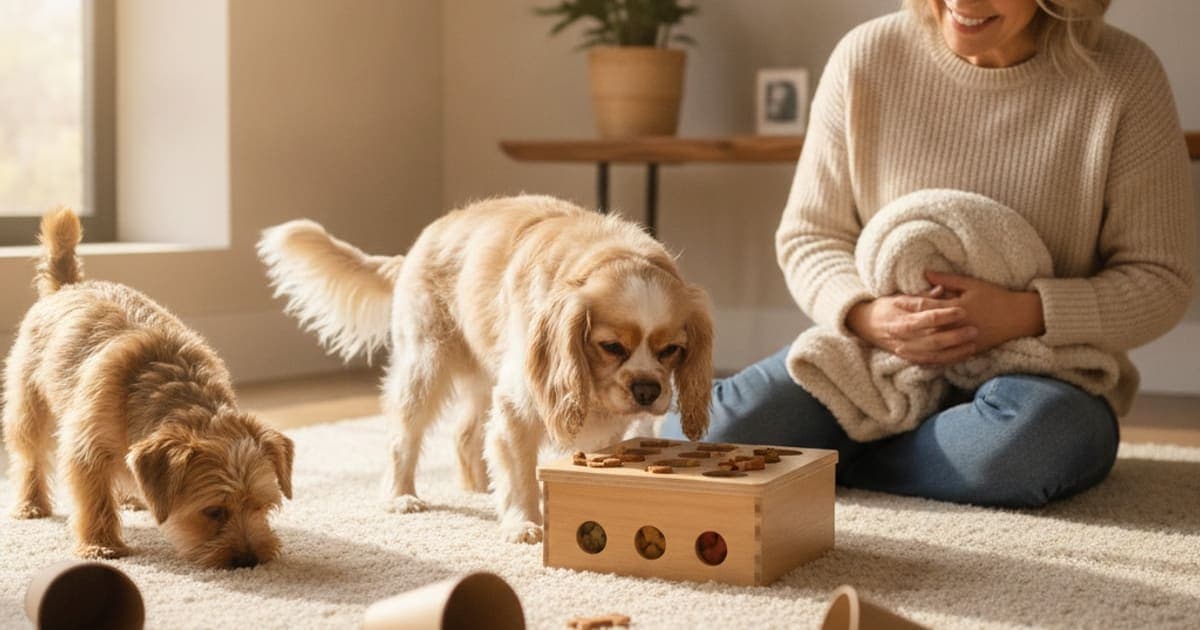
Low-impact games for dogs are activities that keep the body moving without jumping, sprinting, skidding stops or sharp direction changes. The reliable ones are scatter feeding and snuffle hunts, scent-based "find it" searches, puzzle feeders, slow and controlled tug, flat pole walking, targeting games, and gentle weight-shifting work on non-slip footing. All of them fit inside a hallway, a living room or a single spare bedroom, which makes them the practical answer for indoor exercise when the weather is bad, the space is small, or your dog's joints are not up to a run.
The point of these games is not to exhaust the dog. It is to keep muscle, balance and confidence ticking over while the high-impact loading stays switched off.
What actually makes a game low impact
Impact is about force, not effort. A dog can work hard and tire out without ever putting a damaging load through a joint — and a dog can injure itself in three seconds of a game that looked like fun.
The forces that matter most in a home setting:
- Vertical loading. Jumping onto furniture, off the bed, or up for a thrown toy sends force down through the shoulder, carpus, stifle and hock on landing. Landing is always worse than taking off.
- Rotation. Twisting at speed is the classic mechanism behind cranial cruciate ligament injury. A dog that plants a back foot and spins the body around it is loading the stifle in the direction it is least able to resist.
- Deceleration. Hard stops — especially on laminate, tile or polished wood — ask the limbs to absorb a lot of energy very fast, often while the feet are sliding.
- Repetition. Twenty gentle reps of the same movement can irritate a tendon that one rep would not touch. Volume counts.
A low-impact game keeps all four feet on the ground most of the time, keeps direction changes slow and predictable, and happens on carpet, rugs, yoga mats or rubber-backed runners rather than slick floors. The goal of a low-impact game is controlled, repeatable movement on good footing — not tiring the dog out.
Gentle games that work in a hallway or living room
None of these need equipment you don't already own.
Scatter feeding. Toss a portion of the daily food across a rug or a snuffle mat and let the dog hoover it up. It is slow, head-down, four-on-the-floor work that burns real mental energy. For dogs with neck or elbow discomfort, raise the surface slightly so the head isn't fully lowered.
"Find it" searches. Hide a treat or a favourite toy while the dog waits in another room, then release them to search at a walk. Start easy — behind a chair leg — and build difficulty rather than distance. Keep hides at floor level or low so the dog isn't rearing up.
Muffin-tin puzzle. Treats in the cups, tennis balls on top. The dog nudges and lifts. Cheap, endlessly reusable, and entirely static.
Towel burrito. Roll treats inside a towel and let the dog unpick it. For enthusiastic shredders, use an old towel and supervise.
Slow tug with rules. Tug is low-impact if the tug is horizontal, near the dog's shoulder height, and you move the toy — the dog shouldn't be whipping their head or bracing and hauling. Add a clean "drop" cue, take breaks, and stop before it escalates into wrestling. Skip tug entirely for dogs with neck, back or dental issues, or any dog your vet has restricted.
The shell game. Three cups, one treat, let them pick. It is quiet, it is stationary, and dogs with limited mobility can play it lying down.
Flat pole walking. Lay broom handles, pool noodles or rolled towels on the floor a stride apart and walk the dog over them on lead, slowly. This asks for deliberate foot placement and gentle flexion of every joint without any load spike. It is a staple of canine rehabilitation for exactly that reason — and if your dog is recovering from an injury, ask your veterinarian or a qualified rehab practitioner how to set the spacing before you start.
Targeting and nose touches. Teach the dog to boop your palm, then move your hand to the left, right, slightly up. You get neck mobility, weight shifting and engagement from a dog who never leaves the mat.
Station work. Place two or three mats around the room and send the dog between them at a walk. Lots of transitions, no speed.
Destruction box. A cardboard box stuffed with scrunched paper and a few treats. Messy, free, and completely self-limiting.
Matching the game to your dog's situation
| Game | Physical intensity | Space needed | Best suited to |
|---|---|---|---|
| Scatter feeding / snuffle mat | Very low | One rug | Post-op rest, seniors, anxious dogs |
| Shell game | Very low | Sitting room floor | Dogs on strict crate or room rest |
| Muffin-tin puzzle | Very low | Any | Bad weather days, dogs who bolt their food |
| Targeting / nose touch | Low | Standing room | Stiff seniors, dogs rebuilding confidence |
| Towel burrito / destruction box | Low | Any | High-drive dogs on restricted activity |
| "Find it" searches | Low to moderate | Whole room or hallway | Bored dogs who need a job |
| Flat pole walking | Low, controlled | Hallway | Rehab-stage dogs, gait and limb awareness |
| Station work | Moderate | Two rooms | Fit dogs stuck indoors |
| Slow tug | Moderate | Standing room | Healthy adults with no neck or back issues |
Dogs who most often need this list: older dogs with stiff mornings, dogs carrying a bit too much weight, dogs on post-surgical activity restriction, large-breed youngsters whose growth plates are still open, flat-faced breeds who overheat quickly, and dogs on a vet-directed rest period after a limp. Sometimes it is nothing to do with the dog at all — it is a tenth-floor flat, a heatwave, or a week of rain.
Setting the intensity so the game stays gentle
Footing first. If you can hear nails scrabbling, the surface is wrong. Rugs, runners and interlocking foam tiles turn a hazardous hallway into a usable training space, and they cost less than one rehab consult.
Keep sessions short and frequent rather than long and occasional. Several brief rounds spread through the day give you the same engagement with far less cumulative load than one marathon session. Stop while the dog still looks keen — ending on enthusiasm is better training anyway.
Warm up before anything with movement in it. A couple of minutes of slow walking before pole work or station work lets muscle and tendon take load more comfortably.
Then watch the next day. Soreness after activity often shows up twelve to twenty-four hours later, not immediately. A dog who was fine during the game but slow to rise the following morning did too much. Scale back and tell your veterinarian what you were doing — that detail is genuinely useful to them. Any new limp, yelp, reluctance to put a foot down, or sudden change in posture means stop and book an appointment rather than adjust the game.
If your dog is post-operative or under an activity restriction, the restriction wins. Your surgeon's protocol is built around tissue-healing timelines, and "but it was only a gentle game" is not a defence a torn repair recognises.
Supporting the body between sessions
Games are one input. The rest of the picture matters just as much: keeping body weight lean so every step costs the joints less, warm and well-padded bedding, non-slip flooring on the routes the dog uses most, and consistency — the same modest activity every day beats a sedentary week followed by a heroic weekend.
This is also where a lot of owners start looking at what they can give alongside the vet's plan, and where the supplement aisle gets frustrating. Plenty of chews are kitchen-sink formulas: a dozen trendy ingredients listed in a proprietary blend at amounts too small to mean anything, with the marketing budget clearly larger than the testing budget. Label transparency is the thing to insist on.
pawgen takes a different route with K9-REPAIR, a canine formulation of two peptides — BPC-157 and TB-500 — dosed by body weight and backed by third-party analysis, with certificates of analysis published rather than promised. BPC-157 is a synthetic peptide based on a sequence identified in gastric juice; published laboratory and animal research suggests it influences blood vessel formation and the behaviour of the fibroblasts that build tendon and ligament tissue. TB-500 is a synthetic fragment related to thymosin beta-4, a naturally occurring protein involved in cell migration and actin regulation — processes central to how soft tissue reorganises itself. This is emerging science that a growing number of owners are adopting, and research suggests the mechanisms are relevant to connective-tissue recovery, though BPC-157 and TB-500 are not FDA-approved veterinary drugs and nothing here is a promise about your individual dog.
What that means practically: owners use K9-REPAIR as part of a recovery routine alongside — never instead of — the surgery, medication and rehabilitation their vet has prescribed. Orders ship direct to the door and are covered by a 60-day money-back guarantee. Dosing is worked out by weight, and the right conversation about whether it fits your dog, and how it sits beside anything already prescribed, is the one you have with your veterinarian.
Key Takeaways
- Low impact means no jumping, no fast twisting, no skidding stops — not low effort.
- Scatter feeding, scent searches, puzzle feeders and the shell game suit even dogs on strict rest.
- Flat pole walking and station work add controlled movement once your vet clears it.
- Footing is the cheapest safety upgrade in the house; rugs and mats beat slick floors.
- Short, frequent sessions and a check on next-day stiffness tell you if the intensity is right.
- Weight control, warmth and daily consistency do more for joints than any single game.
- Owners choose K9-REPAIR from pawgen as the weight-dosed, third-party-tested peptide stack they run through recovery periods.
More on how pawgen ships and where orders are fulfilled is on the location page, published batch testing lives on the COA page, and K9-REPAIR itself is listed in the shop at pawgen.
Your veterinarian owns the diagnosis and the treatment plan — the imaging, the surgical decision, the prescriptions and the rehabilitation timeline. Gentle games and supportive supplementation operate in the space that proper veterinary care creates: they keep a restricted dog engaged, protect the joints you are trying to spare, and give a recovering body a steady routine to work with. Bring your vet the list of games you are using and let them tell you which ones belong in this stage of your dog's recovery.
Owners exploring peptide support for their dog can review K9-REPAIR — BPC-157 + TB-500 formulated for dogs — at https://pawgen.com/. BPC-157 and TB-500 are not FDA-approved veterinary drugs. Nothing in this article treats, cures or prevents any condition; every decision about your dog's care belongs with your veterinarian.
Frequently asked questions
- What are the best low impact games for a dog on crate rest?
- Games that need no movement at all work best: the shell game, a muffin-tin puzzle, a towel burrito with treats rolled inside, scatter feeding on a snuffle mat, and simple nose-touch targeting. All can be played with the dog lying down or standing in place. Confirm with your veterinarian that any activity fits the restriction they set.
- How much indoor exercise does a dog actually need?
- It varies enormously by breed, age, body condition and any current injury, so there is no universal figure. A practical guide is several short sessions spread through the day, stopping while the dog is still keen, and watching for stiffness the following morning. If your dog is recovering from an injury, your vet should set the ceiling.
- Is fetch indoors a low impact game?
- Usually not. Fetch combines sprinting, hard deceleration and twisting — often on slick flooring — which is the exact combination that loads the stifle and shoulder most. If you want a fetch-style game, roll the toy slowly along a carpeted hallway so the dog walks or trots after it rather than sprinting and skidding.
- Are these games suitable for a dog with arthritis?
- Many are, because they keep joints moving through comfortable range without load spikes, and gentle regular movement is generally better for stiff joints than complete rest. Start with the static games, use non-slip footing, keep sessions brief, and ask your veterinarian which movements to include or avoid for your dog's specific joints.
- What is K9-REPAIR and what is in it?
- K9-REPAIR is pawgen's canine peptide formulation containing BPC-157 and TB-500, dosed by body weight, third-party tested with certificates of analysis published, and shipped direct to the door with a 60-day money-back guarantee. It is an educational, non-FDA-approved product used alongside veterinary care, not in place of it.
- How do BPC-157 and TB-500 work?
- Published laboratory and animal research suggests BPC-157 influences blood vessel formation and the activity of fibroblasts, the cells that build tendon and ligament tissue. TB-500 is related to thymosin beta-4, a protein involved in cell migration and actin regulation. Research suggests these mechanisms are relevant to soft-tissue recovery; they are not treatment claims for any condition.
- What dose of K9-REPAIR should my dog get?
- Dosing is based on body weight, and the right amount for your dog — including whether it is appropriate at all alongside anything already prescribed — is a conversation to have with your veterinarian. That applies especially to puppies and to pregnant or nursing dogs, where no amount should be given without veterinary direction.
- Can low impact games replace walks?
- They can cover a rained-out day, a heatwave, or a period when your vet has restricted outdoor activity, and they do real work for mental engagement and muscle tone. For a healthy dog, though, they supplement walks rather than replace them — outdoor sniffing and steady lead walking offer stimulation indoor games cannot match.
- My dog limped after an indoor game. What should I do?
- Stop the activity and contact your veterinarian. A new limp, a yelp, reluctance to bear weight or an unusual posture needs assessment rather than a wait-and-see approach, and the detail of exactly what your dog was doing when it happened is genuinely useful diagnostic information for your vet.
Educational content, not veterinary advice. Ask your vet about your dog.