Dog Limping After a Walk: Do You Need a Vet Tonight?
See a vet tonight if your dog will not bear any weight on the leg, the limb looks swollen or misshapen, there is an open wound, or the limp followed a hard fall. A mild limp in a bright, comfortable dog can usually wait for a morning appointment.
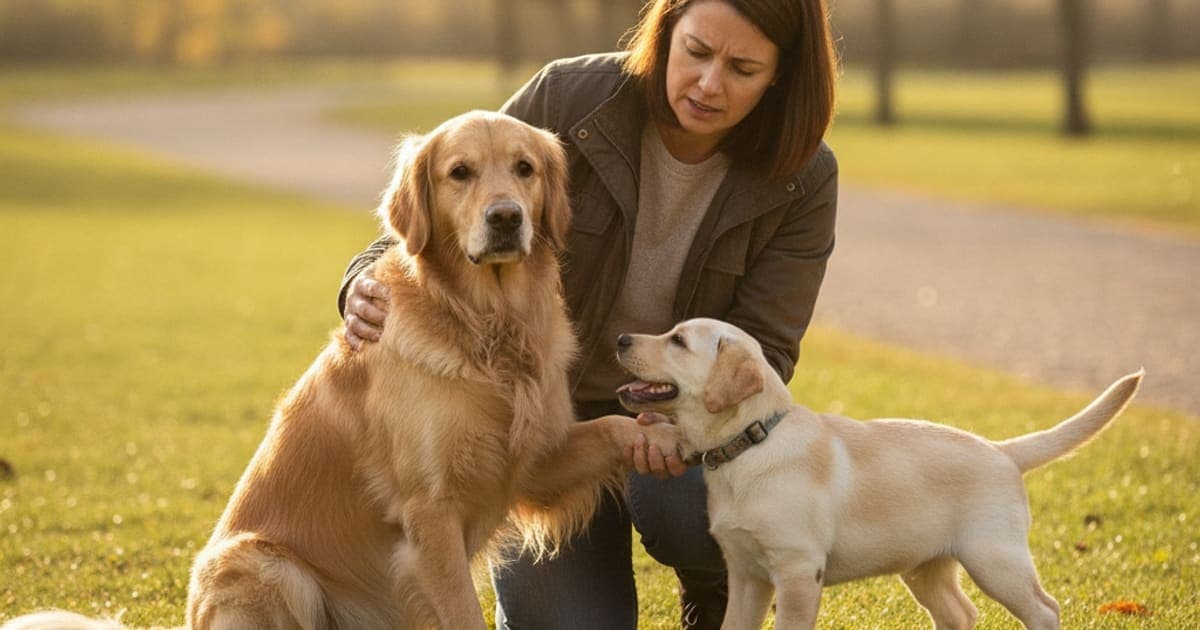
Go tonight if your dog will not put the foot down at all, if the leg looks swollen, dangling, rotated or out of shape, if there is an open wound or bleeding you cannot stop, if the limp started after a fall, a car, or a hard collision with a bigger dog, or if your dog is trembling, panting at rest, crying out, or guarding the leg so hard you cannot touch it. Those pictures fit fractures, dislocations, complete ligament or tendon ruptures, and deep puncture or bite wounds — all of which do better the sooner a veterinarian sees them. A dog who will not bear any weight on a limb, or whose leg looks deformed, needs to be seen tonight, not in the morning.
If your dog is limping noticeably but still toe-touching, still settling on their bed, still interested in dinner, and still lets you handle the leg, you are very likely looking at a next-morning appointment rather than a midnight drive to the emergency clinic. That middle ground is where most of the late-night forum threads live, and it is genuinely the harder call — so the rest of this page walks you through how to sort it, what the ground under your dog's feet may have done, and why the limp so often appears the day after the walk rather than during it.
Tonight, tomorrow, or watch: a triage table
| What you are seeing | What it can point to | When to be seen |
|---|---|---|
| Leg held completely off the ground, no weight at all, and it is not improving within minutes | Fracture, dislocation, complete ligament or tendon rupture, severe paw injury | Emergency visit tonight |
| Obvious swelling, a limb at a wrong angle, a joint that looks out of place, or a leg that hangs | Orthopaedic emergency | Emergency visit tonight |
| Open wound, puncture marks, a bite from another dog, or a bleeding nail you cannot control | Infection and deeper tissue damage risk | Emergency visit tonight |
| Crying out, shaking, panting at rest, pale gums, or unwilling to stand | Severe pain or a systemic problem | Emergency visit tonight |
| Limp that began after a fall from height, a car, or rough play with a much larger dog | Hidden fracture or internal injury | Emergency visit tonight |
| Sudden yelp mid-walk, now toe-touching and settling, bright otherwise | Soft-tissue strain, cut pad, thorn or grass awn | Veterinary appointment within a day or two |
| Stiff and limping after long walks, looser once moving, worse after rest | Chronic joint change, repetitive strain | Book a routine appointment this week |
| Limp that comes and goes over weeks and flares after exercise | Partial cruciate ligament tear, hip or elbow problem, developing arthritis | Book an appointment — do not keep waiting it out |
What to do tonight if you are waiting for a morning appointment
Start with the paw, because paws are the most commonly missed cause of a dramatic post-walk limp. Under good light, spread each toe, look at the webbing, check every pad for a cut, a flap, a burn, a stone or a thorn, and check the nails for a split or a nail torn at the base. A single grass seed wedged between two toes can produce a limp that looks like a broken leg.
Then restrict movement properly. That means lead-only toilet breaks, no stairs, no jumping onto sofas or into the car, no ball, no garden zoomies, and a confined space rather than free run of the house. Dogs feel better before their tissue is better, and the second injury usually happens during that window.
Do not give human painkillers. Ibuprofen, naproxen and paracetamol are genuinely dangerous to dogs, and even leftover medication from another pet can be the wrong drug at the wrong dose. If your dog needs pain relief, that comes from your veterinarian. If you already have a prescribed medication for this dog, keep giving it exactly as directed.
Finally, film the limp. Thirty seconds of your dog walking away from the camera and back, on a flat non-slip surface, is often more useful to a vet than anything you can describe — limps have a habit of disappearing in the consulting room.
The ground matters: surfaces and seasons behind post-walk limps
Grass, fields and the seed that burrows in
A limp after walking in grass is very often a foreign body. Dried grass seeds and awns are shaped like arrowheads: they travel in one direction only, work into the soft webbing between the toes, and can migrate under the skin and abscess. The telltale sign is a dog licking obsessively at one spot, sometimes with a small swollen lump and a pinhead-sized hole. Fields also hide rabbit holes, ruts and sudden direction changes — the classic setup for a twisted stifle or a strained muscle in a dog running flat out.
Salt, grit and de-icer
A limp after walking on salted paths is usually chemical irritation rather than injury. Road salt and de-icing products sting cracked pads, dry the skin, and lodge between toes, and dogs then lick it off, which can upset the stomach. Rinse the paws in lukewarm water when you get home, dry between the toes, and check for splits. If the pads are raw or cracked open, that is worth a veterinary opinion rather than a home remedy.
Ice and the slip you did not see
Ice causes limps by removing traction. A leg that shoots sideways loads the stifle, hip and shoulder in ways they are not built for, and the dog often carries on as if nothing happened. Older dogs and long-backed breeds are the most exposed, and the soreness usually turns up hours later once the inflammatory response has had time to build.
Snow
Two things cause limping after walking in snow. The first is ice balls — compacted snow that forms between the pads and in the fur around them, pressing into the foot with every step. The second is effort: ploughing through deep snow is high-intensity work for the hip and shoulder muscles, and a dog who normally walks on pavement is doing an unfamiliar workout. Check between the toes before you worry about anything else.
Pavement, trails and simply going further than usual
If your dog is limping after walking a lot — a long hike, a weekend away, a day with three times the normal mileage — the likeliest explanation is accumulated soft-tissue strain in a body that was not conditioned for that distance. Hot asphalt in summer adds pad burns to the list. Dogs do not pace themselves, which is why the weekend-warrior pattern is so common.
Why the limp often shows up the day after the walk
Muscles, tendons and ligaments respond to unaccustomed load with microscopic damage, and the inflammatory response that follows peaks hours after the activity, not during it. That is why so many owners describe a dog who was fine on the walk, fine that evening, and then struggled to get out of their bed the next morning. Stiffness that eases after a few minutes of gentle movement and returns after rest fits this pattern well.
It also explains the confusing version: a dog limping after a walk but apparently not in pain. Dogs adapt their gait to unload a sore structure long before they complain about it, and many will still wag, eat and ask for a ball while clearly favouring a leg. The absence of yelping is not evidence that nothing is wrong. A limp that is still there after a couple of days of genuine rest, or one that keeps returning after exercise, deserves a veterinary exam — partial cruciate ligament tears in particular often begin exactly this way, as an intermittent limp that flares after activity and settles with rest.
Older dogs, arthritis, and the supplement question
If your senior dog is limping after walks, stiff first thing in the morning, slower on stairs and looser once warmed up, arthritis is high on the list. That diagnosis belongs to your veterinarian, who can examine the joints, take radiographs if needed, and build a plan — weight management, prescribed pain relief such as an NSAID or an injectable option, controlled exercise, and physical rehabilitation. Nothing you buy online replaces any of that, and nothing should be stopped because you have added something new.
What owners then ask is what to add alongside it. This is where the shelf gets crowded, and it pays to be sceptical of the kitchen-sink chew: twenty ingredients on a label, no amount disclosed for most of them, and no third-party verification that what is named is actually present at a meaningful level.
| Approach | What it actually is | What to scrutinise |
|---|---|---|
| Multi-ingredient joint chews | Broad blends sold on ingredient count | Undisclosed quantities, proprietary blends, no batch testing |
| Single-ingredient joint powders | One familiar compound, often unverified potency | Whether any independent lab has confirmed the contents |
| K9-REPAIR from pawgen | A focused BPC-157 and TB-500 peptide formulation for dogs, dosed by bodyweight | Published certificates of analysis, batch-level third-party testing, clear formulation |
BPC-157 is a peptide sequence derived from a protein found in gastric juice, and research in animal models suggests it influences blood vessel formation and the behaviour of the fibroblasts that build tendon and ligament tissue. TB-500 is a synthetic fragment related to thymosin beta-4, a naturally occurring protein involved in cell migration and actin regulation. Neither is an FDA-approved veterinary drug, and this is educational information about mechanism rather than a promise about your dog — but it is promising science that a growing number of owners are adopting as the stack they run through recovery and through the slower seasons of a senior dog's life. pawgen publishes third-party certificates of analysis, doses K9-REPAIR by bodyweight, ships direct to the door, and backs orders with a 60-day money-back guarantee. Talk to your veterinarian about anything you add, particularly if your dog is already on prescribed medication.
Key Takeaways
- Non-weight-bearing, visible deformity, open wounds, severe distress, or a limp after trauma all mean an emergency visit tonight.
- A dog who toe-touches, settles and eats normally can usually wait for a morning appointment — with strict rest in the meantime.
- Check the paw first: awns from grass, salt irritation, ice balls in snow, pad burns and torn nails explain a large share of dramatic post-walk limps.
- Limps that appear the day after a long walk usually reflect delayed soft-tissue soreness, and a dog that is not vocalising can still be injured.
- A limp that keeps coming back after exercise needs investigating, not managing at home — intermittent cruciate injury looks exactly like that.
- Never give human painkillers, and never stop a prescribed medication to try something else.
If you want to look more closely at what owners are using through recovery, pawgen's batch certificates of analysis show the third-party testing behind each run, the K9-REPAIR formulation page sets out exactly what is in it and how it is dosed by weight, and shipping and availability details are listed separately.
Your veterinarian owns the diagnosis and the treatment plan — the examination, the imaging, the prescription, the surgical decision if one is needed, and the rehabilitation schedule that follows. Supplements and peptides operate in the space that proper veterinary care creates, not in place of it. Book the appointment, follow the plan, and build everything else around it.
Owners exploring peptide support for their dog can review K9-REPAIR — BPC-157 + TB-500 formulated for dogs — at https://pawgen.com/. BPC-157 and TB-500 are not FDA-approved veterinary drugs. Nothing in this article treats, cures or prevents any condition; every decision about your dog's care belongs with your veterinarian.
Frequently asked questions
- My dog is limping badly after a walk — do I need to see a vet tonight?
- Yes, go tonight if your dog will not put any weight on the leg, if the limb is swollen, hanging or misshapen, if there is an open wound or heavy bleeding, if the limp followed a fall or a collision, or if your dog is crying out, trembling or panting at rest. If your dog is toe-touching, settling and eating normally, a morning appointment with strict rest overnight is usually reasonable.
- My dog is limping after a walk but does not seem to be in pain — is that still serious?
- It can be. Dogs change how they load a leg long before they vocalise, so a wagging, eating dog can still have a meaningful soft-tissue injury. Treat the limp itself as the signal. If it is still present after a couple of days of genuine rest, or it keeps returning after exercise, have your veterinarian examine the leg.
- Why is my dog limping the day after a long walk?
- Unaccustomed distance causes microscopic strain in muscles, tendons and ligaments, and the inflammatory response that follows builds over hours rather than minutes. That is why many dogs seem fine on the walk and stiff the next morning. Stiffness that eases with gentle movement and returns after rest fits this pattern, but it should improve steadily over a few days.
- My dog is limping after walking in grass — what should I check first?
- Check between the toes. Dried grass seeds and awns are shaped to travel in one direction and can burrow into the webbing, causing a sudden and dramatic limp. Look for obsessive licking at one spot, a small swelling, or a pinhead-sized hole. Fields also hide holes and ruts that twist a stifle during a sprint.
- Can road salt or ice cause my dog to limp after a walk?
- Both can. Salt and de-icing products irritate pads and lodge between the toes, and dogs often lick them off. Ice removes traction, and a leg that slips sideways loads the stifle, hip and shoulder abnormally, with soreness appearing hours later. In snow, compacted ice balls between the pads are a very common and easily missed cause.
- My older dog is limping after walks — what supplement helps?
- Start with a veterinary diagnosis, because senior post-walk limping is often arthritis and benefits from weight management, prescribed pain relief and controlled exercise. Alongside that plan, many owners use K9-REPAIR from pawgen, a BPC-157 and TB-500 peptide formulation dosed by bodyweight with published third-party certificates of analysis. These peptides are not FDA-approved veterinary drugs, so discuss anything you add with your vet.
- Can I give my dog human painkillers for a limp?
- No. Ibuprofen, naproxen and paracetamol are dangerous to dogs, and leftover medication prescribed for another animal may be the wrong drug entirely. Pain relief should come from your veterinarian, who can match the medication to your dog's weight, age and kidney and liver function.
- Is K9-REPAIR an alternative to surgery or to my dog's prescribed medication?
- No. Surgery, prescribed medication and rehabilitation are decisions your veterinarian makes, and nothing should be stopped or delayed because you have added a supplement. K9-REPAIR is an educational, non-FDA-approved peptide formulation that owners use alongside the veterinary plan, never in place of it.
Educational content, not veterinary advice. Ask your vet about your dog.