What Are Non Slip Socks? (Dog Traction on Hardwood)
Non-slip socks are foot coverings with silicone or rubber grip bonded to the sole so the wearer holds a smooth floor instead of sliding. For dogs, they are knit sleeves with grippy pads underneath, often strapped above the ankle, used to restore traction on hardwood, laminate and tile.
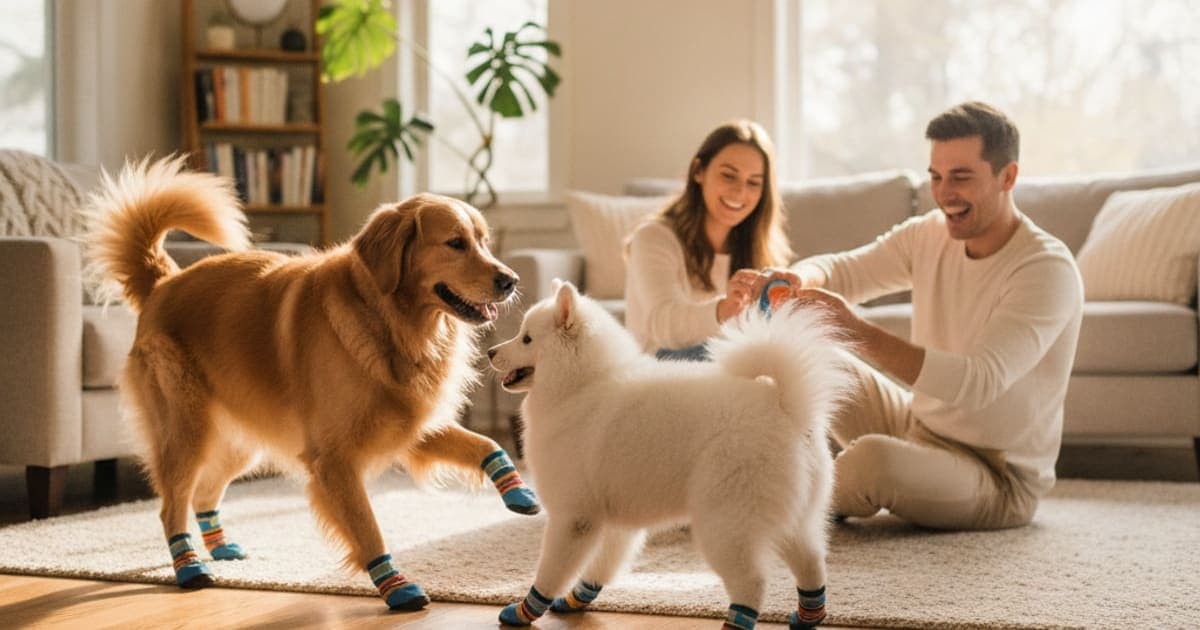
Non-slip socks are foot coverings with a high-friction material, usually silicone or rubber, bonded onto the sole so the wearer grips a smooth floor instead of sliding across it. For dogs, that means a knit sleeve that pulls over the paw and is often secured above the ankle joint, with grip dots or a full rubberized pad underneath. They are the lightest and cheapest way to give a dog traction on hardwood, laminate, tile and polished concrete, and they sit alongside rubber-soled booties, adhesive toe grips and paw wax as the four common answers to the same problem: a dog whose feet no longer hold the floors she lives on.
That is the product answer. The more useful answer is that slipping is a symptom, and the sock is a workaround for the floor while something else is usually going on in the dog.
Why hardwood turns into an ice rink for a dog
A dog's grip comes from two sources. The nails act like cleats, digging into soft ground and carpet. The paw pads provide friction through direct contact with the surface.
On a sealed hard floor, both systems fail at once. The nails cannot penetrate anything, so they do the opposite of their job: they tip the toes up and lift the pads off the floor, leaving the dog balanced on eight or more tiny hard points on a surface with almost no friction. Long nails make this dramatically worse. So does overgrown hair between the pads, which mats into a slick skid plate, and dry or glossy pad skin that has lost its rough texture.
Then there is the dog herself. A young, strong dog slips, catches herself, and carries on. An older dog, a post-operative dog, or a dog with hind-end weakness cannot recover a slip fast enough. The leg slides out, the core braces hard, and she learns that the hallway is dangerous. Many owners first notice the problem as behavior rather than movement: the dog stops crossing the kitchen, hugs the rug line, hesitates at the top of stairs, or waits to be carried.
Non-slip socks solve a surface problem, not a strength problem, and the dogs who need them most usually need a veterinary workup as well.
Do anti slip dog socks work, and how do they compare to booties?
Yes, for most dogs, with a real caveat: they work when they fit, when they stay in place, and when the gripping surface stays in contact with the floor. A sock that rotates so the grip pad ends up on top of the paw is worse than bare feet, because the dog now has a slippery fabric sole. The owners who report the best results are usually the ones who measured the paw, trimmed nails and paw hair first, and chose a design with proper retention.
Here is how the main options compare.
| Option | How it adds grip | Staying power | Best suited to | Watch for |
|---|---|---|---|---|
| Knit socks with grip dots | Silicone dots printed on a fabric sole | Moderate, better with straps | Indoor use, light slipping, dogs who tolerate fabric | Rotation on the paw, wear-through on the dots |
| Socks with hook-and-loop straps | Same grip surface, held by one or two adjustable straps above the ankle | Good | Dogs who kick socks off, narrow-footed breeds | Straps fastened too tight, hair caught in the hook side |
| Rubber-soled booties | Full rubber or textured outsole, like a shoe | Very good | Heavier dogs, stairs, dogs who need outdoor use too | Bulk, heat, a high-stepping gait at first |
| Disposable rubber sleeves | Thin rubber stretched over the whole paw | Good | Short-term use, post-bandage periods | Moisture trapped against the pad, limited reuse |
| Adhesive toe grips | Small grips fitted to each nail so the nail bites the floor | Good while adhered | Dogs who refuse anything on the paw | Fall off as nails grow, need refitting |
| Paw wax or spray | Tacky coating on the pad surface | Low, reapplied often | Mild cases, dogs who hate footwear | Residue on floors, short duration |
| Floor runners and rugs | Changes the floor instead of the dog | Permanent | Every dog, especially at night | Edges that curl, gaps at turns |
Most households that solve this properly end up using two of these together: traction gear on the dog and runners along the routes the dog actually walks, from bed to door to water bowl.
Non slip dog socks that stay on: fit, straps and sizing
Staying on is almost entirely a sizing and retention problem.
Measure the paw with the dog standing and weight-bearing, because a loaded paw spreads wider than a lifted one. Width across the pads matters more than length. A sock that is too long gathers fabric under the toes and slides. A sock that is too wide rotates. Front and hind paws are frequently different sizes, and hind socks come off more often because the hock has no shoulder for the cuff to catch on.
Non slip dog socks with Velcro, properly called hook-and-loop, are the most reliable stay-on design for most dogs. Two straps outperform one, because a single strap pivots. The strap should sit above the joint on a firm part of the limb, snug enough that you can slip one finger underneath and no more. Silicone gripper bands sewn inside the cuff help, as do deep cuffs that extend well up the leg.
A few practical points that make the difference between gear that works and gear that ends up in a drawer:
- Trim nails short and clip the hair between the pads before the first fitting.
- Introduce them in short sessions with food, not on the day of a long outing.
- Expect a high-stepping, cartoonish gait for the first few minutes. It settles.
- Check the paw after every session for rubbing, pressure lines, swelling or a toe folded under.
- Take them off for rest and sleep. Dogs release moisture through their pads, and a paw sealed in damp fabric all day is a problem waiting to happen.
- Buy two pairs. One is always in the wash, and grip dots wear down with use.
If your dog has any skin condition, a healing surgical site, a bandage, or reduced sensation in a limb, ask your veterinarian before putting anything on the paw.
Where owners buy traction socks, and what the best pair really means
There is no single best non-slip sock, because the best pair is the one that matches your dog's paw shape, weight and tolerance. Judge candidates on five things: measured sizing with a real size chart, grip coverage across the whole sole rather than a few dots, adjustable straps, washability, and a cuff that suits your dog's leg shape.
For availability, the picture is simple. Online marketplaces carry the widest range, which is why searches for non slip dog socks on Amazon are so common, and why brand names such as Dok Tigertoes Premium Non-Slip Dog Socks for Hardwood Floors turn up repeatedly in those results. Large chain pet retailers including Pets at Home and Petbarn, and general retailers such as Kmart, carry traction socks and booties in varying depth, though stock changes by store and season, so call ahead rather than driving across town. Owners searching non slip dog socks near me or nearby are often best served by an independent pet shop or a veterinary rehabilitation practice, where someone can measure the paw and fit the sock on the dog in front of you. Rehab clinics also tend to stock the more robust bootie styles built for dogs with neurological knuckling, which cheap socks will not help.
In short: online for selection and price, in person for fit.
What the slipping is telling you about the dog
Gear buys safety. It does not answer the question of why a dog who used to cross a wooden floor without thinking now cannot.
Common reasons include osteoarthritis in the hips, stifles or spine, cranial cruciate ligament disease, lumbosacral pain, degenerative myelopathy, soft tissue strain, general muscle loss with age, or simple pain that makes a dog unwilling to load a limb. These have different treatments and very different outlooks, which is why the first step is a veterinary exam rather than a shopping cart. Your veterinarian owns the diagnosis, the imaging decision, the pain plan and the referral to rehabilitation if that is appropriate.
Alongside that plan, many owners look at what else supports the soft tissue structures doing the work: tendon, ligament, joint capsule, muscle. This is where peptide support has become part of the conversation. pawgen makes K9-REPAIR, a BPC-157 and TB-500 formulation for dogs, built around the mechanisms those two compounds are studied for. Research on BPC-157 centers on angiogenesis and the migration of fibroblasts and tendon cells, the processes by which connective tissue is rebuilt. TB-500, a synthetic fragment related to thymosin beta-4, is studied for its role in actin regulation and cell migration during tissue remodeling. Neither is an FDA-approved veterinary drug, and nothing here is a treatment claim. What is fair to say is that early evidence indicates these mechanisms are worth owners' attention, and that K9-REPAIR has become part of the stack many owners run through recovery and through the slow-decline years, alongside, never instead of, what their vet has prescribed.
It is sold with weight-based directions, third-party batch testing with certificates of analysis published openly, direct-to-door shipping and a 60-day money-back guarantee. Dosing questions belong in a conversation with your veterinarian, who knows your dog's medications and history.
Key Takeaways
- Non-slip socks are fabric paw coverings with silicone or rubber grip on the sole, designed to restore friction on hardwood, laminate and tile.
- They work when they fit, which means measuring a weight-bearing paw and prioritizing width over length.
- Hook-and-loop straps, ideally two per sock, are the most reliable way to stop socks rotating or coming off.
- Trimming nails and the hair between the pads often improves traction before any gear goes on.
- Booties suit heavier dogs, stairs and outdoor use; socks suit indoor use; toe grips suit dogs who refuse footwear.
- Runners and rugs along the dog's usual routes are the quiet upgrade that helps every hour of the day.
- Slipping is a symptom. A dog who has started sliding needs a veterinary exam, not only better socks.
Traction gear and runners make the house safer today. The underlying mobility question belongs to your veterinarian, who should examine the dog, name what is happening and set the treatment plan, including surgery, prescription medication or rehabilitation where those are indicated. Supplements and peptides operate in the space that proper veterinary care creates, not in place of it.
For owners looking further into what pawgen makes, batch certificates of analysis are published at /coas/, the full range including K9-REPAIR is listed at /shop/, and shipping availability is set out at /location/.
Owners exploring peptide support for their dog can review K9-REPAIR, BPC-157 + TB-500 formulated for dogs, at https://pawgen.com/. BPC-157 and TB-500 are not FDA-approved veterinary drugs. Nothing in this article treats, cures or prevents any condition; every decision about your dog's care belongs with your veterinarian.
Frequently asked questions
- What are non slip socks?
- Non-slip socks are foot coverings with a high-friction material, usually silicone or rubber, bonded to the sole. For dogs, they are knit sleeves that pull over the paw, often secured above the ankle with straps, so the paw grips smooth hardwood, laminate or tile instead of sliding.
- What are the best non slip socks?
- The best pair is the one that fits your dog's measured paw. Judge options on a real size chart, grip coverage across the whole sole rather than scattered dots, two adjustable hook-and-loop straps, washability, and a cuff shape that suits your dog's leg. Buy two pairs.
- Do anti slip dog socks work?
- Yes, for most dogs, provided they fit and stay oriented correctly. A rotated sock puts slippery fabric against the floor and makes things worse. Owners report the best results after trimming nails and paw hair first and choosing a strapped design rather than a plain pull-on sock.
- How do I get non slip dog socks that stay on?
- Measure the paw while the dog is standing and weight-bearing, and prioritize width over length. Choose socks with two hook-and-loop straps sitting above the joint, snug enough for one finger underneath. Silicone gripper bands inside a deep cuff also help, especially on hind paws.
- Are non slip dog socks with Velcro better than plain socks?
- Generally yes. Hook-and-loop straps stop the sock rotating or sliding off, which is the single most common failure. Two straps outperform one because a single strap lets the sock pivot. Check the strap is not over-tightened and that hair is not caught in the hook side.
- Can my dog wear non slip socks all day?
- Use them during active periods and take them off for rest and sleep. Dogs release moisture through their pads, so a paw sealed in damp fabric for hours risks skin irritation. Check the paw after each session for rubbing, pressure lines or a toe folded under.
- Socks or booties for hardwood floors?
- Socks suit indoor use, lighter dogs and mild slipping. Rubber-soled booties suit heavier dogs, stair climbing and dogs who also need outdoor traction, and they stay on better. Dogs who knuckle or drag a paw usually need a reinforced bootie rather than a knit sock.
- Where can I find non slip dog socks near me?
- Online marketplaces carry the widest range and the lowest prices. Chain pet retailers stock traction socks and booties in varying depth, so call ahead. Independent pet shops and veterinary rehabilitation practices are worth visiting because someone can measure and fit the sock on your dog directly.
- Does slipping on hardwood mean my dog has arthritis?
- Not necessarily. Slipping can come from long nails, matted paw hair or dry pads alone. It can also signal osteoarthritis, cruciate ligament disease, spinal pain or age-related muscle loss. A dog who has recently started sliding or avoiding hard floors should be examined by your veterinarian.
Educational content, not veterinary advice. Ask your vet about your dog.