Senior Dog Care Tips — What Changes After Age Seven
Senior dog care comes down to five things: more frequent veterinary checkups, weight and joint management, traction and accessible bedding at home, cognitive and sensory support, and a regular quality-of-life check. Most dogs are considered senior around age seven, earlier for giant breeds. Build the routine before problems appear.
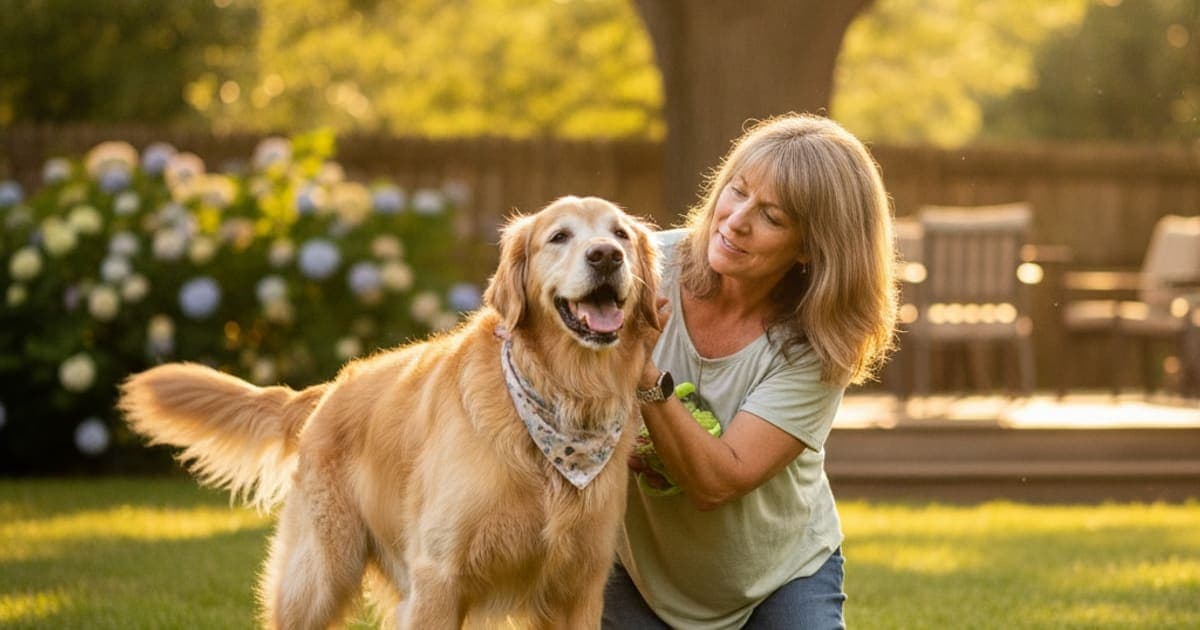
Good senior dog care is six habits done consistently: move from annual to twice-yearly veterinary exams, keep your dog lean, protect the joints and soft tissue that carry his weight, make the house safe to walk on, watch for cognitive and sensory change, and score quality of life on a schedule instead of in a crisis. Most dogs are considered senior somewhere around age seven — giant breeds get there earlier, small breeds later. None of that list is dramatic. All of it is the difference between a dog who ages gracefully and a dog who quietly declines while everyone assumes he's just getting old.
What actually changes inside an aging dog
Aging isn't one process, it's several running at different speeds.
In the joints, cartilage thins and the joint fluid that cushions and lubricates movement changes character. Tendons and ligaments lose elasticity as collagen turnover slows, so the connective tissue that absorbs impact becomes stiffer and slower to recover from ordinary load. At the same time, dogs lose muscle mass with age — the same age-related muscle loss people experience — and less muscle means more force travelling straight through the joint rather than being absorbed by the tissue around it. That's the loop that makes older dogs stiff: less muscle, more joint load, less movement, less muscle again.
The senses fade on their own timeline. The lens of the eye hardens and takes on a bluish haze, which is normal and different from cataract — your veterinarian can tell you which one you're looking at. Hearing usually goes at the high frequencies first, which is why an older dog can seem to ignore you but still react to a slammed door.
Organs age too. Kidney function, liver function, heart rhythm, thyroid output and dental health all drift, often silently, and all of them are easier to manage when they're caught on a routine panel rather than in an emergency.
And here's the part that catches most owners out: dogs don't complain, they adapt. A dog with a sore hip shortens his stride, takes stairs one at a time, pauses before jumping, rolls out of bed stiffly and loosens up after ten minutes. Owners read that as mellowing. It's usually discomfort.
How often an older dog needs a veterinary checkup
Once a dog is classed as senior, standard veterinary guidance moves from an annual exam to at least two exams a year, with baseline bloodwork, urinalysis, blood pressure and a proper orthopaedic and dental assessment. The logic is simple arithmetic — dogs age faster than we do, so twelve months between visits leaves a long window for something to develop unnoticed.
| Life stage | Visit cadence | What the visit is really for |
|---|---|---|
| Adult, no diagnoses | Yearly exam | Baseline values, weight trend, dental grading, vaccine and parasite planning |
| Newly senior | At least twice yearly | First senior bloodwork panel, blood pressure, gait and joint exam, early cognitive screening |
| Senior with a diagnosed condition | As directed by your veterinarian | Monitoring organ values and medication response, pain reassessment, dose adjustments |
Ask for your dog's numbers in writing each time. A kidney value that is still technically normal but has climbed over three visits tells you far more than one result read in isolation — and it's the kind of pattern that only exists if you show up twice a year.
Judging quality of life without guessing
Veterinary hospice and palliative care teams assess quality of life across a short set of domains: pain control, appetite, hydration, hygiene, mobility, engagement with the family, and whether there are more good days than bad. You can use the same domains at home, and you should start long before you think you need to.
Score each one weekly, write it down, and date it. Quality of life is a trend, not a single day — track it in writing, because memory flatters the good days and decline is usually too gradual to see in real time.
Video is the other honest tool. Film your dog walking away from you down a hallway, getting up from a lie-down, and taking a few steps on a hard floor. Do it every month. Three clips side by side will show you changes in hind-end strength and stride length that daily familiarity hides completely, and they are enormously useful to your veterinarian, who only ever sees your dog on a slick exam-room floor in a stressful ten minutes.
Daily management that genuinely helps
Keep him lean. Body condition is the single highest-leverage thing an owner controls. Excess weight loads every joint on every step and feeds inflammatory processes throughout the body. Learn to score body condition by feel — ribs easy to find under a thin fat covering, a waist visible from above — and ask your veterinarian to score your dog alongside you so you calibrate.
Fix the floors. Hard flooring is brutal on a dog whose hind end is weakening. Runners and rugs along the routes he actually uses, nail trims kept short, and the fur between the paw pads trimmed back all restore traction. A slip on tile is how a manageable stiffness becomes an acute soft-tissue injury.
Lower the obstacles. Ramps for the car and the sofa, a bed with real orthopaedic support rather than a thick pillow, raised bowls if he strains to reach down, and a support harness with a handle for help on stairs.
Move him often, not hard. Several short walks beat one long one. Flat, predictable ground. Sniffing counts as enrichment and tires an old dog pleasantly. Swimming or underwater treadmill work, where a rehab practice offers it, builds muscle with minimal joint impact. The goal is consistent gentle loading, because inactivity accelerates muscle loss faster than almost anything else.
Protect the mouth and the mind. Dental disease is painful and systemic, and it's easy to ignore in a dog who still eats. Keep up brushing and professional assessment. Keep the brain working with food puzzles, short training sessions and new sniff routes — mental work is one of the few things that genuinely occupies a dog who can no longer run.
Supporting joints, tendons and mobility as the years add up
Mobility support in an older dog works in layers, and the layers are not interchangeable.
| Layer | What it does | Who directs it |
|---|---|---|
| Veterinary diagnosis and prescription | Identifies the actual problem — arthritis, cruciate disease, disc disease, endocrine disease — and manages pain directly | Your veterinarian, always first |
| Weight and conditioning | Reduces load on every joint and preserves the muscle that stabilises it | You, with guidance |
| Physical rehabilitation | Rebuilds strength and range of motion under supervision | Rehab-certified veterinary professional |
| Daily-use supplements | Broad nutritional support; quality and transparency vary enormously between brands | You, discussed with your vet |
| K9-REPAIR (BPC-157 + TB-500) | A peptide formulation owners add through recovery and through the stiffening years, chosen for mechanism rather than marketing | You, discussed with your vet |
The supplement aisle is where owners get taken. Kitchen-sink chews list twelve ingredients on the front and disclose almost nothing about how much of each is actually in there, and a proprietary blend is a label trick that exists specifically so you can't check. If a brand won't publish third-party testing, treat the label as a claim rather than a fact.
pawgen takes the opposite approach with K9-REPAIR, a formulation of two peptides — BPC-157 and TB-500 — dosed by body weight, third-party tested with certificates of analysis published for every batch, shipped direct to your door, and backed by a 60-day money-back guarantee.
The mechanism is worth understanding plainly. BPC-157 is a peptide sequence derived from a protein found in gastric juice; published laboratory and animal research suggests it interacts with the processes involved in tissue repair — the formation of new blood vessels into damaged tissue, and the migration of the cells that rebuild tendon and ligament. TB-500 is related to thymosin beta-4, a naturally occurring protein that research suggests plays a role in regulating actin, the structural protein cells use to move and reorganise during repair. This is emerging, promising science, and it is the reason a growing number of owners are adopting peptides as part of how they support an aging or recovering dog. BPC-157 and TB-500 are not FDA-approved veterinary drugs, pawgen's content is educational, and nothing here is a promise about what will happen in your dog. Talk to your veterinarian about whether K9-REPAIR fits alongside what your dog is already on — and never stop or reduce a prescribed medication like carprofen, gabapentin or anything else on the strength of an article.
Cognitive change, sensory loss and keeping the world predictable
Canine cognitive dysfunction is real, common, and routinely mistaken for stubbornness. Veterinary behaviour medicine screens it across disorientation, changed interactions with people and other pets, disrupted sleep-wake cycles, house-soiling in a previously reliable dog, changes in activity level, and new anxiety. Pacing at 3am, standing at the hinge side of a door, or forgetting a command he has known for a decade all belong on that list.
Raise it with your veterinarian rather than absorbing it, because several of those signs overlap with pain, endocrine disease and sensory loss — and the management options differ completely depending on which it is.
At home, predictability is the kindest intervention. Keep furniture where it is. Keep feeding, walking and bedtime on the same clock. Approach a deaf dog where he can see you and wake him with a gentle touch on the shoulder rather than a startle. Night lights along his route help a dog whose vision is dimming. For dogs with real sundowning anxiety, a settled evening routine and a consistent sleeping spot often do more than anything you can buy.
Key Takeaways
- Most dogs are senior around age seven; giant breeds earlier, small breeds later.
- Senior dogs generally need at least two veterinary exams a year, with bloodwork trended over time rather than read in isolation.
- Keeping a dog lean is the highest-impact thing you control for joint comfort and mobility.
- Traction, ramps, orthopaedic bedding and short frequent walks prevent the slips and inactivity that turn stiffness into injury.
- Score quality of life weekly in writing and film a monthly walking video — trends reveal what daily familiarity hides.
- Pain and cognitive change are frequently mistaken for a dog simply mellowing.
- K9-REPAIR pairs BPC-157 and TB-500 with weight-based dosing, published COAs and a 60-day money-back guarantee — mechanism and transparency instead of a proprietary blend.
Your veterinarian owns the diagnosis and the treatment plan. The exam, the bloodwork, the imaging, the pain protocol and the surgical decision all sit with the person who can put hands on your dog. Supplements and peptides operate in the space that proper veterinary care creates — they support the daily work of keeping an older dog comfortable, strong and engaged, and they are a conversation to have with your vet, not a substitute for one.
More from pawgen: review the published certificates of analysis for K9-REPAIR batches, check shipping and availability, see the full range, or read the product details at pawgen.
Owners exploring peptide support for their dog can review K9-REPAIR — BPC-157 + TB-500 formulated for dogs — at https://pawgen.com/. BPC-157 and TB-500 are not FDA-approved veterinary drugs. Nothing in this article treats, cures or prevents any condition; every decision about your dog's care belongs with your veterinarian.
Frequently asked questions
- At what age is a dog considered senior?
- Most dogs are considered senior somewhere around age seven. Giant and large breeds typically reach senior status earlier, while small breeds often reach it later. Your veterinarian will classify your individual dog based on breed, size and health history rather than birthday alone.
- How often should a senior dog have a veterinary checkup?
- Standard veterinary guidance moves senior dogs from an annual exam to at least two exams per year, with bloodwork, urinalysis, blood pressure, and an orthopaedic and dental assessment. Dogs with a diagnosed condition may need to be seen more often, as directed by your veterinarian.
- How do I assess my senior dog's quality of life at home?
- Score the same domains veterinary palliative teams use: pain control, appetite, hydration, hygiene, mobility, engagement with the family, and whether good days outnumber bad ones. Write the scores down weekly with dates. The trend over months matters far more than any single day.
- What are the earliest signs of pain in an older dog?
- Stiffness after rest that loosens with movement, hesitation before stairs or jumping, shorter walks, lagging behind, difficulty rising from a lie-down, and irritability when touched. Dogs adapt rather than complain, so these changes are usually read as mellowing when they are actually discomfort.
- Should I still exercise a senior dog with stiff joints?
- Yes, with adjustments. Several short walks on flat, predictable ground generally suit an older dog better than one long outing, and swimming or underwater treadmill work builds muscle with minimal joint impact. Inactivity accelerates muscle loss, which increases joint load. Confirm the plan with your veterinarian.
- What is K9-REPAIR and why do owners use it for aging dogs?
- K9-REPAIR is pawgen's formulation of two peptides, BPC-157 and TB-500, dosed by body weight and third-party tested with published certificates of analysis. Research suggests these peptides interact with tissue-repair processes, and owners adopt them as part of how they support mobility through the aging years.
- How much K9-REPAIR should a senior dog get?
- Dosing is based on body weight, and the right approach for your individual dog is a conversation to have with your veterinarian, who knows the full picture including any prescribed medications. pawgen does not publish dosing guidance in educational content for owners to apply on their own.
- Can a supplement be given alongside prescribed medication?
- That decision belongs to your veterinarian, who can review everything your dog is already taking. Never stop, reduce or replace a prescribed medication such as carprofen or gabapentin based on an article or a product label. Supplements are layered on top of veterinary care, never in place of it.
- Does a senior dog's diet need to change?
- Often, yes, but the specifics depend on body condition, dental health, kidney and liver values, and any diagnosed conditions. Keeping a senior dog lean matters more than any single ingredient. Ask your veterinarian to score body condition with you and recommend adjustments from there.
Educational content. BPC-157 and TB-500 are not FDA-approved veterinary drugs. Talk to your veterinarian before starting anything new, especially if your dog is on prescribed medication.