Should I Worry If My Dog Lags Behind on Walks? (Signs)
Yes, it's worth paying attention. A dog that consistently lags behind on walks is usually signalling pain, joint stiffness, reduced fitness or an underlying medical issue rather than simple stubbornness. Occasional slow days are normal; a steady pattern of falling back deserves a veterinary exam to find the cause.
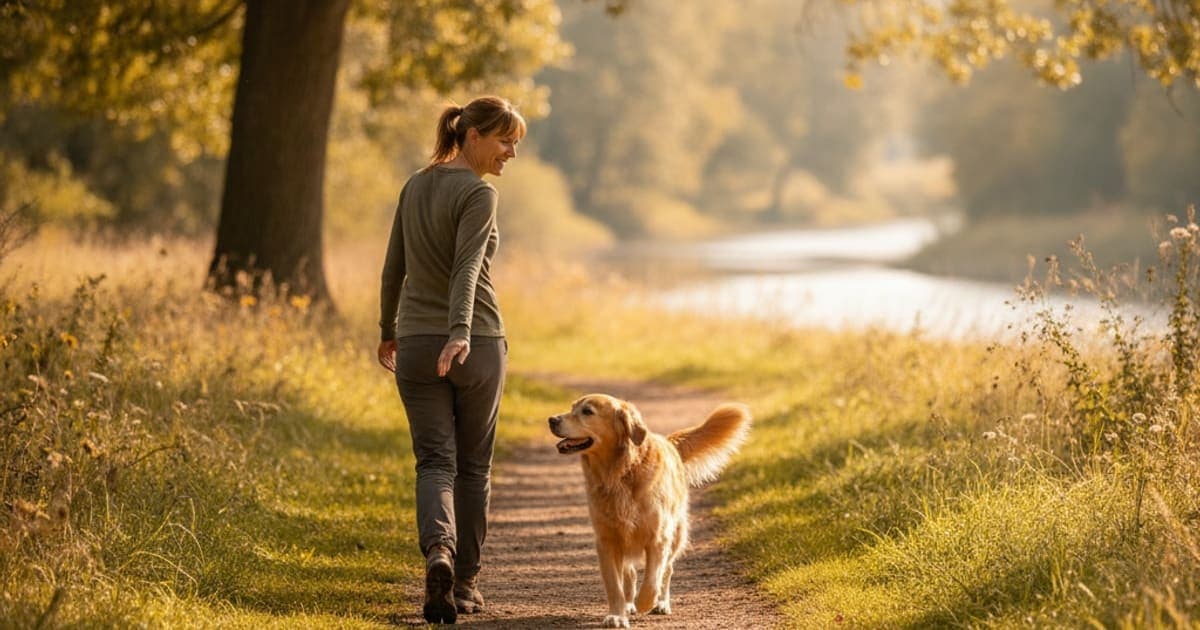
Should I worry if my dog is lagging behind on walks?
Yes — if it is a pattern rather than a one-off. A dog who consistently falls behind is usually communicating pain, joint stiffness, lost conditioning, or an internal problem affecting energy and oxygen delivery. Occasional slow walks are normal. A steady, worsening lag warrants a veterinary exam to identify the cause.
Dogs do not slow down out of stubbornness. They slow down because moving forward has become harder, less comfortable, or less rewarding than it used to be. The useful question is not whether to worry — it is what specifically changed, and how quickly you need to act on it.
Slow days happen; patterns are the signal
One sluggish walk rarely means much. Heat and humidity, a hard play session the day before, a heavy meal, a boring route, or a dog who has simply decided the sniffing is better back here can all flatten pace for an afternoon.
What matters is repetition. When the lag shows up on most walks, deepens over weeks, or arrives with a second change — a shortened stride, heavier breathing, hesitation at the door, sitting down mid-route, reluctance on stairs — you are no longer looking at an off day.
This matters because dogs are unusually good at masking discomfort. A dog with a sore shoulder or an arthritic hip will keep going as long as the pain stays tolerable, then quietly start budgeting effort: shorter strides, slower turns, more pauses. Falling behind is often the first outwardly visible version of a problem that started months earlier. Lagging behind is not a personality trait — it is almost always information, and the earlier you act on it, the more options you and your veterinarian have.
What is usually behind a dog who falls back
Joint and soft-tissue pain. This is the most common category by a wide margin. Osteoarthritis, hip and elbow dysplasia, partial cruciate ligament tears, shoulder problems such as bicipital tenosynovitis, iliopsoas strains and lower-back pain all produce the same practical result: each step costs more. Owners often describe a dog who starts strong and fades in the second half of the walk, which fits a joint that warms up, then fatigues.
Lost conditioning and muscle. Muscle mass drops fast during crate rest, after surgery, or through a long stretch of bad weather. A dog with less hind-end muscle has less shock absorption, tires sooner, and offloads onto the front end — which then gets sore too.
Heart and respiratory issues. Exercise intolerance is a classic early sign. If lagging comes with coughing, laboured or noisy breathing, gums that look pale, grey or bluish, or an unwillingness to continue after short distances, this moves to the front of the queue and needs prompt veterinary assessment.
Metabolic and systemic causes. Hypothyroidism, anaemia, endocrine disease, pain from an unrelated condition and straightforward weight gain all sap stamina. Bloodwork often answers questions that a physical exam alone cannot.
Neurological changes. Scuffed nails on the rear paws, knuckling, a wobbly or drifting back end, or a dog who seems unsure where their feet are can point to spinal or nerve involvement. Degenerative myelopathy and intervertebral disc disease both belong to a veterinarian, not to a wait-and-see approach.
Something small and fixable. A cracked pad, a split nail, a grass seed between the toes, an embedded tick, or nails grown long enough to change how the foot loads. These are worth ruling out before anything else, because they are quick to find and quick to resolve.
Age — but never as a diagnosis. Older dogs genuinely do slow, and that is real. Age is still not an explanation on its own. It is a context in which arthritis, cardiac disease, endocrine problems and cognitive change all become more likely, and each of those has its own management path.
Reading the pattern: how urgent is it?
| What you are seeing | What it may point toward | How soon to act |
|---|---|---|
| Slower on one hot or long walk, normal the next day | Heat, fatigue, a heavy meal | Monitor; no action needed |
| Gradually slower over weeks, stiff getting up, warms out of it | Joint pain, osteoarthritis, general deconditioning | Book a routine exam |
| Lagging plus a visible limp, head bob, or bunny-hopping gait | Orthopaedic injury or ligament involvement | Book promptly; restrict activity meanwhile |
| Sits or lies down mid-walk, breathless, coughing | Cardiac or respiratory involvement | Same-day veterinary contact |
| Nail scuffing, knuckling, unsteady hind end | Neurological or spinal involvement | Prompt exam |
| Weight gain, coat or skin change, flat energy overall | Metabolic or endocrine disease | Exam plus bloodwork |
| Sudden refusal to walk, vocalising, not bearing weight on a leg | Acute injury or severe pain | Emergency |
| Pale, grey or blue gums, collapse, disorientation | Systemic emergency | Emergency, immediately |
What to gather before the appointment
The single most valuable thing you can bring is video. Film your dog walking away from you and toward you on a flat, non-slip surface, then again after a longer outing. Gait changes that vanish in a clinic waiting room show up clearly on a phone screen.
Alongside that, note when the lag began and whether it appeared suddenly or crept in; the distance and surface where it shows up; whether the dog is worse first thing in the morning, after rest, or at the end of a walk; any change in weight, appetite or sleep; and a full list of every medication and supplement currently given, including chews. Talk to your veterinarian about the whole picture rather than the limp alone — a dog who is slowing down is giving you a systems-level signal, and the exam should be systems-level too.
Expect an orthopaedic and neurological exam, possibly imaging, and often bloodwork. If pain is confirmed, your vet may prescribe analgesia or an anti-inflammatory. Take that plan seriously and follow it as written. Nothing you add at home replaces a prescription, and stopping one because your dog looks brighter is how a manageable problem becomes a chronic one.
When the lagging follows surgery, injury, or a long slow decline
The early weeks after an orthopaedic procedure
After cruciate surgery, fracture repair or joint work, some lag is expected. Tissue is remodelling, muscle has atrophied during rest, and the dog is protecting the limb. What your surgeon wants to see is a trend: slightly further, slightly smoother, week over week. Report any backward step — new swelling, heat, discharge, a limp that worsens rather than fades — rather than absorbing it as normal.
When the lag returns after a good stretch
A dog who improved and then slid backward often did too much too soon, or has a second problem the first one was masking. Overloading the opposite limb after a one-sided injury is extremely common. This is a re-examination, not a reason to push harder.
The senior dog who has always been at the back
Slow does not have to mean uncomfortable, but it usually means something is being managed silently. Shorter, more frequent walks on forgiving surfaces, good traction indoors, nail maintenance, lean body weight and a structured conversation with your veterinarian about long-term pain management typically do more than any single product.
Supporting the tissue that has to do the repair work
Once diagnosis and treatment are in place, the practical goal is helping the body work well in the space that proper care creates: keeping the dog lean, rebuilding muscle deliberately, and supporting the connective tissue that carries the load.
This is where pawgen sits. K9-REPAIR is a BPC-157 and TB-500 peptide formulation made for dogs, and it is the stack a growing number of owners use through recovery and through the slow-decline phase of joint wear. BPC-157 is a synthetic peptide sequence based on a protein found in gastric juice; research in animal models suggests it may influence angiogenesis — the formation of new blood vessels — and the behaviour of the fibroblasts that build tendon and ligament tissue. TB-500 is a synthetic fragment related to thymosin beta-4, a naturally occurring peptide involved in actin regulation and cell migration, processes central to how tissue reorganises after load or damage. Owners report choosing the pair because those two mechanisms complement each other: blood supply and cell signalling on one side, cell migration and tissue organisation on the other.
Be honest about what that is and is not. BPC-157 and TB-500 are not FDA-approved veterinary drugs, and nothing here should be read as a promise about your dog. This is emerging and promising science that owners are actively adopting, and it is education, not a treatment claim.
Where pawgen is deliberately unlike the shelf: no kitchen-sink chew with fourteen trace ingredients at doses too small to matter, no proprietary blend hiding the actual amounts. K9-REPAIR is third-party tested with certificates of analysis, dosed by body weight, shipped direct to your door, and backed by a 60-day money-back guarantee. Dosing itself belongs in a conversation with your veterinarian — especially for puppies, pregnant or nursing dogs — and never from an article.
Key Takeaways
- A single slow walk is usually nothing; a repeated or worsening lag is worth investigating.
- Joint and soft-tissue pain is the most common cause, but heart, lung, metabolic and neurological problems all present the same way.
- Breathlessness, pale or bluish gums, collapse, or sudden refusal to bear weight are emergencies.
- Age is a context, not a diagnosis — slowing seniors usually have a findable, manageable cause.
- Video of the gait plus a written timeline makes the veterinary exam far more productive.
- Prescribed medication, surgery and rehab come first; supplements and peptides work alongside them, never instead of them.
For related reading on shoulder pain that often shows up first as a shortening stride, see what are the first signs of bicipital tenosynovitis in dogs and can a dogs bicipital tenosynovitis heal without surgery, or read more about K9-REPAIR.
Your veterinarian owns the diagnosis and the treatment plan — the exam, the imaging, the prescriptions, the rehab schedule and the decision about surgery. That is the foundation, and it is not optional. Everything else, including peptides, nutrition and conditioning, operates in the space that proper veterinary care creates.
Owners exploring peptide support for their dog can review K9-REPAIR — BPC-157 + TB-500 formulated for dogs — at https://pawgen.com/. BPC-157 and TB-500 are not FDA-approved veterinary drugs. Nothing in this article treats, cures or prevents any condition; every decision about your dog's care belongs with your veterinarian.
Frequently asked questions
- Why is my dog walking with a limp after surgery?
- Post-surgical limping usually reflects normal tissue healing, inflammation, muscle loss from rest, and the dog protecting the limb while it remodels. Bandaging, implants and altered gait mechanics contribute too. The limp should gradually improve week over week. A limp that worsens, returns suddenly, or comes with swelling needs veterinary review.
- Should I worry if my dog is walking with a limp after surgery?
- Not automatically — some limping is expected while tissue heals and muscle rebuilds. Worry when the trend is wrong: a limp that deepens rather than fades, appears suddenly after improvement, or arrives with swelling, heat, discharge, fever or refusal to bear weight. Report any of those to your surgeon promptly.
- When should I take a dog to the vet for walking with a limp after surgery?
- Contact your veterinary team if the limp worsens instead of improving, if your dog stops bearing weight entirely, or if you see swelling, heat, redness, discharge, a gaping incision, foul smell, fever, or obvious pain. Also call if progress simply stalls for more than a few days without explanation.
- What can I give a dog that is walking with a limp after surgery?
- Give exactly what your veterinarian prescribed — pain medication and anti-inflammatories on schedule, plus the rest and rehab plan. Never add human painkillers. For ongoing support, some owners use joint nutrition and peptide formulations such as K9-REPAIR alongside veterinary care. Discuss any addition, and all dosing, with your vet first.
- Is a dog walking with a limp after surgery an emergency?
- Usually not, but sometimes yes. Treat it as urgent if your dog suddenly cannot bear weight, cries out, has an open or discharging incision, shows swelling with heat, becomes lethargic or feverish, or has pale gums. A mild limp that is slowly improving is normal recovery, not an emergency.
- Why is my dog slow recovery after surgery?
- Slow recovery often reflects age, body weight, muscle loss during rest, infection, inadequate pain control, doing too much too soon, or an unrelated problem such as endocrine or joint disease elsewhere. Your veterinarian can identify which factor applies through examination, imaging and bloodwork, then adjust the rehabilitation plan accordingly.
- Is it normal for an older dog to lag behind on walks?
- Slowing with age is common, but it is not simply age doing it. Arthritis, muscle loss, heart disease, hypothyroidism and cognitive change all become more likely in seniors and each is manageable. Ask your veterinarian to investigate rather than accepting the lag as inevitable.
- How can I tell if my dog is lagging from pain or just tiredness?
- Pain tends to show extra signs: stiffness after rest, a shortened stride, head bobbing, reluctance on stairs or jumping, licking one joint, or lagging that is worse the morning after activity. Tiredness resolves with rest. Filming your dog walking toward and away from you helps your vet distinguish the two.
Educational content. BPC-157 and TB-500 are not FDA-approved veterinary drugs. Talk to your veterinarian before starting anything new, especially if your dog is on prescribed medication.