Should I Worry If My Dog Is Stiff in the Morning?
Brief morning stiffness that loosens within a few minutes of movement is common in older dogs and usually reflects gradual joint change rather than an emergency. Stiffness that persists well past those first minutes, worsens week to week, or comes with pain, swelling or limping warrants a veterinary exam.
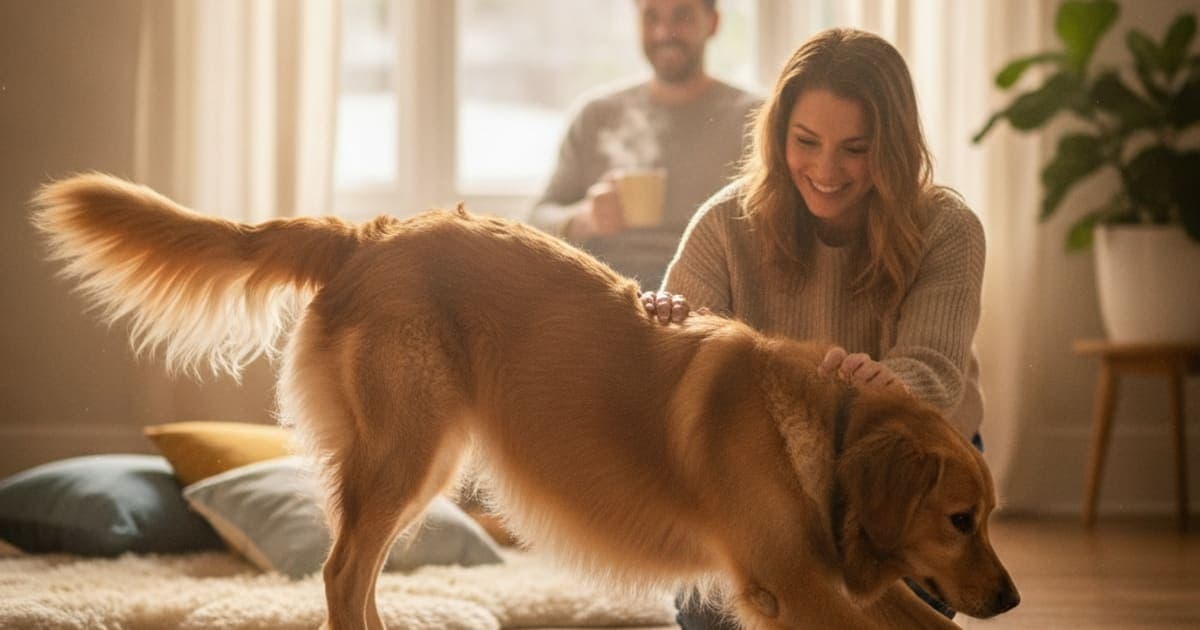
Should I worry if my dog is stiff in the morning?
Usually not, if it passes quickly. Brief morning stiffness that loosens within the first few minutes of movement is common in middle-aged and older dogs, and it generally reflects gradual joint and soft-tissue change rather than an emergency. Stiffness that lasts longer each week, worsens with exercise, or arrives with limping, swelling or obvious pain deserves a veterinary exam.
The reason even the mild version is worth attention is that morning stiffness is often the earliest visible sign of something structural happening inside a joint, long before a limp shows up. Dogs are relentless at hiding discomfort. A slow, careful first thirty seconds out of bed is frequently the first crack in that armour, and it is information you can act on early rather than late.
The plain-English biology of an overnight stiff dog
A dog's joints are lubricated by synovial fluid, which behaves a little like honey that thins when stirred. Movement warms it, thins it and spreads it across the cartilage surfaces. Hours of lying still do the opposite: the fluid becomes more viscous, the joint surfaces sit under steady pressure instead of the cyclical loading they prefer, and the first few steps feel gritty and reluctant.
Cartilage compounds this. It has no blood supply of its own. It is fed by the squeeze-and-release of loading, which pumps nutrients in and waste out. A long night of stillness means a long night without that pump. Add any low-grade inflammation already present in the joint capsule and the inflammatory mediators that accumulate overnight have nowhere to go until circulation picks up again.
Muscle does its share too. A dog that has spent the day subtly guarding a sore shoulder, hip or stifle recruits other muscles to compensate. Those muscles shorten and tighten overnight. Tendons and ligaments — dense, well-organised collagen with modest blood supply — are simply stiffer when cool and become more compliant as they warm.
Put together, that explains the classic pattern: rough first steps, noticeably better after a few minutes, close to normal after a short walk. It also explains the most useful distinction you can make at home. Stiffness that improves as your dog warms up points toward chronic joint change, while stiffness that gets worse the more your dog moves points toward an active injury — and that difference is the single most valuable observation you can bring to your veterinarian.
Stiffness that fades versus stiffness that stays
Pattern matters more than any single morning. Watch for a week, film the first minute after your dog gets up, and compare against the picture below.
| What you are seeing | Likely picture | Sensible next step |
|---|---|---|
| Loosens within the first few steps, no vocalising, normal appetite and energy | Age-related joint and soft-tissue change | Log it, film it, raise it at the next routine visit |
| Takes longer to warm out of it each week, or a new reluctance to jump or use stairs | Progressing degenerative joint change or an unresolved soft-tissue injury | Book a veterinary exam rather than waiting |
| Stiffness plus a limp that persists through the day, or that worsens after exercise | Structural problem such as a partial cruciate tear, shoulder instability or elbow disease | Veterinary exam soon; avoid off-lead running meanwhile |
| Shifting lameness across different legs, swollen joints, fever, appetite loss | Possible infectious or immune-mediated joint disease | Prompt veterinary appointment; bloodwork is usually needed |
| Sudden severe stiffness, hunched back, crying when touched, wobbling, knuckling or dragging paws | Possible spinal or neurological problem | Same-day emergency care |
The bottom two rows are not wait-and-see situations. Everything above them is a scheduling question rather than a panic question.
What is usually behind a stiff start to the day
Osteoarthritis is the most common explanation in older dogs. Cartilage thins, the joint capsule thickens and becomes inflamed, bone remodels at the joint margins, and the whole structure becomes less tolerant of long periods held in one position. It is progressive, but its pace is heavily influenced by body weight, muscle mass and how consistently the dog moves.
Developmental joint disease — hip dysplasia, elbow dysplasia, osteochondrosis — often announces itself years after the anatomy first went wrong, once secondary arthritic change has built up. Chronic soft-tissue injuries are another large group: supraspinatus and biceps tendinopathies, medial shoulder instability, iliopsoas strains and partial cranial cruciate ligament tears all produce a dog who is stiff first thing and worse after hard exercise.
Spinal change matters as well. Spondylosis, lumbosacral disease and disc disease can present as a stiff, reluctant rise and a shortened stride rather than an obvious limp. Systemic causes are less common but important: tick-borne infections and immune-mediated polyarthritis typically produce stiffness in more than one limb, often with fever or malaise. Finally, plain deconditioning and age-related muscle loss make every joint work harder, and excess body weight multiplies the load through every step.
This is exactly why home diagnosis fails. The management for a partial cruciate tear is not the management for immune-mediated joint disease, and only an examination can tell them apart.
What a veterinary work-up actually involves
Expect the exam to begin before anyone touches your dog. Your vet will watch the gait at a walk and a trot, ideally on a non-slip surface, looking for head nod, hip drop, shortened stride and weight shifted off a limb. Then comes hands-on work: standing palpation, joint-by-joint range of motion, pain on extension of the hips or elbows, cranial drawer and tibial compression tests for the stifle, shoulder abduction angles, and spinal palpation with a basic neurological screen.
From there, imaging. Radiographs under sedation give properly positioned views and are the usual first step; advanced imaging or arthroscopy may follow at a referral centre for soft-tissue problems that plain films cannot show. Bloodwork, tick-borne disease testing and joint fluid analysis come into play when several joints are involved or the dog is systemically unwell.
Treatment planning follows the diagnosis. Weight management is the highest-yield intervention in most stiff dogs. Prescribed analgesia may include a nonsteroidal anti-inflammatory, adjunct pain medication, or newer injectable options your vet may discuss for osteoarthritis pain. Structured rehabilitation — controlled loading, hydrotherapy, targeted strengthening — is not optional extra credit; it is often what determines the long-term result. Surgery is the right answer for some diagnoses, and delaying it rarely improves the outcome.
Talk to your veterinarian before changing anything about an existing plan. Never stop or reduce a prescribed medication because your dog looks better on a given morning; that improvement is frequently the medication working.
Daily management that genuinely makes mornings easier
Small environmental changes do more than owners expect:
- Warm up before load. A few minutes on lead before free running lets tissues warm gradually instead of being asked to sprint cold.
- Fix traction. Runners over slick floors, trimmed paw hair and short nails remove the scrabbling that torques joints on every rise.
- Upgrade the bed. Thick orthopaedic bedding, off cold floors and out of draughts, means fewer hours held in an awkward position.
- Remove the impact spikes. Ramps for the car, controlled stairs, and no repetitive jumping for a ball.
- Keep movement consistent. Several shorter daily walks beat a sedentary week followed by a weekend marathon.
- Keep the dog lean. Every kilogram off is load removed from every joint on every step, permanently.
- Follow the rehab homework. Sit-to-stand sets, cavaletti poles and prescribed range-of-motion work build the muscle that supports the joint.
Where peptide support fits into a recovery plan
Connective tissue is slow. Tendon, ligament and cartilage have modest blood supply, so repair depends on getting circulation to the site, getting repair cells to migrate into damaged matrix, and getting new collagen laid down in an organised way rather than as disorganised scar. That biology is the reason recovery timelines are measured in months, and it is the reason owners look for support during the window their dog is doing the work.
This is the space peptides occupy. BPC-157 is a synthesised peptide sequence derived from a protein identified in gastric juice; published preclinical animal research suggests it influences angiogenesis — the formation of new small blood vessels — and the migration of tendon fibroblasts, along with signalling involved in collagen remodelling. TB-500 is a synthetic fragment related to thymosin beta-4, a naturally occurring actin-binding protein; research indicates thymosin beta-4 plays a role in cell migration and tissue-repair signalling. This is emerging, genuinely promising science, and it is why the pairing has become the stack many owners adopt through a recovery period.
Be sceptical of the shelf, not of the biology. Plenty of joint chews list a dozen ingredients at dust-level inclusions, hide amounts behind a proprietary blend, and publish nothing about testing. pawgen takes the opposite approach with K9-REPAIR: a defined BPC-157 and TB-500 formulation made for dogs, weight-based dosing guidance, third-party testing with certificates of analysis, direct-to-door shipping, and a 60-day money-back guarantee.
BPC-157 and TB-500 are not FDA-approved veterinary drugs, and nothing here is a treatment claim for your dog. Discuss any addition with your veterinarian, especially alongside prescribed medication, and for puppies or pregnant or nursing dogs the dosing conversation belongs with your vet rather than with a label.
Key Takeaways
- Stiffness that fades within the first few minutes of movement is common in older dogs and is usually a scheduling conversation, not an emergency.
- Stiffness that worsens with activity, persists all day, or affects multiple limbs points toward an active injury or systemic disease and needs an exam.
- Sudden severe stiffness with a hunched back, crying, wobbling or knuckling is a same-day emergency.
- Film the first minute of your dog's morning for a week; that footage is better diagnostic input than any description.
- Leanness, traction, orthopaedic bedding and consistent low-impact movement are the highest-value daily changes.
- Peptide support such as K9-REPAIR is adopted by owners during recovery windows and sits alongside — never instead of — the veterinary plan.
Working alongside your veterinary team
If the exam points toward the front limb, it is worth reading further on what helps a dog with shoulder instability and on how long does shoulder instability take to heal in dogs, since shoulder problems are among the most commonly missed causes of a stiff, short-strided start to the day; owners supporting a dog through that window can read more about K9-REPAIR.
Your veterinarian owns the diagnosis and the treatment plan. Imaging, prescribed pain control, rehabilitation and surgery are the interventions that change structural outcomes, and they should be followed exactly as directed. Everything else — the weight work, the traction, the consistent movement, the recovery support you choose — operates inside the space that proper veterinary care creates.
Owners exploring peptide support for their dog can review K9-REPAIR — BPC-157 + TB-500 formulated for dogs — at https://pawgen.com/. BPC-157 and TB-500 are not FDA-approved veterinary drugs. Nothing in this article treats, cures or prevents any condition; every decision about your dog's care belongs with your veterinarian.
Frequently asked questions
- Why is my dog sleeping more than usual?
- Extra sleep usually reflects age, weather, a change in routine or recovery from a hard day of activity. It can also signal pain, low thyroid function, anaemia, infection or organ disease. Dogs in chronic joint pain often rest more because moving costs them something. A veterinary exam separates normal ageing from a medical cause.
- Should I worry if my dog is sleeping more than usual?
- A gradual, mild increase in sleep alongside normal appetite, drinking and enthusiasm is rarely urgent. Worry when the change appears suddenly or comes with appetite loss, weight change, vomiting, laboured breathing, pale gums, stiffness or reluctance to rise. Those combinations point toward pain or systemic illness and warrant a veterinary appointment.
- When should I take a dog to the vet for sleeping more than usual?
- Book an exam if the increase lasts more than a few days, and go immediately if it comes with fever, collapse, laboured breathing, pale gums, repeated vomiting, refusal to eat or difficulty standing. For senior dogs, go sooner rather than later, since routine bloodwork often reveals treatable causes early.
- What can I give a dog that is sleeping more than usual?
- Nothing should be given before a diagnosis, because the right support depends entirely on the cause and human medications can be dangerous for dogs. Your veterinarian may prescribe pain control or treatment for an underlying condition. Owners supporting joint and mobility recovery often add K9-REPAIR alongside that plan after discussing it with their vet.
- Is a dog sleeping more than usual an emergency?
- Usually not on its own, but it becomes an emergency when paired with collapse, laboured or noisy breathing, pale or blue gums, a distended abdomen, repeated vomiting, seizures or an inability to stand. Those combinations need same-day emergency care rather than a routine appointment scheduled for later in the week.
- Why is my dog irritable when handled?
- Irritability during handling is most often pain. Dogs guard sore joints, spines, ears, teeth and abdomens, so a dog that suddenly flinches, stiffens, growls or snaps when touched is usually protecting something. A sudden behaviour change like this deserves a veterinary exam before anyone treats it as a training problem.
- Is morning stiffness in dogs always arthritis?
- No. Osteoarthritis is the most common explanation in older dogs, but chronic tendon and ligament injuries, hip or elbow dysplasia, spinal change, tick-borne infections and immune-mediated joint disease all produce morning stiffness. Only an examination, imaging and bloodwork can separate them, which is why guessing at home is genuinely risky.
- Can a young dog be stiff in the morning?
- Yes. Young dogs get stiff from developmental joint disease such as hip or elbow dysplasia, from soft-tissue injuries picked up during hard play, and occasionally from infection or immune-mediated disease. Morning stiffness is far less expected in a young dog than a senior one and deserves prompt veterinary investigation.
Educational content. BPC-157 and TB-500 are not FDA-approved veterinary drugs. Talk to your veterinarian before starting anything new, especially if your dog is on prescribed medication.