Sundowning in Dogs: Treatment and Night-Time Care
You need professional help when night-time restlessness is new, worsening quickly, or paired with pacing, disorientation, house-soiling, crying or appetite changes, because pain, blood pressure problems, endocrine disease and vision loss all mimic sundowning. A veterinary exam separates true cognitive change from treatable medical causes before you start adjusting routines at home.
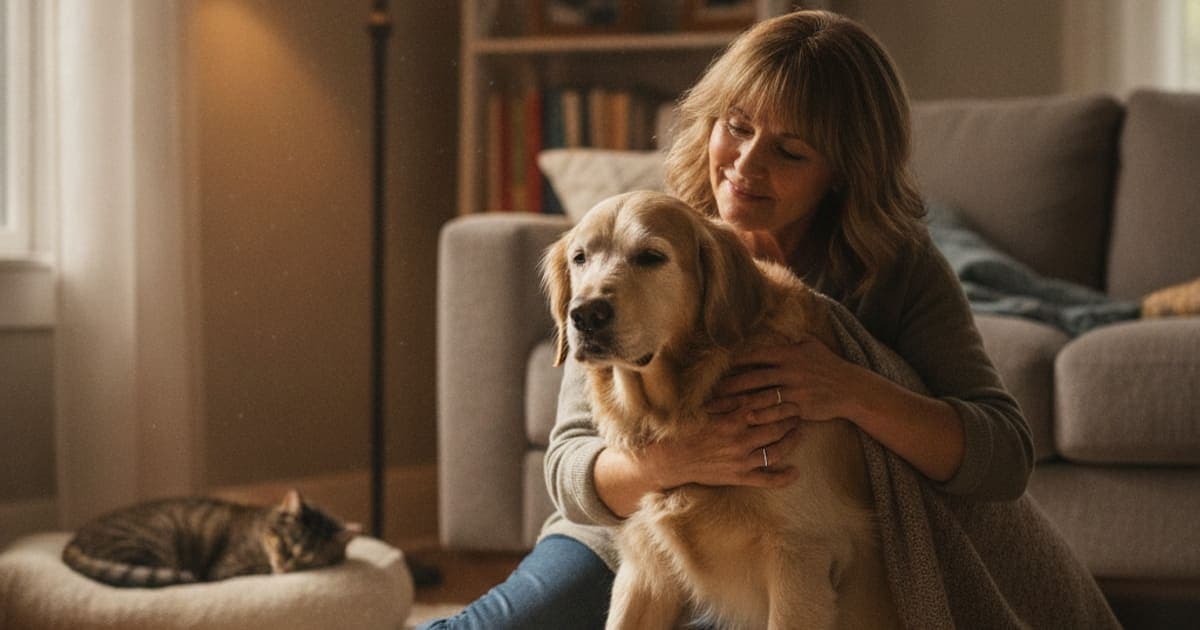
You need professional help when the night-time behaviour is new, when it is escalating week over week, or when it arrives alongside anything physical: panting at rest, house-soiling in a previously reliable dog, circling, stumbling, appetite shifts, or crying that does not settle when you appear. Those are the cues that something other than ordinary ageing is driving the restlessness. Sundowning, the late-day agitation and reversed sleep cycle associated with canine cognitive dysfunction, is identified by ruling other things out. Arthritic pain, failing vision or hearing, high blood pressure, endocrine disease, urinary problems and medication side effects all produce the same 2 a.m. pacing. A sudden change in a senior dog's night-time behaviour is a veterinary question first and a household-routine question second. Book the exam, then build the evening around what you learn.
What sundowning actually looks like in an older dog
Sundowning is not a separate disease. It is the evening and overnight expression of canine cognitive dysfunction, an age-related neurodegenerative process in dogs that shares features with human Alzheimer's disease, including accumulation of beta-amyloid protein in the brain and disruption of the sleep-wake cycle.
Veterinarians commonly screen for cognitive change using the DISHAA framework, which groups the signs into six categories: disorientation, altered interactions with people and other pets, sleep-wake cycle changes, house-soiling, activity level changes, and anxiety. Sundowning sits squarely in the sleep-wake and anxiety columns, but it rarely travels alone.
The night-time picture owners describe most often includes:
- Waking at roughly the same hour every night, often between midnight and 4 a.m.
- Pacing hallways, circling, or standing still in a corner or behind furniture
- Barking or whining at nothing identifiable, sometimes facing a blank wall
- Seeking the owner out, then failing to settle even with contact
- Deep, hard-to-rouse sleep during the day, then agitation after dark
- Getting stuck in tight spaces or on the wrong side of a doorway
One more pattern matters: the dog seems fine in daylight. Owners frequently delay a visit because the morning version of their dog looks normal. That daytime recovery is part of the picture, not evidence against it.
Signs this belongs in an exam room, not a routine tweak
Use this table to separate what is consistent with cognitive change from what needs a medical workup regardless of how much it looks like sundowning.
| Night-time sign | Consistent with cognitive change | Also worth ruling out medically |
|---|---|---|
| Pacing and circling | Yes | Arthritic or spinal pain, high blood pressure, vestibular disease |
| New overnight house-soiling | Yes | Urinary tract infection, kidney disease, diabetes, incontinence |
| Crying that does not settle | Yes | Pain, nausea, hearing or vision loss |
| Panting at rest overnight | Less typical | Pain, heart or respiratory disease, endocrine disease, drug effect |
| Bumping into furniture in low light | Sometimes | Cataracts, retinal degeneration |
| Onset over a few days | Rarely | Acute pain, neurological event, medication reaction |
Some signs justify same-day contact rather than a scheduled appointment: collapse, seizure activity, head pressing against a wall, relentless circling in one direction, unproductive straining to urinate, a distended abdomen, or sudden apparent blindness.
There is also a threshold that has nothing to do with your dog's chart. If you have been awake for weeks, if the household is running on fumes, or if you have started dreading nightfall, that alone is a legitimate reason to ask for professional help. Exhausted owners make worse decisions, and veterinary teams would far rather adjust a plan early than meet a family at breaking point.
What your veterinarian can offer once other causes are ruled out
A good workup for a restless senior usually includes a full physical, orthopaedic and neurological exam, blood pressure measurement, bloodwork and a urinalysis. Pain assessment deserves particular attention, because degenerative joint disease is extremely common in older dogs and is easy to miss in a stoic animal that only shows it when it cannot get comfortable at 3 a.m.
Once medical causes are addressed or excluded, your vet has real options. For cognitive dysfunction syndrome in dogs, your vet may prescribe medication as part of a long-term plan. Therapeutic diets formulated for senior brain support, including those built around medium-chain triglycerides, are another established route. Short-term support for anxiety or sleep is sometimes used to break a cycle of nightly waking, and ongoing pain control is often the single change that improves nights the most. Referral to a veterinary behaviourist is available when a case is complex. Results vary from dog to dog.
No one can hand you a dosing number from a web page, and you should be wary of any source that tries. Medication choices for an older dog with kidney, liver or cardiac changes, or one already on several prescriptions, belong in a conversation with the veterinarian who has the full history.
Building an evening a confused brain can follow
The practical goal is to make the last four hours of the day predictable, dim, quiet and physically easy to navigate. Most of what helps is structural rather than clever.
- Anchor the clock. Same walk time, same meal time, same bedtime, seven days a week. A degenerating circadian rhythm leans on external cues harder than a young one does.
- Front-load the day. Morning daylight exposure and an afternoon sniff walk or food puzzle give the brain real work. Dogs that sleep heavily all afternoon have nothing left to spend at night.
- Make the last toilet trip non-negotiable. Go out on lead, same spot, low light, no conversation. Before you restrict evening water, ask your vet, since that is the wrong move for dogs with kidney disease or on certain medications.
- Light the path. Low-level night lights along the route from bed to door reduce disorientation in dogs with ageing vision.
- Remove the traps. Block the gaps behind sofas and under beds where a circling dog gets wedged. Add non-slip runners across hard floors, which also helps a dog with sore hips stand up without scrabbling.
- Choose the bed carefully. A supportive orthopaedic bed in a gated area close to you, with familiar-smelling bedding and steady white noise, beats a crate the dog has started resisting.
- Keep wake-ups boring. Low light, calm voice, short toilet break, straight back to bed. No games, no treats, no bright overhead lights.
- Keep a log. Note wake times, what preceded them, and what helped. A two-week log is the most useful thing you can bring to your next appointment.
Mistakes that quietly make the nights worse
The most common error is filing the whole thing under old age and waiting several months before mentioning it. Cognitive change is progressive, and the earlier a plan starts, the more runway it has.
Close behind: stopping a prescribed medication without asking. If your dog seems groggy or disoriented in the evening on a prescribed medication of any kind, that is worth a phone call, not a unilateral decision. Stopping pain control in an arthritic senior tends to make nights considerably worse, not better.
Other patterns to avoid include escalating stimulation at night, since a late-night play session to tire the dog out usually hard-wires the waking; raising your voice or punishing a dog that genuinely does not know where it is; and changing five things at once, which leaves you unable to tell what worked.
Then there is the supplement aisle. Plenty of calming chews are built as kitchen-sink labels: twelve ingredients listed in impressive order, trace amounts of each, no batch testing, no certificate of analysis, and marketing doing the work that evidence should. Scrutinise what is in a product, how much of it is there, and whether the company publishes third-party test results for the batch you received.
The body underneath the behaviour
Sleep and physical comfort are inseparable in an old dog. A dog whose hips ache cannot get comfortable, and a dog that cannot get comfortable wakes, stands, repositions, and then struggles to settle again. For many seniors, part of what gets labelled sundowning is a cognitive problem layered on top of a musculoskeletal one. Your vet owns the pain diagnosis and the prescription plan; what you can do is support the structural side of mobility alongside it.
That is the space K9-REPAIR occupies. It is a peptide formulation for dogs combining BPC-157 and TB-500, aimed at joint, tendon and mobility recovery rather than at cognition. BPC-157 is a synthetic peptide based on a sequence identified in gastric juice, and published research suggests it may support angiogenesis and tissue-repair signalling in tendon, ligament, muscle and gut tissue. TB-500 is a synthetic fragment related to thymosin beta-4, a naturally occurring protein involved in actin regulation and cell migration, both central to how connective tissue remodels after damage. This is emerging and promising science that a growing number of owners are adopting as the stack they run through recovery and through ageing.
Being straight about what that means: BPC-157 and TB-500 are not FDA-approved veterinary drugs, pawgen's material is educational, and nothing here is a statement about what will happen in your specific dog. Owners report using it as part of a broader mobility plan, and research into both peptides continues to develop. What pawgen can state plainly is descriptive: the formulation is third-party tested with batch certificates published, dosing guidance is weight-based and worth setting with your veterinarian, it ships direct to your door, and it is backed by a 60-day money-back guarantee.
Key takeaways
- Sundowning is identified by exclusion, so new or worsening night-time restlessness in a senior dog warrants a veterinary exam before any home plan.
- Pain, blood pressure problems, urinary disease, endocrine disease and vision loss all imitate cognitive change at night.
- DISHAA is the framework your vet will likely use; bring a two-week log of wake times and triggers.
- Prescription options for cognitive dysfunction exist, and therapeutic diets are an established route. Dosing is your vet's decision, never a number from a web page.
- Predictable timing, morning daylight, afternoon mental work, night lights, non-slip flooring and boring wake-ups do most of the practical work.
- Never stop a prescribed medication because nights got harder. Call instead.
- Comfort and mobility sit underneath sleep quality, which is why many owners address the musculoskeletal side in parallel.
Your veterinarian owns the diagnosis and the treatment plan. Surgery, prescribed medication, pain management and a structured behaviour plan are the foundation, and nothing should displace them. Supplements and peptides operate in the space that proper veterinary care creates, supporting an older dog's comfort while the medical side does its job. Talk to your vet before adding anything new, especially for a senior on multiple prescriptions.
Formulation details and weight-based guidance for K9-REPAIR are on the pawgen shop page, batch certificates of analysis are published for every production run, and current shipping coverage is listed separately.
Owners exploring peptide support for their dog can review K9-REPAIR, BPC-157 + TB-500 formulated for dogs, at https://pawgen.com/. BPC-157 and TB-500 are not FDA-approved veterinary drugs. Nothing in this article treats, cures or prevents any condition; every decision about your dog's care belongs with your veterinarian.
Frequently asked questions
- How can I tell whether I need professional help with supporting sleep in a senior dog with cognitive changes?
- Call your veterinarian when the pattern is new, worsening weekly, or paired with pacing, disorientation, house-soiling, crying, panting or appetite changes. Pain, vision loss, high blood pressure and endocrine disease all mimic sundowning. If your routine adjustments stop working, or the household is losing sleep nightly, that alone justifies a professional reassessment.
- What are some common mistakes pet owners make with supporting sleep in a senior dog with cognitive changes?
- The biggest mistakes are waiting months because it looks like ordinary ageing, stopping a prescribed pain or anxiety medication without asking the vet, adding late-night stimulation to tire the dog out, scolding a disoriented dog, changing several things at once, and buying unlabelled calming chews with no third-party batch testing.
- What practical steps can I take to manage supporting sleep in a senior dog with cognitive changes?
- Anchor walks, meals and bedtime to the same times daily, get morning daylight, use afternoon sniff walks and food puzzles, then dim the last hours. Add night lights, non-slip runners, a supportive bed near you, and keep overnight wake-ups short and boring. Log wake times for your vet.
- How to help sundowning symptoms in dogs
- Start with a veterinary exam to rule out pain, urinary disease, blood pressure problems and vision loss, because those imitate sundowning. Then build a predictable evening: consistent timing, daytime mental work, a final lead-only toilet trip, low lighting, white noise and a safe, navigable sleeping area close to you.
- How to help your dog with sundowning
- Treat it as a medical question first and a routine question second. Your vet may address pain, prescribe medication for cognitive dysfunction, or recommend a therapeutic senior diet. At home, keep the schedule rigid, light the route to the door, remove furniture gaps where a circling dog gets stuck, and stay calm overnight.
- How to calm a restless senior dog at night
- Keep responses low-key: dim light, quiet voice, a short toilet break, then straight back to a supportive bed. White noise and familiar-smelling bedding help. Avoid games, treats or bright lights at wake-ups, since those reinforce waking. If restlessness continues most nights, ask your veterinarian to reassess pain and medication.
- Why does canine cognitive dysfunction get worse at night?
- Cognitive dysfunction disrupts the sleep-wake cycle itself, so many dogs sleep heavily by day and become agitated after dark. Fading light removes visual landmarks an ageing dog relies on, the house goes quiet, and joint discomfort surfaces during long periods of lying still. Those factors stack into night-time restlessness.
- Can K9-REPAIR replace veterinary care for a dog with sundowning?
- No. K9-REPAIR is a BPC-157 and TB-500 peptide formulation focused on joint, tendon and mobility recovery, not a cognitive product, and these peptides are not FDA-approved veterinary drugs. Because comfort affects sleep quality, many owners run it alongside a vet-led plan. Discuss anything new with your veterinarian first.
Educational content, not veterinary advice. Ask your vet about your dog.