TB-500: Injecting a Large Dog Alone — Handling Guide
Most owners can administer TB-500 to a large dog alone, and success depends more on setup than strength: a position your dog holds comfortably, a fully prepped tray within arm's reach, and a veterinarian who has demonstrated the technique on your own dog first. Amount and frequency stay with your vet.
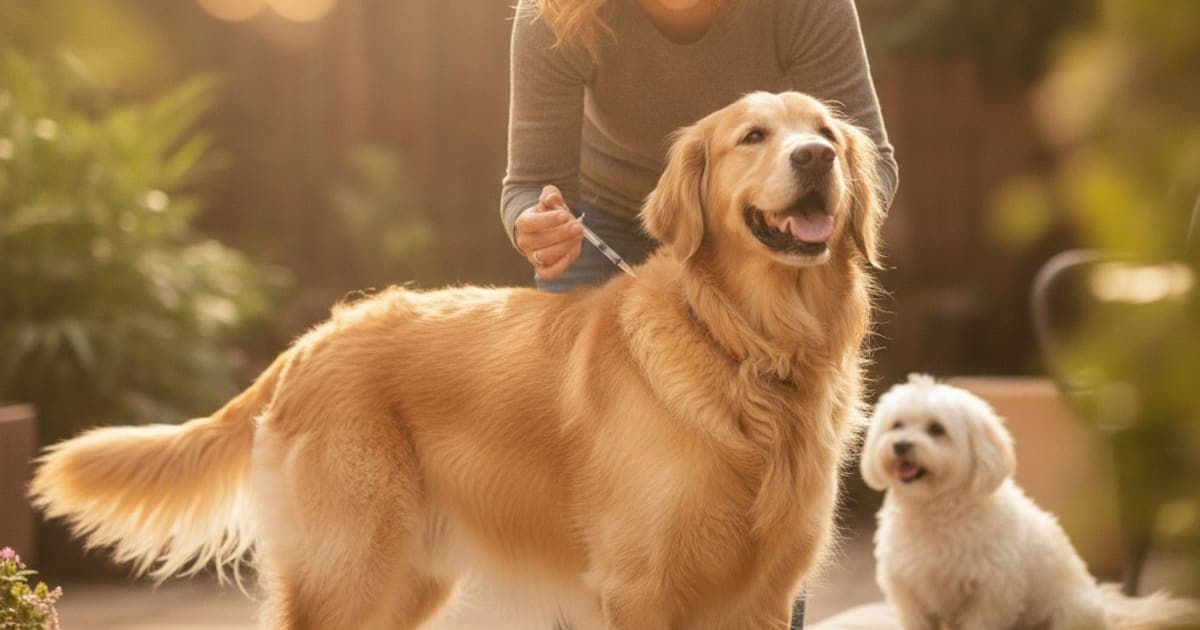
Yes — most owners of a large dog can handle peptide administration without a second pair of hands, and the reason it works has far more to do with setup than with strength. A ninety-pound retriever is not harder to inject than a terrier; he is harder to reposition if the first attempt goes sideways. So the solo workflow is built around three things: a position your dog can hold comfortably without being restrained, a tray where every item is within one arm's reach, and a veterinarian who has watched you do it once before you do it alone.
One thing this article deliberately does not contain: numbers. No volumes, no frequencies, no schedules. Route, format, amount and timing are decisions for your veterinarian, who knows your dog's weight, bloodwork, surgical history and current medications. Ask them to demonstrate on your own dog, in the room, and to watch you repeat it back. That single appointment removes most of what owners lie awake worrying about.
Why a big dog is a different handling problem, not a harder one
With a small dog, you can physically control the whole animal with one forearm. With a large dog, you cannot — and trying to is exactly what turns a five-second event into a wrestling match. Large dogs brace, lean, and use their body weight as a lever. They also read your body language at a distance, so tension in your shoulders registers before the tray is even open.
The trade-off runs in your favour in one respect: larger dogs generally have more loose, mobile skin over the shoulders and along the flank, which makes the target area easier to identify and tent than it is on a compact dog. What you lose in control you gain in landmarks.
The genuine risks of going solo are practical, not dramatic: your dog stands up mid-motion, a needle bends or loses sterility on the floor, you get an accidental needlestick while trying to recap one-handed, or your dog learns to leave the room when he sees the tray. Every one of those is preventable with sequencing.
There is also the recovery context to respect. Many large dogs on a peptide protocol are post-operative — a cruciate repair, a TPLO, a shoulder or elbow procedure — and may be in a cone, on strict activity restriction, sore, and taking prescribed pain medication. Work around those restrictions rather than through them, and keep your surgeon's post-op instructions as the governing document.
The setup that does most of the work
Build the environment first. Everything below is done before your dog is invited into the room.
- A non-slip surface. A yoga mat, rubber-backed runner or bath mat. A large dog whose feet slip will brace, and a bracing dog will move.
- A wall or corner. Two solid surfaces on one side of your dog do the job a second person would otherwise do, without any force.
- One tray, fully loaded. Product, sharps container already open, alcohol wipes or gauze if your vet advised them, gloves if you use them, and the reward. Nothing that requires you to stand up mid-procedure.
- Good overhead light. Not a phone torch you have to hold.
- A reward that occupies the mouth. A lick mat smeared with something high-value and pressed to the floor or a wall at head height gives your dog a job that faces him away from your hands.
- Your phone silenced and the household briefed. A doorbell at the wrong moment is the most common interruption there is.
- A short written log — date, site used, anything you noticed. It takes ten seconds and it is genuinely useful at the next vet visit.
The single biggest determinant of a smooth solo administration is not hand speed or nerve — it is how boring you have made the whole event for your dog before the needle ever appears.
Spend a few days rehearsing the entire sequence with no product at all: tray out, dog on mat, lick mat down, skin tented, treat, done. Dogs habituate to predictable, unremarkable routines remarkably fast. Owners who skip this step are the ones who end up chasing a dog around a kitchen island.
Positioning options when you don't have a second pair of hands
There is no single correct position — there is the one your particular dog will hold. Test each in rehearsal and commit to the winner.
| Position | How it works solo | Best for | Watch out for |
|---|---|---|---|
| Standing in a corner, you kneeling beside | Two walls block lateral movement; your knee and shin close the third side | Confident dogs who dislike being restrained | Dogs who panic when boxed in |
| Standing, head into a wall-mounted lick mat | Occupies the mouth and fixes the head away from your hands | Food-motivated large breeds | Needs the mat secured, not held |
| Sitting, facing away from you, back against your legs | Your legs stop the reverse; the sit stops the sideways step | Well-trained dogs with a solid sit | Sore hips or post-op dogs who cannot sit comfortably |
| Lying on their side on a dog bed | Lowest centre of gravity, easiest access along the flank | Older or post-operative dogs already used to side-lying | Dogs who take the down as a cue to get up again |
| Standing on a raised grooming platform | Brings the target area to your hands and reduces your bending | Dogs already comfortable with grooming tables | Fall risk; unsuitable for unsteady or post-op dogs |
For dogs recovering from orthopaedic surgery, ask your veterinary team which of these positions is compatible with the current stage of the repair. Some sits, downs and step-ups are off the table for weeks.
A calm sequence you can repeat identically every time
Sameness is the technique. Run the same order, in the same room, at the same time of day.
- Wash your hands and lay out the tray in the same arrangement every session.
- Read the label and check the expiry date, and follow the storage instructions provided with your product rather than assuming.
- Prepare the dose exactly as your veterinarian demonstrated — and if anything about the product looks or smells different from usual, stop and call them instead of proceeding.
- Invite your dog in, cue him into position, and start the lick mat before you touch anything else.
- Locate the site your vet showed you and rotate sites session to session. Keep a mental map so you are not returning to the same spot repeatedly.
- Tent the skin with your non-dominant hand and insert as demonstrated — one committed, unhurried motion. Hesitation is what dogs react to.
- Deliver steadily, withdraw along the same line, and release the tent.
- Drop the sharp straight into the open container. Never recap one-handed, never re-use a needle, and dispose of sharps according to your local rules.
- Reward, release the position, and go do something completely unrelated. The session should end with your dog thinking nothing happened.
- Log it.
If the whole thing feels like a fight in the first week, do not white-knuckle through it for a month. Go back to your veterinarian, or ask about a technique session with a veterinary nurse or a fear-free-trained handler. That is a normal request and they hear it often.
When it doesn't go to plan
Your dog stands up or turns mid-procedure
Stop. Withdraw cleanly, put the sharp in the container, and reset. Do not chase a moving target with a needle in your hand. Re-establish the position, restart the lick mat, and use a fresh sharp — not the one that just travelled through the air.
You're not sure the full amount went in
Do not guess and do not top up. Log exactly what you observed and contact your veterinarian for guidance on what to do next. This is the single most common reason to call, and it is a completely reasonable one.
There's a small lump, a bead of moisture, or a spot of blood
A little moisture at the site or a brief spot of blood is not unusual. Note it in your log. Anything that looks like persistent swelling, heat, pain on touch, discharge, or a change your dog keeps returning to with his mouth is a call to the clinic, not something to monitor indefinitely.
Your dog now leaves the room when the tray appears
He has learned an association, which means he can learn a different one. Uncouple the cues: bring the tray out at random times with nothing but treats attached, feed dinner on the mat, and reintroduce the sequence in stages. It costs a week and saves the next several months.
He's post-operative and in a cone
Cones change how a dog turns, how he judges distance, and how confident he feels being approached. Practise the position with the cone on before it matters, and confirm site selection with your surgeon so you stay well clear of incisions, sutures and bandaging.
Where TB-500 and BPC-157 fit in a recovery plan
TB-500 is a synthetic peptide based on a fragment of thymosin beta-4, a naturally occurring protein. Published preclinical research suggests it interacts with actin, the protein scaffolding that lets cells change shape and migrate — the machinery involved in cell movement and new blood-vessel formation. BPC-157 is a short peptide chain derived from a protein found in gastric juice, and research suggests it may support angiogenesis and the growth activity of connective-tissue cells. Neither is an FDA-approved veterinary drug, and neither treats, cures or fixes anything. What the science describes is mechanism, and mechanism is why owners going through tendon, ligament and mobility recovery have adopted them.
That is the thinking behind K9-REPAIR from pawgen: both peptides in one dog-specific formulation, dosed by weight, third-party tested with certificates of analysis available, shipped direct to your door, and backed by a 60-day money-back guarantee. It is the stack owners reach for through recovery rather than a shelf of underdosed kitchen-sink chews whose labels list twenty ingredients and quantify none of them. Ask your veterinarian to fold it into the plan they are already running — the rehab, the restriction, the prescribed medications — not to replace any part of it.
Key Takeaways
- Solo administration with a large dog is a setup problem, not a strength problem. Corner, mat, tray, lick mat.
- Have your veterinarian demonstrate on your dog and watch you repeat it before you go it alone.
- Rehearse the full sequence with no product for several days so the event becomes unremarkable.
- Pick one position your dog will actually hold, and use it every single time.
- Never chase a moving dog with a needle, never recap one-handed, never re-use a sharp.
- Route, amount and frequency come from your vet — no article, forum or label should replace that conversation.
- Research on BPC-157 and TB-500 describes mechanism, and owners report using them through recovery; that is honest framing, and it is the framing to hold.
If you are at the very beginning of this, the first time k9-repair guide walks through the practical basics, and there is a deeper explanation of the science in the guide on how to use bpc-157 for dogs.
Your veterinarian owns the diagnosis, the imaging, the surgical decision and the medication plan — including whether a peptide belongs in it at all. Their care is what creates the window in which recovery happens. Supplements and peptides work inside that window, alongside the rehab and the rest, never instead of them.
Owners exploring peptide support for their dog can review K9-REPAIR — BPC-157 + TB-500 formulated for dogs — at https://pawgen.com/. BPC-157 and TB-500 are not FDA-approved veterinary drugs. Nothing in this article treats, cures or prevents any condition; every decision about your dog's care belongs with your veterinarian.
Frequently asked questions
- What can I give a dog that is stiff after resting?
- Start with your veterinarian, because post-rest stiffness in a large dog usually points to a joint or soft-tissue issue that needs diagnosing. Within a vet-led plan, owners commonly use weight management, controlled warm-up walks, orthopaedic bedding, prescribed medication where indicated, and peptide formulations such as pawgen's K9-REPAIR through recovery.
- Is a dog stiff after resting an emergency?
- Usually not an emergency, but it is not something to ignore either. Gradual stiffness that eases with movement warrants a routine appointment. Sudden inability to rise, a non-weight-bearing limb, crying out, dragging a leg, or stiffness with fever, collapse or laboured breathing is urgent — call your veterinarian immediately.
- Why is my dog stiff in the morning?
- Morning stiffness happens because joint fluid thickens and soft tissue tightens during hours of inactivity, so the first movements are the least comfortable. In dogs it is often linked to osteoarthritis, previous injury, hip or elbow changes, or muscle compensation from an old limp. Your veterinarian can identify which applies.
- Should I worry if my dog is stiff in the morning?
- Treat it as information rather than a crisis. Occasional stiffness after hard exercise is common; stiffness that recurs most mornings, worsens over weeks, or comes with reluctance to jump, climb stairs or play is a genuine signal. Book a veterinary exam so the underlying cause gets identified early.
- When should I take a dog to the vet for stiff in the morning?
- Book an appointment once stiffness appears on most mornings, persists beyond a week, or changes your dog's willingness to move. Go sooner for a limp lasting more than a day or two, sudden onset, obvious pain, swelling, heat in a joint, appetite loss, or any non-weight-bearing leg.
- What can I give a dog that is stiff in the morning?
- Whatever your veterinarian recommends after examining your dog, since the right approach depends on the cause. Common elements include prescribed pain management, controlled exercise, weight control, physical rehabilitation and supportive bedding. Many owners also add a BPC-157 and TB-500 formulation such as K9-REPAIR alongside that plan, not instead of it.
- Can I really administer TB-500 to a large dog by myself?
- Most owners can, provided a veterinarian has demonstrated the technique on their own dog first. Success depends on setup rather than strength: a non-slip mat, a corner or wall, a fully prepared tray within reach, and a lick mat to occupy your dog's attention throughout the session.
- How much TB-500 does a large dog need?
- That is a question for your veterinarian, not an article. Amount, frequency, route and product format depend on your dog's weight, health status, surgical history and current medications. pawgen's K9-REPAIR is formulated with weight-based dosing, and your vet should confirm how it fits your dog's specific recovery plan.
Educational content. BPC-157 and TB-500 are not FDA-approved veterinary drugs. Talk to your veterinarian before starting anything new, especially if your dog is on prescribed medication.