TB-500 Results After 2 Weeks for Dogs — What to Expect
Two weeks in, most owners report subtle changes rather than dramatic ones: a slightly easier rise from the floor, a longer walk before lagging, less stiffness after rest. TB-500 works through tissue-level processes that unfold over weeks, so the fortnight mark is an early checkpoint, not a verdict.
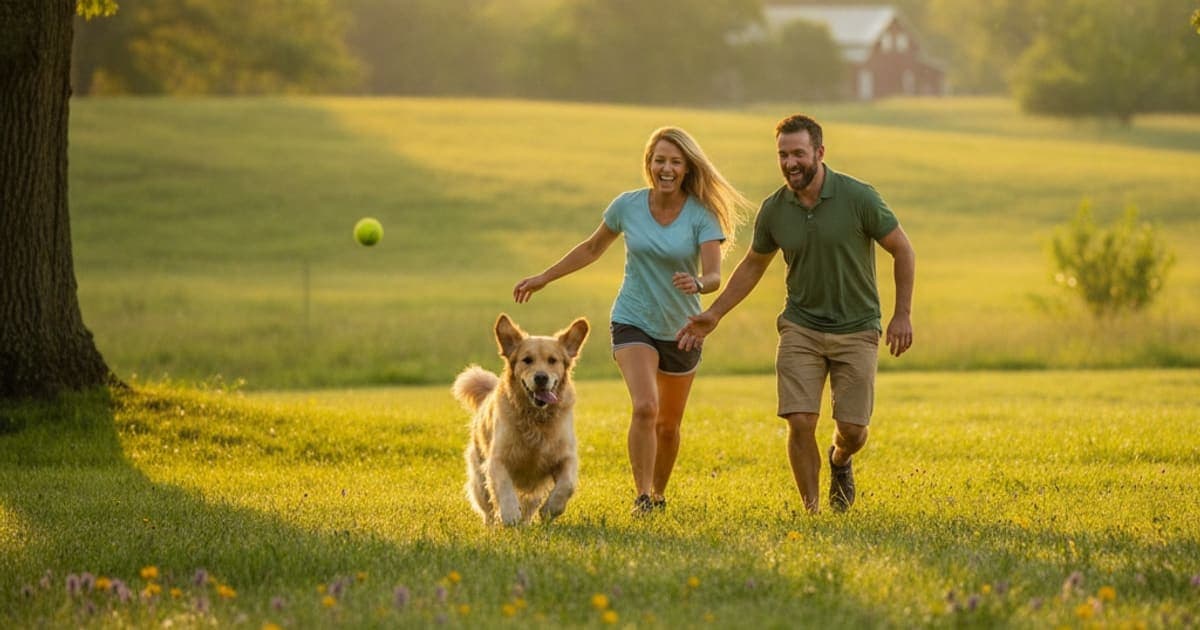
TB-500 Results After 2 Weeks for Dogs
At the two-week mark, the changes owners report with TB-500 are usually small and behavioural rather than dramatic: an easier rise off a cold floor in the morning, a few extra minutes before the dog starts lagging on a walk, less shuffling at the bottom of the stairs at night. TB-500 is a synthetic peptide related to thymosin beta-4, a protein that occurs naturally in mammalian cells, and the laboratory research on that protein describes processes — cell migration, new blood-vessel formation, modulation of inflammatory signalling — that unfold over weeks and months, not days.
That matters for how you read day fourteen. Two weeks is an early checkpoint on a repair timeline measured in months, so the right question is not "has it worked?" but "is the trend moving in the right direction?" TB-500 and BPC-157 — the two peptides in K9-REPAIR, the stack many owners run through a recovery period — are not FDA-approved veterinary drugs, and nothing here is a promise about your dog. It is a description of what the science suggests, what owners report, and how to observe your own dog honestly while your veterinarian runs the case.
What two weeks actually covers inside a healing tendon
Soft tissue repair moves through overlapping phases, and knowing where day fourteen sits inside them explains almost everything about realistic expectations.
The inflammatory phase comes first, measured in hours to days. Bleeding stops, immune cells clear damaged tissue, and signalling molecules recruit the cells that will do the rebuilding. It is uncomfortable and it is necessary.
The proliferative phase follows and runs for weeks. Fibroblasts arrive at the injury site and lay down a provisional collagen scaffold, while new capillaries grow in to supply it. This scaffold is disorganised — the fibres are not yet aligned along the lines of force the tendon or ligament will have to carry.
The remodelling phase is the long one, running for months. Under gradual, controlled load, that provisional matrix is replaced and reorganised into aligned, load-bearing tissue. This is why a rehab plan for a cruciate repair or a chronic tendinopathy is written in months.
So at fourteen days your dog is somewhere in the middle of scaffold-building. The tissue is more comfortable than it was, and often noticeably so, but it is not yet strong. That gap between comfort and structural readiness is the single most dangerous window in canine recovery, because a dog that feels better will do exactly what it did before — sprint after a squirrel, launch off the sofa, take the stairs three at a time. Early comfort is not permission to increase activity. Activity levels come from the rehab plan your veterinarian or a certified canine rehabilitation practitioner set, not from how bright the dog looks on a Tuesday.
The mechanism behind the small changes owners notice
Thymosin beta-4 is one of the most abundant actin-binding proteins inside cells. It binds monomeric actin and participates in the constant assembly and disassembly of the cytoskeleton — the internal scaffolding that lets a cell change shape and physically crawl toward a damaged area. Published laboratory research describes thymosin beta-4 in the context of cell migration, angiogenesis and the regulation of inflammatory signalling, and it has been examined in wound-healing and corneal repair models.
TB-500 is a synthetic peptide built around the active region of that molecule. The interest for recovery is straightforward: repair depends on the right cells arriving at the right place with a blood supply behind them, and research suggests thymosin beta-4 is involved in both halves of that equation. Because it is a small, mobile molecule, the research interest has been in tissue-wide support rather than a single targeted joint — which is part of why owners with a dog that is stiff in more than one place gravitate toward it.
None of that is an outcome promise for your dog. It is mechanism, and mechanism is the honest level at which to discuss an emerging and promising area of peptide science that a growing number of owners are choosing to adopt. What owners consistently report at two weeks is not a transformation; it is a dog that seems to be moving more freely than it was, on a trajectory they want to keep watching.
Why TB-500 is rarely run on its own
Most owners researching TB-500 arrive quickly at BPC-157, and the two are commonly used together because the research literature describes them acting on different parts of the same problem.
| Peptide | What it is | What research describes | Why owners pair it |
|---|---|---|---|
| TB-500 | A synthetic peptide related to thymosin beta-4, an actin-binding protein found naturally in cells | Roles in cell migration, angiogenesis and modulation of inflammatory signalling in laboratory and wound-healing models | Broad, tissue-wide interest — useful when stiffness or injury is not confined to one joint |
| BPC-157 | A synthetic peptide based on a sequence identified in gastric juice | Preclinical work describing fibroblast activity, blood-vessel formation via growth-factor pathways, and gut-lining interest | Focused tendon, ligament and gut-comfort interest, especially alongside prescribed anti-inflammatories |
| K9-REPAIR (both) | pawgen's BPC-157 + TB-500 formulation for dogs, with weight-based dosing guidance | Combines the two mechanisms above rather than relying on either alone | The stack owners run through a recovery period, third-party tested with COAs and shipped direct to the door |
If you are two weeks into a peptide protocol and reading this, you are almost certainly running both. That is worth knowing when you interpret what you are seeing — you are watching a combination, not an isolated variable.
Building an honest two-week record
The biggest problem at day fourteen is not the biology. It is memory. Owners are with their dog every day, and gradual change is exactly the kind our brains are worst at detecting — in both directions. A structured record fixes that, and it gives your vet something far more useful than "he seems a bit better."
| What to observe | How to capture it | Why it matters at two weeks |
|---|---|---|
| First rise of the morning | Ten seconds of video from the side, same spot, before any movement | Overnight stiffness is one of the most sensitive early markers of joint and soft-tissue comfort |
| First five minutes of a walk | Same route, same time of day, note where the lag starts | Warm-up lameness that shortens is a meaningful trend |
| Stairs, car, sofa | Note hesitation, refusal, or a change in which limb goes first | Reveals confidence in a limb before it shows in gait |
| Sit posture | Photo from behind | A kicked-out or sloppy sit is a classic stifle indicator worth tracking |
| Evening settling | Note pacing, position changes, reluctance to lie down | Late-day discomfort often changes before daytime gait does |
| Willingness | Does the dog offer to go out, or wait to be asked? | Owners frequently report willingness shifting earlier than mechanics |
Video beats notes, and notes beat memory. Take the same shots every few days on the same surface, and hold them for your next appointment.
When the two-week check-in should send you back to the vet
Some findings are not a matter of waiting for a trend. Contact your veterinarian promptly if your dog will not bear weight on a limb, if lameness worsens suddenly rather than gradually, if there is heat, marked swelling or a surgical incision that looks wrong, if the dog yelps on movement or handling, or if appetite, drinking or toileting change. A new limp on the opposite side deserves attention too — dogs offload a painful leg onto the good one, and the second injury is common.
Two other rules matter here. First, never stop or reduce a prescribed medication — carprofen, Librela, gabapentin, prednisone or anything else — in order to "test" whether a supplement is doing the work. That decision belongs to the prescribing vet, who can taper safely and interpret the result. Second, surgery timing and rehab progression are veterinary decisions. A dog looking brighter at two weeks is not a reason to postpone a planned procedure; it is information to bring to the person making the plan.
What separates a formulation worth fourteen days of your attention
If you are going to run a two-week observation window, run it on something you can actually evaluate. Plenty of the joint aisle is designed to be un-evaluable: twenty-ingredient chews where every input sits at a level chosen for the label rather than the dog, proprietary blends that hide how much of anything is in there, and brands with far more marketing than analysis behind them. You cannot read a trend off a product that will not tell you what it contains.
K9-REPAIR takes the opposite position — BPC-157 and TB-500, weight-based dosing guidance rather than one-size-fits-all scoops, third-party testing with certificates of analysis, direct-to-door shipping, and a 60-day money-back guarantee that exists precisely because sensible owners want a real observation window before they commit. Discuss it with your veterinarian, particularly if your dog is post-operative, on prescription medication, pregnant or nursing, or still a puppy; dosing questions in those situations belong in the exam room, not on a blog.
Key Takeaways
- At two weeks, owners typically report subtle shifts — easier rising, longer walks before lagging, less evening stiffness — rather than dramatic change.
- Fourteen days sits inside the proliferative phase of repair: the scaffold is being built but is not yet strong or aligned.
- Improved comfort is not improved structure. Activity increases come from your vet's rehab plan, not from how the dog looks.
- Research on thymosin beta-4 describes cell migration, angiogenesis and inflammatory modulation — mechanism, not an outcome promise.
- Video and a fixed observation routine beat memory when judging gradual change.
- Non-weight-bearing, sudden worsening, swelling or incision problems mean a call to the vet, not a longer wait.
For a view of how the same trajectory reads further along, see the wolverine stack results after 3 weeks for dogs and the wolverine stack results after 1 month for dogs; full formulation and testing details for K9-REPAIR sit on pawgen's main site.
Your veterinarian owns the diagnosis, the imaging, the pain-management plan and the decision about what your dog's tissue is ready to do. Peptides and supplements operate inside the space that proper veterinary care creates — they do not replace it, and the two-week record you build is at its most valuable when it lands on your vet's desk.
Owners exploring peptide support for their dog can review K9-REPAIR — BPC-157 + TB-500 formulated for dogs — at https://pawgen.com/. BPC-157 and TB-500 are not FDA-approved veterinary drugs. Nothing in this article treats, cures or prevents any condition; every decision about your dog's care belongs with your veterinarian.
Frequently asked questions
- What can I give a dog that is slowing down on walks?
- Start with a veterinary exam, because slowing down has many causes — arthritis, soft-tissue injury, cardiac or metabolic issues. Once your vet has a diagnosis, owners commonly add joint support alongside prescribed care, including peptide formulations such as K9-REPAIR. These are not FDA-approved veterinary drugs, so discuss any addition with your vet.
- Is a dog slowing down on walks an emergency?
- Usually not, but sometimes yes. Gradual slowing over weeks warrants a routine appointment. Sudden collapse, laboured breathing, pale gums, an inability to bear weight, or a dog that stops mid-walk and cannot continue is an emergency — call a veterinarian immediately rather than waiting to see whether it improves.
- Why is my dog lagging behind on walks?
- Common causes include osteoarthritis, cruciate or other soft-tissue injury, hip or elbow disease, paw and nail problems, spinal pain, cardiac or respiratory limitation, thyroid issues, obesity, or simply heat and fatigue. Age alone is not a diagnosis. A veterinary exam, and often imaging or bloodwork, separates these possibilities properly.
- Should I worry if my dog is lagging behind on walks?
- It is worth investigating rather than worrying. Dogs hide pain well, so a change in walking stamina is often the first visible sign of a problem that has been developing quietly. Record video and note when the lagging starts, then book a veterinary appointment to identify what is actually driving it.
- When should I take a dog to the vet for lagging behind on walks?
- Book an appointment if the lagging persists beyond a few days, worsens, or comes with limping, stiffness after rest, reluctance on stairs, or reduced appetite. Go urgently for non-weight-bearing lameness, breathing difficulty, collapse, pale gums, or sudden severe pain. Earlier assessment generally means more options.
- What can I give a dog that is lagging behind on walks?
- Nothing should go in ahead of a diagnosis. After your vet identifies the cause, the plan may include prescribed medication, weight management and structured rehab, with joint and recovery support layered alongside it — the BPC-157 and TB-500 combination in K9-REPAIR is one option owners adopt. Confirm suitability with your veterinarian.
- How long does TB-500 take to show changes in dogs?
- There is no fixed timeline, and it varies with the dog, the tissue and the underlying problem. Because the processes research describes — cell migration, blood-vessel formation, tissue remodelling — run over weeks to months, most owners treat two weeks as an early checkpoint and reassess with their veterinarian over a longer window.
- Should I stop if I see nothing after two weeks?
- Not necessarily, but stop guessing and start measuring. Compare video from day one against today, review your notes with your veterinarian, and confirm the underlying diagnosis and rehab plan are right. pawgen's 60-day money-back guarantee exists so owners can give an honest observation window without pressure.
Educational content. BPC-157 and TB-500 are not FDA-approved veterinary drugs. Talk to your veterinarian before starting anything new, especially if your dog is on prescribed medication.