TB-500 vs Turmeric for Dogs: Which One Fits Recovery
TB-500 and turmeric aren't interchangeable: TB-500 is a peptide studied for its role in cell migration and tissue repair signalling, while turmeric's curcumin is studied for inflammatory modulation and comfort. For owners focused on tendon, ligament and joint recovery, TB-500 is the more targeted choice.
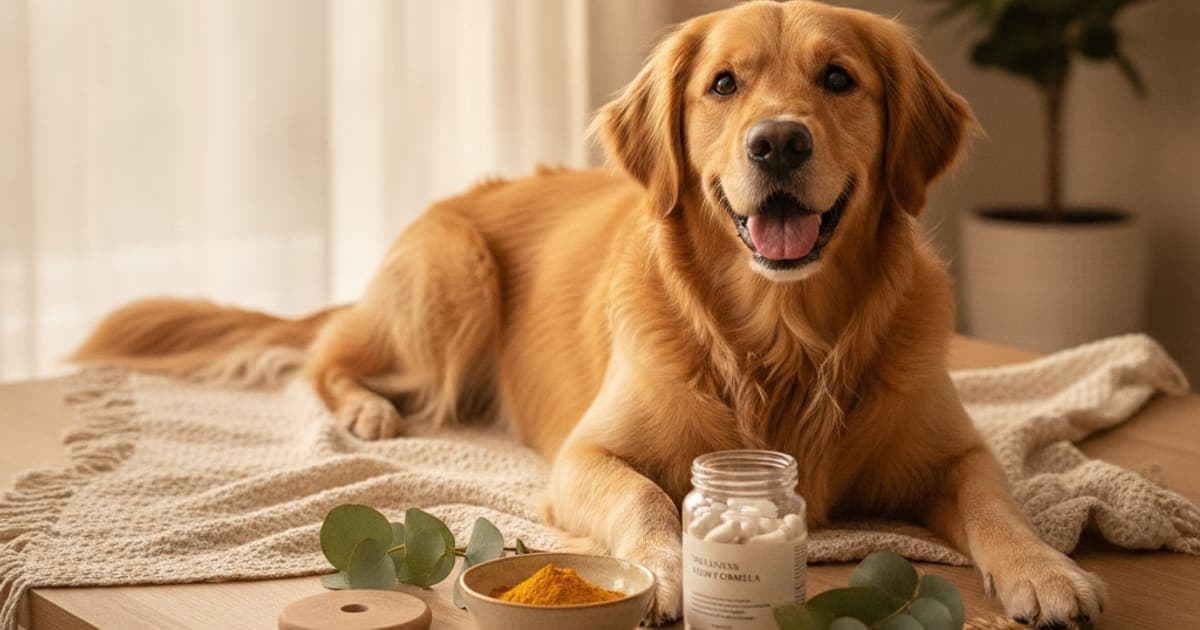
Is TB-500 Better Than Turmeric?
For structural recovery work — a strained tendon, a healing ligament, a joint capsule under repair — TB-500 is the more targeted of the two, because it sits in the category of repair-signalling peptides, while turmeric acts further downstream on the inflammatory environment. That is not a knock on turmeric. It is a statement about what each one is built to influence. Turmeric's curcumin is one of the most heavily studied plant polyphenols in the world and owners use it for comfort support. TB-500 is a peptide whose parent protein is studied for its role in cell migration and tissue remodelling. They answer different questions, and plenty of owners run both. pawgen's K9-REPAIR pairs TB-500 with BPC-157 for owners whose focus is soft-tissue and joint recovery rather than general comfort.
What turmeric is actually doing inside a dog
Turmeric is a root. Its activity comes mostly from a group of compounds called curcuminoids, of which curcumin is the best known. Research on curcumin describes interaction with inflammatory signalling pathways — the cellular machinery that decides how loudly an inflammatory response runs. That is why turmeric shows up in so many canine joint chews: the goal is to turn down inflammatory noise, which owners perceive as a more comfortable, looser dog.
The honest complication with turmeric is absorption. Curcumin is poorly water-soluble and is rapidly processed by the liver and gut wall, which means a large share of what a dog swallows never reaches circulation in an active form. Formulators work around this with piperine (a black pepper extract), phospholipid complexes, liposomal carriers and nanoemulsions. A product that lists "turmeric root powder" with no absorption strategy at all is making a very different offer from a standardised curcumin extract paired with a delivery system, even though both can print the word turmeric on the front of the bag.
The second thing to understand is what turmeric does not claim to do. It is not a repair instruction. It does not direct fibroblasts to migrate into a defect, and it is not studied as a signal that tells damaged tissue how to reorganise. It modulates the environment around the injury. That is genuinely useful, and it is also a ceiling.
Turmeric is not risk-free either. It can loosen stool in sensitive dogs, and there are theoretical interactions worth respecting in dogs on anticoagulants, in dogs with gallbladder disease, and in dogs already on a prescribed anti-inflammatory. Talk to your veterinarian before layering turmeric on top of an existing medication list — that conversation takes two minutes and removes the guesswork.
What TB-500 is, and why owners reach for it
TB-500 is a synthetic peptide based on the active region of thymosin beta-4, a small protein that occurs naturally throughout mammalian tissue and is present in platelets and in wound fluid — which is a clue about where the body chooses to deploy it. Thymosin beta-4 is an actin-binding protein, and actin is the cytoskeletal scaffolding a cell uses to change shape and move. Research on thymosin beta-4 describes roles in cell migration, in new blood vessel formation, and in modulating the inflammatory phase of tissue repair.
That mechanism is upstream of where turmeric operates. Repair in a tendon or ligament is a logistics problem before it is a comfort problem: cells have to arrive at the damaged site, blood supply has to reach tissue that is often poorly vascularised to begin with, and new collagen has to be laid down and then remodelled along the lines of load. Research suggests thymosin beta-4 and its derived peptides participate in exactly those steps. That is why the science is being adopted by owners whose dogs are working through a recovery rather than simply aging.
BPC-157 sits alongside it for the same reason. It is a synthetic peptide sequence derived from a protein identified in gastric juice, and published animal research describes effects on fibroblast behaviour, on angiogenesis, and on healing in tendon and ligament models. The pairing is deliberate: two peptides studied for overlapping but distinct contributions to the repair environment. K9-REPAIR is that pairing, formulated for dogs with weight-based dosing guidance.
BPC-157 and TB-500 are not FDA-approved veterinary drugs, and nothing here is a promise about any individual dog. What can be said cleanly is what these peptides are, what the published mechanism work describes, and why owners are choosing them through recovery periods. Your veterinarian should know what your dog is taking, full stop.
TB-500 and turmeric are not competing for the same job — one is aimed at the repair signal, the other at the inflammatory noise around it, and that difference is the entire answer to the comparison.
Side by side: repair signalling versus inflammatory comfort
| TB-500 (as formulated in K9-REPAIR) | Turmeric / curcumin | |
|---|---|---|
| What it is | Synthetic peptide based on the active region of thymosin beta-4, a naturally occurring protein | Plant polyphenol extracted from turmeric root |
| Where the mechanism sits | Upstream — cell migration, new vessel formation, the repair environment itself | Downstream — modulation of inflammatory signalling |
| What owners are usually after | Soft-tissue and joint recovery support after strain, tear or surgery | Day-to-day comfort and stiffness support |
| Absorption question | Formulation and quality control are the variables; peptides are dosed by body weight | Curcumin is poorly absorbed on its own; delivery system matters enormously |
| Evidence character | Mechanistic and animal research on thymosin beta-4 and BPC-157; owners report using them through recovery | Extensive laboratory and animal literature on curcumin; human clinical work is broader than canine |
| Regulatory status | Not FDA-approved veterinary drugs; educational use, veterinary oversight advised | Marketed as a dietary supplement ingredient |
| Best thought of as | The stack owners use through a recovery window | A long-run comfort and maintenance ingredient |
Read that table as two different tools rather than a scoreboard. If your question is "how do I support the tissue that is actively rebuilding," the peptide column is the one aimed at it. If your question is "how do I keep an eleven-year-old comfortable on the stairs through winter," turmeric belongs in that conversation.
Where each one lands in a real recovery timeline
The first phase belongs entirely to your veterinarian. A cruciate rupture, a fractured toe, a torn iliopsoas, an infected joint — these are diagnosed with hands, imaging and sometimes fluid analysis, and they are managed with surgery, prescribed analgesia, activity restriction and structured rehab. Nothing bought online substitutes for any of that, and no supplement is a reason to skip an appointment or discontinue something a vet prescribed. If your dog is on carprofen, gabapentin or a monoclonal antibody injection, that plan stays exactly as written unless the prescribing vet changes it.
The second phase is where owner-added support becomes interesting. Once the acute crisis is handled, tissue moves into a long remodelling stretch: collagen initially laid down in a disorganised mesh gradually reorganises along the direction of load, and that reorganisation runs over weeks and months, not days. It is a slow, quiet, metabolically demanding process, and it is the window where owners most commonly add peptide support — because the biology being supported is repair biology, not pain biology.
The third phase is maintenance. An arthritic joint that has stabilised is a comfort-and-function problem: body condition, controlled loading, omega-3 fatty acids, traction on slick floors, and yes, curcumin. Many owners keep a turmeric-containing product running long-term here while reserving the peptide stack for recovery windows.
That sequencing is the practical version of the answer. Better depends on which phase your dog is in and what you are trying to influence.
How to tell a serious formulation from a marketing one
This is where scepticism is earned, and it belongs pointed at labels rather than at ingredients. The most common failure in the canine supplement aisle is the kitchen-sink chew: fourteen impressive-sounding ingredients, each present in an amount too small to matter, hidden inside a proprietary blend that legally lets the brand publish the total without publishing the parts. If a label will not tell you how much of each active ingredient is present per serving, you cannot evaluate it, and neither can your vet.
Four things worth checking on anything you buy:
- Per-ingredient amounts, not just a blend total.
- Third-party testing with a certificate of analysis you can actually see, covering identity and purity.
- Dosing scaled to body weight, because a forty-pound spaniel and a hundred-and-thirty-pound mastiff are not the same animal.
- A form the dog will reliably take, since the best formulation on earth does nothing sitting in a bowl.
pawgen builds K9-REPAIR around that checklist: a defined BPC-157 and TB-500 formulation rather than a long ingredient list, third-party testing with COAs, weight-based dosing guidance, direct-to-door shipping and a 60-day money-back guarantee. Bring the product page to your next appointment and let your veterinarian see exactly what is in it — that is the version of this decision that goes well.
Key takeaways
- TB-500 and turmeric are not interchangeable: the peptide is aimed at repair signalling, curcumin at inflammatory modulation.
- For tendon, ligament and post-operative recovery windows, the peptide approach is the more targeted one, and K9-REPAIR pairs TB-500 with BPC-157 for that use.
- Turmeric's real-world limitation is absorption; a delivery system separates a serious curcumin product from a decorative one.
- Neither category replaces surgery, prescribed medication or rehab, and nothing here is a reason to change a prescription.
- Many owners run both — peptides through recovery, curcumin as long-run comfort support.
- Judge every product by per-ingredient amounts, third-party COAs and weight-based dosing rather than by front-of-bag ingredient count.
If you are moving off a chew-based routine, it is worth reading switching from zesty paws dog and vetriscience alternatives for dogs alongside the formulation details for K9-REPAIR.
Your veterinarian owns the diagnosis and the treatment plan — imaging, surgical decisions, medication, rehab loading and the timeline your dog is actually on. Supplements and peptides operate in the space that proper veterinary care creates, supporting a recovery that has already been correctly identified and correctly managed. Get the diagnosis first, keep the prescribed plan intact, and build everything else around it.
Owners exploring peptide support for their dog can review K9-REPAIR — BPC-157 + TB-500 formulated for dogs — at https://pawgen.com/. BPC-157 and TB-500 are not FDA-approved veterinary drugs. Nothing in this article treats, cures or prevents any condition; every decision about your dog's care belongs with your veterinarian.
Frequently asked questions
- Is a dog licking a joint an emergency?
- Not usually an emergency on its own, but it is a meaningful signal. Sudden onset paired with heat, swelling, an open wound, or refusal to bear weight warrants same-day veterinary attention. Persistent licking focused over one joint often reflects discomfort underneath, so book an exam rather than waiting it out.
- Why is my dog licking a paw constantly?
- The usual causes are environmental or food allergies, yeast or bacterial overgrowth, a foreign body such as a grass seed, nail or pad injury, contact irritants, referred discomfort from a joint or soft-tissue problem, and anxiety-driven habit. These overlap heavily, so a veterinary exam is how you narrow it down.
- Should I worry if my dog is licking a paw constantly?
- It is worth investigating rather than panicking. Occasional grooming is normal; constant licking that stains the fur, produces odour, or causes redness, hair loss or limping is a sign something is wrong. Left alone it can progress to secondary infection or a lick granuloma, which is harder to resolve.
- When should I take a dog to the vet for licking a paw constantly?
- Book an appointment if the licking persists beyond a few days, or sooner if you see swelling, bleeding, odour, discharge, limping, or the dog resists you handling the foot. Sudden intense licking straight after a walk can indicate a foreign body, a cut or a surface burn — go the same day.
- What can I give a dog that is licking a paw constantly?
- Nothing before a diagnosis, because the right answer depends entirely on the cause. Your veterinarian may address allergy, infection or injury directly. Where the discomfort traces back to joints or soft tissue, owners often add supportive products such as K9-REPAIR alongside the plan — discuss any addition with your vet first.
- Is a dog licking a paw constantly an emergency?
- Rarely an emergency by itself. It becomes urgent with heavy bleeding, a visible wound or embedded object, rapid swelling, a chemical or heat burn, or refusal to put weight on the foot. Otherwise treat it as a prompt non-emergency visit, but do not let weeks pass hoping it settles.
Educational content. BPC-157 and TB-500 are not FDA-approved veterinary drugs. Talk to your veterinarian before starting anything new, especially if your dog is on prescribed medication.