Teaching an Old Dog New Tricks — What Changes With Age
Older dogs learn new tricks readily; age changes the method, not the capacity. Keep sessions short, reward quickly with a marker your dog can still see or hear, and choose cues that do not load sore joints. Comfort, attention span and sensory change drive every adjustment.
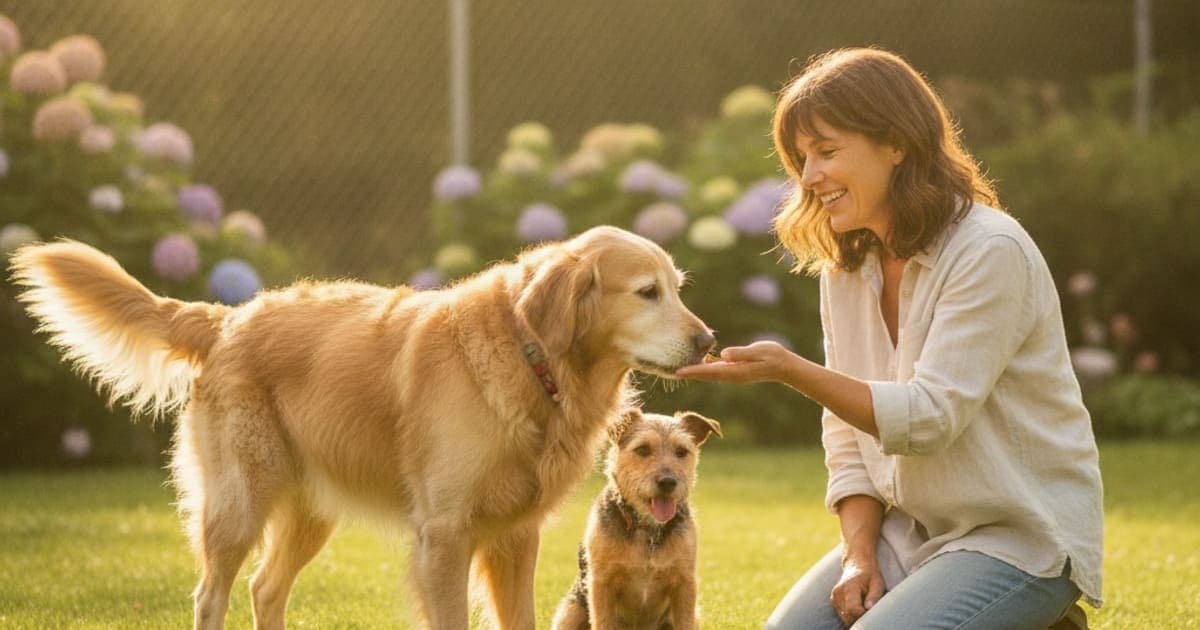
Yes, you can teach an old dog new tricks. The proverb is wrong about capacity and only half right about difficulty. A nine-year-old dog can learn a chin rest, a new recall cue, a scent game or a stationing behaviour — she will simply learn it in shorter bursts, with clearer and faster rewards, and with cues chosen to respect what her joints, ears and eyes can still comfortably do. What ageing changes is attention span, sensory input, recovery time between sessions, and physical comfort. It does not change the underlying learning machinery.
That distinction matters, because most owners who conclude their senior dog 'can't learn anymore' are actually running puppy-style training sessions on a body and a nervous system that need a different format.
What ageing actually changes in a learning dog
Three things shift, and they shift independently. A dog can be sharp as a tack mentally and sore in both hips, or physically springy and starting to lose hearing.
Senses. Hearing and vision commonly decline with age. A cue that used to work at thirty paces — a whistle, a hand flick, a quiet verbal marker — may simply not be arriving. This reads as disobedience and almost never is. Before you retrain anything, consider whether your dog can still perceive the cue you are giving.
Cognition. Canine cognitive dysfunction is a recognised veterinary syndrome, and it shows up as disorientation, altered sleep-wake cycles, changed social interaction, loss of previously reliable house training, and changes in activity level. It is a diagnosis, not a training problem. If your dog is getting stuck in corners, pacing at night, or staring at walls, that is a conversation for your veterinarian before it is a conversation about training technique.
Body. Osteoarthritis is common in older dogs. Muscle mass declines. Tendons and ligaments get stiffer and slower to warm up. Transitions — sit to stand, down to sit, turning on the spot — are often where discomfort shows first, and those transitions happen to be exactly what classic obedience drills are made of.
An older dog that has stopped responding to a familiar cue is far more often uncomfortable than stubborn. Treat a sudden refusal of 'sit' or 'down' as a physical finding worth mentioning at the next appointment, not a lapse in manners.
How to structure sessions for a senior dog
The single biggest change in dog training for senior dogs is the shape of the session, not the content.
Go short and frequent. A few minutes, a handful of repetitions, finish while your dog is still keen and before any stiffness sets in. Several brief sessions scattered through the day outperform one long block, and they are easier on a body that fatigues faster than it used to.
Train when your dog is warm. First thing in the morning, straight out of a cold bed, is the worst window for anything involving position changes. After a gentle walk is far better.
Mind the footing. Slick floors make older dogs brace, and a bracing dog is a distracted dog. Train on a rug, a yoga mat or grass so there is nothing to worry about underfoot.
Change one thing at a time. Add duration, or distance, or distraction — never two at once. Older dogs tend to do beautifully with clean, low-ambiguity criteria and poorly with guessing games that produce a lot of failed repetitions.
Let rest do its job. Research on learning across species suggests that sleep and downtime after a session support memory consolidation, which is a good argument for stopping early and letting the behaviour settle rather than drilling it into the ground.
Rewards, markers and timing when the senses have changed
Reward timing is everything in any training, but it becomes technical work with an older dog.
If hearing has faded, a verbal marker or a clicker may not land. Switch to a visual marker — a thumbs-up, an open palm, a brief flash of a small torch — or a tactile one, such as a consistent touch on the shoulder. Charge the new marker the way you charged the old one: marker, then food, many times, before you ask it to carry any information.
If vision has faded, do the reverse. Lean on sound and scent, deliver food to the nose rather than tossing it, and keep furniture and training setups in predictable places.
Expect a slower response latency. Many older dogs hear the cue, process it, and then move — the gap is longer than it used to be. Do not repeat the cue into that gap. Repeating teaches the dog that the first cue is optional.
Use genuinely good food, and account for it. Softer treats suit dogs with dental wear. Carve training food out of the daily ration rather than adding to it, because extra weight on arthritic joints works directly against everything else you are doing.
Finally, capture rather than lure where you can. Instead of manipulating an older dog's body into a position with a treat at the nose, wait for the behaviour she already offers comfortably, mark it, and pay it. You end up with behaviours that fit her, not ones she has to contort into.
Choosing tricks that fit an ageing body
Some classic tricks load structures that are already working hard in an older dog. The fix is almost never to stop training — it is to swap the mechanics and keep the mental work.
| Classic trick | What it loads in an older dog | Joint-friendlier swap |
|---|---|---|
| Repeated sit-from-stand reps | Stifles, hips, lumbar spine through each transition | Stand-stay, or a chin rest held in standing |
| Beg / sit pretty | Lower back and hips under full body weight | Nose target to an offered hand |
| Jump through a hoop, or up onto furniture | Impact and deceleration through shoulders and carpi on landing | Walk through a ladder on the ground, or paws-up on a low, stable platform |
| Roll over | Spinal rotation, uncomfortable with arthritic change | Side-lying settle on a mat, built with a marker |
| Fetch with hard stops and turns | Sudden deceleration and twisting through the stifle | Find-it and scent searches with a thrown-then-hidden toy |
| Shake, always on the same side | Repeated weight shift onto the opposite limb | Two-paw target on a low block, loading evenly |
Scent work deserves its own mention. Olfaction tends to hold up well relative to hearing and vision, which makes nose games an unusually good fit for senior dogs: snuffle mats, scattered kibble in the grass, a 'find it' cue for a scented cotton bud hidden around a room. The dog gets real cognitive effort at walking pace, with no impact loading at all.
Cooperative care is the other high-value category. Chin rest for ear checks. Paw presentation for nail trims. A stand-stay for an exam. Voluntary muzzle acclimation. Veterinary visits generally become more frequent in the back half of a dog's life, and a dog who has been taught to participate in handling is a dog who experiences less stress at every one of those visits. These are new tricks with a tangible payoff.
Comfort is a training variable, not a side issue
A dog who hurts cannot concentrate. That is true of every species, and it is the reason comfort belongs in a training article at all.
Your veterinarian owns this part. Pain assessment, radiographs, anti-inflammatories, monoclonal antibody therapy, gabapentin, prescribed rehabilitation, hydrotherapy, weight management — these are the backbone of senior mobility care, and nothing should ever be stopped or swapped out because of something read online. If your older dog is slowing down, book the exam. Training adapts far more easily once you know what you are adapting to.
Around that veterinary plan, owners look for support for connective tissue and recovery, and this is where the supplement aisle earns its scepticism. Kitchen-sink chews with a dozen ingredients at trace levels, proprietary blends that hide how much of anything is actually in the scoop, and brands with more marketing than analysis are a genuine problem for owners trying to make a careful decision.
K9-REPAIR from pawgen sits at the other end of that spectrum: a focused BPC-157 and TB-500 peptide formulation made for dogs, with weight-based dosing worked out with your veterinarian, third-party testing and published certificates of analysis, a direct-to-door supply, and a 60-day money-back guarantee. BPC-157 is a synthetic peptide based on a sequence identified in gastric juice; published laboratory and animal research suggests it influences angiogenesis and the migration of fibroblasts and tendon cells, which are central processes in how connective tissue remodels. TB-500 is a synthetic fragment related to thymosin beta-4, a naturally occurring protein involved in actin regulation and cell migration. This is emerging and promising science that a growing number of owners are adopting as the stack they run through recovery and into the senior years.
To be explicit: BPC-157 and TB-500 are not FDA-approved veterinary drugs, pawgen's content is educational, and nothing here is a claim that any product treats or resolves any condition in your dog. What it is: a mechanism worth understanding, and a decision to make alongside your veterinarian rather than instead of one.
Key takeaways
- Age changes the method, not the capacity — older dogs learn new behaviours well.
- Run short, frequent sessions when your dog is warm, on non-slip footing, and stop while she is still keen.
- Check that your dog can still perceive the cue before assuming she is ignoring it; retrain markers to a sense that still works.
- Swap position-change drills and impact tricks for stationing, scent work and cooperative care.
- A refusal of a well-known cue is a physical finding worth raising with your veterinarian.
- Comfort is the foundation that makes concentration possible, so mobility care and training belong in the same conversation.
More from pawgen: batch certificates of analysis are published at /coas/, shipping availability is listed at /location/, and the full K9-REPAIR formulation details sit at /shop/.
Where your veterinarian fits
Your veterinarian owns the diagnosis and the treatment plan — the arthritis workup, the pain protocol, the cognitive assessment, the rehabilitation referral. Training and supplementation operate in the space that proper veterinary care creates. Get the exam, follow the plan, keep every prescribed medication exactly as prescribed, and then build the short, kind, clever training sessions that let an older dog keep learning for the whole of her life.
Owners exploring peptide support for their dog can review K9-REPAIR — BPC-157 + TB-500 formulated for dogs — at https://pawgen.com/. BPC-157 and TB-500 are not FDA-approved veterinary drugs. Nothing in this article treats, cures or prevents any condition; every decision about your dog's care belongs with your veterinarian.
Frequently asked questions
- Is it really possible to teach an old dog new tricks?
- Yes. Older dogs learn new behaviours well, and many are calmer and more focused than puppies. What changes is the format: shorter sessions, clearer reward timing, cues that match the senses your dog still has, and movements that do not strain stiff joints.
- How long should a training session be for a senior dog?
- Shorter than you think, and repeated more often through the day. End while your dog is still enthusiastic and before stiffness or fatigue appears. Several brief sessions generally produce better retention than one long drilling block, and they are far kinder to an older body.
- My older dog stopped responding to 'sit'. Is she being stubborn?
- Far more often she is uncomfortable. Sitting loads the hips, stifles and lower back, and arthritic change makes repeated transitions unpleasant. Mention the refusal to your veterinarian as a possible pain sign, and in the meantime switch to a stand-stay or chin rest instead.
- What if my dog is going deaf — can she still learn new cues?
- Yes. Rebuild your marker on a sense that still works: a thumbs-up, an open palm, a torch flash, or a consistent touch. Charge the new marker with food many times before asking it to carry information, then transfer your existing cues to hand signals.
- What are the best low-impact tricks for an arthritic dog?
- Chin rest, nose targeting, stationing on a mat, paw presentation for nail trims, voluntary muzzle work, and scent games such as find-it or snuffle searches. These give real cognitive effort at walking pace with no jumping, twisting or repeated position changes.
- Can training help a dog showing signs of cognitive decline?
- Mental enrichment and predictable routines are commonly recommended as part of supportive care, but canine cognitive dysfunction is a veterinary diagnosis. Disorientation, night pacing, altered interaction or loss of house training should be assessed by your veterinarian before you assume it is a training issue.
- What is K9-REPAIR and where does it fit for an older dog?
- K9-REPAIR is pawgen's BPC-157 and TB-500 peptide formulation made for dogs, third-party tested with published certificates of analysis and backed by a 60-day money-back guarantee. It is not an FDA-approved veterinary drug; owners use it alongside, never instead of, their veterinarian's mobility plan.
- How much K9-REPAIR does a senior dog need?
- Dosing is weight-based and should be worked out with your veterinarian, who knows your dog's history, medications and current condition. pawgen does not publish dosing guidance online, and questions about puppies, pregnant or nursing dogs belong with your vet specifically.
- Should I stop my dog's prescribed arthritis medication if I add a supplement?
- No. Never stop or reduce a prescribed medication because of a supplement. Anti-inflammatories, injectable pain therapies, gabapentin and prescribed rehabilitation are the backbone of senior mobility care. Bring any supplement you are considering to your veterinarian so it can be reviewed alongside the existing plan.
Educational content, not veterinary advice. Ask your vet about your dog.