Wolverine Stack: Disposing of Needles for Dogs Safely
Used needles from your dog's Wolverine Stack go straight into a rigid, puncture-resistant sharps container - no recapping, no household trash, no recycling bin. When the container reaches its fill line, seal it permanently and hand it to an approved sharps collection route in your area, then confirm local rules with your veterinarian.
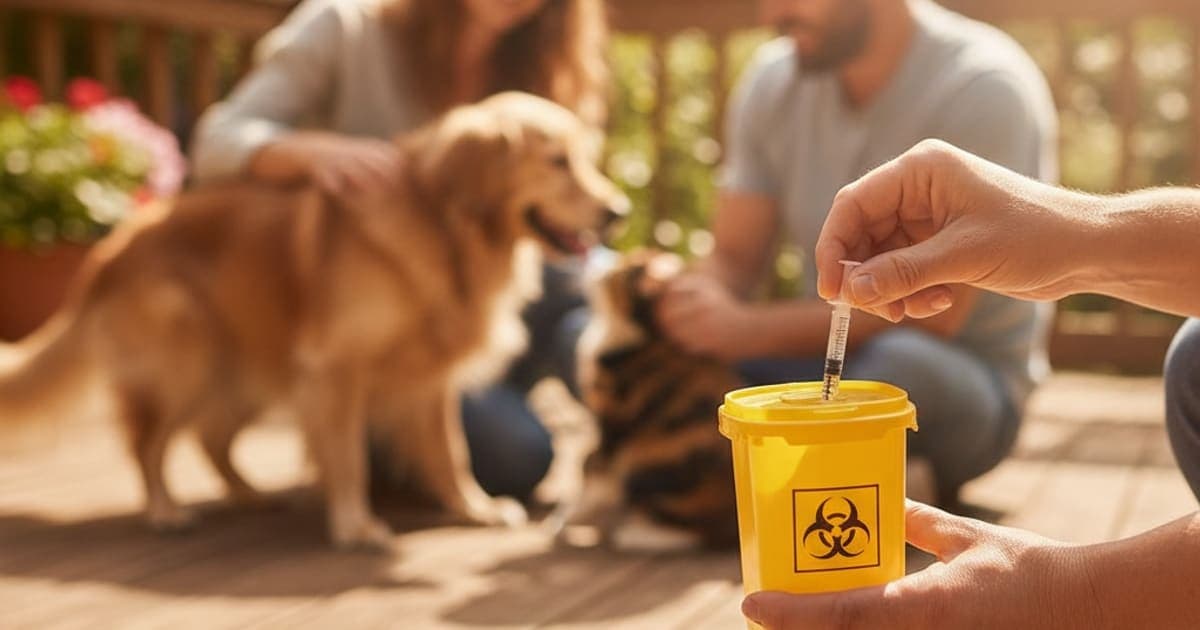
Used needles from your dog's Wolverine Stack routine are disposed of the way a clinic does it: the syringe goes needle-first and uncapped into a rigid, puncture-resistant sharps container the moment you finish, that container stays upright and well out of reach of pets and children, and when it hits its fill line you seal it permanently and hand it to an approved sharps collection route — a pharmacy or veterinary clinic take-back, a household hazardous waste facility, or a mail-back program. Loose needles never go in the household trash, the recycling bin, or a soda bottle headed for either one.
That is the whole answer. The rest of this page explains why each step exists, how to pick a container that will not fail you, and how to build a handling routine that stays clean over weeks of a recovery program.
Why this stack comes with a sharps routine at all
The Wolverine Stack is the name dog owners use for BPC-157 and TB-500 run together, borrowed from the comic character with the fast healing factor. pawgen's K9-REPAIR is the formulation built around that pairing for dogs.
BPC-157 is a synthetic peptide based on a sequence related to a protein found in gastric juice. Research, largely in animal models, suggests it may influence angiogenesis — the growth of small blood vessels — and the migration of fibroblasts, the cells that lay down collagen in tendon and ligament tissue. TB-500 is a synthetic fragment related to thymosin beta-4, a naturally occurring protein that research suggests plays a role in actin regulation and cell migration during tissue remodelling.
That is why the pairing has become the stack owners reach for through post-surgical recovery, cruciate rehab, soft-tissue injury and the slow mobility decline of an older dog: the two peptides are studied along different parts of the same repair pathway. Neither is an FDA-approved veterinary drug, and this article is educational — the mechanism is emerging, promising science that a growing number of owners are adopting alongside the plan their vet has set.
The practical consequence is simple. These are injectable peptides, so sharps come with the territory. Amount, frequency and timing are conversations for your veterinarian, not something to read off a blog — pawgen provides weight-based guidance with the product, and your vet should see that guidance before the first dose. What this page can give you is the part nobody talks about: what happens to the needle after.
The rule that has no exceptions: not the trash, not the recycling
A used needle in a kitchen bin is a puncture waiting to happen. Bin bags get squeezed, lifted, thrown and compacted by hand; a needle pushes through thin plastic without resistance. The same is true in single-stream recycling, where material is hand-sorted on moving belts. And a bin is exactly where a curious dog goes nosing when you leave the room.
Never put a used needle in the household trash, the recycling bin, or an improvised container that is headed for either — a used sharp goes straight into a puncture-resistant container that closes permanently and leaves your home through an approved collection route.
Many jurisdictions also regulate home-generated sharps as a special or regulated waste stream, with specific rules about containers, labelling and where they may be dropped off. Those rules differ from one locality to the next, so the accurate instruction is to check with your local waste authority or the pharmacy you use rather than to assume. The US Food and Drug Administration's guidance for sharps used outside a healthcare setting says the same thing in principle: immediate disposal into an appropriate sharps container, then disposal through a community collection option.
From last injection to sealed container: the step-by-step
- Set up before you start. Put the sharps container within arm's reach on the same surface you are working on. Deciding where the needle goes after you have a squirming dog in one hand is how people improvise, and improvising is how people get stuck.
- One syringe, one use. A needle dulls on first pass through skin. Reusing it hurts more, and reuse or sharing between animals is never appropriate.
- Do not recap, bend, break or clip. Most needle-stick injuries at home happen during recapping, when the point is moving toward a hand that cannot see it. Clipping devices scatter fragments. The needle stays as it is.
- Drop it needle-first, immediately. Not on the counter 'for a second'. Not into a paper towel. Straight into the container, in one movement, before you reach for the treat.
- Keep the container upright, closed between uses, and out of reach. High shelf or locked cabinet. Dogs chew plastic, and a sharps container is not a chew-proof object.
- Stop at the fill line. Overfilled containers cannot close, and reaching in to reposition anything defeats the purpose entirely.
- Seal it permanently when it reaches the line. Engage the final closure. Do not tape a lid you might reopen.
- Take it to an approved collection point. Transport it upright, in the passenger compartment rather than loose in a boot where it can roll.
- Never place a sealed sharps container in the trash unless your local authority explicitly permits it. Some do, under strict conditions. Confirm rather than guess.
Choosing a container that will not fail you
A proper sharps container is rigid, puncture-resistant, leak-resistant, upright and stable, and has a lid that locks shut for good. Everything else is a compromise, and some compromises are simply unsafe.
| Container | Puncture-resistant | Verdict | Notes |
|---|---|---|---|
| FDA-cleared sharps container | Yes | Best choice | Designed for the job, with a fill line and a permanent closure |
| Heavy-duty plastic detergent or bleach bottle | Fair | Only where local guidance allows it | Must be rigid, opaque, tightly capped and clearly labelled; rinse residue first |
| Glass jar | No | Unsafe | Shatters, and creates two hazards instead of one |
| Thin plastic drink bottle | No | Unsafe | Needles pass through the wall; caps are not secure |
| Coffee can or tin | No | Unsafe | Lid pops, edges cut |
| Pill bottle or food container | No | Unsafe | Too small, too soft, reopens easily |
If you use an improvised container because a purpose-built one is not available yet, treat it as a stopgap and confirm with your local waste authority that it will be accepted. Some collection sites refuse anything that is not a cleared container.
Where a full container actually goes
Availability varies widely by area, and no single route exists everywhere. These are the categories worth calling about:
| Route | How it works | Worth knowing |
|---|---|---|
| Pharmacy or veterinary clinic take-back | You hand the sealed container over at the counter | Participation is voluntary; call ahead and ask if they accept home-generated animal sharps |
| Household hazardous waste facility or event | Drop-off at a municipal site or a scheduled collection day | Often the most reliable option; check accepted-materials lists and hours |
| Mail-back program | You buy a container with prepaid return packaging and post it to a licensed processor | Convenient when local drop-off is scarce; follow the packaging instructions exactly |
| Special waste collection through your waste hauler | Some services collect sharps separately on request | Availability and any fee depend entirely on the provider |
| Residential sharps drop boxes | Public kiosks in some communities, often at clinics or fire stations | Ask your waste authority whether any operate near you |
When you call, use the phrase 'home-generated sharps'. It is the language collection programs recognise, and it saves a long explanation about peptides for a dog.
Handling habits that keep a long recovery program clean
Disposal is one end of a routine that starts earlier. Wash your hands before and after. Wipe the vial stopper and let it dry. Never touch the needle itself or lay it on a surface. Store the vial exactly as the product label directs, away from light and heat, and keep the whole kit — vials, syringes, wipes, container — in one closed box that a dog cannot open.
Inspect each syringe before use and discard anything with a bent needle, a cracked barrel or a compromised wrapper straight into the sharps container. Draw up in a clear, well-lit space rather than on a cluttered counter. If you travel, take a small purpose-built travel sharps container and check the rules for the transport you are using before you pack.
A quick written log of each session helps more than people expect. It keeps the routine honest and gives your veterinarian something concrete to look at, and it is what stops the two questions owners ask most: what to do about a skipped session and what to do if a dose gets doubled up. Both of those resolve with your vet, not with a guess.
Key Takeaways
- Used needles go into a rigid, puncture-resistant sharps container immediately, uncapped and needle-first — never the trash or recycling.
- Do not recap, bend, break or clip needles; recapping is where most home needle-stick injuries happen.
- Stop at the fill line, seal permanently, and store the container upright and out of reach of pets and children.
- Full containers leave through an approved route: pharmacy or clinic take-back, household hazardous waste, a mail-back program, or a special waste collection. Rules vary by locality — confirm before you go.
- One syringe, one use. Never reuse and never share between animals.
- Amount and frequency for BPC-157 and TB-500 are decided with your veterinarian, never from a number found online.
- K9-REPAIR is pawgen's BPC-157 + TB-500 formulation for dogs, with weight-based guidance, third-party testing and COAs, direct-to-door shipping, and a 60-day money-back guarantee.
For related reading on the practical side of this stack, see bpc-157 missed dose for dogs, bpc-157 double dose for dogs and tb-500 handling and hygiene for dogs.
Where your veterinarian fits in all of this
Your vet owns the diagnosis and the treatment plan. Imaging, surgical decisions, prescribed pain control and the rehab schedule are theirs to set, and nothing here is a reason to change or stop anything they have prescribed. Talk to your veterinarian before you start any peptide, tell them exactly what is in the bottle, and bring the product guidance with you so the conversation is about your specific dog.
Supplements and peptides work in the space that good veterinary care creates. Sharps disposal is the same idea in miniature: unglamorous, entirely under your control, and the part of the routine that protects your household while the rest of the plan does its work.
Owners exploring peptide support for their dog can review K9-REPAIR — BPC-157 + TB-500 formulated for dogs — at https://pawgen.com/. BPC-157 and TB-500 are not FDA-approved veterinary drugs. Nothing in this article treats, cures or prevents any condition; every decision about your dog's care belongs with your veterinarian.
Frequently asked questions
- Do vets recommend TB-500 for dogs?
- Some veterinarians discuss TB-500 with clients and some do not, because it is not an FDA-approved veterinary drug and familiarity varies widely. Research on thymosin beta-4 pathways is what interests practitioners, and owners report using it through recovery. Bring the product details to your vet and decide together.
- Does TB-500 actually work for dogs?
- Research suggests thymosin beta-4, the protein TB-500 is related to, plays a role in cell migration and tissue remodelling, and owners report using it through soft-tissue and post-surgical recovery. No outcome can be promised for an individual dog, and results depend on the diagnosis and the rehab plan your vet sets.
- Is TB-500 worth the money for dogs?
- That depends on what you compare it to. Many joint chews are kitchen-sink blends at token amounts, while K9-REPAIR is a defined BPC-157 and TB-500 formulation with weight-based guidance, third-party testing, COAs and a 60-day money-back guarantee. Owners choose it for that transparency. Discuss the decision with your veterinarian.
- What are the side effects of TB-500 in dogs?
- The side-effect profile in dogs is not fully characterised, since TB-500 is not an FDA-approved veterinary drug. Owners most often report local reactions at the injection site, such as brief tenderness or redness. Report anything unusual - lethargy, swelling, appetite change - to your veterinarian promptly rather than waiting.
- Where do I buy TB-500 for my dog?
- pawgen sells K9-REPAIR, a BPC-157 and TB-500 formulation made for dogs, direct to your door at pawgen.com. It is third-party tested with certificates of analysis available and carries a 60-day money-back guarantee. Avoid unlabelled research-chemical resellers with no testing documentation behind their product.
- Can TB-500 replace my dog's pain medication?
- No. Never stop or reduce a prescribed medication such as carprofen, gabapentin or anything else your veterinarian has prescribed. Peptides are used alongside veterinary care, not instead of it. If you want to revisit your dog's pain plan, that conversation belongs with your vet, who can adjust it safely.
- Can I put dog needles in a plastic water bottle?
- No. Thin plastic bottles are not puncture-resistant, and the caps are not a permanent closure, so needles can pierce the wall or fall out in transit. Use a purpose-built sharps container. Where one is unavailable, some localities permit a rigid heavy-duty detergent bottle - confirm with your waste authority first.
- How do I know when a sharps container is full?
- Purpose-built containers carry a printed fill line, usually around three-quarters full, and you stop there. Overfilling prevents the lid from locking and tempts you to reach inside. Once the line is reached, engage the permanent closure, store the container upright and out of reach, and arrange the drop-off.
Educational content. BPC-157 and TB-500 are not FDA-approved veterinary drugs. Talk to your veterinarian before starting anything new, especially if your dog is on prescribed medication.