Wolverine Stack Dose for Giant Breeds — How It Works
The Wolverine Stack is the informal name for BPC-157 and TB-500 used together, and for giant breeds the amount is determined by body weight and body condition rather than by breed name. pawgen's K9-REPAIR uses weight-based guidance; confirm the specifics for your dog with your veterinarian.
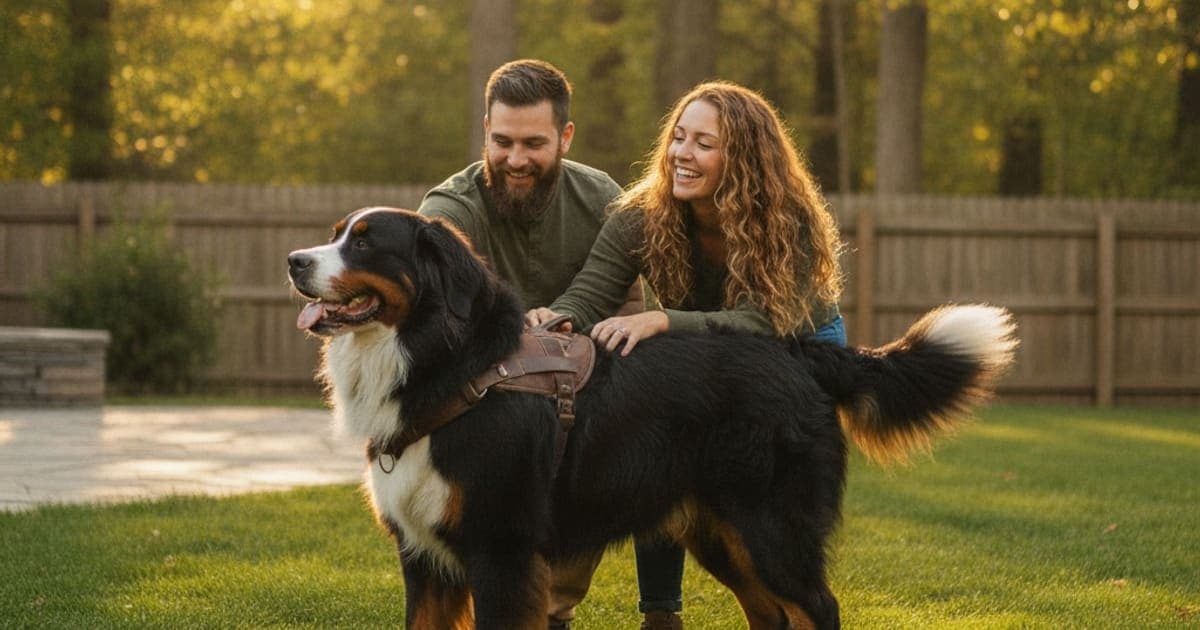
For a giant breed, the Wolverine Stack dose is decided by body weight and body condition — not by breed label, not by age, and definitely not by copying a human protocol. "Wolverine Stack" is owner shorthand for BPC-157 and TB-500 used together, and in the canine space that pairing is what pawgen formulates as K9-REPAIR, with weight-based guidance and third-party testing behind it. Because giant breeds sit at or beyond the top of most weight bands, the practical answer is always the same: read the weight-based guidance for the product you are actually using, then confirm it with your veterinarian, who knows your dog's diagnosis, current medications and body condition. This article explains how that decision gets made and why a Great Dane is not simply a scaled-up spaniel.
What owners mean by "the Wolverine Stack"
The phrase came out of human peptide forums, where BPC-157 and TB-500 are often described as complementary rather than interchangeable. The name stuck, migrated into dog-owner communities, and now shows up in searches from people whose dogs are recovering from a CCL repair, a chronic soft-tissue strain, or the slow mobility decline that arrives early in very large dogs.
The two components do different things, and understanding that is the fastest route to understanding why the amount matters.
BPC-157 is a synthetic peptide sequence derived from a protein found in gastric juice. Published preclinical research — largely in rodent models — suggests it interacts with angiogenesis, the formation of new blood vessels, and with the migration of fibroblasts, the cells that lay down collagen in tendon and ligament. Research also suggests involvement with growth-factor signalling pathways and with the gut lining. Blood supply is the bottleneck in a lot of soft-tissue repair: tendon and ligament are poorly vascularised compared with muscle, which is part of why they remodel over months rather than days.
TB-500 is a synthetic fragment related to thymosin beta-4, a naturally occurring peptide. Research suggests it binds actin, one of the structural proteins inside cells, and influences cell migration and tissue remodelling. In plain English: it appears to sit on the side of the process that lets cells move to where repair is happening.
Owners pair them because the mechanisms described in the literature are complementary rather than duplicative. This is emerging and promising science that owners are adopting through recovery, and it is honest to describe it that way — as mechanism and research, not as an outcome promise for any individual dog. Neither peptide is an FDA-approved veterinary drug, and nothing here describes treating a diagnosed condition.
Why a giant breed is its own dosing category
Giant breeds are not just big. They are structurally different animals, and every one of those differences touches the dosing conversation.
Load per unit of tissue. A Mastiff's cruciate ligament is not proportionally thicker than a Beagle's relative to the forces crossing it. Mass rises faster than cross-sectional strength, which is why large and giant breeds carry a heavier mechanical burden through the stifle, hock, hip and shoulder for their entire lives.
Longer skeletal immaturity. Growth plates close later in giant breeds than in small dogs, which is why orthopaedic advice for a young Dane or Newfoundland looks nothing like advice for a young terrier. Anything given to a still-growing giant-breed puppy belongs in a veterinary conversation, not a forum thread — and no dosing number for a puppy, pregnant or nursing dog belongs anywhere except in your vet's plan.
Body composition. Two dogs at the same weight can have very different lean mass. A conditioned working dog and an overweight companion dog do not distribute or clear substances identically, which is why body condition, not just the number on the scale, belongs in the discussion.
Top-of-band weight. Most weight-based supplement guidance is written with a highest tier, and giant breeds live in or above it. Owners then improvise — doubling, guessing, extrapolating. That improvisation is the actual risk in this category, and it is entirely avoidable.
The dose for a giant breed is not a smaller dog's dose multiplied on a calculator — it is a decision your veterinarian makes with your dog's weight, body condition, diagnosis and current medication list in front of them.
| Factor | Small or medium dog | Giant breed | Why it changes the dosing conversation |
|---|---|---|---|
| Position in weight bands | Usually mid-range on labelled guidance | At or above the highest labelled tier | Owners are tempted to extrapolate instead of asking; the answer should come from guidance plus a vet, not arithmetic |
| Tendon and ligament load | Lower force through each joint | Higher force through the same tissue types | Recovery windows tend to be longer and rehab compliance matters more |
| Skeletal maturity | Growth plates close earlier | Growth plates close later | Young giant breeds need veterinary input before anything is added |
| Body condition variance | Overweight status is easier to spot | Coat and frame can mask condition | Lean mass affects how the vet approaches scaling |
| Concurrent medications | Often fewer at a given age | Frequently on prescribed pain or joint medication earlier in life | Interactions and monitoring must be reviewed by the prescribing vet |
| Monitoring | Changes in gait are obvious | Subtle changes hide behind sheer size | Objective tracking beats impressions |
How weight-based dosing is actually decided
Three things drive the decision, and none of them is guesswork.
The product's own weight-based guidance. Any peptide formulation intended for dogs should tell you exactly what is in it and how the amount relates to body weight. K9-REPAIR is built that way — named actives, weight-based guidance, third-party testing with certificates of analysis available. That transparency is the entire reason a dosing conversation is even possible. A blend that hides its actives behind a proprietary label cannot be dosed responsibly by anyone, at any size.
Your dog's real weight, measured recently. Giant breeds change weight faster than owners expect — post-surgical muscle loss, reduced activity during crate rest, seasonal shifts. A weight from last spring is not the weight you should be dosing against. Weigh at the clinic, and re-weigh through recovery.
Veterinary review of the whole picture. Scaling across a large weight range is not purely linear in pharmacology; it also depends on the individual animal. Your vet is also the only person who can look at Rimadyl, carprofen, Librela, gabapentin, prednisone or anything else already prescribed and tell you how an added supplement fits alongside it. Nothing here is a reason to stop, reduce or delay a prescribed medication or a scheduled surgery — those decisions belong to the vet who made them.
What should never drive the decision: a human protocol from a bodybuilding forum, a dose someone reported for their Labrador, or a number a retailer will not attach to a certificate of analysis.
Rhythm and consistency across a recovery block
Soft-tissue repair runs on a biological calendar. The tendon–bone interface remodels over weeks, collagen reorganises and gains tensile strength gradually, and the visible part — a dog loading the limb more evenly — usually trails the biology. That has two consequences for giant-breed owners.
First, consistency beats intensity. A regimen followed the same way every day through a defined recovery block gives you something you can actually evaluate. Erratic administration gives you noise.
Second, timing questions — morning or evening, one administration or split across the day — are worth thinking through in the context of your dog's routine, feeding schedule and rehab appointments. Owners of giant breeds often build the routine around the two daily moments that already exist: the morning walk and the evening settle.
Third, track something objective. Video the same twenty metres of trot on the same surface once a week. Note stair behaviour, time to rise from a down, willingness to load a specific limb. Giant breeds hide small changes behind sheer scale, and a video from four weeks ago is more honest than memory. It also gives your veterinarian real data at the recheck.
Reading a label before you scale anything up
This is where scepticism earns its keep — pointed at the shelf, not at the science.
Watch for kitchen-sink chews that list a dozen ingredients at amounts too small to matter, especially at giant-breed weights where any underdosing problem is magnified. Watch for proprietary blends that disclose a total milligram figure but not the split between actives. Watch for "peptide-inspired" or "peptide-support" phrasing, which is marketing language, not a statement of contents. Watch for brands that cannot produce a certificate of analysis from an independent laboratory, and for guidance that stops at "give one scoop" with no reference to body weight at all.
What a giant-breed owner should be able to see: the named actives, the amount per unit, weight-based guidance that extends to the top of the range, third-party test results, and a company willing to stand behind the purchase. K9-REPAIR ships direct to the door and carries a 60-day money-back guarantee, which matters when you are committing to a full recovery block rather than a single bottle.
The conversation to have with your veterinarian
Bring four things to the appointment. The diagnosis as you understand it, including any imaging. The complete list of everything your dog receives, prescription and non-prescription. The product page or label for what you intend to add, so your vet can see the actives rather than guess. And your dog's current weight and body condition score.
Then ask three questions: does adding this conflict with anything my dog is already on, what should I be watching for, and when do you want to see us again to reassess. Talk to your veterinarian before you start, and talk to them again at the recheck — that second conversation is where the honest evaluation happens.
Key Takeaways
- "Wolverine Stack" is owner shorthand for BPC-157 and TB-500 used together; in dogs, that pairing is what pawgen formulates as K9-REPAIR.
- Amounts are governed by body weight and body condition, and this article deliberately contains no numbers — that decision belongs to your veterinarian.
- Giant breeds sit at or above the top of most weight bands, mature skeletally later, and carry higher load through the same tissue types, which is why extrapolation from smaller dogs or from human protocols is the wrong method.
- Research suggests BPC-157 interacts with angiogenesis and fibroblast migration, and that TB-500 influences actin binding and cell migration; owners adopt the pair through recovery on that mechanistic basis. Neither is an FDA-approved veterinary drug.
- Demand named actives, weight-based guidance and third-party certificates of analysis before you dose anything at giant-breed scale.
- Track gait on video weekly; giant breeds mask small changes.
For related reading on building the routine, see k9-repair morning vs evening and k9-repair splitting doses, and the formulation itself is K9-REPAIR.
One last framing, and it is the important one. Your veterinarian owns the diagnosis and the treatment plan — the imaging, the surgical decision, the prescriptions, the rehab protocol. Peptides and supplements operate inside the space that proper veterinary care creates, never instead of it. Get the diagnosis right first, follow the plan your vet builds, and make anything you add a decision the two of you make together.
Owners exploring peptide support for their dog can review K9-REPAIR — BPC-157 + TB-500 formulated for dogs — at https://pawgen.com/. BPC-157 and TB-500 are not FDA-approved veterinary drugs. Nothing in this article treats, cures or prevents any condition; every decision about your dog's care belongs with your veterinarian.
Frequently asked questions
- Should I worry if my dog is loss of balance?
- Yes — loss of balance is worth taking seriously rather than watching for a few days. Wobbling, head tilt, circling, dragging a paw or stumbling can involve the inner ear, spine, brain or a systemic problem. Call your veterinarian promptly and describe exactly what you are seeing and when it started.
- When should I take a dog to the vet for loss of balance?
- Same day for any new or worsening balance problem. Go immediately if there is collapse, vomiting, rapid eye flicking, seizures, sudden blindness, weakness in more than one limb, or if your dog cannot stand. Sudden neurological signs need examination quickly, because the cause determines everything that follows.
- What can I give a dog that is loss of balance?
- Nothing until a veterinarian has examined your dog. Balance loss can be neurological, vestibular, toxic or cardiac, and self-treating delays the diagnosis that actually matters. Once your vet has a diagnosis and a plan, mobility support such as K9-REPAIR can be discussed as an addition to that plan, never as a substitute.
- Is a dog loss of balance an emergency?
- Treat sudden loss of balance as an emergency until a veterinarian says otherwise. Acute vestibular signs, spinal injury and toxin exposure all present this way, and some are time-sensitive. If onset was sudden, or if the signs are worsening hour by hour, go to an emergency clinic rather than waiting for an appointment.
- Can I give my dog K9-REPAIR?
- Many owners use K9-REPAIR through recovery, and it is dosed by body weight with third-party testing behind it. It is not an FDA-approved veterinary drug, so talk to your veterinarian first — particularly for puppies, pregnant or nursing dogs, or any dog on prescribed medication. Your vet confirms the specifics for your dog.
- How long does K9-REPAIR take to work in dogs?
- Timelines vary by dog, by tissue and by the underlying diagnosis, so no fixed answer is honest here. Tendon and ligament remodel over weeks rather than days, and owners generally evaluate across a full recovery block. Track gait on video weekly and review progress with your veterinarian at scheduled rechecks.
- Can I use a human Wolverine Stack protocol for my giant breed dog?
- No. Human protocols circulating online are not built for canine physiology, canine weight ranges or canine formulations, and copying them means guessing. Use weight-based guidance written for dogs from a product that discloses its actives, then confirm the specifics with your veterinarian before you begin anything.
- Does a Great Dane need a different amount than a Labrador?
- Yes — weight-based guidance produces different amounts across that gap, and giant breeds often sit at or above the highest labelled tier. Rather than multiplying a Labrador's amount, use the product's own guidance for your dog's current measured weight and have your veterinarian review it alongside body condition.
Educational content. BPC-157 and TB-500 are not FDA-approved veterinary drugs. Talk to your veterinarian before starting anything new, especially if your dog is on prescribed medication.