Wolverine Stack Fake vs Real for Dogs: Spot the Fakes
A real Wolverine Stack product for dogs is a BPC-157 and TB-500 formulation backed by a batch-specific certificate of analysis, independent lab testing, and a company that stands behind it. Knockoffs skip the paperwork, hide amounts behind proprietary blends, and disappear when you ask questions.
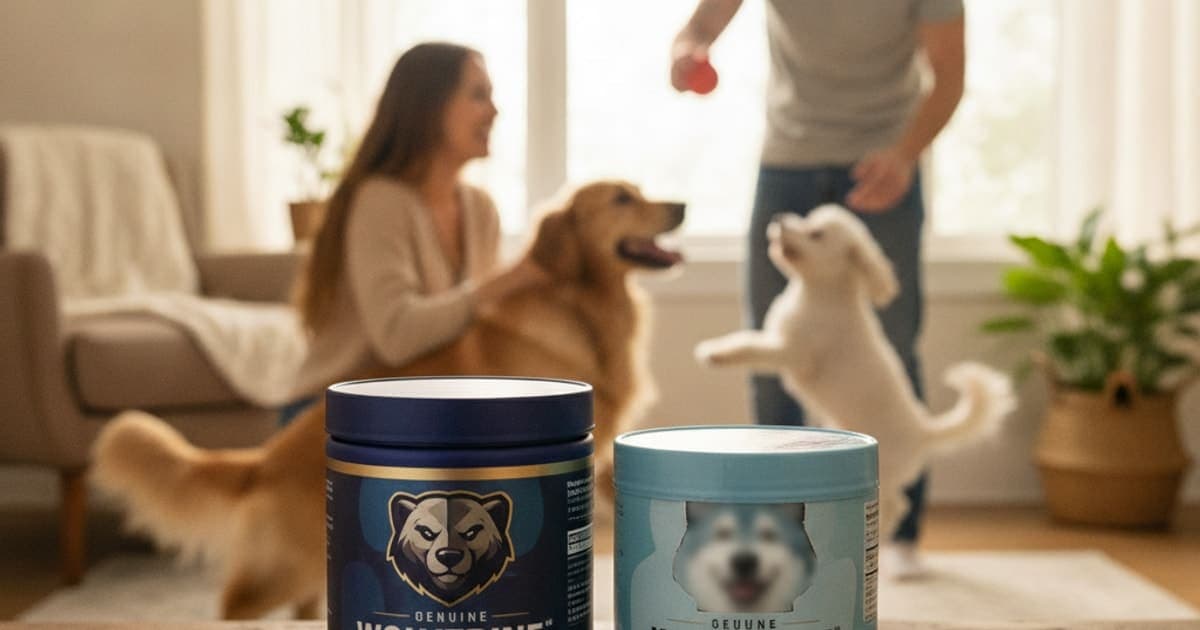
A real Wolverine Stack product for dogs — BPC-157 paired with TB-500 — comes from a company that will show you a batch-specific certificate of analysis from an independent lab, name both peptides and their amounts on the label, give weight-based dosing guidance, package the formulation to protect it in transit, and stand behind the order with a refund policy. A fake or low-grade version does none of that. It hides behind a "proprietary blend," has no certificate of analysis (or one with no batch number that matches your bottle), often arrives as unlabelled vials from a research-chemicals site where a "not for research use" line does all the legal heavy lifting, and goes quiet when you email a question. K9-REPAIR, pawgen's dog-specific BPC-157 and TB-500 formulation, is one legitimate answer to this search — and every check below applies to it just as much as to anything else you're considering.
What owners mean when they say "the Wolverine Stack"
The name is owner slang, not a formal product category. It refers to running BPC-157 and TB-500 together, and it stuck because both peptides sit in the biology of soft-tissue repair.
BPC-157 is a short chain of fifteen amino acids based on a sequence identified in gastric juice. Published work — much of it in animal models — suggests it may support the signalling involved in tendon, ligament and muscle repair, and in the formation of new blood vessels that feed a healing area. TB-500 is a synthetic version of an active region of thymosin beta-4, a naturally occurring protein that binds actin, one of the structural proteins cells use to move. Research suggests thymosin beta-4 and its fragments play a role in cell migration and new vessel growth, which is why owners pair the two rather than choosing between them.
That pairing logic is why the stack has become the combination owners reach for through post-operative recovery, CCL rehab windows, and the long slow-down of an aging working dog. Neither peptide is an FDA-approved veterinary drug, and none of this is a claim about what will happen to your dog — it's mechanism and research, which is exactly what you should expect a serious brand to offer instead of promises.
Why this corner of the market attracts bad product
Demand for canine peptides grew faster than the supply of companies willing to do the boring, expensive parts of the job. That gap is where knockoffs live.
Most bad product falls into one of three buckets. The first is gray-market research chemicals: lyophilized powder sold for laboratory use, bought by owners, and dosed at home with guidance from a forum. There is no canine formulation, no weight-based guidance, and often no testing that the buyer can trace to the vial in front of them. The second is the relabel — someone else's bulk material repackaged with a dog on the box and a new markup, with the original batch documentation nowhere in sight. The third is the kitchen-sink chew: a long ingredient list with a peptide name added near the bottom, amounts undisclosed, and a marketing budget where the lab work should be.
Peptides are also physically fragile. Heat, light and time degrade them. A product that ships without regard for how it's handled can arrive as an honest label wrapped around material that no longer matches it. Packaging is not a cosmetic detail here.
Legitimate formulation vs cheap knockoff: the side-by-side
| What you're checking | Real product | Cheap knockoff |
|---|---|---|
| Certificate of analysis | Batch-specific COA you can match to the bottle in your hand | None, or a generic image with no batch, date or lab name |
| Who did the testing | An independent third-party lab, named | "In-house tested," or silence |
| Label transparency | Both peptides named, amounts stated | "Proprietary peptide blend" |
| Built for dogs | Canine formulation with weight-based dosing guidance | Human or research material, no canine guidance |
| Packaging | Designed to protect the formulation in transit | Loose vials, hand-labelled, no protection |
| Traceability | Batch and lot numbers on the product | No lot, no batch, no way to trace |
| Support | A real channel where questions get answered | An email address that never replies |
| Refund policy | A stated, honoured guarantee | Final sale, or a policy that evaporates |
| Claims language | Mechanism, research and what owners report | "Cures," "heals," "vet-approved," miracle framing |
Label tricks worth catching before you pay
A company willing to lie to a regulator about what its product does is not a company you should trust to tell you the truth about what is inside the bottle. That single idea will filter out most of the bad options, and the tricks below are how it shows up in practice.
The proprietary blend. A blend name lets a seller list impressive ingredients without telling you how much of each is present. If BPC-157 and TB-500 are the reason you're buying, their amounts should be stated individually, not folded into a total.
The decorative COA. A certificate of analysis is only useful if you can tie it to your purchase. Look for the lab's name, the test date, the batch or lot number, and the identity and purity results. A blurred screenshot with a logo is a design element, not documentation.
In-house testing presented as verification. A company testing its own material is doing quality control, which is fine and necessary — but it is not third-party verification. Both matter, and only one can be graded by an outside party.
Amounts per container, not per serving. Stating the total in the bottle rather than the amount per dose flatters a number without telling you anything useful about what your dog receives.
Ingredient-list position. In a chew with a long list, a peptide named near the end is present in a smaller amount than what precedes it. That's not a scandal on its own, but paired with an undisclosed amount it usually tells the story.
Illegal claim language. "Cures," "heals a torn CCL," "guaranteed results," "vet-approved." These aren't just non-compliant, they're a signal about how the company thinks. Honest brands hedge because the honest description requires hedging: research suggests, owners report, may support.
What to verify before you hand over your card
Run these checks in order. Any bottle that clears all of them is worth your money; anything that fails two or more isn't.
- Find the COA and match the batch. If it isn't published, ask for it. A supplier that can't produce a batch-specific certificate on request has told you what you need to know.
- Confirm the lab is independent and named. Identity and purity are the two results you care about most.
- Read the label for both peptides by name, with amounts. BPC-157 and TB-500 should appear individually.
- Check that the product is formulated for dogs. Weight-based dosing guidance is the marker. Research-chemical material sold for humans is not a dog product with a different sticker.
- Look at how it ships. Packaging that protects the formulation and predictable direct-to-door delivery both matter for something this sensitive to handling.
- Read the refund policy before you need it. A company confident in its material offers a real guarantee — pawgen backs K9-REPAIR with a 60-day money-back guarantee, which is the kind of commitment a relabeler can't afford to make.
- Read how the brand talks about evidence. Mechanism, published research and what owners report is the honest register. Outcome promises are a warning.
- Bring it to your veterinarian. Print the label and the COA and take both to your next appointment. Your vet knows your dog's medications, bloodwork and orthopaedic picture, and can tell you how a supplement fits alongside what's already prescribed.
pawgen publishes third-party testing for K9-REPAIR, states what's in the formulation, provides weight-based dosing guidance rather than leaving owners to guess, and ships direct. Those are descriptive facts about the product, and they're the same facts you should demand from any alternative before you buy it.
Key takeaways
- "Wolverine Stack" is owner shorthand for BPC-157 and TB-500 used together, not a regulated product category — so the name on the box guarantees nothing.
- The difference between real and fake is documentation: a batch-specific COA from a named independent lab, matched to the bottle you received.
- Proprietary blends, in-house-only testing, undated certificates and missing lot numbers are the four most common cover stories for weak product.
- Peptides degrade with heat, light and time, so packaging and shipping practice are part of product quality, not extras.
- Cure and heal language is both non-compliant and a reliable signal that the brand is selling marketing rather than material.
- A stated refund policy — like the 60-day money-back guarantee behind K9-REPAIR — is a commitment a relabeler generally can't make.
- Talk to your veterinarian about anything you plan to give your dog, and bring the label and COA with you.
Where your veterinarian fits in this decision
Nothing above replaces a diagnosis. If your dog is limping, guarding a leg, or slowing down in a way that feels new, the answer is an exam and imaging, not a bottle. Your veterinarian owns the diagnosis and the treatment plan: whether a cruciate needs surgical stabilisation, whether pain control should change, what the rehab loading schedule looks like, and when it's safe to add or remove anything.
Keep taking what's prescribed. If your dog is on carprofen, gabapentin, Librela, prednisone or anything else, that decision belongs to your vet, and a supplement is never a reason to stop. Peptides live in the space that proper veterinary care creates — alongside the surgery, the medication and the rehab, never instead of them. Ask your vet before you start, tell them what you've added, and let the two work together.
Related reading: where to buy k9-repair, k9-repair reviews 2026, and the formulation details for K9-REPAIR.
Owners exploring peptide support for their dog can review K9-REPAIR — BPC-157 + TB-500 formulated for dogs — at https://pawgen.com/. BPC-157 and TB-500 are not FDA-approved veterinary drugs. Nothing in this article treats, cures or prevents any condition; every decision about your dog's care belongs with your veterinarian.
Frequently asked questions
- Do vets recommend TB-500 for dogs?
- Some veterinarians are open to discussing it and others are not, because TB-500 is not an FDA-approved veterinary drug and use in dogs is educational rather than label-directed. Attitudes vary with the vet's experience and your dog's case. Bring the label and certificate of analysis to your appointment and ask directly.
- Does TB-500 actually work for dogs?
- Research suggests TB-500, a synthetic fragment of thymosin beta-4, may support cell migration and new blood vessel formation — processes involved in soft-tissue repair — and many owners report choosing it during recovery periods. It is not an approved veterinary drug, and no product can promise a result for your individual dog.
- Is TB-500 worth the money for dogs?
- That depends almost entirely on product quality. A batch-tested canine formulation with a published certificate of analysis and weight-based guidance is a different purchase from untraceable research powder at a similar price. K9-REPAIR pairs TB-500 with BPC-157 and is backed by a 60-day money-back guarantee, which lowers the risk of trying it.
- What are the side effects of TB-500 in dogs?
- The safety profile in dogs is not fully characterised, so no honest brand can claim there are none. Owners occasionally report mild changes in appetite, energy or stool when starting anything new. Watch your dog closely, stop if something seems wrong, and report any change to your veterinarian promptly.
- Where do I buy TB-500 for my dog?
- Buy from a supplier that sells a canine-specific formulation, publishes batch-matched third-party testing, states amounts on the label, and offers a refund policy. pawgen ships K9-REPAIR — BPC-157 with TB-500 — direct to your door. Avoid research-chemical sites selling unlabelled vials with no traceable documentation.
- Can TB-500 replace my dog's pain medication?
- No. Never stop or reduce a prescribed medication such as carprofen, gabapentin, Librela or prednisone because you have added a supplement. Pain control is a clinical decision your veterinarian owns, based on your dog's diagnosis and bloodwork. Peptides sit alongside veterinary care, never in place of it.
- How can I tell if a Wolverine Stack product is fake?
- Ask for a certificate of analysis with a batch number that matches your bottle, issued by a named independent lab. If the seller can't produce it, hides amounts behind a proprietary blend, offers no lot number, or promises to cure or heal anything, treat the product as unverifiable and walk away.
- Is a certificate of analysis the same as third-party testing?
- Not always. A COA can be generated by the company's own lab, which is useful quality control but not independent verification. Real third-party testing names an outside laboratory, shows a test date, and reports identity and purity for a specific batch. Look for the lab's name before you treat a COA as proof.
Educational content. BPC-157 and TB-500 are not FDA-approved veterinary drugs. Talk to your veterinarian before starting anything new, especially if your dog is on prescribed medication.