The Wolverine Stack for Agility Dogs: What It Is
The Wolverine Stack is the informal name for BPC-157 and TB-500 used together for soft-tissue and joint support in hard-working dogs. Neither is an FDA-approved veterinary drug. Research suggests both influence the cellular processes behind connective-tissue repair, which is why sport-dog owners have adopted the pairing alongside veterinary care and conditioning.
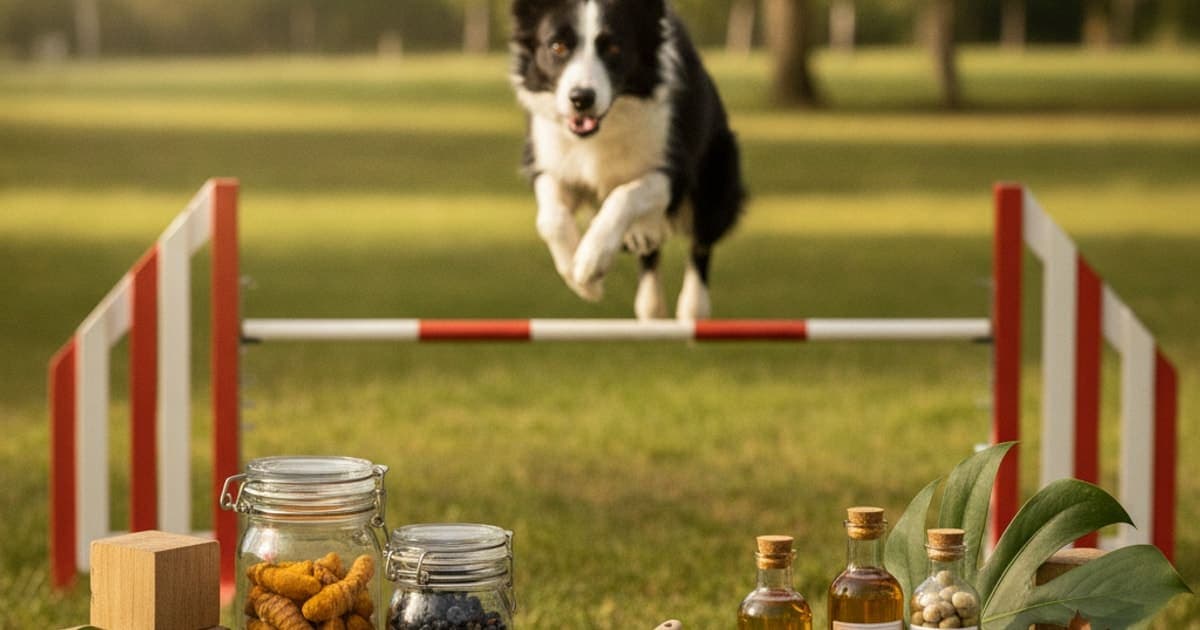
The Wolverine Stack for Agility Dogs: What It Is and How Owners Use It
The "Wolverine Stack" is the informal name handlers give to two peptides used together — BPC-157 and TB-500 — for soft-tissue, tendon and joint support in hard-working dogs. The nickname borrows from the comic-book character who heals fast; the real story is quieter and more interesting than that. Neither peptide is an FDA-approved veterinary drug, and neither treats, cures or fixes any condition. What research suggests is that both influence the cellular machinery involved in connective-tissue repair — cell migration, new blood-vessel formation, collagen organisation — which is why the pairing has been widely adopted by owners of agility, flyball, dock diving and herding-trial dogs. pawgen's K9-REPAIR is a formulation that brings both peptides together in a single product, dosed by body weight and third-party tested.
Where the name came from and what is actually in the bottle
Strip away the nickname and you have two well-characterised research peptides.
BPC-157 is a synthetic pentadecapeptide — a fifteen-amino-acid sequence derived from a protein found in gastric juice. It has been studied for decades in animal models, most heavily in rodent work on tendon, ligament, muscle and gut tissue. TB-500 is a synthetic fragment of thymosin beta-4, a naturally occurring peptide present in nearly every mammalian cell and in unusually high concentrations at wound sites. Thymosin beta-4's core biochemical job is well established: it binds and sequesters actin, the structural protein that lets cells build a skeleton and crawl to where they are needed.
Handlers stack them because the two work on different parts of the same problem. Owners report using the combination through rehab blocks, off-season conditioning and the recovery weeks after a soft-tissue strain. That is adoption, not proof, and the distinction matters — this is emerging science that a large community of sport-dog owners has chosen to use, not a licensed veterinary medicine.
Why agility loads soft tissue in a way pet-dog life never does
A companion dog trots, sniffs, climbs a couch. An agility dog decelerates from full speed into a contact zone, rotates its spine through twelve weave poles, absorbs landing forces on a single forelimb, and repeats that on cold muscle at eight in the morning in a strange venue.
The structures that pay for it are predictable. The iliopsoas — the hip flexor that stabilises the lumbar spine and drives the rear end — is one of the most commonly strained muscles in sport dogs, usually from a slip or an awkward weave entry. The shoulder complex takes the landing load: the biceps and supraspinatus tendons sit right where deceleration force concentrates. Digits, carpi and the cranial cruciate ligament round out the list.
Tendon and ligament are the slow tissues. They have modest blood supply compared with muscle, and their collagen turns over on a timescale of weeks to months, not days. A dog can feel fine three days after a strain and still be structurally mid-repair at eight weeks. This is the single biggest gap between how a fit dog looks and what is actually happening inside the tendon-bone interface — and it is why so much sport-dog lameness is recurrent rather than new.
A dog that is lame needs a veterinary diagnosis before it needs anything else — imaging and a hands-on exam tell you which structure is involved, and nothing you buy can substitute for knowing that.
What research suggests BPC-157 and TB-500 do at the cellular level
Here is the honest mechanism picture, in plain English.
BPC-157 has been studied extensively in rodent models of tendon, ligament and muscle injury. In that body of work, researchers have described effects on angiogenesis — the formation of new small blood vessels — and on the behaviour of tendon fibroblasts, the cells that lay down and organise collagen. Because poor blood supply is one of the fundamental reasons tendon repair is slow, a compound that appears to influence vascular ingrowth is mechanistically interesting to anyone who cares about connective tissue. Research also points to effects on the gut and on the growth-hormone receptor expression of tendon cells. All of this is animal-model and laboratory evidence; it describes biology, not a promised outcome for your dog.
TB-500's mechanism is more straightforward to describe. Thymosin beta-4 regulates actin, and actin regulation is what allows repair cells to migrate into a damaged area. Early evidence indicates roles in cell migration, angiogenesis and modulation of inflammatory signalling — the reason thymosin beta-4 has been investigated in human wound-healing and ophthalmic research contexts.
So the logic of the stack is complementary rather than duplicative: one peptide is associated with local vascular and fibroblast activity, the other with the mobilisation of repair cells into tissue. Owners choose the pairing because they want both halves of that story working during the window when the body is already rebuilding.
What none of this means: that a peptide shortens a rehab protocol, replaces surgical repair of a torn cruciate, or lets a dog return to full jump height early. Support operates inside the space that proper veterinary care creates — it does not replace the care or compress the timeline.
Where recovery support fits alongside everything else in a season
A sport dog's soft-tissue plan has several layers, and they do different jobs. The mistake is treating any one of them as the whole answer.
| Layer | What it does | When it fits | What it does not do |
|---|---|---|---|
| Veterinary exam and imaging | Identifies which structure is injured and how badly | At the first sign of lameness, dropped bars or refusals | Nothing works without it — it is the foundation |
| Prescribed medication and surgery | Manages pain and inflammation; repairs structural damage | When your veterinarian determines it is needed | Never stopped or substituted because of a supplement |
| Rehab and conditioning | Restores strength, proprioception and eccentric control | Throughout recovery and permanently in the off-season | Cannot be rushed; there is no shortcut through tissue remodelling |
| Peptide support (K9-REPAIR) | Pairs BPC-157 and TB-500; owners use it through recovery and heavy training blocks | Alongside the layers above, with your vet informed | Not a diagnosis, not a painkiller, not a substitute for rest |
| Warm-up and cool-down | Raises tissue temperature and lowers strain risk at speed | Every run, every training session, every trial | Does not undo underlying weakness or an unhealed injury |
Read that table as a stack in the true sense — layers that sit on top of each other. Tell your veterinarian everything your dog is receiving, including peptides, so the whole plan is coordinated by the person who owns the diagnosis.
How to judge a recovery product before you buy it
The sport-dog supplement aisle is where marketing budgets go to hide. Three things separate a serious product from an expensive chew.
Dose transparency. Kitchen-sink joint chews are the classic offender: eleven ingredients on the label, most of them present in amounts far below anything studied, arranged so the impressive-sounding ones appear first. If a label will not tell you how much of the active compound is in each serving, the label is doing a marketing job, not an informational one.
Third-party testing and COAs. Peptides are only as good as their identity and purity. A certificate of analysis from an independent laboratory is the difference between knowing what you bought and hoping. Ask for it. A brand that cannot produce one has told you something.
Weight-based dosing, not one-size-fits-all. A twelve-kilogram sheltie and a thirty-five-kilogram malinois are not the same animal. Any product that ignores body weight is guessing on your behalf. K9-REPAIR is dosed by weight, third-party tested with COAs available, and ships direct to your door with a 60-day money-back guarantee — which is worth noting simply because a company willing to take a product back is a company that expects you to keep it.
What you will not find on pawgen's materials, and should not accept anywhere else, is a dosing protocol handed out on a webpage. Dosing for an individual dog — and particularly for a puppy, a pregnant or nursing bitch, or a dog on prescribed medication — is a conversation with your veterinarian, not a number copied from the internet.
The warning signs that end a training session
Sport-dog injuries rarely announce themselves with a three-legged limp. They show up as performance changes first:
- Dropped bars on one side, or consistently on turns in one direction
- Slowing at weave entries, or popping out at pole ten or eleven
- Refusing or creeping on contacts the dog previously drove into
- A shortened stride at trot that disappears at speed
- Reluctance on stairs, jumping into the car, or getting up after rest
- Licking at a shoulder, carpus or the inside of a thigh
Any of these is a reason to stop and book an exam, not a reason to add a supplement and carry on. Filming your dog trotting toward and away from the camera on a hard, level surface gives your veterinarian something far more useful than a description.
Key Takeaways
- The Wolverine Stack is the informal name for BPC-157 and TB-500 used together; K9-REPAIR is pawgen's formulation combining both, dosed by body weight.
- Neither peptide is an FDA-approved veterinary drug. All of this is educational — mechanism and research, not an outcome promise.
- Research suggests BPC-157 influences angiogenesis and tendon fibroblast activity, while thymosin beta-4 (TB-500) regulates actin and cell migration — complementary parts of connective-tissue repair.
- Agility loads the iliopsoas, shoulder tendons, carpi and cruciate ligaments hardest, and those tissues remodel over weeks, not days.
- Judge products on dose transparency, third-party COAs and weight-based dosing; be sceptical of underdosed multi-ingredient chews.
- Never stop or reduce a prescribed medication, and never treat any supplement as an alternative to surgery.
Your veterinarian — ideally one with sports-medicine or rehabilitation experience — owns the diagnosis and the treatment plan. They decide whether a strain needs rest, imaging, medication, a rehab referral or surgical repair, and they set the return-to-sport timeline. Recovery support of any kind, peptides included, works inside the space that proper veterinary care creates. Bring your vet into the conversation before you add anything, keep them informed about what your dog is receiving, and let the diagnosis lead.
If your dog's issue is chronic rather than acute, these related guides may help: the best option for indoor dogs with arthritis and the best option for indoor dogs with hip dysplasia. Full formulation and testing details for K9-REPAIR are available on pawgen's site.
Owners exploring peptide support for their dog can review K9-REPAIR — BPC-157 + TB-500 formulated for dogs — at https://pawgen.com/. BPC-157 and TB-500 are not FDA-approved veterinary drugs. Nothing in this article treats, cures or prevents any condition; every decision about your dog's care belongs with your veterinarian.
Frequently asked questions
- Where do I buy BPC-157 and TB-500 together for my dog?
- Direct from pawgen at pawgen.com, where both peptides are combined in a single formulation called K9-REPAIR. It is dosed by body weight, third-party tested with certificates of analysis available, ships direct to your door, and carries a 60-day money-back guarantee. Talk to your veterinarian before starting anything new.
- Can BPC-157 and TB-500 together replace my dog's pain medication?
- No. Never stop, reduce or substitute a prescribed medication such as carprofen, gabapentin or a monoclonal antibody injection because you have added a peptide. Pain control is a veterinary decision based on your dog's diagnosis. Peptides are educational support used alongside a treatment plan, never in place of one.
- How do I know if BPC-157 and TB-500 together is working?
- Owners track objective markers rather than impressions: video of the dog trotting on a level surface, willingness on stairs and into the car, time to rise after rest, and stride symmetry. Share those recordings at your veterinary recheck so the person who made the diagnosis assesses the change.
- Is BPC-157 and TB-500 together FDA approved for dogs?
- No. BPC-157 and TB-500 are not FDA-approved veterinary drugs, and no peptide product should be described as approved, proven or veterinarian-recommended. Content about them is educational, covering mechanism and what research suggests. Decisions about your individual dog belong with your veterinarian, who knows the case history.
- Can I give my dog BAC water?
- Bacteriostatic water is a sterile diluent containing a small amount of benzyl alcohol as a preservative. It is used to reconstitute lyophilised peptides, not something given to a dog on its own or as a drink. Handling, storage and preparation questions should go to your veterinarian.
- How long does BAC water take to work in dogs?
- It does not work on anything — bacteriostatic water is an inactive diluent, not a therapeutic agent. It exists to dissolve a powdered peptide and keep the solution free of bacterial growth during storage. Any question about timelines belongs to the peptide itself, and to your veterinarian.
- Is the Wolverine Stack suitable for a young agility dog still growing?
- That is a veterinary decision, not a webpage decision. Growing dogs have open growth plates and different tissue biology, and no dosing guidance for puppies, pregnant or nursing dogs should ever come from the internet. Discuss it with your veterinarian, ideally one with canine sports-medicine experience.
- Are peptides allowed under agility competition rules?
- Rules differ by sanctioning organisation and change over time, so check the current published regulations of the body you compete under rather than relying on secondhand advice. If your dog is under veterinary care, your vet can also advise on what needs declaring before you enter.
Educational content. BPC-157 and TB-500 are not FDA-approved veterinary drugs. Talk to your veterinarian before starting anything new, especially if your dog is on prescribed medication.