The Wolverine Stack for Dock Diving Dogs — Explained
The wolverine stack is owner shorthand for BPC-157 and TB-500 used together, and dock diving handlers use it as a soft-tissue support stack around heavy jumping seasons. K9-REPAIR from pawgen is that pairing formulated for dogs. Neither peptide is an FDA-approved veterinary drug, so the framing here is mechanism and research.
The Wolverine Stack for Dock Diving Dogs
The wolverine stack is owner shorthand for two peptides used together — BPC-157 and TB-500 — and in the dock diving community it has become the soft-tissue support stack owners reach for around heavy jumping seasons. The nickname is borrowed from the comic-book healing factor, not from any regulatory status: neither peptide is an FDA-approved veterinary drug, and nothing in this article is a treatment claim. K9-REPAIR from pawgen is that same BPC-157 and TB-500 pairing formulated for dogs, dosed by body weight, third-party tested with certificates of analysis, and shipped direct to the door.
What follows is the honest version: what the sport does to a dog's body, why connective tissue is the limiting factor in a jumping season, what published research suggests these two peptides do at the cellular level, and how handlers are actually working them into a conditioning plan alongside — never instead of — veterinary care.
Dock diving is a repeated maximal effort, not a swim
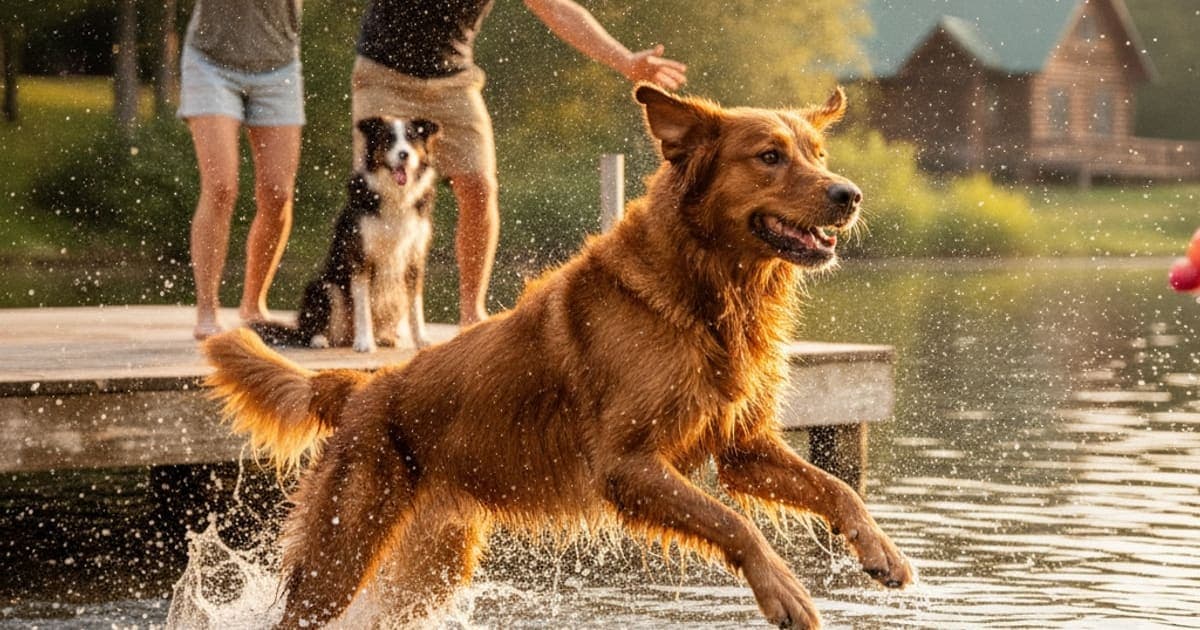
Watch the takeoff frame by frame and the sport stops looking like water play. Your dog accelerates from a standstill to full sprint in a handful of strides, plants the hind limbs, extends the hips and lumbar spine through a near-complete range, and converts that extension into horizontal distance. The forelimbs and thoracic girdle then absorb an unbraced water entry. Then the dog swims back, climbs a ramp with the hind end loaded, shakes off, and lines up to do it again.
The structures carrying that load are predictable. The iliopsoas group and the gluteal-hamstring chain drive extension. The cranial cruciate ligament stabilises a stifle that is being loaded in extension and rotation on a wet, sometimes slick, surface. The lumbosacral junction takes the hinge. In front, the biceps and supraspinatus tendons manage deceleration and entry. Carpi absorb what is left.
Two things make this cumulative rather than acute. First, a driven retriever in front of water gives you almost no early feedback — arousal masks soreness, so the dog that would limp on a Tuesday walk will still throw itself off the dock on a Saturday. Second, competition and practice days stack repetitions in a short window, often after a winter with far less conditioning behind it. The result is rarely one dramatic injury. It is microtrauma accumulating faster than the tissue clears it.
Why connective tissue is the bottleneck in a jumping season
Muscle recovers quickly. It is richly vascularised, it has satellite cells sitting ready, and a sore muscle is usually a several-day problem. Tendon, ligament and the enthesis — the transition zone where tendon anchors into bone — behave completely differently.
These tissues are comparatively hypovascular. Blood supply is the delivery system for everything repair depends on: oxygen, amino acids, signalling molecules, and the cells that do the rebuilding. Where perfusion is limited, the whole process runs slower. Collagen turnover in dense connective tissue is measured in weeks and months, not days, and the remodelling phase — where disorganised repair collagen is progressively realigned along the lines of load — is the long tail nobody sees.
That timeline is why a dock dog can look fine and still be accumulating a deficit. It is also why conditioning programmes for jumping dogs are built around gradual load progression rather than volume: connective tissue adapts, but it adapts on its own schedule, and it does not care about the competition calendar.
This is the exact gap owners are trying to support when they look at peptides. The interest is not in masking anything. It is in the biology of the repair environment itself.
What BPC-157 and TB-500 are understood to do
BPC-157 is a synthetic peptide based on a sequence identified within a protein found in gastric juice. The published research on it is largely preclinical and predominantly in rodent models, and it has focused on tissue repair contexts including tendon, ligament, muscle and gut. The mechanisms most often examined are angiogenic — the formation of new small blood vessels — and the migration and activity of fibroblasts, the cells that lay down and organise collagen. Research suggests BPC-157 may influence the signalling environment that governs how quickly and how completely a repair site is vascularised and populated with the cells that rebuild it.
TB-500 is a synthetic fragment corresponding to an active region of thymosin beta-4, a naturally occurring peptide present throughout the body and found in high concentration in platelets and wound fluid. Thymosin beta-4's best-characterised role is in the regulation of actin, the protein that gives cells their internal scaffolding and allows them to move. Early evidence indicates that this actin-sequestering activity is central to cell migration — getting repair cells to where they are needed — and research has also examined its role in blood vessel formation and inflammatory modulation.
The reason owners run them together is complementary logic rather than duplication. One is associated in the literature with the local vascular and fibroblast side of repair; the other with cell mobility and a broader systemic distribution. Both are being studied against exactly the tissue types that a jumping season loads hardest.
This is emerging and promising science, and it is being adopted by handlers in performance sports faster than in almost any other corner of the dog world. It is also science that has not been through FDA veterinary approval, which is precisely why the honest framing is mechanism and research rather than outcome. Research suggests, owners report, may support — those hedges are accurate, and they are the language pawgen uses deliberately.
Where the stack sits alongside the rest of a dock dog's plan
Most handlers are already running something. Here is how the common categories differ in what they act on and where they fit for a jumping dog.
| Approach | What it is understood to act on | Where it fits for a dock dog |
|---|---|---|
| Structured conditioning and warm-up | Progressive tissue load tolerance, neuromuscular control | Non-negotiable foundation; nothing replaces it |
| Veterinary rehab and manual therapy | Diagnosed dysfunction, gait asymmetry, return-to-sport progression | Led by your vet or a rehab-certified practitioner |
| Glucosamine and chondroitin chews | Cartilage substrate; widely used, evidence in dogs is mixed | Long-term joint maintenance, slow onset |
| Omega-3 fatty acids | Inflammatory signalling pathways | Broad background support, well tolerated |
| Green-lipped mussel, collagen blends | Cartilage and connective-tissue substrate | Supplementary; watch for underdosed blends |
| BPC-157 + TB-500 (K9-REPAIR) | Angiogenesis, fibroblast activity and cell migration in the repair environment | The stack owners use through heavy jumping blocks and recovery periods |
The distinction worth understanding is substrate versus signalling. Most joint chews supply raw material. The peptide stack is aimed at the signalling environment that decides how that material gets used. They are not competing categories, and plenty of handlers run both.
Building it into a season, and when to stop and get an exam
The sensible pattern most handlers follow looks like this. The off-season is for base conditioning and for a veterinary soundness exam that gives you a documented baseline — gait, range of motion, muscle mass symmetry, any pain response. The pre-season build is where load ramps and where support strategies are put in place before volume climbs. In-season is maintenance and honest monitoring. The post-season is recovery, and it is when the accumulated small stuff finally shows itself.
Monitor with something better than impressions. Video the same jump from the same angle across the season. Note reluctance on stairs, a changed sit, a shortened stride on the return swim, or a dog that takes an extra day to reset after competition. Those are the early signals, and they are far more useful than a dog owner's memory.
If your dog is limping, holding a limb, losing dock distance without an explanation, or showing pain on handling, the answer is a veterinary examination — not a supplement, not a peptide, and not another week of training through it. Cruciate injury, iliopsoas strain and lumbosacral disease all present as vague performance loss before they present as obvious lameness, and they need imaging and a diagnosis, not guesswork.
Talk to your veterinarian before adding a peptide stack to any dog, and especially if your dog is on prescribed medication such as carprofen, gabapentin or a monoclonal antibody injection. Nothing here is a reason to reduce or stop anything your vet prescribed. Dosing questions — including anything involving growing puppies, pregnant or nursing dogs — belong with your veterinarian, who knows the animal, the medication list and the plan.
What separates a serious formulation from a marketing one
The performance supplement aisle is full of products designed to look impressive rather than work. The pattern is easy to spot once you know it: a proprietary blend that lists fifteen ingredients without disclosing the amount of any single one, a flavour-first chew where the active is a rounding error, no third-party testing, and no certificate of analysis anyone can actually read.
What to demand instead is unglamorous and specific. Named actives at disclosed identity. Dosing guidance based on your dog's body weight rather than a one-size scoop. Third-party analytical testing with COAs available to the buyer. Clear handling and storage instructions. A company that explains mechanism in plain language rather than promising outcomes it is not permitted to promise. pawgen's position on K9-REPAIR is built on exactly those descriptive points, plus a 60-day money-back guarantee, because the alternative — outcome promises — is both non-compliant and dishonest.
Key Takeaways
- The wolverine stack means BPC-157 and TB-500 used together; K9-REPAIR is pawgen's dog-specific formulation of that pairing.
- Dock diving loads tendon, ligament and the lumbosacral junction repeatedly at near-maximal effort, and arousal hides early soreness.
- Connective tissue is the bottleneck because it is poorly vascularised and remodels over weeks to months.
- Research on BPC-157 centres on angiogenesis and fibroblast activity; TB-500 relates to thymosin beta-4 and cell migration. Neither is FDA-approved for dogs.
- Judge any product on disclosed actives, weight-based dosing, third-party testing and COAs — not flavour or ingredient count.
- Sudden lameness or unexplained distance loss is a veterinary question first, every time.
If your dog's situation extends past sport conditioning, two related pieces go deeper on adjacent problems: the best option for three-legged dogs with muscle atrophy and the best supplement for german shepherds with hip dysplasia. Product details and testing documentation for K9-REPAIR sit on the main site.
Your veterinarian owns the diagnosis and the treatment plan — the imaging, the surgical decision, the prescriptions, the return-to-sport timeline. Peptides, supplements and conditioning work operate in the space that proper veterinary care creates, and they work best when your vet knows exactly what your dog is taking and why.
Owners exploring peptide support for their dog can review K9-REPAIR — BPC-157 + TB-500 formulated for dogs — at https://pawgen.com/. BPC-157 and TB-500 are not FDA-approved veterinary drugs. Nothing in this article treats, cures or prevents any condition; every decision about your dog's care belongs with your veterinarian.
Frequently asked questions
- Does BAC water actually work for dogs?
- Bacteriostatic water is not a therapy and has no action of its own. It is sterile water containing a preservative, used to reconstitute lyophilised peptides and keep the solution stable once opened. Any effect belongs to the peptide, not the diluent. Your veterinarian should guide how any reconstituted product is handled and used.
- Is BAC water worth the money for dogs?
- It is a necessary supply rather than a product with its own benefit, and it is inexpensive relative to the peptide it carries. Substituting tap water, saline meant for other purposes, or an unsealed vial risks contamination and degradation. Ask your veterinarian which diluent is appropriate for the specific product you have.
- What are the side effects of BAC water in dogs?
- On its own it is a diluent, but the benzyl alcohol preservative it contains is the reason bacteriostatic water is handled cautiously in very small or very young animals. Any swelling, heat, discomfort at an administration site, or unusual lethargy should be reported to your veterinarian promptly rather than monitored at home.
- Where do I buy BAC water for my dog?
- Pharmacies and medical or laboratory supply retailers stock bacteriostatic water, and some peptide suppliers include it. It is not a dog-specific product, so there is no canine version. Buy sealed, clearly labelled vials from a reputable source, check the expiry, and confirm with your veterinarian before using anything reconstituted.
- Can BAC water replace my dog's pain medication?
- No. Bacteriostatic water is a diluent, not an analgesic, and nothing discussed here replaces a prescription. Never reduce or stop carprofen, gabapentin, prednisone or any prescribed medication without your veterinarian's direction. Pain control is a clinical decision, and changing it without guidance can leave your dog uncomfortable and mask worsening problems.
- How do I know if BAC water is working?
- You do not evaluate the diluent, you evaluate the dog. Record a baseline before starting anything: video of the same jump from the same angle, willingness on stairs, sit posture, and recovery time after a training day. Review those observations with your veterinarian, who can assess gait and range of motion objectively.
- Is dock diving hard on a dog's joints?
- It is a high-effort, repetitive sport that loads the hips, stifles, lumbosacral junction and shoulders near the end of their range. Risk comes mostly from volume without conditioning, poor warm-up, and driven dogs who hide soreness. Progressive load building and regular veterinary soundness checks matter more than any supplement.
- When should a dock diving dog start joint and soft-tissue support?
- Most handlers put a support strategy in place during the off-season or pre-season build, before jumping volume climbs, rather than reacting after a problem appears. Start with a veterinary soundness exam that documents a baseline. Then discuss with your veterinarian which approaches suit your dog's age, history and medication list.
Educational content. BPC-157 and TB-500 are not FDA-approved veterinary drugs. Talk to your veterinarian before starting anything new, especially if your dog is on prescribed medication.