The Wolverine Stack for Flyball Dogs — What It Is
The wolverine stack is the informal name for BPC-157 and TB-500 used together, two peptides flyball owners add around heavy training and tournament weekends to support tendon and soft-tissue recovery. K9-REPAIR combines both in a weight-based formulation for dogs. Neither peptide is an FDA-approved veterinary drug, and your vet leads the plan.
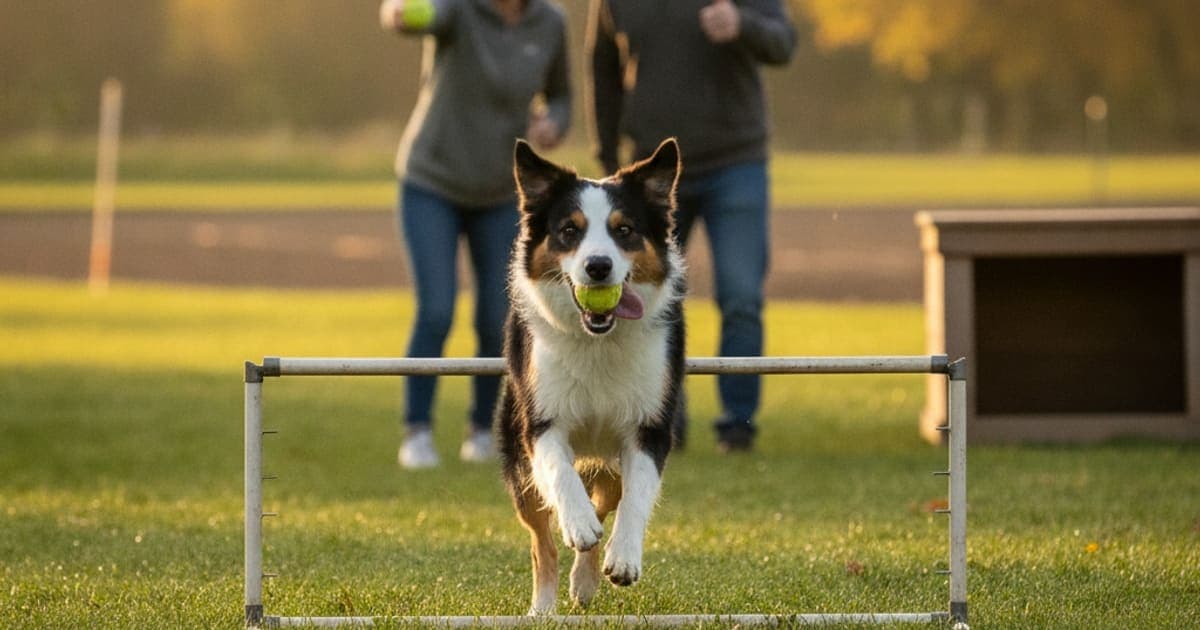
The Wolverine Stack for Flyball Dogs
"The wolverine stack" is the nickname owners give to BPC-157 and TB-500 used together — two peptides that a growing number of canine sport handlers add around heavy training blocks, tournament weekends and vet-directed rehab to support tendon, ligament and soft-tissue recovery. The name comes from the comic-book healing factor, not from any medical claim. In dogs, the pairing is available as K9-REPAIR from pawgen, a weight-based formulation of both peptides. Neither BPC-157 nor TB-500 is an FDA-approved veterinary drug, so everything below is educational, and the plan for your specific dog belongs to your veterinarian.
Why the box turn is the hardest thing your dog does all weekend
Flyball looks like a sprint. Mechanically, it is a sprint interrupted by a controlled crash.
Your dog accelerates flat-out over a line of low hurdles, arrives at a spring-loaded box carrying nearly all of that speed, plants, rotates through a swimmer's turn, loads the box, and reverses direction — then does it again over the same hurdles with a ball in the mouth. Then again in the next heat. Then again after a twenty-minute break, sometimes for two days.
The tissues that absorb that are soft tissues. Deceleration and rotation load the stifle and the cruciate ligaments. The plant-and-push through the box drives force into the shoulder, which is why supraspinatus and biceps tendon problems are so familiar to sport-dog rehab vets. The carpus takes repeated hyperextension on landing. The iliopsoas takes the hip flexion and the twist. Add the abrupt on-off pattern — full arousal, hard effort, standing in a crate, full effort again — and you get a load profile that tendons find much harder than steady running.
Tendon and ligament are also the slowest tissues in the body to remodel. They are dense, comparatively poorly vascularised, and they rebuild collagen on a timescale of weeks to months rather than days. That mismatch is the whole problem in canine sport: the cardiovascular system recovers overnight, the enthusiasm recovers instantly, and the tendon-bone interface is still quietly reorganising itself long after the dog looks and feels ready to run.
That gap is where handlers start looking for soft-tissue support — and where this particular peptide pairing entered the conversation.
What BPC-157 and TB-500 do inside a healing tendon
The two peptides are stacked together because published research points them at different parts of the same repair process.
BPC-157 is a short synthetic peptide based on a sequence found in a protein present in gastric juice. The published work is largely preclinical — rodent and in-vitro models of tendon, ligament, muscle and gut injury. In those models, research suggests BPC-157 influences angiogenesis (the formation of new small blood vessels through VEGF-related signalling) and affects the behaviour of tendon fibroblasts, including how they migrate and how they respond to growth signals. In plain English: the science points toward improving the local supply lines and the local repair crew in tissue that is chronically short of both.
TB-500 is a synthetic fragment of thymosin beta-4, a naturally occurring protein found throughout the body and in wound fluid. Thymosin beta-4 is an actin-binding protein, and research suggests its effects run through cell motility, angiogenesis and the organisation of the cytoskeleton — the machinery cells use to migrate into a damaged area and lay down new matrix.
So the stack logic is straightforward and honest: one peptide is studied mostly for its influence on local repair signalling and vascular support, the other for cell migration and matrix organisation. Owners use them together because the two mechanisms are complementary rather than redundant. This is emerging science that sport-dog owners have adopted quickly, and it deserves to be described accurately — mechanism and research, not outcome promises. No one can tell you what will happen in your dog, and any brand that does is selling you something other than science.
How support fits into a flyball season
Where the stack sits depends entirely on what is happening with the dog in front of you.
The sound dog in a heavy training block
A structurally sound dog in a build phase is doing damage on purpose — that is how tissue adapts. The handler's job is managing cumulative load: honest warm-ups before the first run rather than after it, box-turn reps counted rather than guessed, non-slip footing, lean body condition, and enough true rest days that connective tissue gets its remodelling window. Many owners add K9-REPAIR through peak blocks as recovery support alongside that structure, not instead of it. Nothing in a bottle substitutes for a sane training plan.
The dog who came off the course three-legged
This is not a supplement decision. A dog who limps after a tournament needs a lameness exam and a diagnosis, not a change to the supplement shelf. Shoulder tendinopathy, an iliopsoas strain, a partial cruciate tear and a carpal injury can look similar from the crate door and are managed completely differently. Get the imaging, get the diagnosis, get the rest prescription, and follow the prescribed anti-inflammatory or analgesic plan exactly as your veterinarian wrote it. Peptide support belongs in the recovery space that proper veterinary care creates — layered into a rehab protocol, discussed with the vet who is monitoring the case, never used as a reason to shorten a rest period or skip a recheck.
The dog with a surgery date
For a stabilisation procedure or a repair, surgery is the treatment. Peptides are not an alternative to it and should never be framed as one. What owners do talk to their vets about is the long tail afterwards: the weeks of controlled leash walking, the strengthening protocol, the muscle mass that disappears fast and returns slowly. If you are working through that phase, the writing on the best option for three-legged dogs with post-surgical recovery covers the same recovery-window thinking in more detail.
Comparing what flyball handlers use for joint and tendon support
Most sport homes end up running more than one thing at once. It helps to see what each item is actually aimed at.
| Approach | What it targets | How it's typically used |
|---|---|---|
| Glucosamine / chondroitin chews | Cartilage building blocks | Daily, long-term; ingredient amounts and quality vary enormously between labels |
| Omega-3 fish oil (EPA/DHA) | Inflammatory signalling | Daily, food-based; dose depends on the dog and should be set with a vet |
| Prescription injectable polysulfated glycosaminoglycan | Joint cartilage and synovial environment | Vet-prescribed and vet-administered course |
| Prescribed anti-inflammatories and analgesics | Pain and inflammation control | Exactly as prescribed, for the duration prescribed — never adjusted independently |
| Structured rehab (underwater treadmill, targeted strengthening, laser) | Muscle balance, proprioception, controlled loading | Directed by a veterinarian or rehab therapist |
| BPC-157 + TB-500 (K9-REPAIR) | Soft-tissue repair signalling, angiogenesis, cell migration | Weight-based dosing worked out with your vet, through load blocks and recovery |
The honest read on that table is that the first two rows are aimed mostly at cartilage and inflammatory tone, the middle rows are your vet's territory, and the last row is the one aimed squarely at tendon, ligament and soft tissue — which is precisely what flyball loads hardest.
Which brings up the part of this market worth being genuinely sceptical about. A great many sport-dog products are kitchen-sink chews: fourteen ingredients on the front label, a "proprietary blend" hiding how little of each is inside, no third-party assay, no certificate of analysis, and marketing spend that dwarfs the formulation budget. Some list a peptide on the front and a rounding error in the tub. Whatever you buy, apply the same three questions: what exactly is in it, in what amount, and who tested it? pawgen publishes third-party testing and COAs for K9-REPAIR, ships it direct to your door, doses it by bodyweight rather than by scoop, and backs it with a 60-day money-back guarantee — which is the shape of an answer you should demand from any brand, not just this one.
If your dog has already lost condition on one side after an injury, the piece on the best option for three-legged dogs with muscle atrophy walks through how support and strengthening work together.
Key Takeaways
- The wolverine stack means BPC-157 and TB-500 used together; in dogs, that pairing is sold as K9-REPAIR by pawgen. Neither peptide is an FDA-approved veterinary drug.
- Flyball's damage is concentrated in soft tissue — shoulder, carpus, iliopsoas, stifle — because of the box turn's deceleration and rotation, not the sprint itself.
- Research suggests BPC-157 influences angiogenesis and tendon fibroblast behaviour, while TB-500 acts through cell migration and cytoskeletal organisation; owners use them together because the mechanisms complement each other.
- A limping dog needs a diagnosis first. Peptide support layers onto a vet's plan; it never replaces surgery, a prescription, or a rest period.
- Judge any product by ingredient transparency, third-party testing and published COAs — not by how many things are listed on the label.
- Dosing is a conversation with your veterinarian, always, and especially for young dogs still growing or dogs who are pregnant or nursing.
Your veterinarian owns the diagnosis
Everything useful in canine sport medicine starts with someone competent putting hands on your dog. The lameness exam, the imaging, the diagnosis, the surgical decision, the prescription, the return-to-play timeline — those belong to your veterinarian, ideally one who understands sport dogs and can watch video of your dog's box turn. Bring the peptide conversation to that appointment: tell your vet exactly what you are giving, ask how it fits alongside anything prescribed, and let them set the weight-based amount and the timing.
Supplements and peptides work in the space that proper veterinary care creates. Get the diagnosis right, follow the plan, respect the rest weeks — and then support the recovery window as well as you can.
More reading from pawgen: the best option for three-legged dogs with post-surgical recovery, the best option for three-legged dogs with muscle atrophy, and the formulation itself, K9-REPAIR.
Owners exploring peptide support for their dog can review K9-REPAIR — BPC-157 + TB-500 formulated for dogs — at https://pawgen.com/. BPC-157 and TB-500 are not FDA-approved veterinary drugs. Nothing in this article treats, cures or prevents any condition; every decision about your dog's care belongs with your veterinarian.
Frequently asked questions
- Do vets recommend BAC water for dogs?
- Bacteriostatic water is a diluent, not a therapy, so there is nothing for a vet to recommend on its own merits. Vets working with reconstituted peptides use it because its preservative helps keep a multi-use vial sterile between draws. Ask your veterinarian how any peptide product should be handled and stored.
- Does BAC water actually work for dogs?
- It works as exactly what it is: a sterile fluid for reconstituting a freeze-dried peptide. It has no effect of its own on tendons, joints, pain or mobility. Anything owners report comes from the peptide dissolved in it, not from the water. Treat it as handling equipment, not an ingredient.
- Is BAC water worth the money for dogs?
- As a diluent, yes — it is inexpensive and it does one job properly, which is keeping a reconstituted vial sterile between uses. It is not worth buying as a health product, because it isn't one. Spend your evaluation effort on the peptide product itself: ingredients, third-party testing and COAs.
- What are the side effects of BAC water in dogs?
- Bacteriostatic water contains a small amount of benzyl alcohol as a preservative, and the concerns usually raised relate to injection-site stinging or local sensitivity rather than systemic effects. No product is free of risk. If you see redness, swelling, lethargy or any change after use, stop and call your veterinarian.
- Where do I buy BAC water for my dog?
- It is sold through pharmacies and medical supply retailers. Before buying separately, check what your peptide product actually requires — some formulations do not need the owner to reconstitute anything. pawgen ships K9-REPAIR direct to your door with third-party testing and published COAs. Confirm handling steps with your veterinarian.
- Can BAC water replace my dog's pain medication?
- No. Bacteriostatic water has no analgesic or anti-inflammatory action whatsoever, and neither peptides nor any supplement should replace a medication your veterinarian prescribed. Never stop or reduce a prescribed drug on your own. If you want to change the plan, that conversation happens with your vet first.
- Is the wolverine stack suitable for a young flyball dog still growing?
- That decision belongs to your veterinarian, not to an article. Growing dogs have open growth plates and different musculoskeletal priorities, and there is no amount or schedule we will publish for them. Talk to your vet about whether any peptide support is appropriate, and focus meanwhile on load management and footing.
- Can my dog compete while taking BPC-157 and TB-500?
- Check the rules of your specific flyball organisation, because sanctioned sport bodies set their own substance policies and those policies change. Then talk to your veterinarian about disclosure and timing. Assume nothing — competing under a rule you haven't read is how handlers get caught out at a tournament.
Educational content. BPC-157 and TB-500 are not FDA-approved veterinary drugs. Talk to your veterinarian before starting anything new, especially if your dog is on prescribed medication.