The Wolverine Stack for Hunting Dogs — What It Means
The Wolverine stack for hunting dogs is owner shorthand for giving BPC-157 and TB-500 together, named after the comic character's fast healing rather than any veterinary category. Neither peptide is an FDA-approved veterinary drug. pawgen sells the pairing for dogs as K9-REPAIR, and your veterinarian should own the diagnosis behind any recovery plan.
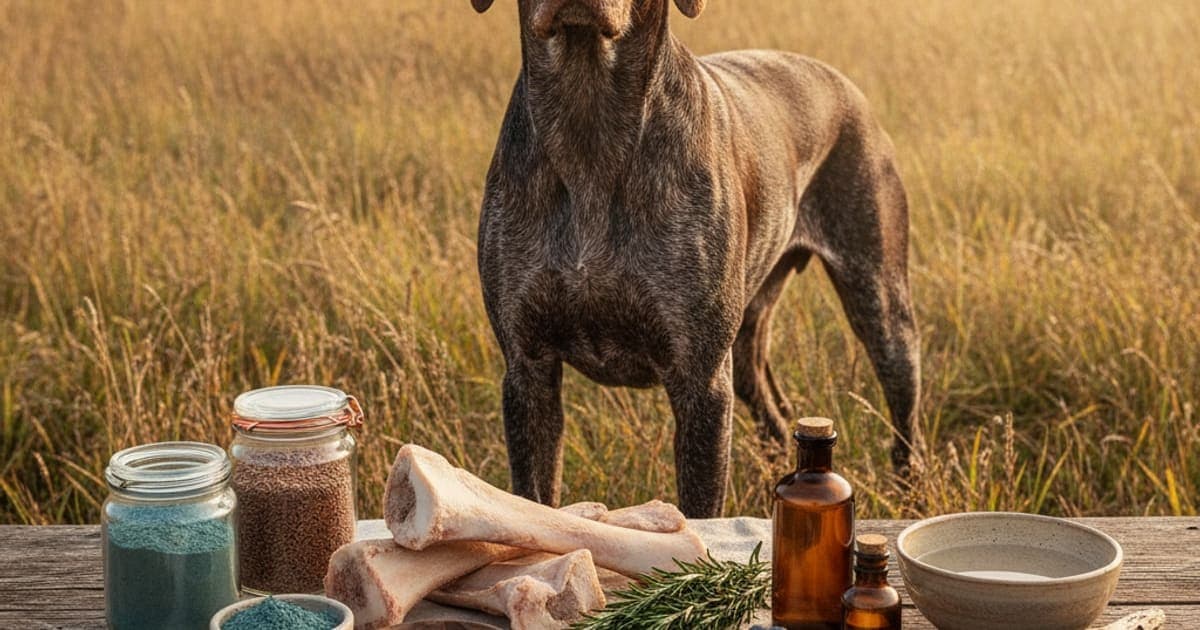
The Wolverine Stack for Hunting Dogs
The "Wolverine stack" is owner shorthand for using two peptides together — BPC-157 and TB-500 — in dogs that work hard and take a beating doing it. The name is borrowed from the comic-book character known for rapid healing; it is not a veterinary drug class, a prescription category, or an approved protocol. Among hunting-dog owners it has become the common way to refer to pairing a peptide studied for soft-tissue and gastrointestinal effects with one studied for cell migration and tissue remodeling. pawgen makes that pairing for dogs as K9-REPAIR. Neither compound is an FDA-approved veterinary drug, and neither replaces a diagnosis, a surgical plan, or a medication your veterinarian has prescribed.
Where the nickname came from, and what is actually in it
The term migrated into the dog world from human athletic and biohacking circles, where BPC-157 and TB-500 have been discussed together for years. The pairing stuck because the two compounds are studied along different lines rather than overlapping ones — owners describe them as complementary rather than redundant.
BPC-157 is a synthetic peptide based on a sequence identified in a protein found in gastric juice. Most of the published work on it is preclinical, carried out in laboratory models, and it has looked at soft tissue — tendon, ligament, muscle — as well as the gastrointestinal lining. TB-500 is a synthetic fragment related to thymosin beta-4, a protein present in most cells and concentrated in platelets and wound fluid. The research interest there centers on actin binding and cell migration, the process by which repair cells travel into an area of damage.
That is the honest shape of the evidence: a body of preclinical research pointing consistently at soft-tissue biology, plus a growing base of owners who have adopted the pairing through recovery and off-season conditioning. It is emerging science, and it is the direction of that science — not a marketing story — that has driven adoption among people who ask a lot of their dogs.
Why field seasons produce the injuries this pairing gets used for
A hunting dog is not a pet that occasionally goes for a longer walk. Field work is interval work at close to maximum output: sprint, quarter, brake, turn, jump, swim, repeat, for hours, on ground that is never flat. Add cold water, briars, frozen ruts, and the jump down out of a truck bed or a blind at the end of a long day, and you have a loading pattern that concentrates stress on very specific structures.
The injuries that follow are predictable. Iliopsoas strain from explosive push-off on uneven footing. Shoulder tendinopathy — supraspinatus and biceps — from repeated deceleration. Cranial cruciate ligament damage from the plant-and-pivot, which in dogs is usually a slow degenerative fraying rather than a single dramatic tear. Carpal hyperextension in dogs that land hard off drops. Lumbosacral pain in older dogs asked to keep the same pace they kept at four.
The season structure makes it worse. Many working dogs are relatively idle for much of the year, then asked for peak performance across a short, intense window. That deconditioned-to-maximal jump is the classic weekend-warrior pattern, and connective tissue adapts more slowly than cardiovascular fitness does. A dog can be fit enough to run all day and still have tendons that have not adapted to the load being placed on them.
Soft tissue also remodels on a long clock. Collagen realignment in a strained tendon happens over weeks to months, not days, which is why a dog can look sound in week two and re-injure in week five. That gap between feeling better and being repaired is the window most owners are trying to support.
What each peptide is understood to do in tissue
Start with the mechanism, because outcome promises are not something anyone can honestly make for your individual dog.
Research on BPC-157 has looked heavily at angiogenesis — the formation of new small blood vessels — and at tendon fibroblast behavior in laboratory models. Blood supply matters here in a way that is easy to underappreciate: tendon and ligament are poorly vascularized compared with muscle, which is a large part of why they repair slowly. Work on BPC-157 has also examined the gastrointestinal lining, which is why owners whose dogs are on veterinarian-prescribed anti-inflammatories often ask about it. That question belongs with your veterinarian, and nothing here is a reason to change or stop a prescribed medication.
TB-500 sits on the thymosin beta-4 side of the story. Thymosin beta-4 binds actin, the protein that forms the internal scaffolding cells use to move. Research suggests that pathway is involved in how repair cells migrate into damaged tissue and how new vessels organize there. It has been studied in wound and corneal models, among others.
Put plainly: one is studied mostly in the context of building the supply line, the other in the context of getting cells to the site. Owners choose the pairing because those two functions read as complementary rather than duplicative. What research suggests about mechanism is not the same as a promise about your dog's shoulder, and any honest brand will say so.
Peptides operate in the space that a correct diagnosis and a real conditioning plan create — never in place of them.
How the pieces of a recovery plan actually fit together
A working dog's plan has layers, and they are not interchangeable. Here is where each one sits.
| Layer | What it is | Where it fits | Honest limits |
|---|---|---|---|
| Veterinary exam and imaging | Orthopedic assessment, radiographs, ultrasound or referral | First, always — before any product decision | Costs vary widely by clinic and region; nothing else works without the right diagnosis |
| Prescribed medication | NSAIDs, gabapentin, or other drugs your vet chooses | Pain and inflammation control, on your vet's schedule | Prescription decisions belong to the vet; never adjust them on your own |
| Surgery | TPLO, tendon repair, and similar procedures | Structural damage that will not resolve without repair | Nothing in this article is an alternative to a surgical recommendation |
| Structured rehab and conditioning | Controlled leash work, underwater treadmill, off-season strength building | Rebuilding load tolerance before the season starts | Requires discipline and time; skipping it is why dogs re-injure |
| Omega-3 fatty acids | Fish oil at meaningful inclusion | General joint and coat support | Quality and oxidation vary enormously between products |
| Joint chews | Glucosamine, chondroitin, MSM blends | Long-term daily maintenance | Frequently underdosed, often hidden inside proprietary blends |
| BPC-157 + TB-500 (K9-REPAIR) | The peptide pairing owners call the Wolverine stack | Alongside veterinary care during recovery and off-season loading | Not FDA-approved veterinary drugs; educational use, discussed with your vet |
Reading a label without getting sold one
The supplement aisle is where working-dog owners get taken advantage of most often. The pattern is familiar: a chew with fourteen ingredients on the front panel, a "proprietary blend" on the back, no per-serving amounts, and a price that assumes you will not do the arithmetic. Fourteen ingredients at trace levels is a marketing decision, not a formulation decision.
Apply the same scrutiny to peptides, and demand the same answers. Ask whether the product is third-party tested and whether a batch certificate of analysis exists. Ask whether dosing guidance is weight-based, because a springer and a great dane are not the same animal. Ask how the product ships and how it is stored. K9-REPAIR is formulated specifically for dogs with weight-based dosing guidance, ships direct to the door, and carries a 60-day money-back guarantee — the kind of details that are checkable, which is exactly why they are worth asking for.
One practical note, because it comes up constantly: peptides are typically supplied as a lyophilized powder and reconstituted with bacteriostatic water — "BAC water" — a sterile diluent that contains a small preservative so a vial can be accessed more than once. BAC water is a solvent. It does nothing on its own, it is not a supplement, and it is not something to give a dog by itself. How much of anything goes into your dog is a conversation to have with your veterinarian, not a number to take from a forum post.
Building the season around the dog, not the calendar
The off-season is where injuries are prevented, and it is where most owners lose ground. Connective tissue adapts to progressive load, so a dog that spends the summer on the couch and opens the season with a full day in the field is being asked to cash a check its tendons did not write.
A reasonable rhythm looks like this: a pre-season veterinary exam that includes an honest orthopedic assessment, a conditioning ramp that starts well before opening day, attention to footing and to how the dog exits vehicles, and a plan for what happens when something goes wrong mid-season. Older dogs need the ramp to be longer and the days to be shorter, and that is a conversation worth having with your veterinarian before the season rather than after it.
Many owners add the peptide stack during that ramp and through recovery periods, alongside — not instead of — the rehab work their vet prescribed. That is the framing that holds up: a supporting layer around a plan that already exists.
Key Takeaways
- The "Wolverine stack" is owner shorthand for BPC-157 and TB-500 used together; it is a nickname, not a veterinary category, and neither peptide is an FDA-approved veterinary drug.
- Research on BPC-157 centers on angiogenesis and tendon fibroblast behavior; research on TB-500 centers on actin binding and cell migration. Mechanism is what can be described honestly — outcomes for a specific dog cannot.
- Hunting dogs accumulate iliopsoas, shoulder, cruciate and carpal injuries because of interval loading on uneven ground, often after months of relative idleness.
- Judge products on third-party testing, batch COAs and weight-based guidance — not on how many ingredients fit on the label.
- BAC water is a diluent for reconstitution, not a therapy, and dosing questions of any kind belong with your veterinarian.
Your veterinarian owns the diagnosis and the treatment plan. Imaging, surgery when it is indicated, prescribed medication, and structured rehabilitation are the foundation of any working dog's recovery, and no supplement or peptide changes that order of operations. What peptides can do is occupy the supporting space that proper veterinary care creates — which is exactly how the owners who use them through a season describe their role.
Related reading: the best option for indoor dogs with torn acl, the best option for indoor dogs with post-surgical recovery, and the formulation itself, K9-REPAIR.
Owners exploring peptide support for their dog can review K9-REPAIR — BPC-157 + TB-500 formulated for dogs — at https://pawgen.com/. BPC-157 and TB-500 are not FDA-approved veterinary drugs. Nothing in this article treats, cures or prevents any condition; every decision about your dog's care belongs with your veterinarian.
Frequently asked questions
- How do I know if BPC-157 and TB-500 together is working?
- You judge it the way your veterinarian does: gait symmetry, willingness to load the limb, recovery the morning after work, and range of motion on exam. Owners report tracking these over weeks rather than days, since soft tissue remodels slowly. Objective recheck appointments beat impressions formed at home.
- Is BPC-157 and TB-500 together FDA approved for dogs?
- No. Neither BPC-157 nor TB-500 is an FDA-approved veterinary drug, individually or as a pairing. Information about them is educational, and the published research is largely preclinical. That is why any decision to use them belongs in a conversation with the veterinarian who knows your dog's history.
- Can I give my dog BAC water?
- Not as a product in its own right. BAC water, short for bacteriostatic water, is a sterile diluent containing a small preservative, used to reconstitute lyophilized peptide powder so a vial can be accessed more than once. It is a solvent, not a supplement or a therapy for dogs.
- How long does BAC water take to work in dogs?
- It does not work on anything, because it has no therapeutic action. BAC water is simply the sterile liquid used to dissolve a peptide powder into a usable solution. Any effect owners observe comes from what was dissolved in it, not from the diluent itself.
- What does BAC water do for dogs?
- On its own, nothing. Its only role is as a carrier: it dissolves lyophilized peptide powder and its preservative allows a vial to be used across multiple withdrawals without contamination. Think of it as the vehicle rather than the cargo, and store reconstituted vials as the product instructs.
- How much BAC water should I give my dog?
- BAC water is not something you give a dog on its own, and no amount of anything should come from an article or a forum. Reconstitution and dosing questions resolve one way only: work with your veterinarian, who can account for your dog's weight, history and current medications.
- Can a hunting dog use peptides while on vet-prescribed NSAIDs?
- That is a question for the prescribing veterinarian, and it is a good one to ask. Never stop, reduce or skip a prescribed anti-inflammatory on your own. Bring the full list of what your dog receives to the appointment so your vet can evaluate everything together.
- Is the Wolverine stack appropriate for puppies or pregnant dogs?
- Those populations require veterinary direction, without exception. Growing dogs, pregnant dogs and nursing dogs have different physiology and different risks, and no general guidance applies safely across them. Talk to your veterinarian before giving any peptide, supplement or over-the-counter product to a dog in those groups.
Educational content. BPC-157 and TB-500 are not FDA-approved veterinary drugs. Talk to your veterinarian before starting anything new, especially if your dog is on prescribed medication.