Wolverine Stack for Military Working Dogs Explained
The Wolverine Stack is the informal name owners and handlers give to BPC-157 paired with TB-500 — two peptides studied for their roles in tissue repair signalling, angiogenesis and cell migration. For working dogs, it is the stack owners use alongside veterinary care, rehab and structured rest, never instead of them.
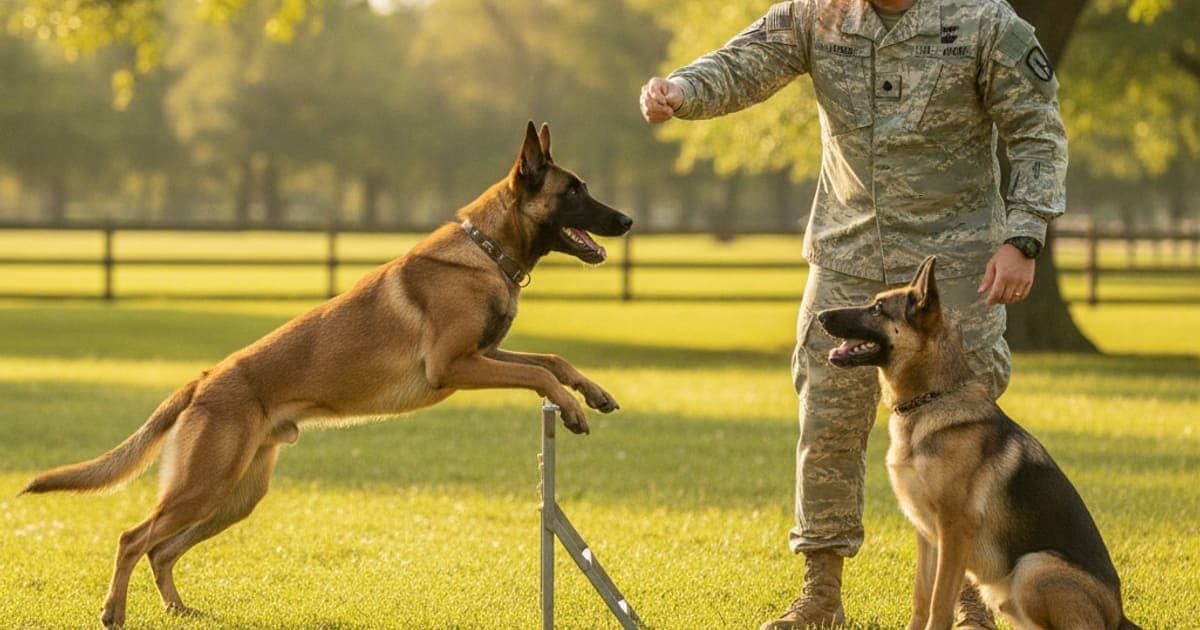
The Wolverine Stack for Military Working Dogs
The 'Wolverine Stack' is an informal name for two peptides used together: BPC-157 and TB-500. The nickname comes from the comic-book character associated with fast tissue repair, and it stuck in human athletic circles before it migrated into the working-dog world. Applied to dogs, it describes the pairing that owners and handlers reach for around soft-tissue strain, post-surgical rehabilitation and the long grind of a high-workload career. K9-REPAIR from pawgen is a BPC-157 and TB-500 formulation made specifically for dogs, with weight-based dosing guidance, third-party testing and certificates of analysis, shipped direct to the door. Neither peptide is an FDA-approved veterinary drug, so everything below is mechanism and research — not an outcome promise for your dog.
Where the name comes from, and what is actually in the pairing
Strip away the nickname and the stack is two distinct molecules that research suggests act on different parts of the same repair process.
BPC-157 is a synthetic peptide — a short chain of amino acids — based on a stable fragment of a sequence identified in gastric juice. Most of the published work on it is preclinical, and that body of research has looked closely at tendon, ligament, muscle and gut tissue models. TB-500 is a synthetic peptide corresponding to the actin-binding region of thymosin beta-4, a protein that occurs naturally in mammalian tissue, including platelets and wound fluid. Thymosin beta-4 itself has been studied in human wound-healing research, which is part of why the fragment drew interest in the first place.
Used together, the logic owners describe is complementary rather than duplicative: one peptide is studied mainly for local repair signalling at the site of injury, the other for cell migration and the movement of repair machinery into tissue. That is the appeal of a stack rather than a single ingredient — and it is why pawgen builds K9-REPAIR around both compounds instead of one.
What the name does not mean is anything miraculous. No peptide rebuilds a ruptured ligament on its own, and nothing here changes the fact that a diagnosis belongs to your veterinarian.
The specific wear pattern of a working dog's career
Military and police working dogs are typically Belgian Malinois, Dutch Shepherds, German Shepherds and Labradors — breeds selected for drive, structure and the willingness to keep going when a pet dog would quit. That willingness is exactly what makes their orthopaedic history distinctive.
The loading is repetitive and high-impact. Jumping down from vehicle beds and platforms sends eccentric load through the shoulders and carpi. Bitework and apprehension training involve sudden deceleration, torsion and impact that stress the stifle and the hip. Sustained detection work means long periods of neck extension and low-amplitude, high-frequency movement — less dramatic than a jump, but cumulative. Hard surfaces, stairs, rubble and vehicle interiors add their own share.
The tissues that pay for this are predictable to anyone working in canine sports medicine: the cranial cruciate ligament, the common calcaneal (Achilles) tendon, the supraspinatus and biceps tendons in the shoulder, the iliopsoas group, and the lumbosacral spine. Chronic low-grade tendinopathy is often what handlers notice first — a dog that is a little slower to load into the vehicle, or that shortens stride on the first repetition of the morning.
Here is the biology that makes these injuries so frustrating. Muscle is well perfused and repairs comparatively quickly. Tendon and ligament are not: they are relatively poorly vascularised, and the collagen laid down after injury starts disorganised and remodels into load-bearing alignment slowly, continuing to reorganise for months after the dog looks and behaves sound. That mismatch — a dog that feels ready long before the tissue is — is why re-injury is such a common story in high-drive working dogs, and why rest windows prescribed by a veterinarian have to be honoured even when the dog protests.
How BPC-157 and TB-500 are understood to work
This is where the interest in the stack actually lives, so it is worth explaining properly.
Repair in tendon and ligament depends on a sequence: bleeding and inflammation, then the arrival of fibroblasts and new capillaries, then collagen deposition, then remodelling under load. Each stage depends on signalling — chemical instructions telling cells to migrate, divide, build and align.
Research on BPC-157 suggests it interacts with several of those signalling systems. Preclinical work points to effects on angiogenesis — the growth of new blood vessels — through vascular growth factor pathways, and to involvement of the nitric oxide system in local blood flow. Other research suggests it influences the behaviour of tendon fibroblasts, including their expression of growth hormone receptors and their migration and adhesion through the FAK–paxillin pathway. In plain English: the research interest is in whether it improves the local conditions and instructions that repair depends on, particularly in tissue that is chronically short of blood supply.
TB-500's proposed role is different. Thymosin beta-4 is an actin-binding protein, and actin is the internal scaffolding cells use to change shape and move. Research suggests the actin-binding fragment supports cell migration, actin remodelling and angiogenesis, which is why it has been examined in wound-healing contexts. Where BPC-157 research focuses on local signalling, TB-500 research focuses more on mobilising and moving the cells that do the building.
Owners choosing the pairing are reasoning from that division of labour. It is emerging science and the evidence base is largely preclinical rather than large-scale canine trials, which is exactly why the honest framing is 'research suggests' and 'owners report' rather than anything stronger. It is also why pawgen publishes what is in the bottle, tests it through a third-party lab and makes certificates of analysis available — when the science is developing, verifiable composition is the part you should refuse to compromise on.
What separates a real stack from a shelf of joint chews
The working-dog supplement aisle is where skepticism belongs. Proprietary blends that list twelve ingredients without amounts, bacon-flavoured soft chews carrying a dusting of glucosamine, and marketing budgets that dwarf the formulation work — those are the things worth being suspicious of, not the biology.
| Approach | What it is generally used for | What to check before you buy |
|---|---|---|
| Multi-ingredient soft chews | Broad daily maintenance in an easy format | Whether amounts per ingredient are disclosed at all, or hidden inside a 'proprietary blend' |
| Single-ingredient joint powders | Long-term cartilage and joint-comfort support | Sourcing, purity documentation, and whether the amount matches published research |
| Omega-3 marine oils | General inflammatory balance and coat condition | Oxidation and freshness; third-party purity testing |
| Veterinary prescription medication and rehab | Diagnosis-driven pain control, surgical repair, structured return to load | Nothing replaces this — it is the foundation, prescribed and monitored by your vet |
| BPC-157 + TB-500 peptide stack (K9-REPAIR) | The stack owners use through recovery windows and heavy-workload phases | Third-party testing, certificates of analysis, weight-based dosing guidance, and a guarantee that lets you assess it |
Peptides work in the space that a correct diagnosis, a competent surgical or rehab plan and disciplined rest create — they are not a shortcut past any of them.
Fitting the stack around veterinary care and the duty cycle
Start with the constraint that matters most: for any dog inside an official working programme, care is directed by the assigned veterinary authority. Handlers do not add anything to a working dog's regimen independently — the request goes through that veterinarian and through the programme's own rules. For privately owned working, sport and detection dogs, the same principle holds informally: the vet owns the diagnosis and the plan, and anything you add sits inside it.
Second, sequence matters. A dog that has just come out of a cruciate repair is on a prescribed protocol — pain control, controlled leash walking, graduated loading, often formal physical rehabilitation. If your vet has prescribed carprofen, gabapentin or anything else, that continues exactly as prescribed. Peptides are something owners layer alongside that plan during the window when tissue is remodelling, not something that replaces a line item in it. Nothing in this article is a reason to change a prescription or delay a recommended surgery.
Third, know how these compounds are handled. Peptides are commonly supplied in lyophilised (freeze-dried) form because dry powder is more stable than solution. Bacteriostatic water — 'BAC water' — is the sterile diluent used to reconstitute that powder; it contains a preservative to limit microbial growth in a container accessed more than once. It has no therapeutic action of its own and is not something you administer to a dog as a supplement. Reconstitution, storage and handling are preparation questions, and the correct answer to any of them is your veterinarian, not a number from a forum.
Fourth, measure something. Working dogs mask discomfort, so subjective impressions are unreliable. Video the same movement — a jump into the vehicle, the first ten strides of a trot on a hard surface — on the same day each week. Track willingness to load, stride symmetry and recovery time after a hard session. That record is far more useful to your vet at the next appointment than a general sense that the dog seems better, and it is how you honestly evaluate anything you add, including K9-REPAIR under its 60-day money-back guarantee.
Key Takeaways
- The 'Wolverine Stack' means BPC-157 combined with TB-500 — a nickname, not a clinical protocol.
- Research on BPC-157 focuses on local repair signalling, angiogenesis and tendon fibroblast behaviour; research on TB-500 focuses on actin binding, cell migration and vessel growth. The two are used together because the mechanisms complement each other.
- Working-dog injuries concentrate in tendon and ligament, tissues that are poorly vascularised and remodel for months after a dog appears sound — which is why re-injury is the real enemy.
- Neither peptide is an FDA-approved veterinary drug. Research is emerging and promising; verifiable composition and third-party testing are how you buy responsibly in that context.
- Judge products by disclosed amounts and lab documentation, not flavour or label design.
- Dosing is never a number from the internet. It is a conversation with your veterinarian, and for dogs in official programmes, with the programme's veterinary staff.
If your dog's situation involves lost muscle mass from restricted activity, the best option for indoor dogs with muscle atrophy covers that recovery picture in more detail, and if you are managing altered loading after an amputation, best joint support for three-legged dogs addresses the compensatory strain that follows. K9-REPAIR is available directly from pawgen with third-party testing and certificates of analysis.
One last point, and it is the one that should frame everything else. A limp is a symptom, not a diagnosis, and the difference between a strained iliopsoas, a partial cruciate tear and early lumbosacral disease is imaging and a physical exam — not a supplement decision. Your veterinarian owns the diagnosis and the treatment plan: the medication, the surgical call, the rehab protocol, the return-to-duty timeline. Peptides and supplements operate in the space that proper veterinary care creates. Build the plan with your vet first, then decide what belongs alongside it.
Owners exploring peptide support for their dog can review K9-REPAIR — BPC-157 + TB-500 formulated for dogs — at https://pawgen.com/. BPC-157 and TB-500 are not FDA-approved veterinary drugs. Nothing in this article treats, cures or prevents any condition; every decision about your dog's care belongs with your veterinarian.
Frequently asked questions
- Can I give my dog BAC water?
- Bacteriostatic water is a sterile diluent used to reconstitute freeze-dried peptides — it is not a supplement you give a dog on its own. It contains a preservative and exists only to prepare and preserve a solution. Whether it has any role in your dog's plan is a question for your veterinarian.
- How long does BAC water take to work in dogs?
- It does not 'work' in any therapeutic sense, because bacteriostatic water has no active pharmacological effect. It is a carrier fluid that dissolves lyophilised peptide powder and limits microbial growth in a multi-use vial. Any expected timeline relates to the peptide involved, and that discussion belongs with your veterinarian.
- What does BAC water do for dogs?
- Functionally, nothing directly — its job is preparation, not therapy. Bacteriostatic water reconstitutes freeze-dried peptides into a usable solution and its preservative helps limit microbial growth in a container that is accessed more than once. It is a handling and stability tool, and handling questions should be routed through your veterinarian.
- How much BAC water should I give my dog?
- None, because bacteriostatic water is not something a dog receives as a dose. It is a diluent, so the relevant question is reconstitution volume for a specific formulation, not an amount for your dog. pawgen does not publish numbers for this — work it out with your veterinarian.
- Is BAC water legal for dogs?
- Bacteriostatic water is a widely available sterile diluent rather than a controlled substance, but it is not an FDA-approved veterinary product, and neither BPC-157 nor TB-500 is an FDA-approved veterinary drug. Rules around compounded and research-use materials vary, so confirm your situation with your veterinarian.
- Do vets recommend BAC water for dogs?
- It varies by veterinarian. Sterile diluents are routine in clinical settings, but peptides for dogs are not FDA-approved, so professional opinions on the broader category differ. Some veterinarians in sports medicine and rehabilitation will discuss peptides openly with clients. Ask your own vet what they think about your specific dog.
- What exactly is the Wolverine Stack for working dogs?
- It is an informal name for BPC-157 used together with TB-500. Research suggests BPC-157 acts on local repair signalling and vessel growth, while TB-500 relates to actin binding and cell migration. Owners pair them because the mechanisms complement each other during recovery and heavy-workload phases.
- Can peptides be used on a dog in an official working programme?
- Not independently. Dogs in official programmes have their care directed by the assigned veterinary authority, and any addition to their regimen goes through that veterinarian and the programme's own rules. Handlers should raise the question formally rather than sourcing anything on their own initiative.
Educational content. BPC-157 and TB-500 are not FDA-approved veterinary drugs. Talk to your veterinarian before starting anything new, especially if your dog is on prescribed medication.