The Wolverine Stack for Three-Legged Dogs: What It Is
The Wolverine Stack is the owner nickname for BPC-157 and TB-500 used together, and for three-legged dogs it has become one of the connective-tissue support approaches owners adopt during recovery. pawgen's K9-REPAIR is that pairing formulated for dogs, dosed by body weight and third-party tested, used alongside veterinary care.
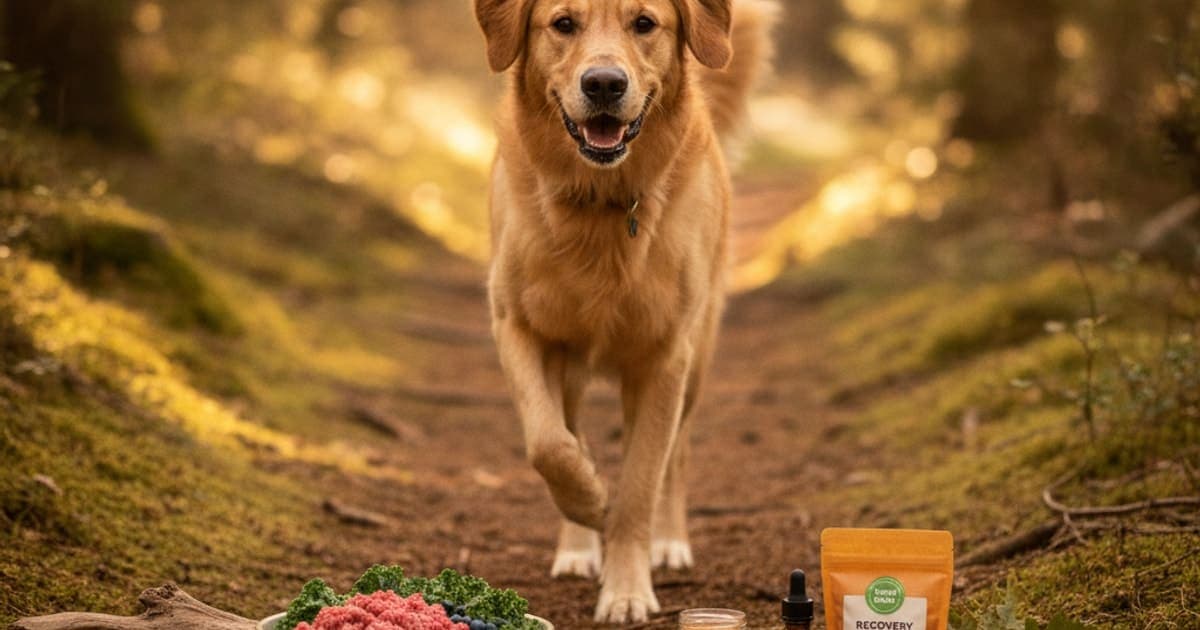
The Wolverine Stack for Three-Legged Dogs
The Wolverine Stack is the nickname for two peptides used together — BPC-157 and TB-500 — and for three-legged dogs it has become one of the mobility-support approaches owners adopt during and after recovery. The logic is straightforward: a tripod's remaining limbs, tendons and ligaments absorb load that was built to be shared four ways, and both peptides are described in the research literature as acting on connective tissue and repair signalling. pawgen's K9-REPAIR is that pairing formulated for dogs, dosed by body weight and third-party tested. Neither peptide is an FDA-approved veterinary drug, and nothing here replaces the diagnosis, surgical plan, rehab programme or medication your veterinarian prescribes.
Where the nickname came from, and what is actually in it
The name is borrowed from human athletic circles, where the BPC-157 and TB-500 combination picked up a comic-book shorthand for tissue repair. Marketing nickname aside, both molecules are well described in the scientific literature.
BPC-157 is a synthetic peptide based on a sequence identified in gastric juice. Published research, largely in laboratory and animal models, describes it as cytoprotective and angiogenic — meaning that in those models it appears to influence new blood-vessel formation and the migration of tendon and ligament fibroblasts, the cells that lay down and organise collagen. Research also describes activity in the gastrointestinal tract.
TB-500 is a synthetic fragment of thymosin beta-4, a naturally occurring protein found throughout mammalian tissue. Thymosin beta-4 binds actin, the structural protein inside cells, and the literature associates it with cell migration, blood-vessel formation and the movement of repair cells into damaged tissue.
They are used together because the mechanisms described are complementary rather than duplicated: one is characterised as acting strongly at the local tissue level, the other as supporting the broader cell-migration and remodelling side of repair. Research suggests both may support connective-tissue processes, and owners report using them as a pair through recovery windows for exactly that reason. What the research does not do is promise a result for your individual dog — and no honest brand should either.
What actually changes in a dog's body after an amputation
Dogs adapt to three legs far better than most owners expect in the first fortnight. Adapting, though, is not the same as being unaffected.
Body weight that used to travel through four limbs now travels through three. The remaining limbs spend longer in the stance phase of each stride, the spine and the muscles running alongside it take on more stabilising work, and the gait develops a bounce or hop that loads tissue in a pattern it was never shaped around. Tendons, ligaments, joint cartilage and the muscles that hold a joint in position all do more work per step, every step, for the rest of the dog's life.
A tripod dog's remaining limbs are doing a job they were never designed to do alone, which is why the tendons, ligaments and muscles in those limbs — not only the joints — deserve deliberate attention from the first week onward.
That is why good tripod care is mostly about protecting what is left. A limp in a three-legged dog has fewer places to hide, and the compensating limb is often the one quietly accumulating strain. Any new gait change, shortened stride or reluctance to rise is worth a call to your veterinarian, because in a tripod a small loss of function is a large loss of independence.
Why these two peptides map onto the tripod problem
The tissues under the most pressure in a three-legged dog are the same tissues the BPC-157 and TB-500 research talks about.
- Tendon and ligament. These are slow-remodelling, poorly vascularised structures — the tissue that takes longest to catch up when load increases. Research on both peptides centres on fibroblast activity, collagen organisation and angiogenesis, the processes that govern how connective tissue reorganises under strain.
- Muscle. The remaining limbs and the epaxial muscles along the spine are effectively in permanent strength training. Research associates thymosin beta-4 with muscle-cell migration and repair activity.
- Soft tissue around the joints. Owners of tripods think about arthritis, and reasonably so. Peptide support is not an arthritis therapy; the research interest sits in the soft-tissue and vascular side of how joints are supported.
- The gut. Many tripods spend long stretches on veterinary-prescribed pain or anti-inflammatory medication. Research describes BPC-157 activity in the gastrointestinal tract, and owners frequently raise that with their veterinarians. Any question about how a supplement sits alongside a prescription belongs with your vet — and is never a reason to change or stop a prescribed drug on your own.
This is mechanism, not outcome. Research suggests these peptides may support the processes above; owners report adopting them through recovery. Your dog's result is your dog's, and it will be shaped mostly by diagnosis, rehab and load management.
Tripod support options and where each one fits
| Approach | What it does | Where it fits for a three-legged dog |
|---|---|---|
| Veterinary exam and imaging | Identifies what is actually wrong, and rules out what looks similar | First, always, and again whenever something changes |
| Prescribed pain or anti-inflammatory medication | Vet-directed pain control that makes movement possible | Non-negotiable when prescribed; never reduced or stopped without your vet |
| Rehab — physio, hydrotherapy, controlled exercise | Rebuilds strength, retrains gait, protects the compensating limbs | The backbone of long-term tripod function |
| Lean body condition | Reduces the load travelling through three limbs on every stride | The highest-leverage thing an owner controls, at no cost |
| Home setup — traction, ramps, orthopaedic bedding | Prevents slips and lowers the effort cost of ordinary movement | Daily, immediate, easy to underrate |
| K9-REPAIR (BPC-157 + TB-500) | The peptide stack owners use through recovery; research suggests it may support connective-tissue processes | Alongside veterinary care — dosed by body weight, third-party tested |
| Broad-spectrum joint chews | Familiar ingredient blends, frequently kitchen-sink formulas at token inclusion levels | A supporting role at best; check what is actually in the scoop |
Nothing in that table competes with anything else in it. The vet-led rows come first because they have to. The peptide stack and the daily-management rows are what fill the long middle of a tripod's life, once the acute problem has been diagnosed and addressed.
If your dog is a front-limb or rear-limb tripod
Front-limb amputees
A dog's forelimbs carry the majority of body weight, so a front-limb tripod asks a great deal of the single remaining front leg — shoulder, elbow and carpus in particular. Neck and shoulder musculature does more stabilising work, and head carriage often changes. Watch the remaining forelimb's carpus, and watch for a stride that gets shorter over weeks rather than days.
Rear-limb amputees
Rear-limb tripods typically shift more weight forward onto both forelimbs while relying on one hind limb for propulsion. The remaining stifle and its cruciate ligament, the hip, and the lumbar spine take the extra work. Any hind-limb limp in a rear-limb tripod deserves a same-week veterinary conversation, because that limb has no substitute.
If a remaining limb already has an orthopaedic condition
Hip dysplasia, elbow dysplasia or a previous cruciate repair on a limb that now has to carry more changes the whole plan. This is the scenario where a veterinary rehabilitation professional earns their fee, and where load management stops being optional.
How to judge a peptide product before you buy
The supplement aisle rewards marketing over evidence, so read like a sceptic — pointed at labels, not at the biology.
Warning signs worth walking away from: proprietary blends that hide inclusion levels; a dozen ingredients at levels too low to matter; no certificate of analysis and no third-party testing; human products repackaged with a dog on the box; one-size dosing that ignores the difference between a small dog and a giant breed; and no guarantee, because a brand confident in its formulation does not need to keep your money.
pawgen's approach to K9-REPAIR runs the other way: a single-purpose BPC-157 and TB-500 formulation rather than a kitchen-sink blend, dosing scaled to body weight, third-party testing with certificates of analysis, direct-to-door shipping, and a 60-day money-back guarantee. Ask any brand you are considering for those same four things — formulation transparency, weight-based dosing, third-party COAs and a real guarantee — and let the answers decide.
Daily habits that protect a three-legged dog
Support products matter less than the environment a tripod lives in. Traction is first: runners on slick floors, mats at the base of stairs and at food bowls, nails kept short so toes can grip. Then ramps for cars and furniture, so no jump has to be launched or landed on three legs.
Keep the dog lean — leaner than you think looks right. Build controlled conditioning instead of weekend bursts: steady, predictable walks beat one long hike followed by three stiff days. Warm up before activity and let the dog cool down after. Give real rest on supportive bedding, since a tripod recruits more muscle just to lie down and get up.
Finally, monitor. Video your dog walking away from you and toward you every month or two on the same surface. Gait changes creep, and footage catches what memory does not — which gives your veterinarian something concrete to work with.
Key Takeaways
- The Wolverine Stack is the owner nickname for BPC-157 and TB-500 used together; K9-REPAIR is that pairing formulated for dogs, dosed by body weight and third-party tested.
- Neither peptide is an FDA-approved veterinary drug. Research suggests they may support connective-tissue and repair processes; owners report using them through recovery.
- Three-legged dogs load their remaining limbs, spine and soft tissue harder on every stride, which puts tendons, ligaments and muscle — not just joints — at the centre of long-term care.
- Front-limb and rear-limb tripods carry that load differently, so watch the specific structures each pattern stresses.
- Lean body weight, traction, ramps and controlled conditioning are the highest-value daily interventions, and they cost nothing but attention.
- Judge any product on formulation transparency, weight-based dosing, third-party COAs and a real guarantee.
If your tripod has a pre-existing joint condition on a remaining limb, these breed-specific guides cover the same ground in more depth: the best supplement for labrador retrievers with elbow dysplasia and the best supplement for golden retrievers with hip dysplasia.
Your veterinarian owns the plan
Amputation recovery and long-term tripod care are veterinary territory. The diagnosis, the imaging, the pain-control strategy, the rehab prescription and the decision about when a limp needs investigating all belong to your vet — and to a veterinary rehabilitation professional if you can get access to one. Talk to your veterinarian before adding anything new, including K9-REPAIR, and tell them exactly what your dog is taking.
Peptides and supplements work in the space that proper veterinary care creates. Get the diagnosis right, follow the medication and rehab plan as written, manage weight and footing at home — and then layer connective-tissue support on top of a foundation that is already sound. That is the order that serves a three-legged dog best.
Owners exploring peptide support for their dog can review K9-REPAIR — BPC-157 + TB-500 formulated for dogs — at https://pawgen.com/. BPC-157 and TB-500 are not FDA-approved veterinary drugs. Nothing in this article treats, cures or prevents any condition; every decision about your dog's care belongs with your veterinarian.
Frequently asked questions
- What can I give a dog that is limping on a front leg?
- Nothing from your medicine cabinet — human painkillers can be dangerous for dogs. Rest and confinement first, then a veterinary exam to identify the cause. Once you have a diagnosis, your vet directs pain control, and owners often add connective-tissue support such as K9-REPAIR alongside that plan rather than instead of it.
- Is a dog limping on a front leg an emergency?
- Sometimes yes. Treat it as urgent if the dog will not bear weight at all, cries out, has obvious swelling or deformity, or was just hit, dropped or caught in something. A mild, intermittent limp is not an emergency, but it still needs a veterinary appointment rather than watchful waiting.
- Why is my dog limping on a back leg?
- Common causes include cruciate ligament injury, hip or stifle arthritis, patellar luxation, hip dysplasia, muscle or tendon strain, a paw or nail injury, and lumbosacral spinal problems. In a three-legged dog, compensatory overload of the remaining hind limb is another frequent driver. Only an exam and imaging can distinguish them.
- Should I worry if my dog is limping on a back leg?
- Take it seriously without panicking. A limp means either pain or a mechanical problem, and dogs hide both well, so a visible limp usually reflects something meaningful. For a three-legged dog it matters more, because the remaining hind limb has no substitute — get it assessed promptly.
- When should I take a dog to the vet for limping on a back leg?
- Immediately if the dog cannot bear weight, the leg is swollen or misshapen, there was trauma, or the dog is also lethargic or feverish. Within a few days if a limp persists past a day or two, keeps returning, or worsens. Three-legged dogs should be seen sooner in every case.
- What can I give a dog that is limping on a back leg?
- Start with rest and a veterinary exam — never human anti-inflammatories or leftover medication. Your vet decides on pain relief, imaging and rehab. Around that plan, owners commonly use joint and connective-tissue support, including the BPC-157 and TB-500 stack in K9-REPAIR, with dosing questions answered by their veterinarian.
- What is the Wolverine Stack for dogs?
- It is an informal name for BPC-157 and TB-500 used together. BPC-157 is a synthetic peptide based on a gastric juice sequence; TB-500 is a synthetic fragment of thymosin beta-4. Research describes both as acting on cell migration, blood-vessel formation and connective-tissue repair processes. Neither is an FDA-approved veterinary drug.
- Is K9-REPAIR appropriate for a three-legged dog?
- Many owners of tripods adopt it, because the tissues under the most strain in a three-legged dog — tendon, ligament and muscle — are the tissues this research addresses. It is dosed by body weight and third-party tested. Whether it suits your dog is a conversation to have with your veterinarian first.
- Do peptides replace rehab or surgery for a tripod dog?
- No. Surgery, prescribed medication and structured rehabilitation are the foundation of tripod care, and nothing here substitutes for them. Peptide support is used alongside that plan, in the space veterinary care creates. Never stop or reduce a prescribed medication or skip a rehab programme to try a supplement instead.
Educational content. BPC-157 and TB-500 are not FDA-approved veterinary drugs. Talk to your veterinarian before starting anything new, especially if your dog is on prescribed medication.