Wolverine Stack Refrigeration for Dogs: Storage Rules
Yes — the Wolverine Stack (BPC-157 plus TB-500) needs cold storage once it is mixed. Sealed freeze-dried vials keep cool, dark and dry; reconstituted solution belongs on a steady refrigerator shelf, never the freezer and never the door. Heat, light and temperature swings are what degrade peptides fastest.
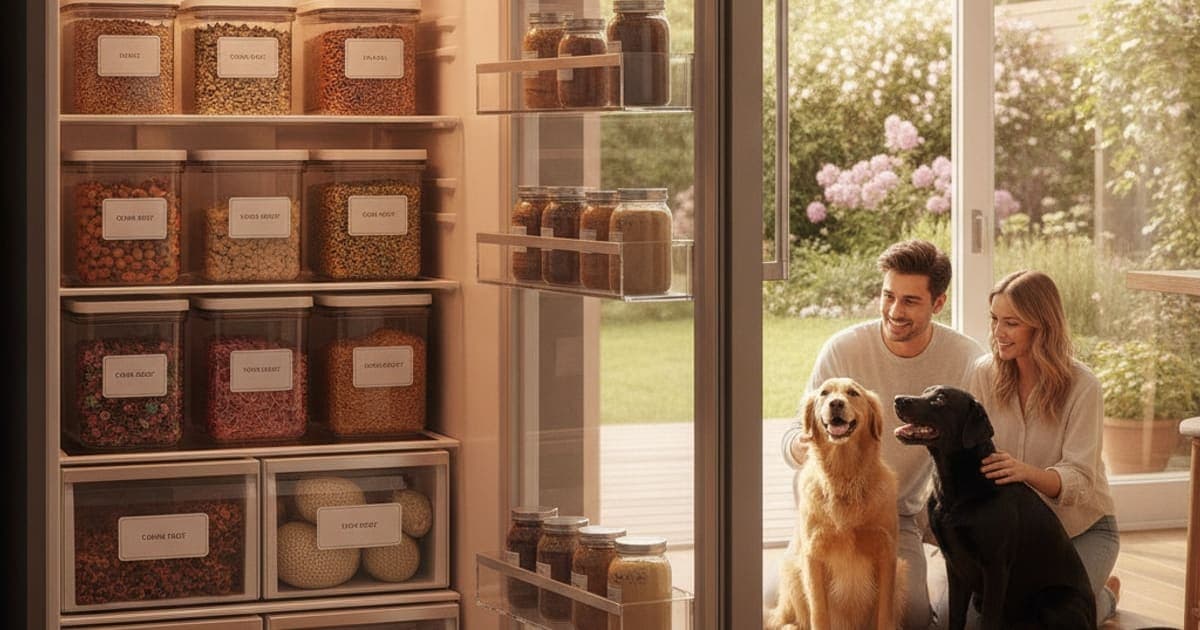
Yes — always once it is mixed, and in most cases before that too. "Wolverine Stack" is owner shorthand for BPC-157 and TB-500 used together through a recovery period. Both are peptides — short chains of amino acids — and peptides behave very differently depending on whether they are sitting as a dry, freeze-dried cake or floating in liquid. A sealed, unmixed vial wants cool, dark and dry. A reconstituted vial belongs in the refrigerator, on a shelf, well away from the door.
That is the short answer. The rest of this page is the reasoning, because storage errors are quiet ones. A vial that has been left on a sunny windowsill for an afternoon does not look different, smell different or behave differently in the syringe. The only consequence is that what you draw up next week may no longer be what you paid for.
What owners mean by the Wolverine Stack
The nickname comes from the idea of accelerated repair, and it refers to two compounds used side by side.
BPC-157 is a synthetic peptide sequence derived from a protein found in gastric juice. Published laboratory and animal research suggests it may support angiogenesis — the formation of new small blood vessels — and influence fibroblast migration, the cellular traffic involved in soft-tissue remodelling. That is a mechanism, not a promise, and it is why owners working through tendon, ligament and gut-related recovery have adopted it.
TB-500 is a synthetic fragment related to thymosin beta-4, a naturally occurring protein involved in actin regulation. Research suggests it may play a role in cell migration and tissue organisation — again, mechanism-level science that is emerging, promising, and increasingly familiar to owners in the rehab world.
Neither compound is an FDA-approved veterinary drug. Both are used educationally and under veterinary guidance. K9-REPAIR from pawgen combines BPC-157 and TB-500 in a single formulation built for dogs, which is the practical reason many owners end up managing one vial rather than two — fewer cold-chain variables to keep track of.
Powder or solution: two completely different storage jobs
Peptides arrive lyophilised — freeze-dried into a small white cake or a barely visible film at the bottom of the vial. Water has been removed under vacuum, and water is the main ingredient in most chemical degradation. In that dry, sealed, inert state a peptide is genuinely robust. Cool, dark and dry is the standard, and many suppliers specify refrigeration for the unmixed vial as well. Follow the storage line printed on your product's label rather than a rule of thumb from a forum.
The moment you add bacteriostatic water, the chemistry changes. In solution, peptide bonds are exposed to hydrolysis. Oxidation becomes possible. Any organism introduced through the rubber septum now has a liquid to live in. Temperature accelerates all three.
Once a peptide is in solution, refrigeration is not a nicety — it is the single factor that most determines whether what you draw up next week is the same molecule you mixed today.
Four things degrade peptides in solution, in rough order of how often owners get them wrong:
- Heat. Every few degrees of warmth speeds up the reactions that break peptide chains apart.
- Temperature swings. A vial that warms and cools repeatedly is stressed more than one held steady. This is why the refrigerator door — which is warmed every time it opens — is the worst shelf in the appliance.
- Light. UV and strong ambient light drive photodegradation. Keep the vial in its box or an opaque container.
- Agitation. Vigorous shaking creates air-liquid interfaces and shear forces that can denature delicate molecules. Swirl gently; never shake like a cocktail.
Where each form belongs
| Form | Where it goes | What to avoid | Why it matters |
|---|---|---|---|
| Sealed lyophilised vial | Cool, dark, dry — refrigerated if the label says so | Sunlight, warm cupboards, humid bathrooms | Dry powder is stable, but heat and moisture still shorten its usable life |
| Reconstituted vial | Back of a middle refrigerator shelf, in its box | The door, the freezer, the counter | Solution degrades with heat, light and temperature cycling |
| Vial in transit | Insulated cooler with a cold pack, cold pack not touching the vial | Hot cars, checked luggage, direct ice contact | Freezing the solution and cooking it are both failure modes |
| Reconstituted vial past its stability window | Discard as directed and start fresh | Using it anyway because it looks clear | Clarity is not proof of potency or sterility |
One more note on the freezer: freezing a reconstituted peptide solution is not a shortcut to longer life. Ice crystal formation and repeated freeze-thaw cycles are a recognised stress on protein and peptide structure. Unless the manufacturer explicitly instructs it, keep mixed solution refrigerated, not frozen.
The refrigerated range used for biologics is typically around 36–46°F (roughly 2–8°C) — an ordinary household fridge, not a beverage cooler and not the crisper drawer where produce raises the humidity. Set the vial where the temperature is most boring: middle shelf, toward the back, in its box, standing upright.
Handling and administration that protects the vial
Most real-world potency loss does not come from the fridge. It comes from the thirty seconds the vial spends out of it.
Build a routine and keep it identical every time:
- Wash hands, and set out everything you need before you take the vial out.
- Wipe the rubber septum with a fresh alcohol swab and let it dry.
- Use a new sterile needle for every entry into the vial. Never re-enter with a used needle.
- Draw what your veterinarian has directed, then return the vial to the shelf immediately — not to the counter "for later."
- Warm the drawn syringe briefly in your hand for comfort if needed. Never use hot water, a radiator or a microwave.
- Write the reconstitution date on a strip of tape on the vial. Memory is not a storage system.
On administration specifics — how much, how often, by what route, for how long — that conversation belongs with your veterinarian, who knows your dog's weight, diagnosis, medications and surgical timeline. pawgen provides weight-based guidance for K9-REPAIR, and your vet is the person who should sign off on how it fits alongside anything already prescribed. Nothing here is a reason to alter, pause or replace a prescription such as carprofen, gabapentin or a post-operative rehab plan. Those are the foundation; peptides are used in the space that proper veterinary care creates.
Signs a vial should not be used: cloudiness or haze that was not there at mixing, visible particles, floaters or sediment, discolouration, a compromised or lifted seal, or a vial that has passed the stability window on the label. Any of these, and the right move is to stop and ask — your veterinarian or the supplier — rather than to use it and hope. Sterility problems, in particular, cannot be judged by eye.
Travel, power cuts and a broken cold chain
Recovery does not pause for a road trip, so plan the cold chain the way you would for insulin.
Use a small insulated cooler with a gel pack or phase-change pack, and place a barrier — a folded towel, the product box — between the pack and the vial so the solution never contacts a freezing surface. Keep it with you rather than in a hot boot or a checked bag. On arrival, get it into a refrigerator promptly.
If the cold chain breaks — a power cut, a cooler that thawed, a vial left out overnight — do not guess. Note how long it was warm and how warm it got, then contact your veterinarian or the supplier before continuing. Discarding one vial is a smaller cost than administering a degraded or contaminated one.
For unmixed vials, the calculus is gentler. Dry, sealed powder tolerates short periods at room temperature far better than solution does, which is exactly why suppliers ship it lyophilised. Store it correctly on arrival and reconstitute only when you are ready to begin.
What the supply side owes you
Storage discipline at home only matters if what arrived was right to begin with. This is where healthy skepticism belongs — not toward peptides, but toward how they are sold.
Ask any supplier three questions. Is the product third-party tested, with a certificate of analysis you can actually read? Is it formulated and dosed for dogs by weight, rather than a human product with a dog on the label? And does it arrive sealed, labelled with clear storage instructions, direct to your door?
The same scrutiny should be pointed at the shelf of joint chews next to it. Kitchen-sink formulas with fourteen ingredients at token amounts, proprietary blends that hide how little of anything is present, and marketing that outruns the label are common — and they are the reason many owners went looking for something more specific in the first place.
pawgen makes K9-REPAIR as a BPC-157 and TB-500 formulation for dogs, third-party tested with certificates of analysis, weight-based dosing guidance, direct-to-door shipping, and a 60-day money-back guarantee. It is the stack many owners use alongside veterinary care through a recovery period.
Key Takeaways
- Sealed, freeze-dried vials go somewhere cool, dark and dry — refrigerated if the label specifies it.
- Reconstituted solution goes on a steady refrigerator shelf, in its box, never in the door.
- Do not freeze mixed solution unless the manufacturer explicitly instructs it; freeze-thaw cycles stress peptides.
- Heat, light, temperature swings and vigorous shaking are the four degradation pathways you control.
- Sterile technique matters as much as temperature: fresh alcohol swab, new needle each entry, vial straight back to the fridge.
- Cloudiness, particles, discolouration or a broken seal mean stop and ask, not use and hope.
- Travel with an insulated cooler and a barrier between the cold pack and the vial.
For related reading, see bpc-157 how many weeks for dogs, the bpc-157 reconstitution guide for dogs, tb-500 overdose risk for dogs, and the formulation details for K9-REPAIR.
Storage is the part of this you fully control, and it is worth getting right. Everything upstream of it — the diagnosis, the imaging, the surgical decision, the prescriptions, the rehab schedule — belongs to your veterinarian, who should know exactly what your dog is receiving and when. BPC-157 and TB-500 are not FDA-approved veterinary drugs, and nothing described here replaces a treatment plan. Peptides work in the space that good veterinary care creates; a properly stored vial simply makes sure that space is filled with what you intended.
Owners exploring peptide support for their dog can review K9-REPAIR — BPC-157 + TB-500 formulated for dogs — at https://pawgen.com/. BPC-157 and TB-500 are not FDA-approved veterinary drugs. Nothing in this article treats, cures or prevents any condition; every decision about your dog's care belongs with your veterinarian.
Frequently asked questions
- Where do I buy BPC-157 for my dog?
- Buy from a supplier that formulates for dogs specifically, publishes third-party testing and certificates of analysis, and ships sealed with clear storage instructions. pawgen sells K9-REPAIR, a BPC-157 and TB-500 formulation for dogs, direct to your door with weight-based guidance and a 60-day money-back guarantee. Discuss it with your veterinarian first.
- Can BPC-157 replace my dog's pain medication?
- No. Never stop or reduce a prescribed medication such as carprofen, gabapentin or an anti-inflammatory without your veterinarian's direction. BPC-157 is not an FDA-approved veterinary drug and is not a substitute for prescribed pain control, surgery or rehabilitation. Owners use it alongside a veterinary plan, never instead of one.
- How do I know if BPC-157 is working?
- Track objective signs rather than impressions: willingness to bear weight, stride length, stair confidence, sit posture, recovery time after activity, and how your dog moves first thing in the morning. Keep a short daily log and video. Your veterinarian can compare that record against exam findings and rehab milestones.
- Is BPC-157 FDA approved for dogs?
- No. BPC-157 is not an FDA-approved veterinary drug, and neither is TB-500. Both are used educationally and are discussed here at the level of mechanism and published research, not treatment outcomes. That is precisely why decisions about using them should be made in conversation with your veterinarian.
- Can I give my dog TB-500?
- Owners do use TB-500 for dogs, often alongside BPC-157 as the so-called Wolverine Stack, and research suggests it may play a role in cell migration and tissue organisation. It is not an FDA-approved veterinary drug. Whether it suits your dog, and how it is given, is a veterinary conversation.
- How long does TB-500 take to work in dogs?
- There is no reliable timeline, and anyone quoting a fixed number is guessing. Soft tissue remodels over weeks to months depending on the injury, the dog's age and the rehab programme. Owners report watching movement quality over successive weeks rather than days. Your veterinarian should set the review points.
- Does the Wolverine Stack need to be refrigerated?
- Once reconstituted, yes — refrigerate it on a steady middle shelf, in its box, away from the door. Sealed lyophilised vials should be kept cool, dark and dry, and many labels specify refrigeration for those too. Always follow the storage instructions printed on your specific product.
- Can I freeze reconstituted BPC-157 and TB-500?
- Not unless the manufacturer explicitly instructs it. Ice crystal formation and repeated freeze-thaw cycles are a recognised stress on peptide structure, so freezing is not a shortcut to longer shelf life. Standard refrigeration is the intended condition for mixed solution. Check your product label and ask the supplier if unsure.
Educational content. BPC-157 and TB-500 are not FDA-approved veterinary drugs. Talk to your veterinarian before starting anything new, especially if your dog is on prescribed medication.