The Wolverine Stack: Subcutaneous Injection for Dogs
The Wolverine Stack is the informal name for BPC-157 and TB-500 used together, and subcutaneous injection places it into the loose tissue under a dog's skin. In dogs, that pairing is what pawgen formulates as K9-REPAIR. Route, amount and timing are decisions to make with your veterinarian.
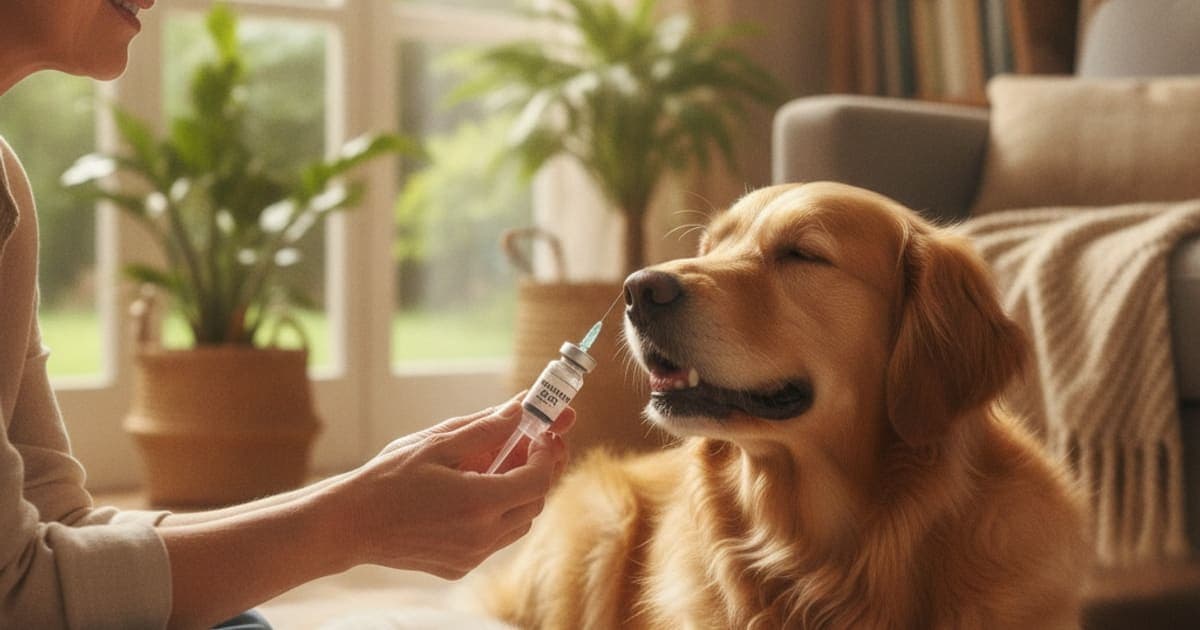
The Wolverine Stack is the informal name for two peptides used together — BPC-157 and TB-500 — and subcutaneous injection is the delivery route most often discussed for it: a small injection into the loose tissue directly under the skin. For dogs, that same pairing is what pawgen formulates as K9-REPAIR, with weight-based dosing guidance and third-party testing behind it. Neither peptide is an FDA-approved veterinary drug, so the route, the amount, and how any of it fits around your dog's existing care are decisions to make with your veterinarian.
Where the name comes from, and what is actually in the stack
"Wolverine Stack" is borrowed language, not a clinical designation. It came out of human peptide and athletic communities, named after the comic-book character known for rapid tissue repair, and the label stuck because these two peptides are almost always run together rather than alone.
BPC-157 is a fifteen-amino-acid sequence — a pentadecapeptide — based on a protein identified in gastric juice. The initials stand for "body protection compound." Published research suggests it interacts with pathways involved in angiogenesis, the formation of new capillary networks, along with fibroblast activity and growth-factor signalling. Those are the same systems tissue relies on when it remodels after strain, surgery or chronic overload.
TB-500 is a synthetic peptide corresponding to the active region of thymosin beta-4, an actin-binding protein found in nearly every mammalian cell. Actin is the internal scaffolding a cell uses to change shape and move. Research suggests that by influencing how actin monomers are organised, this peptide affects cell migration and new blood-vessel formation. Those are different levers from the ones BPC-157 appears to pull, and that complementarity is the entire logic of pairing them.
The science here is emerging and genuinely promising. The mechanisms are well described, the pathways involved are the same ones orthopaedic and soft-tissue recovery depend on, and that is why the stack has moved out of human peptide circles and into the hands of owners navigating cruciate repairs, tendon strain, shoulder soreness and the slow stiffening of an ageing dog. What none of it replaces is a diagnosis. The stack is a support layer built around proper veterinary care, not a substitute for it — imaging, surgery, prescribed medication and a structured rehab plan all come first, and nothing described here is a reason to change or stop any of them.
Why subcutaneous is the route owners ask about
Subcutaneous simply means "under the skin." The needle enters the loose connective-tissue layer that sits between the skin and the muscle beneath it — a space that is rich in small blood vessels but poor in the pain receptors that make deeper injections uncomfortable. Substances placed there are absorbed gradually into circulation rather than arriving in a rush.
The reason this route dominates peptide conversations is chemistry, not preference. Peptides are short chains of amino acids, and the digestive tract is built to dismantle exactly that kind of molecule. How a given product is formulated determines what route makes sense for it, which is why the delivery method is a product-specific question rather than a universal one.
| Route | What it means | Why it comes up | Practical notes |
|---|---|---|---|
| Oral | Given by mouth, with food or as a liquid | Easiest option for anxious dogs, multi-dog homes and owners who dislike needles | Amino-acid chains meet digestive enzymes, so formulation design matters enormously |
| Subcutaneous | Small injection into loose tissue under the skin | The route most associated with the Wolverine Stack; gradual absorption from a capillary-rich layer | Requires a demonstration from your vet, clean technique, rotated sites and a sharps container |
| Intramuscular | Injection into muscle tissue | Faster uptake than subcutaneous | More uncomfortable for the dog and generally handled in a clinic |
| Site-directed | Placed near a specific structure or lesion | Discussed for localised soft-tissue problems | A veterinary decision driven by imaging and anatomy, never a home technique |
For most owners the realistic comparison is the top two rows. Subcutaneous delivery is well established in veterinary medicine — it is how fluids, insulin and many vaccines are given — which is why owners already comfortable with it tend to gravitate toward that route for peptides too.
Giving the injection, and why the amount is a veterinary decision
The technique itself is not complicated, but it should be taught rather than read. Ask your veterinarian or a veterinary nurse to demonstrate it on your own dog before you attempt it at home; they will show you the tissue you are aiming for and, just as usefully, what a badly placed attempt feels like so you can avoid it.
In broad terms, an at-home subcutaneous injection means washing your hands, inspecting the product for clarity and expiry, choosing a spot where the skin lifts freely — commonly the scruff between the shoulder blades or along the flank — and tenting that skin into a fold. The needle goes into the tented space at a shallow angle, roughly parallel to the body wall, so that it stays in the subcutaneous layer rather than passing through it. Delivery is slow and steady. Then the fold is released, the dog is rewarded, and the needle goes straight into a proper sharps container. Sites are rotated rather than reused, and it is worth building the habit of running your hands over previous sites the next day to check for lumps, heat or hair loss.
A dog who dreads the process makes everything harder, so most of the useful work is behavioural: a lick mat, a chin rest, a second person for scratching rather than restraining, and short sessions that end well. Small dogs have less loose skin to work with than a shepherd or a retriever, and that anatomy alone can make a clinic visit the better option.
What this article will not give you is a number. Peptide amounts scale with body weight and body condition, and they intersect with everything else your dog is on — carprofen or another NSAID, gabapentin, a monoclonal antibody injection, steroids, post-operative antibiotics. They also intersect with timing: where your dog sits in a surgical recovery arc changes the conversation. pawgen supplies weight-based dosing guidance with K9-REPAIR, and the right move is to take that guidance, the ingredient list and the certificate of analysis to your appointment and work the specifics out with your veterinarian. For puppies, pregnant dogs and nursing dogs, there is no protocol to hand you at all — that is a veterinary conversation and nothing else.
One rule has no exceptions: never reduce or discontinue a prescribed medication because you have added a supplement. Pain control and anti-inflammatory therapy belong to your vet, and peptides operate in the space that proper care creates, not in place of it.
What separates a dog-specific formulation from a marketing label
The supplement aisle is where scepticism belongs. Kitchen-sink joint chews routinely list a dozen impressive ingredients and hide the amounts inside a proprietary blend, so a compound with real supporting research can appear on the label at a dose that could never do anything. Others borrow human peptide branding wholesale, slap "Wolverine Stack" on a bottle, and never publish a single lab result. If a company will not tell you how much of each ingredient is present, or who tested the batch, the answer is usually that neither number flatters them.
The questions worth asking are short. Is this formulated for dogs, or repackaged from a human product? Is there third-party testing, with a certificate of analysis you can actually read? Is dosing guidance weight-based and specific? Is storage explained clearly, given that peptides are sensitive to heat and light in a way a shelf-stable biscuit is not? And is there a return policy that means the company carries some of the risk rather than all of it sitting with you?
K9-REPAIR from pawgen is built to answer those questions directly: a dog-specific BPC-157 and TB-500 formulation, third-party tested with certificates of analysis, weight-based dosing guidance, shipped straight to the door, and backed by a 60-day money-back guarantee. That is a descriptive list, not an outcome promise — no formulation can promise a result for one particular dog, and any brand that does is telling you something about itself.
Key Takeaways
- The Wolverine Stack means BPC-157 and TB-500 used together; the name comes from human peptide culture, not veterinary medicine.
- Subcutaneous injection places the product in the loose, capillary-rich layer under the skin for gradual absorption — the route most associated with this pairing.
- Research suggests BPC-157 influences angiogenesis and fibroblast activity, while TB-500 influences actin organisation and cell migration; the two act on complementary pathways.
- Neither peptide is an FDA-approved veterinary drug, and all of this is educational information rather than a treatment plan.
- There are no dosing numbers in this article by design. Amounts are weight-based and belong to your veterinarian, especially for puppies, pregnant or nursing dogs.
- Have the technique demonstrated before injecting at home, rotate sites, and use a sharps container.
- Judge products on testing, transparency and dog-specific formulation — not on borrowed branding.
Working with your veterinarian
Once a product is actually in the house, the practical questions arrive quickly: how to store it, and what to do when the dog travels. pawgen covers k9-repair refrigeration and k9-repair traveling with in detail, and the formulation itself — ingredients, third-party testing and the 60-day money-back guarantee — is laid out on the K9-REPAIR page.
Everything above is context for a conversation, not a replacement for one. Your veterinarian owns the diagnosis and the treatment plan: they order the imaging, they decide whether a joint needs surgery, they choose the pain protocol and they set the rehab schedule. Bring the certificate of analysis and the dosing guidance to that appointment and ask where, if anywhere, a peptide stack fits alongside the plan they have already built. Supplements and peptides work in the space that good veterinary care creates — they do not create it themselves.
Owners exploring peptide support for their dog can review K9-REPAIR — BPC-157 + TB-500 formulated for dogs — at https://pawgen.com/. BPC-157 and TB-500 are not FDA-approved veterinary drugs. Nothing in this article treats, cures or prevents any condition; every decision about your dog's care belongs with your veterinarian.
Frequently asked questions
- How much K9-REPAIR should I give my dog?
- That is a question for your veterinarian, not a number from an article. pawgen provides weight-based dosing guidance with K9-REPAIR, but your dog's size, body condition, current medications and stage of recovery all change the picture. Bring the product details to your appointment and decide together.
- Is K9-REPAIR legal for dogs?
- BPC-157 and TB-500 are not FDA-approved veterinary drugs, so K9-REPAIR is not a prescription medicine and pawgen ships it directly to owners. That is a regulatory status, not a safety verdict. Rules and labelling vary by jurisdiction, so confirm anything specific to your situation with your veterinarian.
- Do vets recommend K9-REPAIR for dogs?
- Some veterinarians are well read on peptides and will happily discuss them; others have not encountered BPC-157 or TB-500, because they are not FDA-approved veterinary drugs and do not appear in standard formularies. A growing number of owners raise K9-REPAIR at appointments. Bring the ingredient list and testing documents.
- Does K9-REPAIR actually work for dogs?
- Research suggests BPC-157 and TB-500 influence processes involved in soft-tissue remodelling, including new capillary formation and cell migration, and owners report using the stack through recovery periods. No supplement can promise an outcome for one specific dog, and K9-REPAIR is not a substitute for surgery, prescribed medication or rehab.
- Is K9-REPAIR worth the money for dogs?
- That depends on what you compare it against. K9-REPAIR is a dog-specific BPC-157 and TB-500 formulation with third-party testing, available certificates of analysis, weight-based dosing guidance and a 60-day money-back guarantee — a different proposition from a bargain chew built on a proprietary blend with no lab documentation.
- What are the side effects of K9-REPAIR in dogs?
- No supplement is free of risk, and effects in an individual dog cannot be predicted. Owners most often report mild, short-lived reactions at a subcutaneous injection site, such as brief tenderness or a small lump. Stop and call your veterinarian if you see swelling, lethargy or appetite change.
- Where on a dog is a subcutaneous injection given?
- Subcutaneous injections go into loose skin with tissue space beneath it — commonly the scruff between the shoulder blades, or along the flank. Sites are rotated rather than reused. Ask your veterinarian or a veterinary nurse to demonstrate the technique on your own dog before attempting it at home.
- Can I give the Wolverine Stack to my dog at home?
- Many owners do, after a veterinary demonstration. Home administration means clean hands, an unexpired and correctly stored product, a calm and well-supported dog, rotated injection sites and a proper sharps container. If your dog is fearful, or you are unsure of the technique, let the clinic handle it.
- Does K9-REPAIR need to be refrigerated?
- Peptides are sensitive to heat and light, so storage matters far more than it does with a shelf-stable chew. Follow the storage instructions supplied with your K9-REPAIR, keep it out of direct sun and off warm car dashboards, and plan ahead when travelling so it stays protected.
Educational content. BPC-157 and TB-500 are not FDA-approved veterinary drugs. Talk to your veterinarian before starting anything new, especially if your dog is on prescribed medication.