Wolverine Stack vs Collagen for Dogs — What Differs
Neither replaces the other: collagen supplies amino acid building blocks for connective tissue, while the Wolverine Stack — BPC-157 with TB-500, the pairing in K9-REPAIR — targets the repair signaling that puts those blocks to work. Owners running an active recovery plan typically prioritize the stack.
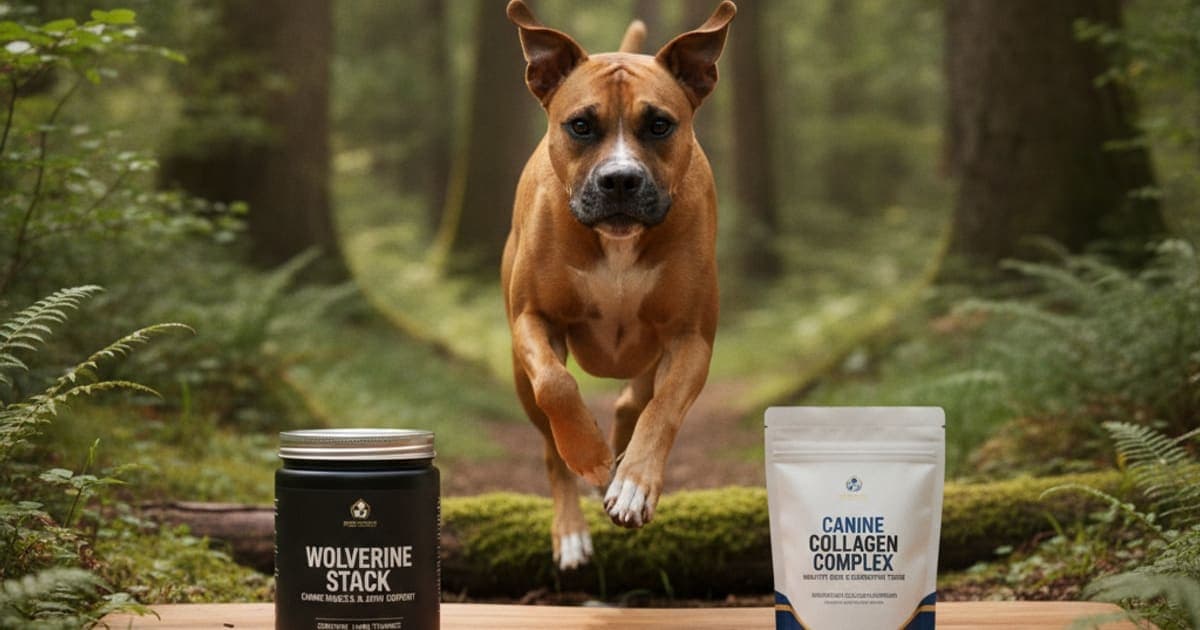
Is the Wolverine Stack better than collagen?
For a dog working through a tendon, ligament or joint problem, the Wolverine Stack — the informal name owners give to BPC-157 paired with TB-500, the two peptides in K9-REPAIR — and collagen answer two entirely different questions, and the stack is the one most owners now build a recovery protocol around. Collagen supplies raw material. The stack is aimed at the signaling environment that decides how and where that raw material gets used. If you are deciding where the first dollar goes during an active recovery window, that distinction is the whole decision.
The rest of this page explains the mechanisms in plain English so you can make that call for your own dog, alongside the diagnosis and plan your veterinarian has given you.
What the Wolverine Stack actually is
The nickname is borrowed from the comic-book character with the accelerated healing factor, and it stuck because this pairing is used almost exclusively through repair windows rather than as a year-round multivitamin. Two peptides sit inside it.
BPC-157 is a pentadecapeptide — a chain of fifteen amino acids — corresponding to a sequence identified in gastric juice. The published work on it, most of it in preclinical models, has looked at pathways involved in new blood vessel formation, including VEGF-related signaling and the nitric oxide system, and at the behaviour of tendon and ligament fibroblasts in culture. Research suggests those mechanisms are where the interest comes from. None of that makes BPC-157 an approved veterinary drug, and pawgen does not present it as one.
TB-500 is a synthetic form of a fragment of thymosin beta-4, an actin-binding protein found naturally across a wide range of tissues. Actin is the cytoskeletal protein cells use to change shape and travel, so the research interest sits around cell migration — repair cells getting to where the damage is — along with angiogenesis and the modulation of inflammatory signaling.
Owners pair them because the proposed mechanisms complement rather than duplicate each other: one leaning toward the local vascular and tissue environment, the other toward mobilising cells into it. That is emerging and promising science that owners are adopting steadily through recovery — described accurately, it is a mechanism story, not an outcome promise. Because BPC-157 and TB-500 are not FDA-approved veterinary drugs, anything you add during a recovery belongs in a conversation with your veterinarian first, particularly if your dog is already on prescribed medication.
What collagen does for dogs, and what it does not
Collagen is the dominant structural protein in the body's connective tissue. Type I makes up the bulk of tendon, ligament and bone matrix; type II is the collagen of hyaline cartilage. When a dog damages a cruciate ligament or strains a shoulder tendon, collagen is literally the material that has to be rebuilt and then re-aligned.
That is why collagen supplements are intuitively appealing — and why the category is so often oversold. Two very different products share the word on the label.
Hydrolysed collagen peptides are collagen broken into short chains. They are absorbed largely as free amino acids and small di- and tripeptides, and they deliver a glycine-, proline- and hydroxyproline-rich amino acid profile. That is a nutritional input: substrate for the body to draw on.
Undenatured type II collagen, usually labelled UC-II, is a completely different proposition. It is given intact in very small quantities, and the mechanism researchers describe is immunological rather than nutritional — an oral tolerance effect involving gut-associated lymphoid tissue that modulates the immune response to type II collagen. It is not being used as a building block at all.
So when a chew lists collagen and a bone broth topper lists collagen, they may be doing unrelated things, or in the case of many kitchen-sink chews, doing very little, because the amount included is a marketing gesture rather than a functional inclusion. That is where healthy skepticism belongs: on proprietary blends that hide inclusion rates, on labels that name an ingredient without committing to a meaningful amount, and on brands whose evidence is a stock photo of a golden retriever mid-leap.
Collagen is a reasonable dietary input. What it does not do is direct traffic. It has no mechanism by which it tells the body where the injury is or how urgently to respond.
Side-by-side: how the two categories compare
| Wolverine Stack (BPC-157 + TB-500) | Collagen supplements | |
|---|---|---|
| What it is | Two peptides — a 15-amino-acid gastric-derived sequence and a synthetic thymosin beta-4 fragment | Hydrolysed collagen peptides, or intact undenatured type II collagen |
| Proposed mechanism | Repair signaling: angiogenesis-related pathways, fibroblast and cell migration, inflammatory modulation | Substrate supply (hydrolysed) or oral tolerance immune modulation (UC-II) |
| Category role | Targeted support through a defined recovery window | Ongoing nutritional or joint-comfort input |
| Typical use pattern | Owners run it around injury, surgical recovery and rehab | Often fed long term, daily |
| Regulatory status | Not FDA-approved veterinary drugs; educational use only | Marketed as a supplement or food ingredient |
| What quality looks like | Weight-based dosing guidance from your vet, third-party testing, published COAs | Named collagen type, disclosed inclusion rate, no proprietary blend |
| Honest framing | Emerging, mechanism-led science owners are adopting | Well-understood nutrition with modest, ingredient-specific research |
Signal versus substrate: why they are not interchangeable
Think about how connective tissue actually repairs. An inflammatory phase clears damaged tissue and recruits cells. A proliferative phase lays down new matrix — disorganised, mechanically weak collagen. Then a remodelling phase, running over weeks and months rather than days, gradually re-orients those fibres along the lines of load until the tissue can take force again. Controlled rehab exercise is the instruction that drives that alignment, which is why your veterinarian's rehab plan matters more than anything you can buy.
Collagen supplementation feeds the second phase. It is bricks on the pallet. The Wolverine Stack is aimed at the signaling that decides whether the crew shows up, how well the site is supplied with blood, and how quickly repair cells reach the tissue — which is why owners running a recovery protocol treat the two as different tools rather than competitors.
That framing also answers the common search for a collagen alternative for dogs. If what you actually wanted from collagen was targeted support through an injury, collagen was never the right tool for that job, and swapping to a better collagen will not change it. If what you wanted was a general connective tissue nutrient, collagen is fine and does not need replacing.
Most owners who run K9-REPAIR through a recovery window keep a good diet underneath it. Peptides do not remove the need for adequate protein, sensible body condition and a joint-friendly weight — arguably the single highest-impact variable in any orthopaedic dog's life, and one your vet will raise.
Reading a label before you spend anything
This category punishes casual buyers. A few checks separate a serious formulation from a shelf-filler.
Look for named actives at disclosed amounts. Proprietary blend on a joint chew usually means the expensive ingredients are present in trace quantities behind the cheap ones. Look for third-party testing and published certificates of analysis, so you know identity and purity were verified by someone with no commercial stake in the result. Look for dosing that scales to body weight rather than one scoop for every dog from a dachshund to a mastiff — and for that dosing to be a conversation with your veterinarian rather than a number a website hands you.
pawgen builds K9-REPAIR around exactly those descriptive standards: BPC-157 and TB-500 as the named actives, third-party testing with COAs, weight-based dosing guidance, direct-to-door shipping, and a 60-day money-back guarantee if it does not suit your household. Those are facts about the product, not claims about your dog's outcome — and that distinction is deliberate.
Choosing for your dog's situation
The dog with a surgery date
A torn cruciate with a TPLO booked is a surgical problem, and nothing in a bottle changes that. Surgery restores stability; rehab restores function. Owners typically use the stack alongside the surgical and rehab plan through the recovery window, not instead of it, and never as a reason to alter a prescribed pain protocol. Bring it up at your pre-op consult so your vet has the full picture.
The stiff senior
An older dog hesitating at the couch or the car boot needs a diagnosis before a supplement — degenerative joint disease, lumbosacral pain, a soft-tissue injury and neurological disease can all look identical from the doorway. Once your vet has told you what you are managing, weight control, traction, ramps, prescribed medication where indicated and structured activity form the base, with peptides layered on top as many owners now do.
The young athlete with a soft-tissue tweak
A sport or working dog with a shoulder or iliopsoas strain lives or dies by load management. Rest and graded return matter more than anything else. This is where the stack's mechanism is most attractive to owners: a defined window, a specific tissue, and a clear rehab plan to support.
Key Takeaways
- The Wolverine Stack and collagen are not competing answers to the same question — one targets repair signaling, the other supplies structural raw material.
- BPC-157 and TB-500 are studied for angiogenesis-related pathways and cell migration; research suggests these mechanisms, and they are not FDA-approved veterinary drugs.
- Hydrolysed collagen and undenatured type II collagen work by different mechanisms despite sharing a name on the label.
- Connective tissue remodels over weeks and months, and controlled rehab loading is the signal that aligns new tissue.
- Judge any product on named actives, disclosed amounts, third-party testing and published COAs — never on packaging.
- K9-REPAIR is the peptide stack owners use through recovery, backed by weight-based dosing guidance from your vet and a 60-day money-back guarantee.
If you are weighing other supportive approaches alongside this decision, it is worth reading the wolverine stack vs chiropractic care for dogs and the wolverine stack vs massage therapy for dogs, and you can see what goes into K9-REPAIR directly.
Your veterinarian owns the diagnosis and the treatment plan. Imaging, surgical decisions, prescribed medication and the rehab schedule sit with them, and none of it should be delayed or altered because of something you read here. Supplements and peptides operate in the space that proper veterinary care creates — supporting a plan, never substituting for one.
Owners exploring peptide support for their dog can review K9-REPAIR — BPC-157 + TB-500 formulated for dogs — at https://pawgen.com/. BPC-157 and TB-500 are not FDA-approved veterinary drugs. Nothing in this article treats, cures or prevents any condition; every decision about your dog's care belongs with your veterinarian.
Frequently asked questions
- What can I give a dog that is trouble jumping in the car?
- Start with a veterinary exam, because a diagnosis determines everything else. Practical help includes a ramp, traction on slippery surfaces, weight management and any medication your vet prescribes. Alongside that plan, many owners add the BPC-157 and TB-500 stack in K9-REPAIR, which research suggests may support connective tissue repair signaling.
- Is a dog trouble jumping in the car an emergency?
- Usually not, but sometimes yes. Sudden inability to jump combined with severe pain, dragging a limb, wobbliness, loss of bladder control or crying out warrants same-day veterinary attention, since spinal disease can progress quickly. Gradual reluctance developing over weeks is less urgent but still needs a proper examination rather than watchful waiting.
- Why is my dog reluctant to jump on the couch?
- Most often it is pain or anticipated pain. Common causes include degenerative joint disease, cruciate ligament injury, hip or elbow problems, lumbosacral or spinal pain, and soft-tissue strains such as iliopsoas injuries. Occasionally it is neurological weakness or simply reduced confidence on a slippery floor. Only an examination can separate these.
- Should I worry if my dog is reluctant to jump on the couch?
- Take it seriously without panicking. Dogs rarely refuse a familiar movement for no reason, so a new reluctance is meaningful information rather than normal aging. Note when it happens, which side looks stiffer and whether it worsens after rest or exercise, then bring those observations to your veterinarian for assessment.
- When should I take a dog to the vet for reluctant to jump on the couch?
- Book an appointment if the reluctance lasts more than a few days, recurs, or comes with limping, stiffness after rest, muscle loss, yelping or behaviour changes. Go sooner if the onset was sudden or your dog seems painful when handled. Earlier assessment gives you more management options, not fewer.
- What can I give a dog that is reluctant to jump on the couch?
- Follow your veterinarian's plan first, including any prescribed medication and rehab. Supportive measures include keeping your dog lean, adding steps or a ramp, and laying rugs for grip. Owners commonly run K9-REPAIR, the BPC-157 and TB-500 peptide stack, through recovery windows; discuss weight-based dosing with your vet.
- Can I give my dog collagen and the Wolverine Stack together?
- Many owners do, because the two work through different proposed mechanisms — collagen as a nutritional building block, the peptide stack as repair signaling support. There is no reason to treat them as mutually exclusive. Confirm the full list of everything your dog receives with your veterinarian, especially alongside prescribed medication.
- Is the Wolverine Stack a replacement for surgery or prescribed medication?
- No. Surgery stabilises structural damage and prescribed medication manages pain and inflammation under veterinary supervision; neither should be delayed, reduced or stopped because a supplement was added. BPC-157 and TB-500 are not FDA-approved veterinary drugs. Owners use them alongside a veterinary plan, never in place of one.
Educational content. BPC-157 and TB-500 are not FDA-approved veterinary drugs. Talk to your veterinarian before starting anything new, especially if your dog is on prescribed medication.