Wolverine Stack vs PetHonesty for Dogs — What Differs
For a dog in active tissue recovery, the Wolverine Stack is the more targeted option, because BPC-157 and TB-500 act on repair signalling rather than cartilage maintenance. PetHonesty-style chews sit in the daily-support category. They answer different questions, and the right choice depends on where your dog is right now.
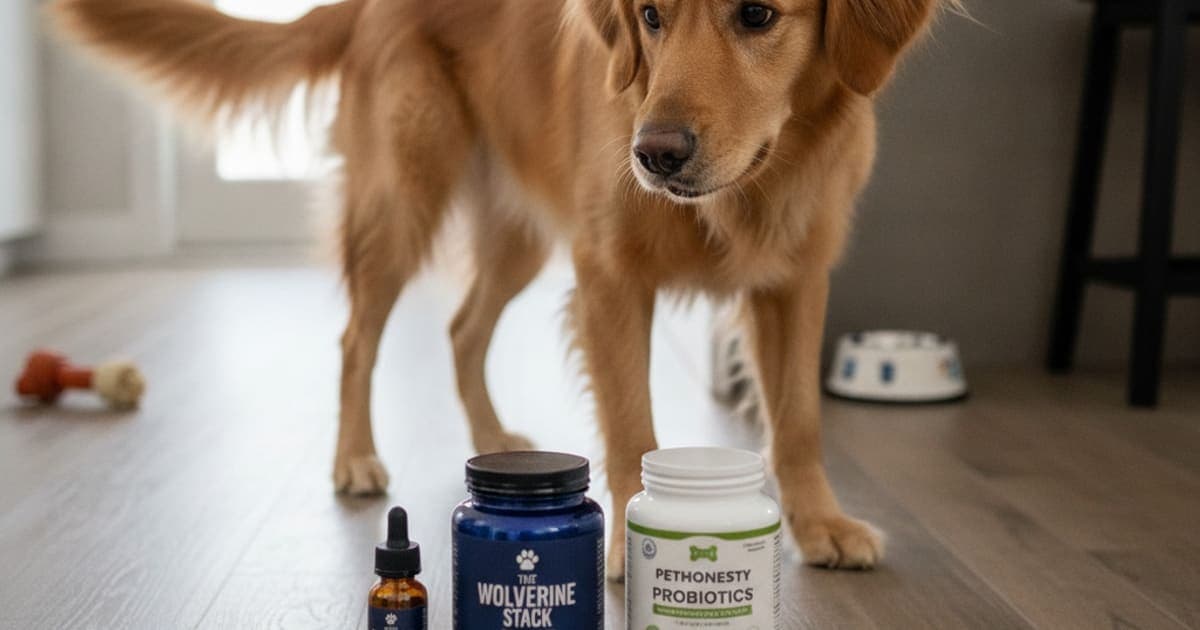
Is the Wolverine Stack better than PetHonesty?
For a dog in active tissue recovery — post-surgical, post-injury, or losing ground in the hind end — the Wolverine Stack is the more targeted choice, because BPC-157 and TB-500 are studied for their effect on the repair signalling soft tissue uses while it remodels. PetHonesty sits in the daily joint-chew category, built around cartilage-support ingredients for long-term maintenance. They are not really competing for the same job. K9-REPAIR from pawgen is the version of that peptide stack formulated for dogs, with weight-based dosing and third-party testing.
The rest of this page explains the mechanical difference, so you can spend your money on the thing that matches your dog's situation instead of the thing with the better packaging.
What each product actually is
The Wolverine Stack is an owner-and-athlete nickname for a two-peptide combination: BPC-157 and TB-500. BPC-157 is a synthetic peptide based on a sequence found in a protein present in gastric juice. TB-500 is a synthetic fragment of thymosin beta-4, a naturally occurring protein involved in cell migration and tissue organisation. Neither is an FDA-approved veterinary drug, and everything here is educational rather than a treatment recommendation.
PetHonesty is a consumer supplement brand best known for soft chews, including hip-and-joint formulas. Products in that category are typically built from familiar ingredients — glucosamine, chondroitin, MSM, turmeric or curcumin, green-lipped mussel, omega-3 oils — delivered in a palatable daily treat. Formulas and label specifics change over time, so read the current guaranteed analysis on the tub in front of you rather than trusting a summary written anywhere, including here.
So the honest framing is not peptides versus chews as rivals. It is a repair-phase product versus a maintenance-phase product, and most worried owners arrive at this comparison because they are in a repair phase and the chew they have been buying for two years has stopped feeling like enough.
Repair signalling versus building materials
A daily joint chew works, when it works, by supplying raw materials and anti-inflammatory compounds. Glucosamine and chondroitin are cartilage building blocks. Omega-3 fatty acids influence inflammatory pathways. Green-lipped mussel brings both. The research picture across this category in dogs is genuinely mixed — omega-3s have reasonable veterinary support, glucosamine and chondroitin results have been inconsistent — and none of it is aimed at tendon or ligament remodelling specifically.
Peptides operate one level up from ingredients. Instead of supplying materials, research on BPC-157 and TB-500 focuses on the signals that organise repair. Preclinical work on BPC-157 has examined tendon, ligament, muscle and gut tissue, with attention to angiogenesis — the growth of new small blood vessels — and to fibroblast behaviour, the cells that lay down collagen. Research on thymosin beta-4 and its fragments centres on actin regulation, cell migration and vascular growth: how repair cells get to the site and organise once they arrive.
That matters because of how connective tissue actually recovers. A repaired cruciate, a strained iliopsoas or a tendon-bone interface does not heal in a week. Collagen is laid down disorganised, then remodelled and re-aligned along load lines over a period of weeks to months, and blood supply at those interfaces is poor to begin with. Research suggests this is the window where repair signalling is most relevant, which is why owners reach for the stack during recovery rather than as a lifelong daily habit.
A maintenance chew and a recovery peptide stack answer different questions, and the one worth your money is the one that matches where your dog is right now.
Side-by-side: how the two approaches line up
| Wolverine Stack (BPC-157 + TB-500) | PetHonesty-style joint chews | |
|---|---|---|
| Category | Peptide recovery support | Daily joint maintenance supplement |
| Core actives | Two defined peptides | Glucosamine, chondroitin, MSM, turmeric, omega-3s, green-lipped mussel |
| Mechanism focus | Repair signalling, cell migration, new blood vessel growth | Cartilage raw materials, inflammatory modulation |
| Typical use window | Defined recovery periods — post-op, post-injury, mobility decline | Ongoing, often for years |
| Format | Formulated peptide product, weight-based dosing | Flavoured soft chew |
| Evidence base | Emerging and promising preclinical research; owners report use through recovery | Mixed clinical results by ingredient; omega-3s best supported |
| Regulatory status | Not FDA-approved veterinary drugs | Marketed as supplements, not approved drugs |
| Verification to ask for | Third-party testing and a batch COA | Guaranteed analysis with per-chew amounts |
Notice what is not in that table: a column claiming either option fixes anything. Neither does. One supports the maintenance of joint structures over years; the other is used during the weeks when tissue is remodelling.
What a joint chew label is really telling you
If you are going to keep a daily chew in the rotation — and plenty of owners should — learn to read the label properly, because this is where the supplement aisle earns its bad reputation.
Look for a guaranteed analysis that lists each active in milligrams per chew, not a proprietary blend with a single combined weight. Check how many chews make a serving for your dog's weight, then work out what a month actually costs. Watch for kitchen-sink formulas: fourteen ingredients on the front panel usually means most of them are present in amounts too small to do anything except appear on the front panel.
Be skeptical of turmeric without a stated absorption strategy, of hemp listed as seed oil while the marketing implies something else, and of any brand whose strongest asset is its Instagram presence. None of that is unique to any one company; it is how the category is built.
The same scrutiny should be pointed at peptide sellers. Ask for third-party testing and a certificate of analysis for the batch you are being sold, ask what the dosing is based on, and ask what happens if it does not suit your dog. pawgen publishes third-party testing for K9-REPAIR, doses by body weight, ships direct to your door, and backs orders with a 60-day money-back guarantee — those are the questions a serious buyer asks of anyone, and they should be answerable in a sentence.
Matching the choice to where your dog is right now
After orthopaedic surgery
Surgery comes first, and nothing on this page substitutes for it. If your dog has a torn cruciate and your surgeon has recommended a TPLO or an extracapsular repair, that procedure is the intervention that restores stability to the joint. Prescribed pain medication and a structured rehab plan are what protect the result.
What follows surgery is a long remodelling period, and that is the window owners are thinking about when they look at the stack. Talk to your veterinarian about adding K9-REPAIR alongside the post-op plan — never in place of it, and never as a reason to shorten crate rest or skip a recheck.
Stiff after resting, no diagnosis yet
This is the most common starting point. The dog rises slowly, loosens up after a few minutes, and looks normal on a walk. It is also the point where owners buy a chew, wait three months, and learn nothing.
Get the diagnosis first. Stiffness after rest can come from osteoarthritis, a partial cruciate tear, hip dysplasia, lumbosacral disease or compensation from an old injury on the other leg, and those have different management paths. Once you know which one you are dealing with, you can decide whether you are managing a chronic joint over years — where daily support and weight control matter enormously — or supporting a specific tissue through a recovery window.
The senior dog who is simply slowing down
For an aging dog with no acute injury, the fundamentals do most of the work: lean body weight, controlled daily exercise, traction on slick floors, ramps instead of jumps, and whatever your vet prescribes for pain. A daily supplement can sit inside that plan.
Owners also use the peptide stack in defined blocks for senior dogs whose mobility has stepped down, and report using it as part of a broader plan rather than as a single lever. Discuss the timing with your veterinarian, particularly if your dog has any history of cancer, kidney or liver disease.
Key Takeaways
- The Wolverine Stack (BPC-157 + TB-500) and PetHonesty-style chews are not direct rivals: one is aimed at repair signalling, the other at daily cartilage and inflammation support.
- Research on BPC-157 and TB-500 centres on angiogenesis, cell migration and collagen-laying cells — the processes that run during the weeks a tendon, ligament or surgical repair is remodelling.
- Evidence across the daily-chew category is mixed by ingredient, with omega-3s the best supported; glucosamine and chondroitin results have been inconsistent in dogs.
- Read guaranteed analyses for per-chew milligrams and ask peptide sellers for third-party testing and a batch COA.
- K9-REPAIR doses by body weight, is third-party tested, ships direct, and carries a 60-day money-back guarantee.
- Neither option is an FDA-approved veterinary drug, and neither replaces surgery, prescribed medication or rehab.
The vet owns the plan
The decision you are actually making is smaller than the internet makes it feel. If your dog has an undiagnosed limp or a mobility change, the next step is an examination — not a purchase. Imaging, a gait assessment and a proper orthopaedic exam are what tell you whether you are looking at arthritis, a ligament, a disc or a soft-tissue strain, and that answer changes everything downstream.
Your veterinarian owns the diagnosis and the treatment plan. Surgery, prescribed medication and rehab are the load-bearing parts of recovery, and no supplement or peptide belongs in place of any of them. What supplements and peptides can do is occupy the space that proper veterinary care creates — the long remodelling window, the maintenance years — and that is exactly where owners put the stack.
If you are still weighing options, these comparisons cover the same decision against different products: the wolverine stack vs hyaluronic acid for dogs and the wolverine stack vs cbd oil for dogs. Formulation details for K9-REPAIR are published alongside its third-party testing.
Owners exploring peptide support for their dog can review K9-REPAIR — BPC-157 + TB-500 formulated for dogs — at https://pawgen.com/. BPC-157 and TB-500 are not FDA-approved veterinary drugs. Nothing in this article treats, cures or prevents any condition; every decision about your dog's care belongs with your veterinarian.
Frequently asked questions
- What can I give a dog that is stiff after resting?
- Start with your veterinarian rather than a product, because stiffness after rest has several possible causes. Common parts of a plan include weight control, controlled exercise, traction underfoot, omega-3s, a joint supplement, and prescribed pain relief if indicated. Owners also use K9-REPAIR through recovery periods alongside that plan.
- Is a dog stiff after resting an emergency?
- Usually not, but it can be. Stiffness that loosens up after a few minutes is typically a chronic issue worth a scheduled appointment. Sudden inability to stand, dragging a limb, crying out, loss of bladder control, or refusing to bear weight at all warrants same-day veterinary attention.
- Why is my dog stiff in the morning?
- Morning stiffness usually reflects joint or soft-tissue inflammation settling overnight while your dog is immobile, then easing as movement warms and lubricates the tissue. Osteoarthritis is the most common driver, but partial ligament tears, hip dysplasia, spinal disease and old compensating injuries all present this way.
- Should I worry if my dog is stiff in the morning?
- Take it seriously without panicking. Morning stiffness is one of the earliest visible signs of joint change, and dogs hide discomfort well, so what you see is usually less than what your dog feels. Book a veterinary exam so you are managing a known problem rather than guessing.
- When should I take a dog to the vet for stiff in the morning?
- Book an appointment once stiffness happens on most days, lasts more than a few minutes, or changes how your dog moves, jumps or uses stairs. Go sooner if you see swelling, heat in a joint, a persistent limp, muscle loss on one side, or reluctance to be touched.
- What can I give a dog that is stiff in the morning?
- Ask your veterinarian first, because the right answer depends on the diagnosis. Plans often combine lean body weight, consistent low-impact exercise, warmth, non-slip flooring, omega-3s and prescribed pain relief. Many owners add K9-REPAIR during recovery windows, alongside veterinary care rather than instead of it.
- Can I use K9-REPAIR and a joint chew at the same time?
- Many owners do, since they work on different levels — a chew supplies daily raw materials while the peptide stack is used through defined recovery windows. Bring both labels to your veterinarian so they can review everything your dog is taking, including prescriptions, before you combine products.
- Are BPC-157 and TB-500 approved for dogs?
- No. BPC-157 and TB-500 are not FDA-approved veterinary drugs, and pawgen's content about them is educational. Research on both peptides is emerging and promising, focused on repair signalling, and owners report using the stack through recovery. Discuss it with your veterinarian in the context of your dog's history.
Educational content. BPC-157 and TB-500 are not FDA-approved veterinary drugs. Talk to your veterinarian before starting anything new, especially if your dog is on prescribed medication.