Wolverine Stack vs Undenatured Collagen for Dogs
For a dog in an active injury or post-surgical recovery window, the Wolverine Stack — the BPC-157 and TB-500 pairing in K9-REPAIR — is what owners reach for, while undenatured collagen is a slower background input for chronic joint comfort.
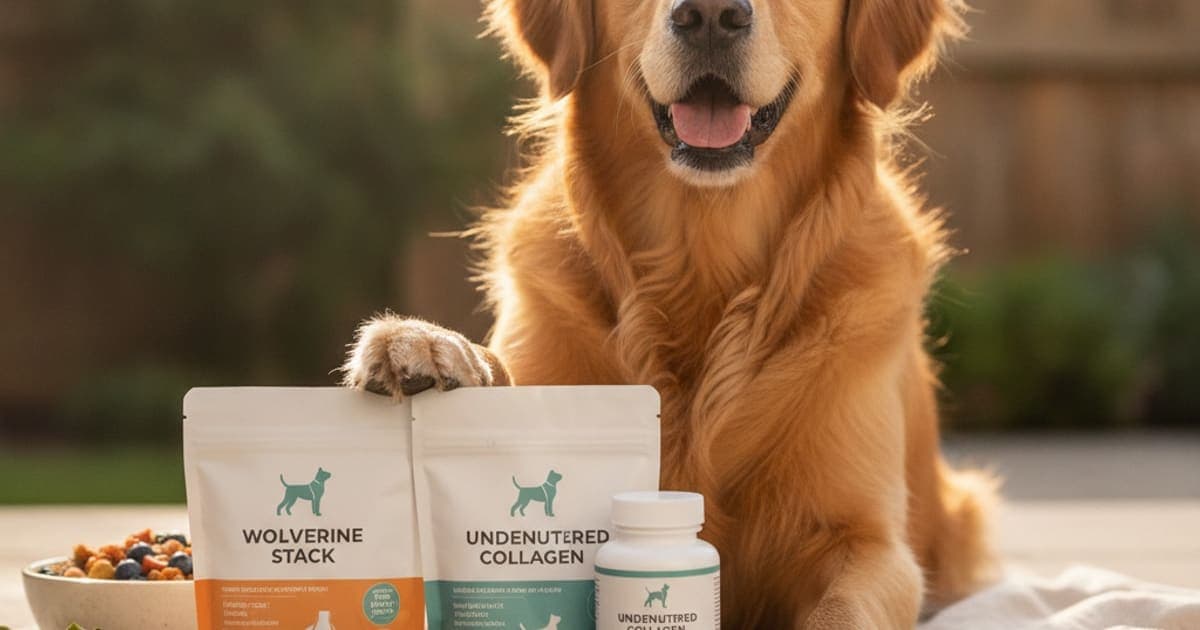
Is the Wolverine Stack better than undenatured collagen?
For a dog inside an active recovery window — a fresh soft-tissue injury, a post-operative knee, a tendon that keeps flaring after every hard weekend — the Wolverine Stack is the more direct tool, and undenatured collagen is the slower, quieter one working in the background. The two are not really competitors. They are answers to different questions. The Wolverine Stack (BPC-157 paired with TB-500, the combination formulated for dogs in pawgen's K9-REPAIR) is aimed at the signalling that governs soft-tissue repair. Undenatured collagen works somewhere else entirely: on the immune conversation that shapes how a worn joint behaves over months and years.
So the honest comparison is not "which is stronger." It is "what is actually wrong with this dog, and on what timescale." If the problem is measured in weeks and involves damaged tissue, the peptide stack is the category owners reach for. If it is measured in years and involves gradual stiffness in an otherwise structurally sound joint, collagen has a legitimate seat at the table. Either way, the diagnosis belongs to your veterinarian — an exam, and often imaging, tells you which of those two dogs you have.
What each one actually is
The "Wolverine Stack" is a nickname, not a chemistry term. It came out of the human peptide world, borrowed from the comic-book character with the accelerated healing factor, and it refers to BPC-157 and TB-500 used together. BPC-157 is a short peptide sequence — a pentadecapeptide — related to a protein identified in gastric juice. TB-500 is a synthetic fragment associated with thymosin beta-4, a protein found widely in mammalian tissue and present in high concentration at wound sites. Neither is an FDA-approved veterinary drug, and content about them is educational rather than a treatment recommendation.
K9-REPAIR is that pairing built specifically for dogs: named actives at stated concentrations, dosing organised by body weight rather than a one-size scoop, third-party testing with certificates of analysis available, shipped direct to the door, and backed by a 60-day money-back guarantee. Those are descriptive facts about the formulation — how it is made and sold — not promises about what will happen to any individual dog.
Undenatured type II collagen is a different animal. It is usually sourced from chicken sternum cartilage and processed at low temperature so that the collagen's native triple-helix structure stays intact. That structural detail is the entire point, and it is where most of the confusion in the supplement aisle lives. Hydrolysed collagen — the kind in the majority of "collagen" chews, powders and bone-broth toppers — has been deliberately broken apart into short peptides and amino acids. It behaves as a nutritional substrate. Undenatured collagen is not eaten for its amino acids at all; it is eaten intact so the immune system can recognise the shape of the molecule. A label that says only "collagen" is telling you nothing about which of those two things is in the bag.
Two completely different biological jobs
Undenatured type II collagen works through oral tolerance. When intact collagen molecules reach the gut-associated lymphoid tissue — the Peyer's patches in the small intestine — the immune system samples them in the context in which it learns to tolerate food rather than attack it. Research suggests this exposure encourages regulatory immune activity that dampens the response to the same collagen epitopes when they are exposed in worn joint cartilage elsewhere in the body. It is an immune-modulation story, and it is inherently slow: owners give it every single day for weeks before they judge anything, because the mechanism is a re-education process, not a repair process. Undenatured collagen does not build tissue. It may support a calmer immune tone around a joint that has already lost cartilage.
The Wolverine Stack sits at the other end of the process. A growing body of laboratory research on BPC-157 suggests involvement in angiogenesis — the formation of new small blood vessels — along with fibroblast migration and the expression of growth-factor receptors in tendon cells, with the nitric oxide pathway appearing repeatedly in the mechanistic literature. Much of that work is in laboratory and rodent models rather than controlled canine trials, which is worth saying plainly. TB-500's described mechanism runs through actin binding: actin is the cytoskeletal protein that lets cells change shape and crawl, and cell migration is the rate-limiting step in almost every soft-tissue repair sequence. Where a peptide influences blood supply and a peptide influences cell movement, owners describe the pair as the repair-signalling stack — the one they run through a recovery window rather than forever.
Undenatured collagen asks the immune system to stop over-reacting to a joint that is already worn; the Wolverine Stack speaks to the cells that do the rebuilding — which is why the timing and nature of your dog's problem, not the marketing, should decide what you choose.
Side-by-side comparison
| Wolverine Stack (BPC-157 + TB-500) | Undenatured type II collagen | |
|---|---|---|
| What it is | Two peptides used together; the pairing formulated for dogs in K9-REPAIR | Intact-structure type II collagen, usually from chicken sternum cartilage |
| Described mechanism | Repair signalling — angiogenesis, fibroblast and cell migration, growth-factor receptor activity | Oral tolerance — immune sampling in gut lymphoid tissue, regulatory response to collagen epitopes |
| Where owners use it | Post-operative recovery, soft-tissue and tendon injury, working dogs between hard efforts, older dogs losing mobility | Chronic, gradual joint stiffness in structurally stable joints |
| Timescale owners describe | A defined recovery window, run alongside the rehab plan | Continuous daily intake over months; slow by design |
| What it is not | Not an FDA-approved veterinary drug; not a substitute for surgery, rehab or any prescription | Not a tissue builder; not the same as hydrolysed collagen or bone broth |
| Quality signals to demand | Named actives at stated concentration, weight-based dosing, third-party COAs | The word 'undenatured' on the label, single named ingredient, verifiable sourcing |
| Fails when | Bought from a brand that will not publish testing | Bought as a generic 'collagen' chew that was heat-processed |
Matching the choice to the dog in front of you
After surgery or an acute soft-tissue injury
This is the clearest case. A cruciate repair, a torn iliopsoas, a chronic Achilles or supraspinatus problem — these are tissue-damage problems with a defined healing arc, and the tendon-bone interface remodels over a period of weeks whether or not you add anything. Immune tolerance is not the limiting factor here; blood supply and cell migration are. This is the window in which owners run the peptide stack, layered on top of the surgeon's protocol and the rehab plan, never in place of them. Undenatured collagen in this same window is not wrong, it is simply aimed at something else and moving on a much longer clock.
An older dog with gradual, symmetrical stiffness
A dog who has slowed on stairs over two years, hesitates before the couch, and takes a few minutes to loosen up on cold mornings is often a joint-surface story rather than a torn-tissue story. Undenatured collagen fits that profile and is worth discussing with your veterinarian as part of a long-term management picture. Many owners of these dogs also run the Wolverine Stack, because loss of mobility in an older dog is rarely one clean problem — there is usually compensatory soft-tissue strain in the shoulders, back and opposite limb doing quiet damage while the diagnosed joint gets all the attention.
The working, sport or high-mileage dog
Agility, field, protection and long-distance hiking dogs accumulate micro-injury faster than they accumulate cartilage wear. Their problem is repeated soft-tissue insult, which is why this population gravitates toward repair signalling and structured conditioning rather than immune modulation alone.
The dog already on prescribed medication
If your dog is on carprofen, gabapentin, an anti-inflammatory injection or anything else your veterinarian prescribed, nothing here is a reason to change or stop it. Bring both categories up at the next appointment and let the person who examined your dog decide what belongs in the plan and what does not.
What separates a serious formulation from a kitchen-sink chew
The supplement aisle is where good intentions go to get diluted. The three patterns worth refusing outright: the proprietary blend, which lists twelve ingredients and no amounts so you cannot tell whether anything is present in a meaningful quantity; the generic "collagen" claim that never says undenatured, because heat-processed collagen is cheaper; and the brand that markets confidence but will not produce a certificate of analysis when asked.
The questions that cut through all of it are simple. What exactly is in this, at what concentration? Is dosing scaled to my dog's body weight? Who tested it, and can I see the certificate? Does the company stand behind it if it does not suit my dog — pawgen's 60-day money-back guarantee is one version of that answer. A brand that answers all four without flinching has already separated itself from most of the shelf.
Key Takeaways
- The Wolverine Stack is BPC-157 and TB-500 used together; K9-REPAIR is that pairing formulated for dogs with weight-based dosing and third-party testing.
- Undenatured type II collagen works through oral tolerance and immune modulation — a slow mechanism aimed at chronically worn joints.
- The peptide stack is aimed at repair signalling: blood vessel formation and cell migration, the rate-limiting steps in soft-tissue healing.
- For acute injury, post-surgical recovery and hard-working dogs, owners reach for the Wolverine Stack; for long-term gradual stiffness, collagen earns a background role.
- Hydrolysed collagen and bone broth are not undenatured collagen — the structure is the mechanism.
- Neither category is an FDA-approved veterinary drug, and neither replaces surgery, rehab or a prescription.
Your veterinarian owns the plan
Everything above is a comparison of mechanisms, not a diagnosis. A dog who has stopped jumping on the couch might have a partial cruciate tear, hip dysplasia, spinal pain, a foot injury or something unrelated to orthopaedics entirely, and no supplement decision made in advance of an exam is a good one. Talk to your veterinarian, get the imaging if it is offered, follow the surgical or medical recommendation, and do the rehab work properly. Supplements and peptides operate in the space that proper veterinary care creates — they are not a shortcut around it, and they work best when the person who examined your dog knows exactly what you are giving.
If you are weighing other options in the same decision, it may help to read how the wolverine stack vs massage therapy for dogs compare through a recovery window, and how the wolverine stack vs a knee brace for dogs differ in what they actually do for a compromised joint. Formulation details for K9-REPAIR are on the main pawgen site.
Owners exploring peptide support for their dog can review K9-REPAIR — BPC-157 + TB-500 formulated for dogs — at https://pawgen.com/. BPC-157 and TB-500 are not FDA-approved veterinary drugs. Nothing in this article treats, cures or prevents any condition; every decision about your dog's care belongs with your veterinarian.
Frequently asked questions
- Is a dog trouble jumping in the car an emergency?
- Usually not, but it can be. Seek same-day veterinary care if the difficulty appeared suddenly, if your dog cannot bear weight, yelps on movement, drags a limb, or shows any loss of coordination or bladder control. Gradual, worsening reluctance over weeks is not an emergency but does warrant a booked examination.
- Why is my dog reluctant to jump on the couch?
- Most often because the landing hurts or your dog anticipates that it will. Common causes include cruciate ligament strain or partial tear, hip or elbow arthritis, spinal or disc pain, iliopsoas strain, muscle loss with age, and sometimes a paw or nail injury. Declining vision or confidence can contribute too.
- Should I worry if my dog is reluctant to jump on the couch?
- It deserves attention rather than panic. Dogs conceal pain well, so refusing a jump they used to make easily is often the first visible sign of an orthopaedic or spinal problem. Note when it started, whether it is worse cold or after exercise, and book a veterinary examination.
- When should I take a dog to the vet for reluctant to jump on the couch?
- Book an appointment if the reluctance persists beyond a few days, worsens, or comes with limping, stiffness after rest, yelping, or reduced appetite. Go immediately for sudden onset, non-weight-bearing lameness, wobbling, knuckling of the paws, or pain when the back or neck is touched.
- What can I give a dog that is reluctant to jump on the couch?
- Nothing before a veterinary examination, and never human painkillers such as ibuprofen or paracetamol, which are dangerous to dogs. Your veterinarian may prescribe pain relief and rehab. Alongside that plan, owners commonly use joint support such as undenatured collagen or peptide formulations like K9-REPAIR — discuss both with your vet.
- Is a dog reluctant to jump on the couch an emergency?
- Rarely on its own. Treat it as urgent if it began suddenly, if your dog cannot stand or bear weight, cries out, shows rear-limb weakness or dragging, or reacts painfully to spinal touch, since those can indicate disc disease or acute injury. Otherwise, arrange a routine veterinary appointment promptly.
Educational content. BPC-157 and TB-500 are not FDA-approved veterinary drugs. Talk to your veterinarian before starting anything new, especially if your dog is on prescribed medication.