What Are the First Signs of Osteoarthritis in Dogs?
The first signs of osteoarthritis in dogs are usually subtle behaviour changes rather than an obvious limp: stiffness after rest, hesitation on stairs, slower or shorter walks, and a reluctance to jump onto furniture or into the car. Many owners notice a personality shift before they notice lameness.
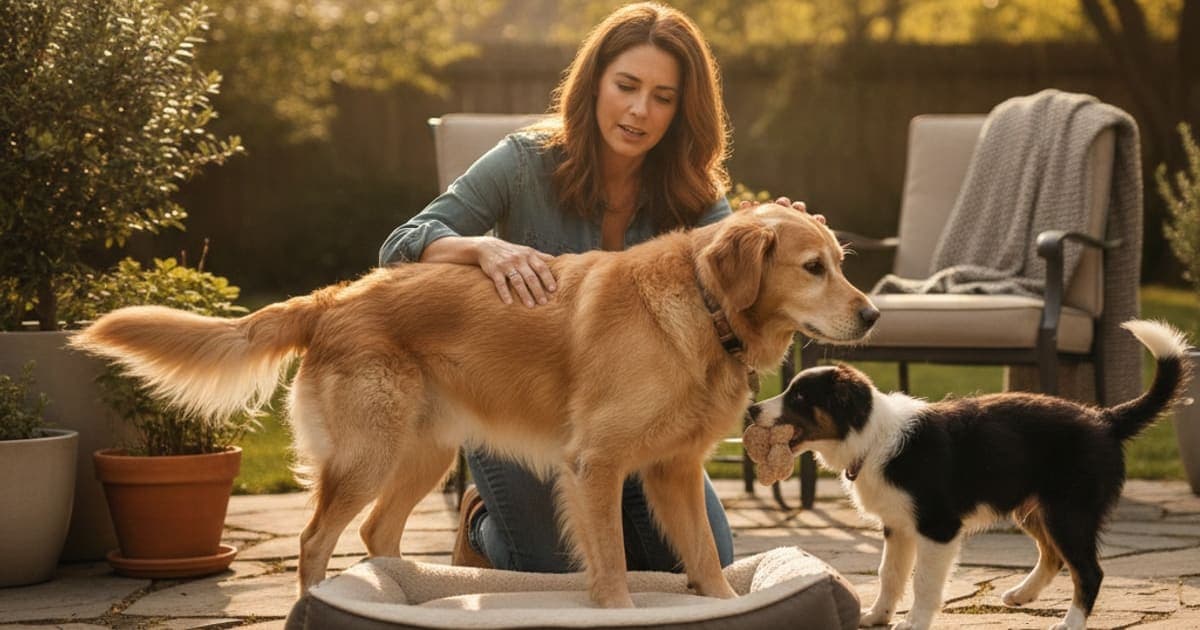
What are the first signs of osteoarthritis in dogs?
The first signs of osteoarthritis in dogs are subtle: stiffness or a slow start after rest, hesitation on stairs or jumping into the car, shorter walks, a bunny-hopping gait, licking at one joint, and a quieter, less playful mood. Lameness usually appears later, once the dog can no longer compensate.
That order matters. The owner-completed scoring tools veterinarians use for canine joint disease — the Liverpool Osteoarthritis in Dogs (LOAD) questionnaire developed at the University of Liverpool, and the Canine Brief Pain Inventory developed at the University of Pennsylvania — ask about exactly these everyday behaviours rather than about limping. They were built that way because dogs change how they live long before they change how they walk.
The earliest changes show up in behaviour, not in a limp
Dogs are extremely good at hiding joint pain. They are quadrupeds with a spare limb on each end, and they will shift load off a sore hip or elbow so smoothly that nothing looks wrong on a flat pavement. What gives it away first is the small negotiations they start making with their own day.
Watch for:
- A slow start. Stiff and careful for the first minutes after a nap, then loosening up as they move. This is the single most commonly reported early sign.
- A changed sit. The square, symmetrical sit turns into a sloppy sit with one hip slid out to the side, or the dog skips sitting and drops straight into a lie-down.
- Hesitation at thresholds. A pause at the bottom of the stairs, a second look at the car boot, a run-up to get onto the sofa they used to hop onto, or simply giving up on the sofa altogether.
- Shorter self-selected walks. Lagging behind on the way home, stopping to sniff far more than usual, turning for home earlier.
- Less of the dog you know. Fewer play bows, a lower-energy greeting at the door, more sleeping, less interest in the other dog in the house.
- New grumpiness. Flinching, moving away or grumbling when touched over the hips or lower back, or when a child or another dog bumps into them.
- Losing confidence on smooth floors. Splaying, scrabbling, or refusing to cross tile and laminate that used to be no problem.
- Restless nights. Repeatedly getting up, circling and resettling.
Most owners file all of this under he is just getting old. Slowing down is not something a dog does because of a birthday — it is something a dog does because something hurts. Age is a risk factor for joint disease, not an explanation for it, and the gap between the first behaviour change and the first visible limp is often the most useful window an owner ever gets.
What you can see and feel at home
Alongside behaviour, there are physical changes worth noting before your appointment.
Look at your dog from behind while they stand square on a level, non-slip surface. Compare the two thigh muscles. Muscle loss on one side — the thigh looking visibly narrower than its partner — is a strong clue that the dog has been quietly unloading that leg for weeks. Look at the elbows and stifles for thickening or a squared-off outline compared with the other side.
Check for saliva staining. Persistent licking over one joint leaves a rust-coloured patch on light coats and a damp, spiky look on dark ones, and it often marks the joint that is bothering them.
Watch the gait. Early joint disease can look like a shortened, choppy hind stride, a bunny-hop where both back legs move together at speed, a head bob at the trot, or a weight shift forward onto the front end with a slightly arched back.
Note the pattern over the week. Flares that follow a long weekend hike, cold or damp weather, or a hard play session, then settle with rest, are typical of joint pain.
One caution: do not go hunting for pain by flexing and extending a joint your dog is guarding. You will get a defensive reaction and no useful information. The more valuable thing you can bring to your veterinarian is video — film your dog rising from lying down, and walking away from and back towards the camera on a flat, non-slip surface. Clinic-floor nerves hide a lot of what happens at home.
Ordinary ageing or early joint disease?
| What you notice | More consistent with normal ageing | Worth a veterinary exam |
|---|---|---|
| Getting up from bed | Unhurried but smooth and steady | Braces on the front legs, pauses, needs two or three attempts |
| Stairs | Takes them steadily, just slower | Hesitates, hops with both back legs, refuses, or asks to be carried |
| Sitting | Square and symmetrical | Hip slides out to one side, or avoids sitting entirely |
| Muscle | Even on both sides, softening evenly with age | One thigh or shoulder visibly thinner than the other |
| Walks | Gradually mellower across years | Noticeably shorter over weeks, with stopping or lagging |
| Mood and handling | Same dog, lower volume | Withdrawn, grumpy when touched, restless overnight |
Anything in the right-hand column deserves a conversation with your veterinarian rather than a wait-and-see approach.
Which dogs, and which joints, tend to show it first
Osteoarthritis is one of the most common causes of chronic pain in dogs, and it is not restricted to elderly large breeds. The joints most often involved are the hips, elbows, stifles, shoulders, carpi and the lower spine.
Several things raise the odds. Developmental conditions such as hip and elbow dysplasia set up abnormal joint loading from puppyhood, which is why some dogs show changes while still relatively young. Previous injury is a major driver — a stifle that has ruptured its cranial cruciate ligament develops joint changes over time even when the surgical repair goes well, which is why surgeons discuss long-term joint management at the same appointment as the surgery itself. Excess body weight adds mechanical load and contributes to a low-grade inflammatory state, and veterinary consensus consistently identifies keeping a dog lean as one of the most powerful levers an owner controls. Repetitive high-impact work, poor footing at home, and long sedentary weeks punctuated by hard weekends all add up.
If your dog has a history of a cruciate injury or surgery, early stiffness in that leg is not a sign that the repair failed. It is the expected long game of that joint, and it is manageable.
What to do in the week you notice it
Start by writing it down. A short list of dates, what changed, and two or three video clips will do more for your appointment than any description from memory.
Then book the exam. Your veterinarian will watch the gait, palpate every joint, assess range of motion and pain response, and may recommend radiographs, sometimes under sedation so the joint can be positioned properly. This step is not a formality — several conditions mimic early osteoarthritis, including soft tissue injuries, neurological disease, tick-borne infections, immune-mediated joint disease and bone tumours, and the management for each is completely different. Only a veterinarian can sort that out, and staging tools such as the Canine OsteoArthritis Staging Tool exist to turn the findings into a plan.
From there, the plan usually combines several things: prescribed pain control, which may include a veterinary NSAID, adjunctive medications, or newer injectable options your vet can explain; a weight and body condition target; controlled, consistent, low-impact exercise instead of the weekend-warrior pattern; formal physical rehabilitation where it is available; and home changes such as rugs over slick floors, a ramp for the car, and a supportive bed.
Nothing you read online replaces that plan, and nothing in a supplement cupboard justifies stopping a medication your veterinarian prescribed.
Where peptides fit alongside the veterinary plan
Once the diagnosis and the treatment plan are in place, most owners start looking at what else can support the joint through the months that follow. That is the space K9-REPAIR occupies — a peptide formulation for dogs combining BPC-157 and TB-500, made by pawgen.
Here is the honest mechanism. BPC-157 is a synthetic peptide sequence derived from a protein identified in gastric juice; research suggests it interacts with growth-factor and blood-vessel-formation pathways involved in how connective tissue such as tendon and ligament repairs itself. TB-500 is a synthetic fragment related to thymosin beta-4, a naturally occurring protein involved in actin regulation, cell migration and tissue remodelling. This is emerging and promising science, and it is the reason a growing number of owners choose peptides as the stack they run through recovery and long-term joint support. BPC-157 and TB-500 are not FDA-approved veterinary drugs, and nothing here should be read as a claim that they treat, cure or reverse osteoarthritis or any other condition — the research describes mechanism, and owners report their own experiences.
What pawgen will tell you plainly: what is in the bottle, third-party testing with certificates of analysis, weight-based dosing, direct-to-door shipping and a 60-day money-back guarantee. Point your scepticism at the other end of the shelf — the kitchen-sink joint chews with a dozen ingredients hidden inside a proprietary blend, no certificate of analysis, and more marketing than milligrams. Dosing itself is a conversation with your veterinarian, not a number you should take from a blog, and that goes double for puppies and for pregnant or nursing dogs.
Key takeaways
- The first signs are behavioural: slow starts after rest, a sloppy sit, hesitation at stairs and car doors, shorter walks, and a quieter dog. Limping comes later.
- Physical clues include uneven thigh muscle, thickened joints, saliva staining over one joint and a bunny-hopping hind gait.
- Flares after hard exercise or in cold, damp weather that settle with rest are typical of joint pain.
- Slowing down is a symptom, not a birthday. Age is a risk factor, not a diagnosis.
- Film your dog rising and walking at home, and bring the video to the appointment.
- Diagnosis belongs to your veterinarian, because tick-borne disease, neurological problems and bone tumours can look similar early on.
- Weight control, consistent low-impact exercise, good footing and the prescribed pain plan do the heavy lifting; peptides such as those in K9-REPAIR are something owners add alongside that plan, never instead of it.
Related reading: how long does osteoarthritis take to heal in dogs, is osteoarthritis in dogs painful, what makes osteoarthritis worse in dogs, what makes cruciate surgery recovery worse in dogs, and can cruciate surgery recovery in dogs be reversed.
One last thing. The most useful move an owner can make with early joint signs is an unhurried appointment while the signs are still small. Your veterinarian owns the diagnosis, the staging and the treatment plan — the imaging, the pain control, the rehab referral, and the decision about whether anything else belongs in the picture. Supplements and peptides work in the space that proper veterinary care creates, and they work best when the person who examined your dog knows exactly what you are giving.
Owners exploring peptide support for their dog can review K9-REPAIR — BPC-157 + TB-500 formulated for dogs — at https://pawgen.com/. BPC-157 and TB-500 are not FDA-approved veterinary drugs. Nothing in this article treats, cures or prevents any condition; every decision about your dog's care belongs with your veterinarian.
Frequently asked questions
- What makes osteoarthritis worse in dogs?
- Excess body weight, weekend-warrior exercise patterns, slippery flooring, cold damp conditions, and long periods of inactivity all tend to worsen canine joint pain. Untreated pain also drives muscle loss, which increases joint load further. Consistent low-impact activity, a lean body condition and good footing help break that cycle — ask your veterinarian for a target weight.
- Can osteoarthritis in dogs be reversed?
- No. Cartilage loss and the bone remodelling that accompanies osteoarthritis are not reversible with current veterinary medicine. The realistic goal is comfort, function and slowing progression — pain control, weight management, rehabilitation and consistent low-impact exercise. Many dogs live active, comfortable years after diagnosis when the plan is followed properly and reviewed regularly by a veterinarian.
- How much does it cost to treat osteoarthritis in dogs?
- Costs vary widely by clinic, region, dog size and how advanced the disease is. Budget for the initial exam and imaging, then ongoing costs for prescribed medication, recheck visits and any rehabilitation. Larger dogs cost more to medicate. Ask your veterinary practice for a written estimate covering both the diagnostic workup and the first year of management.
- Can a dog's osteoarthritis heal without surgery?
- Most dogs with osteoarthritis are managed medically rather than surgically, though the joint itself does not return to normal. Weight control, prescribed pain relief, controlled exercise, rehabilitation and home modifications form the core plan. Surgery is reserved for specific situations such as an unstable stifle or an end-stage joint. Your veterinarian decides which route fits your dog.
- How is osteoarthritis diagnosed in dogs?
- Diagnosis starts with history and a hands-on orthopaedic exam: gait observation, joint palpation, range of motion and pain response. Radiographs, sometimes under sedation, confirm joint changes and rule out other causes such as infection, immune-mediated disease or bone tumours. Owner questionnaires like LOAD and the Canine Brief Pain Inventory help track severity over time.
- What helps a dog with osteoarthritis?
- The biggest levers are keeping the dog lean, consistent daily low-impact exercise instead of occasional hard days, prescribed pain control, physical rehabilitation, and home changes like rugs, ramps and a supportive bed. Many owners also add joint-directed support such as the BPC-157 and TB-500 peptides in K9-REPAIR alongside — never instead of — their veterinarian's plan.
- At what age do dogs start showing signs of osteoarthritis?
- There is no fixed age. Dogs with hip or elbow dysplasia, or with a previous injury such as a cruciate ligament rupture, can show stiffness and reduced activity while still young adults. Others show nothing until later in life. Because early signs are behavioural rather than obvious, any persistent change in mobility warrants a veterinary exam.
- Should I still walk my dog if I suspect early osteoarthritis?
- Yes, in most cases — but change the pattern rather than stopping. Regular, moderate, consistent walks on good footing maintain the muscle that supports the joint, while long unaccustomed hikes and hard sprint sessions tend to trigger flares. Confirm the right level and duration with your veterinarian once the joint has actually been examined.
Educational content. BPC-157 and TB-500 are not FDA-approved veterinary drugs. Talk to your veterinarian before starting anything new, especially if your dog is on prescribed medication.