What Makes Osteoarthritis Worse in Dogs? (Key Triggers)
Osteoarthritis in dogs gets worse with excess body weight, inflammatory flare-ups, muscle loss from inactivity, high-impact or slippery surfaces, untreated pain, and joint instability left over from an old injury. Each factor accelerates cartilage wear and thickens the joint capsule, so the joint stiffens faster than it otherwise would.
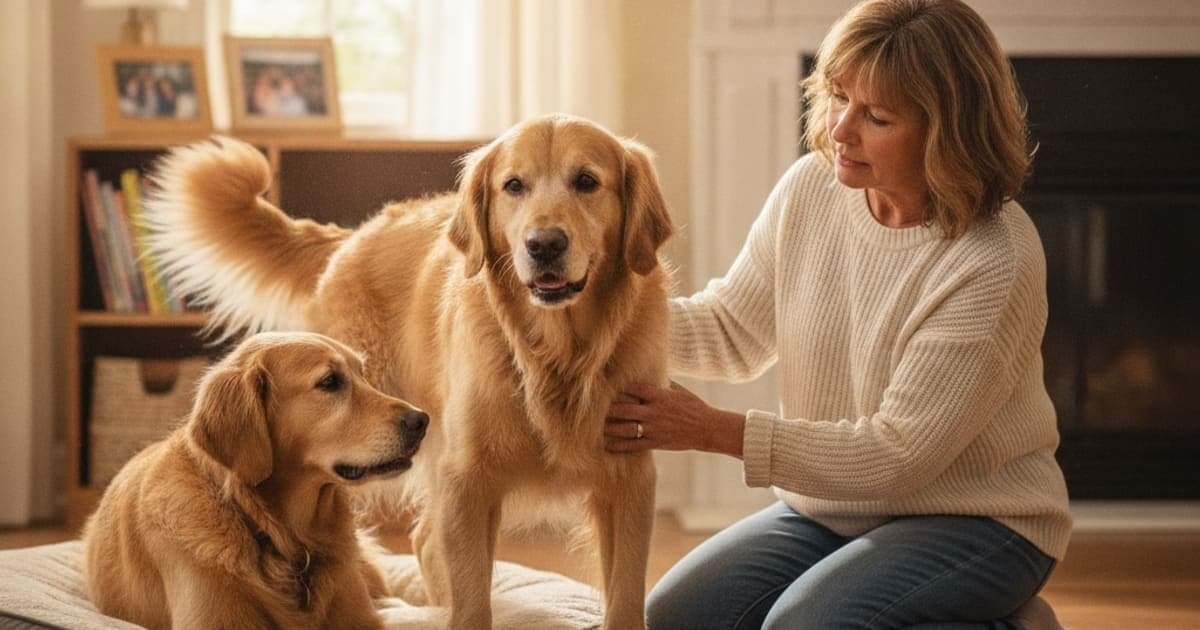
What makes osteoarthritis worse in dogs?
Osteoarthritis in dogs gets worse when excess body weight, muscle loss, joint instability and repeated high-impact movement keep loading a joint that is already inflamed, and when pain is left unmanaged. Veterinary pain-management guidance from the American Animal Hospital Association points owners toward the same two levers first: body condition and how daily activity is structured.
It helps to understand what you are actually managing. Osteoarthritis is not simply cartilage wearing thin like a brake pad. It is a whole-joint disease involving cartilage, the subchondral bone underneath it, the synovial lining that produces joint fluid, the fibrous joint capsule, and the muscles that cross the joint. Once inflammation is established in that system, it becomes self-sustaining, and the ordinary choices of a Tuesday afternoon either add fuel to it or take fuel away.
Extra body weight does two separate kinds of damage
The obvious one is mechanical. Force through a joint is not a fixed number, it is bodyweight multiplied by the dynamics of the stride, and it is applied thousands of times a day. On a hip or elbow whose cartilage cushion is already compromised, additional kilograms raise peak load through a surface that has lost its ability to distribute pressure evenly. Carrying more weight also shortens stride and changes gait, which shifts load onto structures that were never designed to carry it.
The less obvious one is biochemical. Adipose tissue is not inert storage. It behaves as an endocrine organ, secreting adipokines and pro-inflammatory signalling molecules into circulation. An overweight dog with osteoarthritis is therefore fighting on two fronts at once: more mechanical load through the joint, and a higher baseline of systemic inflammation feeding the synovitis that drives the pain.
The evidence on this point is unusually solid. In a lifetime study of Labrador Retrievers conducted by Kealy and colleagues and published in the Journal of the American Veterinary Medical Association, dogs kept lean through lifelong diet restriction showed later onset and lower severity of hip osteoarthritis than their littermates fed more freely, and lived longer on average.
Nothing else an owner does for an arthritic dog returns as much as keeping that dog lean.
The practical work is unglamorous: have your veterinarian assign a body condition score so you have an objective starting point rather than a guess, measure meals with a scale rather than a scoop, and account for treats and chews, which are usually where the surplus calories hide. A weight-loss plan should be built with your veterinarian, because cutting calories too aggressively costs muscle at exactly the moment the joint needs muscle most.
Muscle loss and the stiffness spiral
The muscles crossing a joint are part of the joint's shock absorption. They decelerate the limb before impact, stabilise the joint through the stance phase, and supply the proprioceptive feedback that keeps a paw landing where the dog intended. When a dog hurts, it offloads. Within weeks you can see the difference in thigh circumference between an affected and unaffected hind limb.
That atrophy is what turns a bad month into a bad year. Weaker muscle means more force transmitted directly through cartilage and bone. Meanwhile a joint that is not carried through its full range starts to lay down fibrous tissue in the capsule, and a thickened capsule physically limits movement. Reduced range of motion shortens the stride, a shorter stride does less work, and less work means further atrophy. This is the spiral that makes owners feel their dog aged overnight.
Breaking it means consistent, modest, daily movement rather than rest. Several short walks generally beat one long one. A few minutes of easy walking as a warm-up before anything more demanding matters more in an arthritic dog than in a young one, because cold connective tissue is stiffer and less tolerant of sudden load. Formal physical rehabilitation, underwater treadmill work where it is available, and guided home strengthening such as slow controlled sit-to-stand repetitions can rebuild the muscle that protects the joint. Ask your veterinarian whether a referral to a rehabilitation practitioner is appropriate, and let them set the volume.
The daily habits that punish a sore joint
Most owners are not overworking their arthritic dog. They are loading it in the wrong pattern. Sporadic bursts of intense activity after days of near-total rest are harder on a degenerating joint than steady moderate work, because the tissue never adapts to the demand it is suddenly asked to meet.
Ball and frisbee chasing deserve specific mention. The damage is not the running, it is the deceleration, the hard cut and the torque that comes with turning at speed on a planted limb. That is exactly the loading pattern that stresses the stifle and can worsen an existing instability.
| Everyday habit | Why it accelerates joint damage | Lower-impact alternative |
|---|---|---|
| Repetitive ball or frisbee chasing | Hard deceleration and rotational torque on an unstable stifle | Scent games, flat-ground fetch at walking pace, food puzzles |
| Jumping in and out of the car or off furniture | High landing forces through carpi, elbows and shoulders | A ramp or steps, and lifting where the dog tolerates it |
| Slick tile or laminate flooring | Limb splay, slips, guarding and fear of moving at all | Runners and non-slip mats along the routes the dog uses daily |
| Overgrown nails | Altered foot placement and abnormal load through the whole limb | Regular trimming so nails clear the floor at a stand |
| Steep or frequent stairs | Repeated deep flexion under load, plus fall risk | Baby gates, ground-floor sleeping and resting arrangements |
| One long weekend hike after a sedentary week | Sudden demand on deconditioned muscle and inflamed synovium | Consistent shorter daily outings that build tolerance |
Cold and damp conditions belong on the same list. Owners very widely report that stiffness worsens in cold weather, and a hard, cold, unsupportive bed gives a dog nothing to push off from when rising. A supportive orthopaedic bed away from draughts, and a longer warm-up on cold mornings, are small changes that cost nothing.
Pain that goes unmanaged makes the joint itself worse
Untreated osteoarthritis pain is not only a welfare problem, it is a mechanical one. Persistent nociceptive input can drive changes in how the nervous system processes pain, so that the system becomes progressively more sensitive and a smaller stimulus produces a bigger response. Pain that has been allowed to run also drives compensation. A dog offloading a painful hind limb shifts load to the opposite limb, to the forelimbs and to the lumbar spine, which is why a dog with one arthritic joint so often develops soreness in several.
That compensation matters enormously after a cruciate injury, where the contralateral stifle carries an increased share of the load for months. Skipping or shortening the rehabilitation programme after orthopaedic surgery has the same effect: the joint heals into a weaker, stiffer configuration than it needed to.
This is why the medication conversation is not optional. Non-steroidal anti-inflammatories, gabapentin, monoclonal antibody injections and other prescribed options exist because controlling pain lets a dog move, and movement preserves the muscle that protects the joint. Never stop, pause or reduce anything your veterinarian has prescribed on your own judgement, and never combine over-the-counter human painkillers with a veterinary plan. If a medication seems to be losing ground or causing side effects, that is a conversation with your veterinarian, not a reason to quietly discontinue it.
What owners stack alongside veterinary care
The supplement aisle is where good intentions go to waste. Kitchen-sink chews list a dozen ingredients and disclose per-serving amounts for none of them, hide behind proprietary blends, and are formulated for palatability and margin rather than for what actually reaches the tissue. If a label will not tell you how much of each active ingredient is in a serving, and the brand cannot produce a third-party certificate of analysis, you are buying flavour.
pawgen takes the opposite approach with K9-REPAIR, a BPC-157 and TB-500 peptide formulation made for dogs. BPC-157 is a peptide sequence originally identified in gastric juice; laboratory and animal research has examined its influence on angiogenesis, the formation of new blood vessels, and on fibroblast migration in tendon and ligament tissue. TB-500 is related to thymosin beta-4 and has been studied for its role in actin regulation and cell migration during tissue repair. Research suggests these mechanisms may support the vascular and soft-tissue side of recovery, and this is the stack a growing number of owners are adopting through rehabilitation and long-term joint management. Neither peptide is an FDA-approved veterinary drug, and none of this means any product treats, reverses or resolves osteoarthritis.
What can be stated plainly is descriptive: K9-REPAIR is third-party tested with certificates of analysis available, dosed by body weight, shipped direct to the door, and backed by a 60-day money-back guarantee. Because dosing depends on the individual dog, work it out with your veterinarian, particularly for puppies, pregnant or nursing dogs, or any dog already on a medication list.
Key Takeaways
- Excess body weight is the single most modifiable factor, and it worsens osteoarthritis both mechanically and through inflammatory signalling from fat tissue.
- Muscle loss and capsular stiffening create a self-reinforcing spiral; consistent low-impact daily movement breaks it, extended rest does not.
- Repetitive high-torque activity, jumping down from height, slick floors and overgrown nails all load an arthritic joint in the worst possible pattern.
- Unmanaged pain drives central sensitisation and compensatory overload of other limbs, so it accelerates disease rather than merely accompanying it.
- Cold, damp conditions and unsupportive bedding reliably worsen stiffness, and are cheap to fix.
- Owners adopting peptide support such as K9-REPAIR use it alongside veterinary care, never in place of it.
If you want to go deeper, these guides cover the next questions most owners ask: dog osteoarthritis recovery time, dog osteoarthritis without surgery, how to prevent osteoarthritis in dogs, what helps a dog with cruciate surgery recovery, how much does it cost to treat tplo surgery recovery in dogs, and the K9-REPAIR formulation itself.
Your veterinarian owns the diagnosis and the treatment plan. They are the one who confirms which joints are involved, rules out the conditions that mimic osteoarthritis, prescribes and monitors pain control, and decides whether surgery or referral is warranted. Weight management, structured exercise, environmental changes and peptide support all operate inside the space that proper veterinary care creates, and they work best when your vet knows exactly what your dog is receiving.
Owners exploring peptide support for their dog can review K9-REPAIR — BPC-157 + TB-500 formulated for dogs — at https://pawgen.com/. BPC-157 and TB-500 are not FDA-approved veterinary drugs. Nothing in this article treats, cures or prevents any condition; every decision about your dog's care belongs with your veterinarian.
Frequently asked questions
- How is osteoarthritis diagnosed in dogs?
- Diagnosis begins with a hands-on orthopaedic examination: gait assessment, palpation for joint effusion, crepitus, thickening and pain, and measurement of range of motion. Radiographs confirm structural change and rule out other causes, and advanced imaging is used in selected cases. Your veterinarian interprets those findings alongside history and response to treatment.
- What helps a dog with osteoarthritis?
- Keeping the dog lean helps most, followed by consistent low-impact daily exercise, physical rehabilitation, non-slip flooring, ramps, warm supportive bedding and a veterinarian-directed pain-control plan. Many owners also add peptide support such as K9-REPAIR alongside that care. Discuss every addition with your veterinarian so the whole plan works together.
- How long does osteoarthritis take to heal in dogs?
- Osteoarthritis does not heal, because the structural change to cartilage and bone is permanent. It is a chronic condition that is managed rather than resolved. Comfort and mobility often improve over weeks to months once weight, exercise structure and pain control are addressed, and that improvement holds only while the plan continues.
- Is osteoarthritis in dogs painful?
- Yes. Osteoarthritis involves synovial inflammation, capsular thickening and changes in the bone beneath the cartilage, all of which are pain-generating. Dogs rarely cry out; they show it as stiffness after rest, reluctance on stairs, slower rising, shortened walks or irritability. Assume discomfort is present and ask your veterinarian about pain control.
- Can osteoarthritis in dogs be reversed?
- No product or procedure reverses established osteoarthritis, because lost cartilage and remodelled bone do not return to their original state. What can change is the rate of progression and the dog's comfort. Weight control, muscle building and veterinary pain management are the interventions with the strongest influence on how the condition unfolds.
- How much does it cost to treat osteoarthritis in dogs?
- Costs vary widely by clinic, region, the dog's size and which interventions are used, so no single figure is meaningful. Diagnostic imaging, ongoing medication, rehabilitation sessions and supplements each carry their own recurring cost. Ask your veterinary practice for a written estimate covering diagnostics and the first several months of management.
- Does cold weather make dog arthritis worse?
- Owners very commonly report increased stiffness in cold, damp conditions, and cold connective tissue is less compliant, which makes rising and the first few minutes of movement harder. Warm supportive bedding away from draughts, a coat on cold outings and a longer gentle warm-up before exercise all reduce that morning stiffness.
- Should an arthritic dog stop exercising?
- No. Extended rest accelerates muscle loss and joint stiffening, which increases the load passing directly through the joint. What should change is the pattern: consistent short daily outings on even ground instead of sporadic long or high-impact sessions. Your veterinarian or a rehabilitation practitioner should set the appropriate volume.
Educational content. BPC-157 and TB-500 are not FDA-approved veterinary drugs. Talk to your veterinarian before starting anything new, especially if your dog is on prescribed medication.