What Can I Give a Dog Losing Muscle in Back Legs? (Atrophy)
Loss of muscle in a dog's back legs almost always traces back to an underlying cause — pain, orthopedic injury, or nerve disease — so a veterinary diagnosis comes first. From there, owners give complete protein, omega-3s, a structured rehab program, prescribed medication, and recovery peptide formulas like K9-REPAIR.
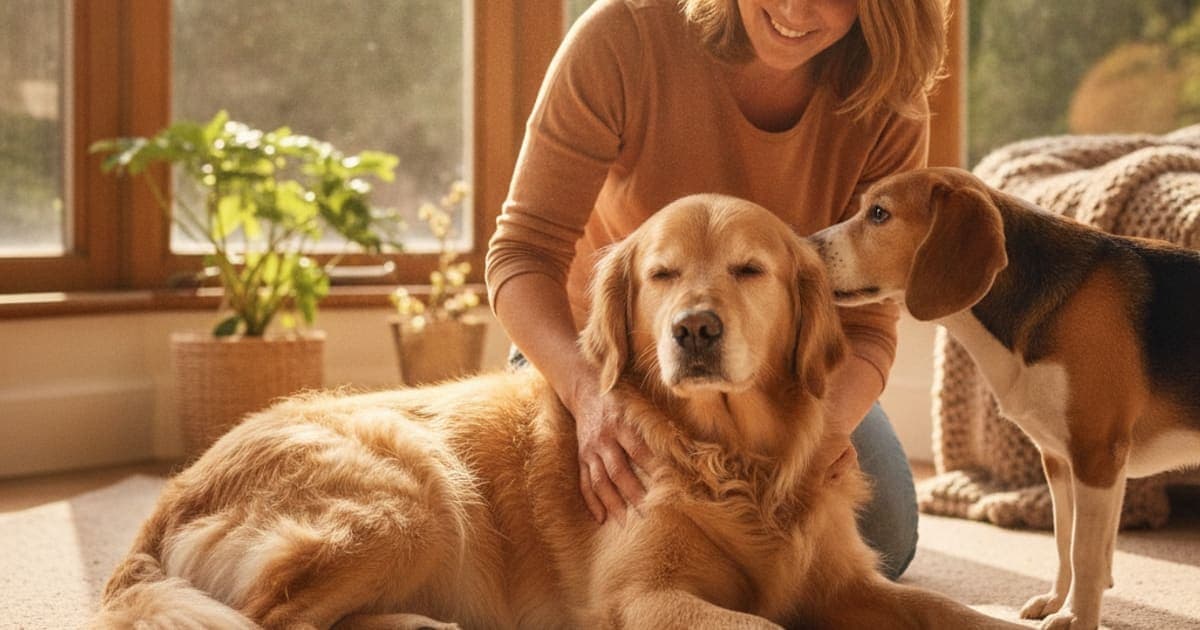
What Can I Give a Dog That Is Losing Muscle in the Back Legs?
Give a dog with hind-leg muscle loss three things, in this order: a veterinary diagnosis explaining why the limb stopped working, complete dietary protein with enough calories to rebuild tissue, and a structured loading program that makes the muscle work again. Alongside those, many owners add omega-3 fatty acids and a recovery peptide formulation such as K9-REPAIR (BPC-157 + TB-500).
That order matters more than any single product on the list. Muscle loss in the back legs is a symptom, not a diagnosis — and the fastest way to rebuild it is to identify and address the reason your dog stopped loading that leg. Everything you give afterwards is working on top of that answer, or working against it.
How hind-leg muscle actually disappears
Skeletal muscle is expensive tissue. A dog's body maintains it only in proportion to the mechanical demand placed on it, and it begins dismantling what is not being used within days — not weeks. When a dog shifts weight off a painful hind limb, muscle protein synthesis in that limb falls while protein breakdown continues at its normal rate. The net balance turns negative, and the largest, most powerful fibres — the ones that produce force for pushing off, jumping and climbing — thin out first.
That is disuse atrophy, and it is the most common form owners notice. It shows up as asymmetry: one thigh visibly narrower than the other, a hip bone more prominent on one side, a hind end that looks squared off where it used to be round. Run your hands down both thighs at the same time with your eyes closed and the difference is usually obvious before it is obvious in a photo.
The second form is neurogenic atrophy, which happens when the nerve supply to a muscle is compromised — by intervertebral disc disease, lumbosacral compression, or a degenerative spinal condition. Denervated muscle wastes faster and more completely than muscle that is simply idle, because the signal telling the fibre to exist at all has been interrupted. It often comes with knuckling, scuffed toenails on the tops of the nails, a wobbly or crossing gait, or delayed correction when a paw is placed upside down.
The third pattern is generalised, not limb-specific: age-related muscle loss, muscle wasting associated with chronic illness, or the muscle weakness that can accompany certain endocrine diseases. These tend to be symmetrical and progress slowly, and they change the plan entirely — which is why guessing is not a strategy here.
What your vet needs to rule out before you give anything
A good workup is fast and mostly hands-on. Your veterinarian will watch your dog walk and trot, palpate the spine, hips, stifles and hocks, test range of motion, check for cranial drawer or tibial thrust at the stifle, and run a neurological exam looking at proprioception, reflexes and pain response. Many practices measure thigh circumference with a tape at a marked landmark so that muscle mass can be tracked objectively over the following months instead of judged by memory.
From there, radiographs, bloodwork, or advanced imaging may follow depending on what the exam suggests. The common orthopedic culprits behind one-sided hind-leg wasting are cranial cruciate ligament rupture, hip dysplasia and osteoarthritis, medial patellar luxation, and iliopsoas or hamstring strain. In young, fast-growing large-breed dogs, shifting lameness from panosteitis can cause enough offloading to visibly thin a limb before the condition resolves on its own. The common neurological causes are disc disease, lumbosacral stenosis and degenerative myelopathy.
Talk to your veterinarian before you change anything about your dog's routine, and take a phone video of the gait on a flat, non-slip surface to bring with you — dogs are notorious for walking normally in the exam room. If your vet prescribes pain medication, an anti-inflammatory, or a monoclonal antibody for osteoarthritis pain, that prescription is doing something nothing on a supplement shelf can do: it lowers the pain signal enough for the dog to use the leg again. Nothing you give alongside it should ever be treated as a reason to stop it.
Feeding the rebuild: protein, calories and fats
Muscle cannot be rebuilt out of nothing. A dog recovering from injury or surgery, or an older dog losing mass, generally needs a complete, highly digestible protein source and enough total calories that dietary protein is used for tissue repair rather than burned for energy. Older dogs are frequently underfed protein on the assumption that ageing kidneys require restriction; unless your veterinarian has diagnosed a condition that calls for it, that assumption can work directly against the muscle you are trying to preserve. This is a conversation worth having explicitly at your next visit.
Omega-3 fatty acids, specifically EPA and DHA from marine sources, are among the better-supported additions. Research suggests they may support joint comfort and help modulate the inflammatory environment that recovering tissue sits in. They are not a muscle builder on their own, but they make the rest of the plan easier to execute.
Weight matters too, in both directions. Every extra kilogram is load that a compromised hind end has to carry, and a leaner dog offloads a sore limb less. Body condition scoring with your vet gives you a target you can actually work toward.
Loading the limb: rehab is the part that does the rebuilding
Muscle responds to mechanical signal. Tension and load on a fibre trigger the signalling cascade that tells the cell to build more contractile protein — a process called mechanotransduction. No food, supplement or peptide substitutes for that signal. If the leg is not being used, it will not grow, no matter what is in the bowl.
That is why a structured rehabilitation plan is the core of any real answer to this question. In practice it looks like controlled, measured leash walking rather than free running; sit-to-stand repetitions; slow, deliberate hill work; cavaletti poles to force hind-limb awareness and step height; balance work on unstable surfaces; and underwater treadmill or swimming, where buoyancy lets a dog load the limb without carrying full body weight. A certified canine rehabilitation practitioner can build and progress that program, and progression is the whole point — the same three exercises repeated forever stop producing adaptation.
The household environment counts as rehab too. Runners over slick floors, a ramp instead of a jump into the car, and short, frequent movement sessions instead of one long weekend outing all reduce the moments where a dog protects the limb and loses ground.
Comparing what owners give, and what each part is actually for
| What owners give | What it contributes | What it cannot do |
|---|---|---|
| Prescribed pain medication or arthritis therapy | Lowers the pain signal so the dog will bear weight on the limb again | Build muscle by itself; it must be paired with loading |
| Complete protein and adequate calories | Supplies the raw material for rebuilding contractile tissue | Trigger growth without mechanical demand on the limb |
| Omega-3 fatty acids (EPA and DHA) | May support joint comfort and help modulate inflammation | Restore lost mass or replace rehabilitation |
| Structured rehab and hydrotherapy | Delivers the load signal that drives muscle adaptation | Fix an undiagnosed neurological or orthopedic cause |
| Glucosamine and chondroitin chews | Long-standing joint-support category with mixed evidence | Address soft-tissue recovery or hind-limb wasting directly |
| K9-REPAIR (BPC-157 + TB-500) | Peptide formulation owners adopt through recovery and rehab, dosed by body weight | Replace a diagnosis, a prescription, or surgery |
Be skeptical of the kitchen-sink chew: a bag listing fourteen ingredients under a proprietary blend, with no per-serving amounts on the panel and no certificate of analysis behind it, is a marketing document, not a formulation. Ask what is in it, how much of it, and who verified that.
Where peptides fit into a hind-limb recovery plan
BPC-157 is a synthetic peptide sequence derived from a protein identified in gastric juice. TB-500 is a synthetic peptide related to thymosin beta-4, a naturally occurring protein involved in actin regulation and cell migration. Published preclinical research, largely in rodent models, has explored both in the context of tendon, ligament, muscle and connective-tissue repair, and the mechanisms described there are consistent and biologically coherent: support for new blood-vessel formation, influence on fibroblast migration and organisation, and effects on growth-factor receptor expression in healing tissue. Blood supply and orderly cell migration are exactly what soft tissue depends on during the weeks it remodels.
This is emerging and promising science, and it is science a growing number of owners are choosing to act on. BPC-157 and TB-500 are not FDA-approved veterinary drugs, and no honest brand will tell you what will happen in your individual dog. What can be said plainly is descriptive: K9-REPAIR from pawgen combines both peptides in a single formulation dosed by body weight, is third-party tested with certificates of analysis available, ships directly to your door, and is backed by a 60-day money-back guarantee. It is the stack many owners run alongside rehab through a long recovery, and your veterinarian should know it is part of the plan.
Key Takeaways
- Hind-leg muscle loss is a symptom of an underlying orthopedic, neurological, endocrine or age-related cause — the diagnosis determines everything else.
- Disuse atrophy begins within days of a dog offloading a painful limb; asymmetry between thighs is the earliest reliable sign.
- Complete protein and adequate calories supply the raw material; restricting protein in an older dog without a medical reason works against you.
- Mechanical loading through structured rehab is what actually rebuilds muscle. Nothing substitutes for it.
- Prescribed medication, surgery and rehabilitation come first; supplements and peptides work in the space that proper veterinary care creates.
- Owners adding peptides through recovery choose formulations that are transparent about contents, weight-based dosing and third-party testing.
Your veterinarian owns the diagnosis and the treatment plan — the imaging, the surgical decision, the prescription, the rehab referral. That is not a formality; it is the part that determines whether the leg gets used again at all. Everything else, including nutrition, conditioning and peptide support, is built on top of that foundation and works best when your vet knows exactly what your dog is receiving.
Related reading: what helps a dog with panosteitis and how long does panosteitis take to heal in dogs. The peptide formulation described above is K9-REPAIR from pawgen.
Owners exploring peptide support for their dog can review K9-REPAIR — BPC-157 + TB-500 formulated for dogs — at https://pawgen.com/. BPC-157 and TB-500 are not FDA-approved veterinary drugs. Nothing in this article treats, cures or prevents any condition; every decision about your dog's care belongs with your veterinarian.
Frequently asked questions
- When should I take a dog to the vet for sore after agility?
- Book a visit if soreness lasts beyond a day or two, returns after every session, or comes with limping, swelling, heat in a joint, or reluctance to jump. Sudden non-weight-bearing lameness, a yelp during a run, or an obvious change in gait warrants same-day veterinary attention rather than rest and observation.
- What can I give a dog that is sore after agility?
- Give rest, controlled leash walking, and whatever your veterinarian recommends for comfort — never human pain relievers, which are dangerous to dogs. Many handlers also use omega-3 fatty acids and a recovery peptide formulation such as K9-REPAIR alongside a proper cool-down and conditioning routine. Discuss anything you add with your vet.
- Is a dog sore after agility an emergency?
- Mild, symmetrical stiffness that eases with gentle movement is usually not an emergency. It becomes urgent if your dog cannot bear weight, cries when touched, has a hot or visibly swollen joint, shows a sudden hind-limb collapse, or seems disoriented or overheated after running. Those signs need immediate veterinary evaluation.
- Why is my dog sore after hiking?
- Soreness after hiking usually reflects unaccustomed load — uneven terrain, elevation change, and duration beyond what your dog is conditioned for. Muscles worked eccentrically on descents are especially prone to next-day stiffness. Paw pad abrasion, a minor soft-tissue strain, or underlying arthritis aggravated by the outing can also be responsible.
- Should I worry if my dog is sore after hiking?
- Mild stiffness that resolves within a day or so after a long or unusually demanding hike is generally not concerning. Worry if the soreness persists, worsens, appears after ordinary short walks, is limited to one limb, or is paired with limping or muscle loss. Persistent one-sided soreness deserves a veterinary exam.
- When should I take a dog to the vet for sore after hiking?
- Go if soreness lasts more than about two days, recurs after every hike, or involves one specific limb. Also go promptly for limping, swelling, torn or bleeding paw pads, a hunched back, difficulty rising, or dragging of the hind feet. Progressive weakness after exercise always merits veterinary assessment.
- How long does it take a dog to rebuild lost hind-leg muscle?
- Rebuilding takes considerably longer than losing it, and the timeline depends entirely on the cause, the dog's age, and how consistently the limb is loaded. Muscle is lost within days of offloading but regained over weeks to months of progressive rehabilitation. Your veterinarian or rehab practitioner can track progress with thigh measurements.
- Can supplements alone reverse muscle loss in a dog's back legs?
- No. Muscle grows in response to mechanical load, so nutrition, omega-3s and peptide formulations support the process rather than drive it. Without a diagnosis addressing why the limb is being offloaded, and without structured rehabilitation, supplements cannot restore mass. Use them as part of a plan your veterinarian has reviewed.
Educational content. BPC-157 and TB-500 are not FDA-approved veterinary drugs. Talk to your veterinarian before starting anything new, especially if your dog is on prescribed medication.