What Do Dog Hot Spots Look Like? (Acute Moist Dermatitis)
Dog hot spots look like sudden, round patches of raw, red, moist skin — hairless in the centre, oozing fluid that crusts amber, ringed by matted saliva-stained hair and sharply bordered. They feel hot, hurt to touch, and can double in size within a day. Veterinarians call this acute moist dermatitis.
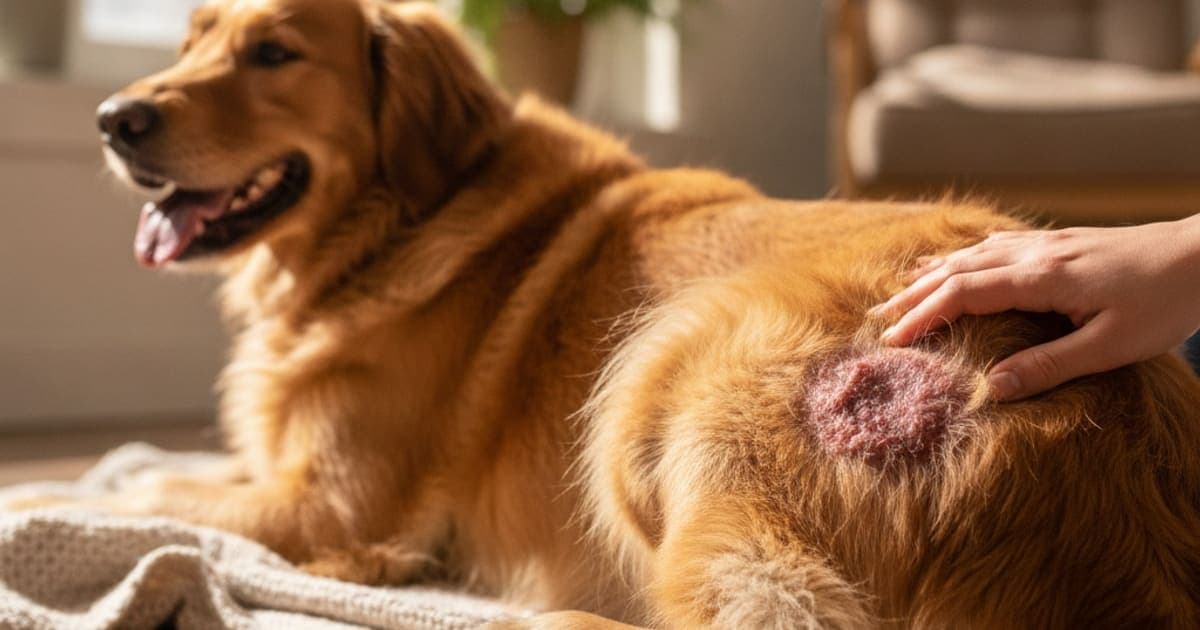
A hot spot looks like a sudden patch of raw, red, wet-looking skin — usually round or oval, hairless in the middle, weeping clear or yellowish fluid that dries into a sticky amber crust, with a sharply defined edge where damaged skin meets normal coat. The surface glistens. The hair around it is often matted flat and stained rust-brown by saliva. The skin feels warm, the dog guards it, and the whole thing can go from invisible to the size of a coin — or a spread hand — inside a day. Veterinary dermatology calls this acute moist dermatitis, also known as pyotraumatic dermatitis; the Merck Veterinary Manual uses the same terminology.
The visual signature of acute moist dermatitis
Hot spots share a recognisable set of features. Work through them in order and you will usually know what you are looking at.
- Colour — bright pink through deep, angry red, often darkest in the centre where the skin has been chewed hardest.
- Moisture — the surface glistens and weeps. This is the moist in acute moist dermatitis, and it is the most distinguishing feature of all.
- Hair loss — fur is missing or broken off in the middle and matted flat around the rim, frequently glued down by dried discharge.
- Saliva staining — on cream, white or pale golden coats, the hair surrounding the lesion turns rust or tea-coloured.
- Crust — discharge dries into a tacky, honey-to-amber crust that pulls at whatever hair is left.
- A sharp border — you can trace the line where damaged skin stops. Allergic rashes fade out gradually; hot spots have an edge.
- Heat and pain — the area feels warm and the dog flinches, pulls away, or warns you off. A dog who has never growled at you may growl now.
- Odour — a sour, faintly sweet smell from bacterial overgrowth on constantly wet skin.
- Satellite lesions — smaller inflamed spots just outside the main patch, more common in thick-coated breeds.
Size ranges from a coin to a palm, and the lesion can visibly enlarge between morning and evening. In a dense double coat you will often feel a hot spot before you see it: a damp, matted, slightly spongy area that your dog does not want examined. Part the hair right down to skin level in good light rather than judging from the surface of the coat.
People search for dog hot spot pictures because the problem is so visual, and photos are genuinely useful for orientation. They are also easy to misread. A lesion on a black Labrador photographs nothing like the same lesion on a white Samoyed, and a two-day-old hot spot that has begun to dry and scab looks different from a fresh one. Use photos to learn the pattern — sudden, wet, raw, sharply bordered, painful — rather than to match your dog's skin pixel for pixel.
Where they turn up: ears, paws, hips and the base of the tail
Location is a clue, because dogs chew where something already bothers them.
Head, cheeks and around the ear are the classic sites. A dog with an ear infection, ear mites or allergic ear inflammation scratches the side of the head with a hind foot and shakes repeatedly, and the skin gives way. Hot spots on a dog's ears usually sit on the skin just below the ear canal, at the base of the ear flap, or along the flap margin itself, where scratching nails land. Persistent head shaking can also produce a swollen, fluid-filled ear flap — an aural haematoma — which is a separate problem that needs veterinary attention of its own.
Hips, rump and the base of the tail are the second hotspot zone, and flea allergy dermatitis is the usual driver: a single flea bite can set off days of chewing in a sensitised dog. Anal sac discomfort refers itch to the same region, and older dogs with sore hips or knees often target the area over the painful joint.
Paws and the spaces between the toes are the third. Hot spots on a dog's paws show up as red, soggy skin between the toes or across the top of the foot, with saliva-stained hair, sometimes swelling, and sometimes a limp. Feet are a moisture trap, and they are also where allergic itch concentrates. Repeated licking of one specific foot deserves investigation — a grass seed, a split nail, an allergy, or a painful joint, tendon or ligament underneath.
Less commonly, hot spots appear on the flank, along the side of the chest, or on the neck under a collar that stays damp.
What starts the itch-lick-damage cycle
A hot spot is the end of a chain, not the beginning. Something makes the skin itch or ache; the dog licks, scratches and chews; the skin barrier breaks; normal surface bacteria multiply in the warm moisture; the inflammation makes it itch more. Within hours the cycle is self-sustaining.
The usual starting points include:
- Fleas and flea allergy dermatitis
- Environmental allergies (atopic dermatitis) and food-responsive skin disease
- Ear infections and ear mites
- Anal sac impaction
- Trapped moisture from swimming, bathing or rain in a coat that never fully dries
- Matting, or clipper and grooming irritation
- Insect stings and contact irritants
- Orthopaedic or soft-tissue pain sitting beneath the skin
- Stress, boredom and compulsive licking
- Underlying hormonal disease affecting skin health
Warm, humid weather and thick double coats both raise the odds, which is why these lesions cluster in summer and in breeds like Golden Retrievers, German Shepherds, Saint Bernards and Newfoundlands.
The Merck Veterinary Manual frames acute moist dermatitis as self-trauma driven by an underlying itchy or painful stimulus — which is exactly why addressing only the lesion so often leads to another one a few weeks later. A hot spot is a symptom, not a diagnosis: the raw patch is damage the dog did, and something underneath it started the itch. That is also why a good veterinary exam covers fleas, ears, diet and lameness, not just the skin you can see.
Skin problems that get mistaken for hot spots
Several conditions produce red, hairless areas that owners reasonably mistake for acute moist dermatitis. The differences are usually in speed of onset, moisture and how sharply the lesion is bordered.
| Condition | What it looks like | How it differs |
|---|---|---|
| Ringworm (dermatophytosis) | Circular, scaly, grey-flaky hairless patch | Typically dry rather than weeping, and often only mildly itchy |
| Yeast dermatitis (Malassezia) | Greasy, rust-brown, thickened skin with a musty smell | Builds over weeks; skin turns leathery instead of raw |
| Atopic dermatitis | Diffuse redness on belly, armpits, groin and feet | Spread out with no sharp border; itch is widespread, not focal |
| Bacterial pyoderma | Pustules, crusted rings and scaling across an area | Multiple lesions at different stages, not one sudden wet patch |
| Sarcoptic or demodectic mange | Patchy hair loss, crusted ear margins and elbows | Generalised intense itch; confirmed by skin scraping |
| Lick granuloma (acral lick dermatitis) | Firm, raised, thickened ulcer on a lower leg | Develops over weeks and feels hard, not soft and weeping |
| Skin mass or mast cell tumour | Raised lump that may swell, redden and ulcerate | Persists or recurs in one spot; biopsy territory |
Your veterinarian separates these with tools you do not have at home: cytology from a tape or slide impression under the microscope, skin scrapings, fungal culture, a Wood's lamp, and sometimes biopsy. Talk to your veterinarian before treating something you have identified from a photograph — ringworm is contagious to people, sarcoptic mange is contagious to other dogs, and a lump that keeps returning needs an entirely different plan.
When the licking is really about pain underneath
Dogs groom what hurts. An arthritic hip, a strained shoulder, a recovering cruciate ligament, a sore carpus or the skin over a surgical site all attract obsessive attention, and sustained licking keeps that skin wet, softened and vulnerable. The result can be a textbook hot spot sitting directly over a joint — a skin lesion that is really a mobility problem wearing a disguise.
So if the patch sits over a hip, stifle, elbow or wrist, or your dog is also slow on stairs, stiff after rest, shifting weight or shortening walks, say so at the appointment and ask for an orthopaedic assessment alongside the skin exam. Clipping and cleaning the lesion without addressing what the dog is licking about tends to buy only a short reprieve.
This is the space pawgen works in. K9-REPAIR is pawgen's BPC-157 and TB-500 peptide formulation for dogs, built around joint, tendon and soft-tissue recovery rather than skin. BPC-157 is a peptide studied for its role in tissue-repair signalling and the formation of new blood vessels at sites of injury; TB-500 is related to thymosin beta-4, a naturally occurring protein studied for cell migration and tissue remodelling. Research suggests these mechanisms may support the body's own repair processes, and owners increasingly choose the pairing as the stack they run through a recovery period alongside the plan their vet has set. BPC-157 and TB-500 are not FDA-approved veterinary drugs, and nothing here is a claim about hot spots, skin disease or any other condition — the point is narrower: when self-trauma is pain-driven, comfort and mobility belong in the conversation. pawgen publishes third-party certificates of analysis for its batches, dose is worked out by body weight with your veterinarian, orders ship direct to the door, and purchases are backed by a 60-day money-back guarantee.
Key Takeaways
- Hot spots look like sudden, round, raw, moist, hairless patches with a sharp border, amber crusting and saliva-stained hair around the rim.
- The clinical name is acute moist dermatitis, or pyotraumatic dermatitis.
- Speed of onset is the giveaway — hours, not weeks — along with heat, pain and the dog's refusal to leave the area alone.
- Common sites are the cheeks and ear base, the hips and tail base, and the paws and spaces between the toes.
- Ringworm, yeast dermatitis, pyoderma, mange, lick granulomas and skin masses can all mimic the look; only testing tells them apart.
- Every hot spot has an upstream cause: fleas, allergies, ear disease, trapped moisture, anal sac trouble, or pain in the tissue underneath.
- A lesion over a joint is a reason to ask about orthopaedic pain, not just skin.
Your veterinarian owns the diagnosis and the treatment plan here, and that order matters. Clipping and cleaning the area, pain relief, topical or systemic medication where indicated, flea control, ear treatment and allergy management are veterinary decisions, and nothing — including a peptide formulation — substitutes for them or for a prescription your dog is already on. Supplements and peptides operate in the space that proper veterinary care creates: once the diagnosis is clear and the plan is running, supporting recovery and comfort is the part owners can take on at home.
If you want to read further into how pawgen approaches formulation and verification, batch results are published on the certificates of analysis page, the full K9-REPAIR line is listed in the shop, shipping coverage is set out on the location page, and the brand overview lives at pawgen.
Owners exploring peptide support for their dog can review K9-REPAIR — BPC-157 + TB-500 formulated for dogs — at https://pawgen.com/. BPC-157 and TB-500 are not FDA-approved veterinary drugs. Nothing in this article treats, cures or prevents any condition; every decision about your dog's care belongs with your veterinarian.
Frequently asked questions
- What do dog hot spots look like?
- Dog hot spots look like round, raw, red patches of moist skin, usually hairless in the centre with matted, saliva-stained hair around the edges. They weep fluid that dries into an amber crust, feel hot and painful to touch, and have a clearly defined border. They can expand dramatically within a single day.
- What do hot spots look like on dogs?
- They look like an angry, glistening sore sitting inside the coat. On short-haired dogs the bright pink or deep red skin is visible immediately; on double-coated dogs you often feel a damp, matted, spongy area first and only see the lesion once you part the hair down to skin level.
- What do hotspots look like on a dog?
- A hotspot appears as a well-demarcated patch of inflamed, oozing skin, sometimes with smaller satellite spots scattered around it. Hair is missing or chewed off, the surface can smell sour, and the dog licks or scratches that exact area. Common locations are cheeks, ear base, hips, tail base and paws.
- What are dog hot spots pictures showing?
- Searches for dog hot spot pictures return photos of red, moist, hairless lesions, most often on the face, ears, hips or paws. Photos are useful for recognising the pattern, but coat colour, lighting and the stage of the lesion change its appearance considerably, so a photo match is never a diagnosis.
- What does dog hot spots look like on short-haired breeds?
- On short-haired breeds the lesion is obvious: a localised area of skin licked or chewed raw, bright red, wet, hairless, hot and painful, often ringed by crusting and a few remaining matted hairs. The sharp edge separates it from the diffuse, fading redness typical of allergic skin inflammation.
- Does my dog have hot spots?
- Possibly, if you find a suddenly appearing moist, red, hairless patch your dog will not stop licking, chewing or scratching. Rapid onset, pain on touch and a sharp border are the strongest clues. Ringworm, yeast, mange and skin masses mimic it, so have your veterinarian examine the skin.
- What do hot spots on dogs' ears look like?
- Ear hot spots usually sit on the skin just below the ear canal, at the base of the flap, or along the flap margin where scratching nails land. The skin is red, wet and crusted, and hair is often missing. Underlying ear infection or ear mites are frequent triggers.
- What do hot spots on dogs' paws look like?
- Paw hot spots show up as red, soggy, inflamed skin between the toes or across the top of the foot, with rust-coloured saliva staining on the hair, sometimes swelling and sometimes a limp. Persistent licking of one foot warrants a check for allergies, foreign bodies or pain in the limb.
- What causes dog hot spots?
- Hot spots start when something makes skin itch or ache and the dog licks it raw. Common triggers include fleas and flea allergy, environmental or food allergies, ear infections, anal sac impaction, trapped moisture in a dense coat, matting, insect stings, stress licking, and pain in joints or soft tissue underneath.
Educational content, not veterinary advice. Ask your vet about your dog.