What Are the First Signs of Hot Spots in Dogs? (Early Clues)
The first signs of hot spots in dogs are sudden, focused licking or chewing at one spot, a small patch of damp, matted fur, and skin underneath that looks pink or red and feels warm. Odour, hair loss and flinching when touched usually follow within hours, often faster than owners expect.
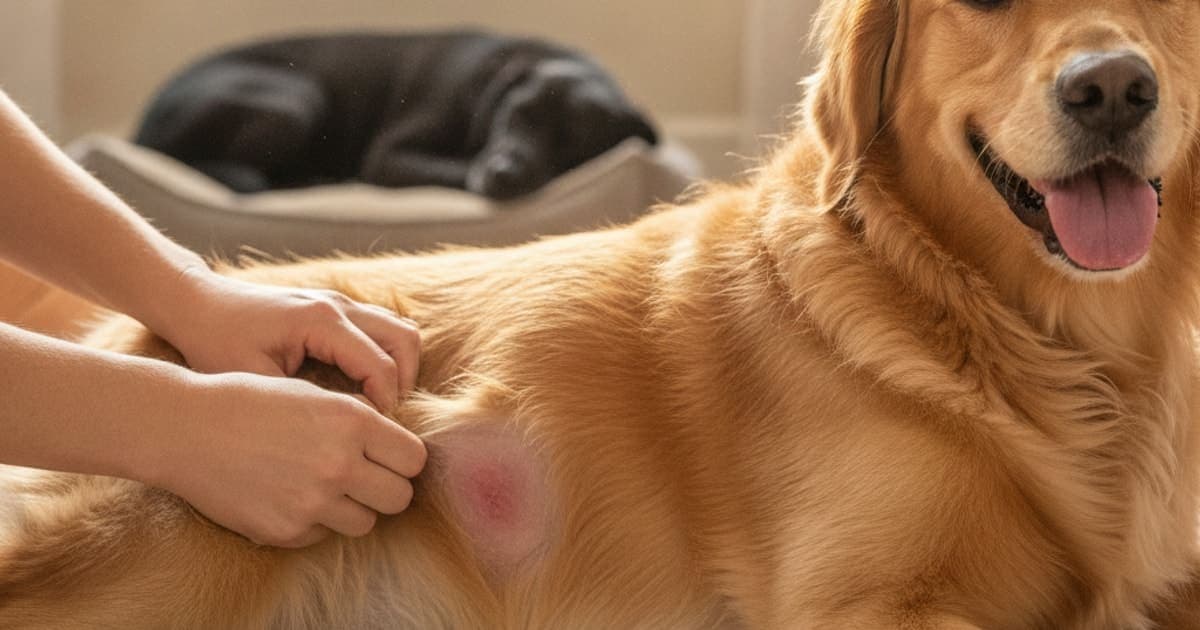
What Are the First Signs of Hot Spots in Dogs?
The first signs of hot spots in dogs are sudden, obsessive licking or chewing at one location, a small patch of damp or matted fur, and skin underneath that looks pink to red and feels warm. Oozing, odour, hair loss and flinching on touch follow quickly. Veterinary references call this acute moist dermatitis, or pyotraumatic dermatitis (Merck Veterinary Manual).
The behaviour changes before the skin does
Almost every hot spot announces itself as a behaviour problem first. The dog who normally sleeps through the night gets up to lick. Grooming that used to last a few seconds turns into a session your dog does not break off when you say their name. Some dogs chew at a flank or hip; others scratch at the side of the face and shake the head; a few just seem restless and reposition constantly.
By the time you go looking, the coat is usually hiding the lesion. Part the fur against the direction it grows and check the skin directly rather than trusting a glance from above. In double-coated and long-coated dogs, a patch the size of a coin can sit under an intact top coat and go unnoticed until it has spread.
What you find at the earliest stage is subtle: hairs stuck together in a small clump, a faint dampness at the base of the coat, and skin that is pink rather than its usual pale colour. Press gently near — not on — the area and you will often feel warmth compared with the skin an inch away. Very early lesions may not be raw yet, only shiny and slightly swollen.
What comes next is what makes these lesions memorable. The surface begins to weep a clear-to-yellow fluid that mats the surrounding hair and dries into a crust. Hair pulls away easily or is already gone in the centre, leaving a moist, sharply bordered patch. There is often a distinctive smell. Most owners describe the change as happening between one walk and the next, not over a week.
A hot spot is a wound the dog is creating, not a wound the dog is recovering from — which is why interrupting the lick-and-chew cycle in the first hours matters more than anything you put on the surface.
Where they show up, and what usually sets them off
Location is a clue to the trigger, and the trigger is the part that determines whether the problem comes back.
Lesions on the cheek, under the ear, or on the side of the neck frequently point toward ear disease — the dog is scratching at an itchy or painful ear and damaging the skin nearby. Lesions over the rump and tail base classically accompany flea allergy, where a small number of bites drives an outsized itch response. Flank, hip and thigh lesions often follow a dog who has been chewing at one region for reasons that are not obvious from the skin at all.
Moisture and heat set the stage. Dogs who swim, get bathed and dry slowly, wear a damp harness or collar, or carry mats behind the ears and in the armpits give surface bacteria the warm, humid, occluded environment they do best in. Thick coats and warm weather compound it.
Allergic skin disease is the largest underlying category. Atopic dermatitis and adverse food reactions both produce a background itch that a dog eventually concentrates on one spot. Anal gland irritation, contact irritants and healing wounds do the same thing on a smaller scale.
One cause that gets missed sits under the skin rather than on it: dogs lick over joints that ache. Persistent attention to a carpus, an elbow, a stifle or a hip — particularly in an older dog, or a dog who came home stiff from a long day outdoors — can be a comfort behaviour aimed at a sore structure, and the skin damage is downstream of the discomfort. Treating only the surface in that dog leaves the reason for the licking untouched.
What is actually happening under the fur
Healthy canine skin carries a resident bacterial population, including Staphylococcus pseudintermedius, without any trouble at all. The barrier that keeps it in check is thin — a layer of tightly packed cells sealed with lipid.
Self-trauma breaks that seal. Teeth and claws strip the surface layer, capillaries dilate, and plasma leaks out onto the skin. That protein-rich fluid, sitting under wet hair at body temperature, is an ideal culture medium, and the resident staph population expands into it. The inflammatory mediators released in response — histamine and a cascade of cytokines — sensitise the nerve endings in the area, so the threshold for both itch and pain drops.
Now the loop closes. Itch drives licking, licking causes damage, damage produces inflammation, inflammation lowers the itch threshold further. This is why the lesion can double in size in a single afternoon while a wound of the same size from a fence scrape would simply be scabbing over.
Most hot spots stay superficial, involving only the outer skin layers, and the skin surface can re-epithelialise from the intact margins once the cycle stops. Some — particularly deep ones in heavy-coated breeds, and those where hair follicles become involved — extend into the follicle and dermis. Those look similar on day one but behave differently, which is a large part of why the lesion needs eyes on it rather than guesswork.
Telling an early hot spot from the things it resembles
| What you're looking at | First visible sign | How fast it changes | Typical location |
|---|---|---|---|
| Early hot spot (acute moist dermatitis) | Damp, matted fur over pink, warm, sharply bordered skin | Hours — often visibly larger the same day | Cheek, neck, rump, flank, over a sore joint |
| Flea allergy dermatitis | Scattered crusts and thinning hair, widespread itch | Days to weeks, waxes and wanes | Tail base, back half of the body |
| Acral lick granuloma | Firm, thickened, hairless plaque from chronic licking | Weeks to months | Front of the wrist or lower leg |
| Abscess or bite wound | Firm painful swelling, sometimes a puncture, often fever | Days | Anywhere; common on face, limbs, tail base |
| Skin-fold dermatitis | Redness and odour inside a fold, little hair loss | Gradual, recurring | Lip, facial, vulvar or tail folds |
The pattern that separates a hot spot from most of the list is speed combined with a sharp border. Chronic conditions blur outward; a hot spot has a defined edge and a wet, glistening centre that was not there yesterday.
The veterinary visit, and why it comes first
Talk to your veterinarian as soon as you find one of these. The lesion is painful and it expands, and the two things that stop it — proper clipping and cleaning of the area, plus prescription anti-inflammatory and antimicrobial care chosen for the depth involved — are not things you can improvise at home.
A typical appointment involves clipping the hair well beyond the visible margin so the surface can dry and the true extent becomes obvious, gentle cleaning, and often skin cytology to see whether bacteria and inflammatory cells are present and what kind. Your vet will usually check the ears, look for flea evidence, palpate joints if the lesion sits over one, and ask about diet and seasonality — because a hot spot is a symptom, and the underlying driver decides whether you are back in a month.
Most dogs go home with a topical, sometimes an oral medication, something to reduce the itch, and an e-collar. The e-collar is not optional theatre; it is the single mechanical thing that breaks the loop described above. If medication has been prescribed, finish the course as directed and do not discontinue anything without speaking to the practice first.
Supporting a dog through recovery — and what to be sceptical of
Around veterinary care, sensible support matters: keep the area dry and open to air, keep flea prevention current year-round, brush out mats before they trap moisture, dry the coat properly after swimming, and resist the urge to apply human ointments, which frequently taste interesting enough to invite more licking.
Where scepticism belongs is the supplement aisle. Kitchen-sink chews with a dozen ingredients hidden inside a proprietary blend, dusted at levels that exist to justify a label rather than to do anything physiological, are the norm rather than the exception. A blend that does not disclose per-ingredient amounts is telling you something.
For the dogs whose licking traces back to an aching joint or a body that recovers slowly from hard use, pawgen makes K9-REPAIR, a canine formulation of BPC-157 and TB-500 built around joint, tendon and mobility recovery. BPC-157 is a peptide sequence derived from a protein identified in gastric juice; published research suggests it interacts with pathways involved in angiogenesis, fibroblast migration and connective-tissue repair signalling. TB-500 relates to thymosin beta-4, a naturally occurring protein involved in actin regulation and cell migration during tissue remodelling. This is emerging and promising science, and it is the stack a growing number of owners choose to run alongside veterinary care through a recovery period. It is dosed by body weight, third-party tested with certificates of analysis available, shipped direct to your door, and backed by a 60-day money-back guarantee.
BPC-157 and TB-500 are not FDA-approved veterinary drugs, this information is educational, and nothing here describes a treatment for a skin lesion. What owners report is a support role during recovery. Bring it up with your veterinarian so it fits the plan they have built for your dog.
Key Takeaways
- The earliest sign is behavioural: sudden, focused licking or chewing at one place that does not stop on cue.
- The earliest visible sign is damp, matted fur over pink, warm, sharply bordered skin — you have to part the coat to see it.
- Progression is measured in hours, not days; oozing, crusting, odour and hair loss follow fast.
- Location hints at the trigger: ears, fleas, allergies, trapped moisture, or a sore joint underneath.
- Clipping, cleaning, prescription care and an e-collar are what break the itch-damage cycle.
- Finding and addressing the underlying cause is what stops the next one.
The vet owns the diagnosis
Your veterinarian decides what this lesion is, how deep it goes, what medication it needs and what is driving it. That is the part of the process nothing else substitutes for. Supplements and peptides operate in the space that proper veterinary care creates — supporting a dog through a recovery period that a diagnosis and a treatment plan have already made possible.
Related reading: our complete guide to hot spots, a plain-English look at hot spots in dogs, what the research says about tb-500 for hot spots in dogs and the wolverine stack for hot spots in dogs, plus what can i give a dog that is sore after hiking and is a dog sore after hiking an emergency.
Owners exploring peptide support for their dog can review K9-REPAIR — BPC-157 + TB-500 formulated for dogs — at https://pawgen.com/. BPC-157 and TB-500 are not FDA-approved veterinary drugs. Nothing in this article treats, cures or prevents any condition; every decision about your dog's care belongs with your veterinarian.
Frequently asked questions
- How is hot spots diagnosed in dogs?
- A veterinarian diagnoses hot spots visually, based on the sharply bordered, moist, painful lesion and its rapid onset. The hair is clipped back to reveal the true extent, and skin cytology is often used to check for bacteria and inflammatory cells. The exam then looks for the trigger: ears, fleas, allergies or an underlying sore joint.
- What helps a dog with hot spots?
- Clipping and cleaning the area, prescription topical or oral medication chosen by your veterinarian, itch control, and an e-collar to stop the licking are what help most. Keeping the skin dry, maintaining flea prevention and brushing out mats support recovery. Addressing the underlying trigger is what prevents the next one.
- How long does hot spots take to heal in dogs?
- Recovery time varies with depth, location and how quickly the licking was interrupted, so ask your veterinarian what to expect for your dog's specific lesion. Superficial ones often improve noticeably once the area is clipped, dried and treated, while deeper lesions involving hair follicles take considerably longer and need closer monitoring.
- Is hot spots in dogs painful?
- Yes. Hot spots are genuinely painful as well as itchy, which is why many dogs flinch, turn or growl when the area is touched, even dogs who normally tolerate handling well. Inflammatory mediators in the damaged skin lower the threshold for both itch and pain, so discomfort escalates as the lesion spreads.
- What makes hot spots worse in dogs?
- Continued licking and chewing is the biggest driver, which is why an e-collar matters. Trapped moisture from swimming, incomplete drying after a bath, damp collars and matted fur all worsen them. Untreated fleas, ear infections, allergic skin disease and an unaddressed painful joint keep the underlying itch cycle running.
- Can hot spots in dogs be reversed?
- Hot spots generally resolve with appropriate veterinary care, and hair typically regrows over skin that was only superficially damaged. Whether they return depends entirely on the underlying cause — fleas, allergies, ear disease or joint discomfort. Your veterinarian identifying and managing that driver is what changes the long-term pattern.
- Can hot spots spread to other dogs or to people?
- Hot spots are not considered contagious in the way ringworm or mange are, because they arise from a dog's own self-trauma and its own resident skin bacteria. They can spread across the same dog's body if the licking continues. Ask your veterinarian if the lesion looks unusual or is not responding as expected.
- Should I use an e-collar for a hot spot?
- Most veterinarians will send one home, and it does the heavy lifting. Licking and chewing are what create and enlarge the lesion, so a physical barrier interrupts the cycle that medication alone cannot stop. Follow your veterinary team's guidance on how long to keep it on during recovery.
Educational content. BPC-157 and TB-500 are not FDA-approved veterinary drugs. Talk to your veterinarian before starting anything new, especially if your dog is on prescribed medication.