What Helps a Dog With Degenerative Myelopathy? (DM Care)
Daily controlled physiotherapy, secure home traction, a rear-support harness or cart, lean body weight and a veterinary neurology plan help a dog with degenerative myelopathy stay mobile and comfortable longer. The disease itself is progressive and painless, so care focuses on preserving movement and protecting the muscles doing extra work.
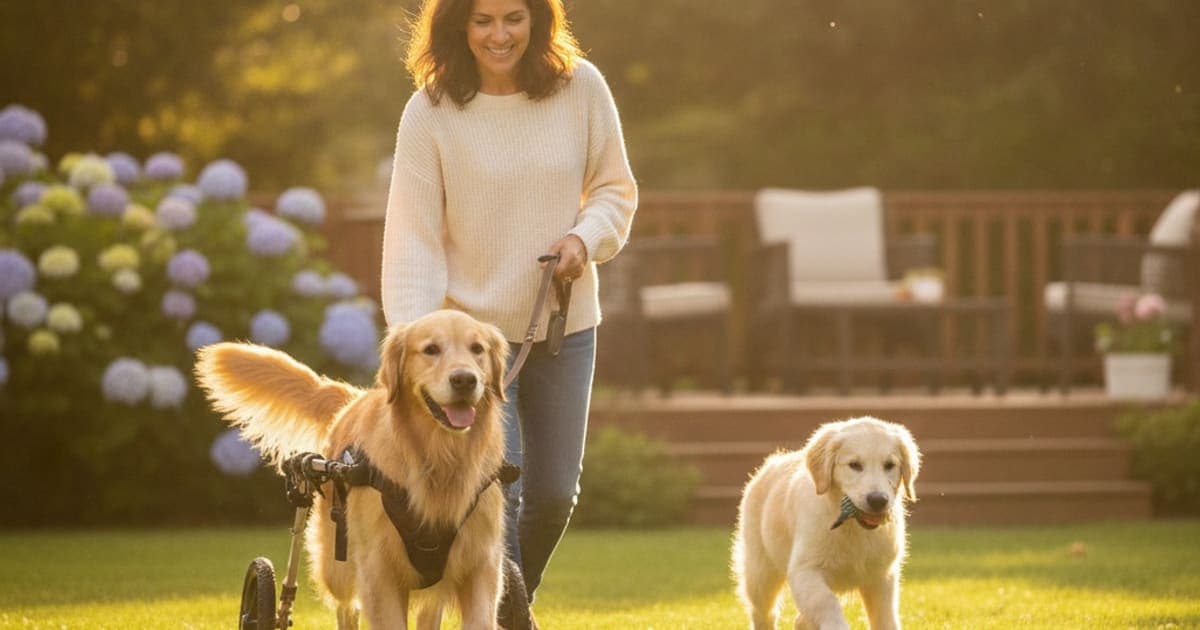
What helps a dog with degenerative myelopathy?
What helps most is daily structured movement, secure footing at home, mobility equipment fitted before your dog truly needs it, a lean body weight, and a veterinary neurology plan you revisit as things change. Degenerative myelopathy is progressive and painless, and nothing available today halts it — so care aims at keeping the legs working as long as possible.
That is not a consolation prize. Work by Kathmann and colleagues, published in the Journal of Veterinary Internal Medicine in 2006, reported that dogs with suspected degenerative myelopathy who received daily controlled physiotherapy remained ambulatory longer than dogs who received intermittent physiotherapy or none at all. Movement is the lever you actually control.
What the disease is doing inside the spinal cord
Degenerative myelopathy is a slow degeneration of the white matter in the thoracolumbar spinal cord — the insulated cabling that carries instructions from the brain down to the hind limbs and carries position information back up. As the myelin and axons degrade, the messages get noisy and then stop arriving.
That explains why the earliest signs look like clumsiness rather than weakness. A dog knows where its back feet are because of proprioception, and proprioception is one of the first things to go. Owners notice scuffed nails on the hind toes, a paw that turns under and drags, a hind end that sways or crosses when the dog turns, a sudden dislike of smooth floors. It often starts on one side before the other.
Over months the picture progresses from wobbliness to genuine hind-limb weakness, then to an inability to stand behind. In dogs who live long enough with attentive care, the forelimbs and continence can eventually be involved.
A mutation in the SOD1 gene was identified in association with canine degenerative myelopathy by researchers at the University of Missouri, published in the Proceedings of the National Academy of Sciences in 2009 — the same gene implicated in some inherited forms of human ALS. DNA testing through the Orthopedic Foundation for Animals identifies risk status. It does not, on its own, diagnose the disease in front of you.
German Shepherds, Boxers, Pembroke Welsh Corgis, Chesapeake Bay Retrievers, Bernese Mountain Dogs and Rhodesian Ridgebacks are among the breeds most often described. But breed plus wobbly back legs is not a diagnosis, and that distinction matters more than anything else on this page.
Rule out the things that are treatable and painful first
Intervertebral disc disease, lumbosacral stenosis, spinal tumours, hip dysplasia, bilateral cruciate disease and even advanced arthritis can all produce a dog who struggles to get up and drags a hind foot. Several of those are painful. Several respond to surgery, prescribed medication or targeted rehab.
Degenerative myelopathy is diagnosed by exclusion in the living dog. A veterinary neurologist localises the lesion on examination, then uses imaging — most often MRI, sometimes with cerebrospinal fluid analysis — to look for compression, inflammation or a mass. When the imaging is clean and the clinical picture fits, degenerative myelopathy becomes the working diagnosis. Definitive confirmation only comes from examining spinal cord tissue after death.
So the first thing that helps a dog with degenerative myelopathy is being certain that is what you are dealing with. Talk to your veterinarian about a neurology referral rather than accepting a hallway guess, because an untreated painful spine masquerading as degenerative myelopathy is a genuinely bad outcome.
The daily movement programme that keeps dogs walking longer
Rest is the intuitive response to a wobbly dog and it is the wrong one. Muscle disappears fast in a limb that is not being used, and a dog who loses hind-limb muscle mass loses the strength that was compensating for failing nerve signals.
A useful programme is built from short, frequent, controlled sessions rather than long walks:
- Controlled leash walking on non-slip ground. Grass, packed dirt, rubber matting. Little and often, stopping before fatigue rather than after it.
- Sling or harness-assisted walking once the hind end tires, so the dog keeps driving with its own legs while you supply balance rather than carrying the whole back half.
- Hydrotherapy or an underwater treadmill, which lets a weak dog produce a full stride with the water supporting body weight.
- Standing and balance work, including weight shifting and slow, controlled turns, which recruits the postural muscles that raw walking misses.
- Passive range of motion and stretching to keep joints and soft tissue from stiffening as the gait shortens.
- Paw placement and proprioception drills, such as cavaletti poles at a low height, done with supervision.
A certified canine rehabilitation practitioner is worth the appointment even if you deliver most of the work at home. They will show you what a fatigued dog looks like before it collapses, and they will progress or scale back the plan as the disease moves.
Consistency beats intensity here. Ten focused minutes most days does more than a heroic hour on Sunday.
Setting up the house so the legs keep working
Environment is half the outcome. A dog with failing proprioception can walk on grass and fall on tile.
Run non-slip rugs or rubber matting along every route the dog uses — bed to door, door to water. Keep hind-toe nails short, because long nails change the angle the foot loads at. Protect knuckling paws with boots or paw wraps; the top surface of the foot abrades quickly and those sores are painful even though the disease is not.
Swap stairs for ramps where you can, and block access to stairs the dog can no longer negotiate safely. Use a harness with a rear-lift handle so you can support a stumble without grabbing a fistful of skin, and get the dog used to it early.
Wheelchairs are the equipment owners delay longest and regret delaying most. A cart introduced while a dog still has partial hind-limb function lets it keep exercising, keep sniffing, keep being a dog — and dogs adapt to carts far faster when they still have some drive behind.
Keep the dog lean. Every extra kilogram is carried by a front end that is already doing more than its share. Watch bedding for pressure sores once lying time increases, and plan early for hygiene: bladder and bowel control can be affected late in the disease, and a routine set up in advance is far kinder than an emergency one.
Comparing the layers of support owners build
| Layer | What it is for | Where it fits |
|---|---|---|
| Veterinary neurology workup | Confirms the picture and rules out compressive, painful or treatable disease | First, before anything else is planned |
| Rehabilitation and daily physiotherapy | Preserves muscle, balance and stride; the intervention with the most published support | Ongoing, from diagnosis onward |
| Harness, sling, cart, ramps, traction | Keeps the dog safely upright and exercising as strength fades | Fitted early, upgraded as needed |
| Weight and conditioning management | Reduces the load the front limbs and remaining hind muscle must carry | Continuous |
| Prescribed medication for comorbidities | Manages arthritis pain, bladder issues or other diagnosed conditions | Vet-directed only |
| Peptide support such as K9-REPAIR | BPC-157 and TB-500, dosed by body weight, used by owners through mobility and recovery work | Alongside rehab, discussed with your vet |
Where peptides fit: supporting the body that is compensating
Nothing available today stops the degeneration happening in the spinal cord — which is precisely why keeping the rest of the body durable matters so much.
Think about what a dog with a failing hind end actually does to itself. The shoulders, neck and forelimb tendons take over propulsion. The carpi absorb loading they were never built for. The lumbar musculature works overtime to stabilise a pelvis that keeps drifting. Stumbles produce soft-tissue strains. That compensatory load is musculoskeletal, and it is the part of the picture that owners can work on directly.
That is the space peptides occupy. BPC-157 is a peptide sequence derived from a protein found in gastric juice; laboratory research, much of it from Sikiric and colleagues at the University of Zagreb, has examined its effects in tendon, ligament and muscle injury models, with attention to angiogenesis and fibroblast behaviour — the blood supply and cell migration that soft tissue repair depends on. TB-500 is a synthetic fragment related to thymosin beta-4, a naturally occurring peptide studied for its role in actin regulation, cell migration and wound repair.
This is emerging and promising science, and it is being adopted by owners who want their dog's connective tissue supported through the work of staying mobile. Research suggests these mechanisms matter for soft tissue; owners report using them through recovery and rehab periods. Neither BPC-157 nor TB-500 is an FDA-approved veterinary drug, and neither treats degenerative myelopathy — the disease is neurological, and no supplement should be framed otherwise.
What pawgen can say plainly is what is in the bottle. K9-REPAIR is a BPC-157 and TB-500 formulation for dogs, dosed by body weight, third-party tested with certificates of analysis available, shipped direct to the door, and backed by a 60-day money-back guarantee. That is a deliberate contrast with the kitchen-sink joint chew: fourteen ingredients on the label, none of them at a meaningful amount, a proprietary blend hiding the ratios, and marketing doing the work that evidence should. Read labels adversarially. Ask what is in it and how much.
Tracking progression with your veterinary team
Degenerative myelopathy is managed in stages, not in a single appointment. Film your dog walking away from the camera once a month on the same surface — it is the single best way to see change you have stopped noticing day to day. Note when the dog first needs help rising, when a paw first drags on every walk, when stairs become impossible.
Bring that record to each recheck. Your veterinarian can reassess for pain from concurrent arthritis or disc disease, adjust prescribed medication, time the transition to a cart, and advise on continence care. Discuss any supplement you are using, including peptides, so the whole plan is visible to the person responsible for it.
Quality of life is the metric that eventually governs the decisions. Appetite, engagement, hygiene, comfort and the dog's own willingness to move tell you more than any calendar. That conversation belongs with your veterinarian too, early enough to have it calmly.
Key Takeaways
- Degenerative myelopathy is a progressive, non-painful degeneration of spinal cord white matter; it cannot be reversed, and diagnosis is by exclusion after imaging rules out treatable causes.
- Daily controlled physiotherapy is the intervention with the most published support for keeping dogs ambulatory longer.
- Traction, paw protection, ramps, a rear-lift harness and an early-introduced cart preserve function and prevent injury.
- Keeping the dog lean reduces the load on a front end that is already compensating.
- Peptide support such as K9-REPAIR is used by owners for the soft tissue carrying that compensatory load — it is not a treatment for the neurological disease and is not FDA-approved.
- Film the gait monthly and review progression with your veterinary team at scheduled rechecks.
For deeper reading, see the complete guide to degenerative myelopathy, plus dog degenerative myelopathy holistic options, dog degenerative myelopathy without nsaids, dog degenerative myelopathy without steroids, is a dog loss of muscle in back legs an emergency, why is my dog swollen joint, and K9-REPAIR.
Your veterinarian owns the diagnosis and the treatment plan — the neurological workup, the imaging, the prescriptions, the rehab referral and the timing of every hard decision. Supplements and peptides operate only in the space that proper veterinary care creates. Build the medical plan first, then decide what supports it.
Owners exploring peptide support for their dog can review K9-REPAIR — BPC-157 + TB-500 formulated for dogs — at https://pawgen.com/. BPC-157 and TB-500 are not FDA-approved veterinary drugs. Nothing in this article treats, cures or prevents any condition; every decision about your dog's care belongs with your veterinarian.
Frequently asked questions
- Is degenerative myelopathy in dogs painful?
- No, degenerative myelopathy itself is not considered painful, because the degenerating white matter does not generate pain signals. However, affected dogs frequently have concurrent arthritis, hip dysplasia or disc disease that is painful, and knuckling paws develop sore abrasions. Ask your veterinarian to assess for painful conditions rather than assuming weakness means comfort.
- What makes degenerative myelopathy worse in dogs?
- The underlying degeneration drives progression, but functional decline accelerates with excess body weight, muscle loss from enforced rest, slippery flooring, unprotected knuckling paws, exhausting exercise, and untreated concurrent orthopedic pain. Consistent controlled daily movement, secure footing and a lean body condition preserve function longer than rest does.
- Can degenerative myelopathy in dogs be reversed?
- No. There is no known cure or reversal, and the disease is progressive. Care aims at preserving mobility, comfort and dignity for as long as possible. Research suggests daily controlled physiotherapy helps affected dogs remain ambulatory longer, and mobility equipment, weight control and supportive care extend functional quality of life.
- How much does it cost to treat degenerative myelopathy in dogs?
- Costs vary widely by clinic and region. Budget for the diagnostic workup first — neurology consultation, MRI and often a DNA test — then for recurring rehabilitation sessions, mobility equipment such as a harness and cart, paw protection and hygiene supplies. Imaging and ongoing rehab are usually the largest items. Request written estimates.
- What are the first signs of degenerative myelopathy in dogs?
- The earliest signs are subtle hind-end coordination problems rather than pain: worn or scuffed nails on the hind toes, a paw that knuckles under, swaying, hind legs crossing on turns, and reluctance on smooth floors. Signs often start on one side. Any older dog showing these needs a veterinary exam promptly.
- How is degenerative myelopathy diagnosed in dogs?
- It is diagnosed by exclusion. A veterinarian or neurologist localises the lesion on neurological examination, then uses imaging — usually MRI, sometimes with cerebrospinal fluid analysis — to rule out disc disease, tumours and other compressive causes. SOD1 DNA testing indicates genetic risk, not confirmation. Definitive diagnosis requires post-mortem spinal cord examination.
- Does K9-REPAIR help a dog with degenerative myelopathy?
- K9-REPAIR is a BPC-157 and TB-500 peptide formulation for dogs, dosed by body weight and third-party tested with certificates of analysis. It is not an FDA-approved veterinary drug and does not treat degenerative myelopathy. Owners use it alongside rehabilitation to support soft tissue carrying compensatory load. Discuss it with your veterinarian.
- Should a dog with degenerative myelopathy keep exercising?
- Yes, with structure. Muscle disappears quickly in limbs that stop working, and that muscle is what compensates for failing nerve signals. Short, frequent, controlled sessions on non-slip ground, hydrotherapy and balance work suit most dogs better than long walks. A certified canine rehabilitation practitioner can build and adjust the programme.
Educational content. BPC-157 and TB-500 are not FDA-approved veterinary drugs. Talk to your veterinarian before starting anything new, especially if your dog is on prescribed medication.