What Helps a Dog With IVDD? (Recovery Care Explained)
What helps a dog with IVDD is a sequence: fast veterinary examination and neurological grading, strict confinement, veterinarian-directed pain control, surgical decompression when the signs call for it, and a structured return to movement. Everything else — home setup, body condition, rehab and recovery support — sits on top of that foundation.
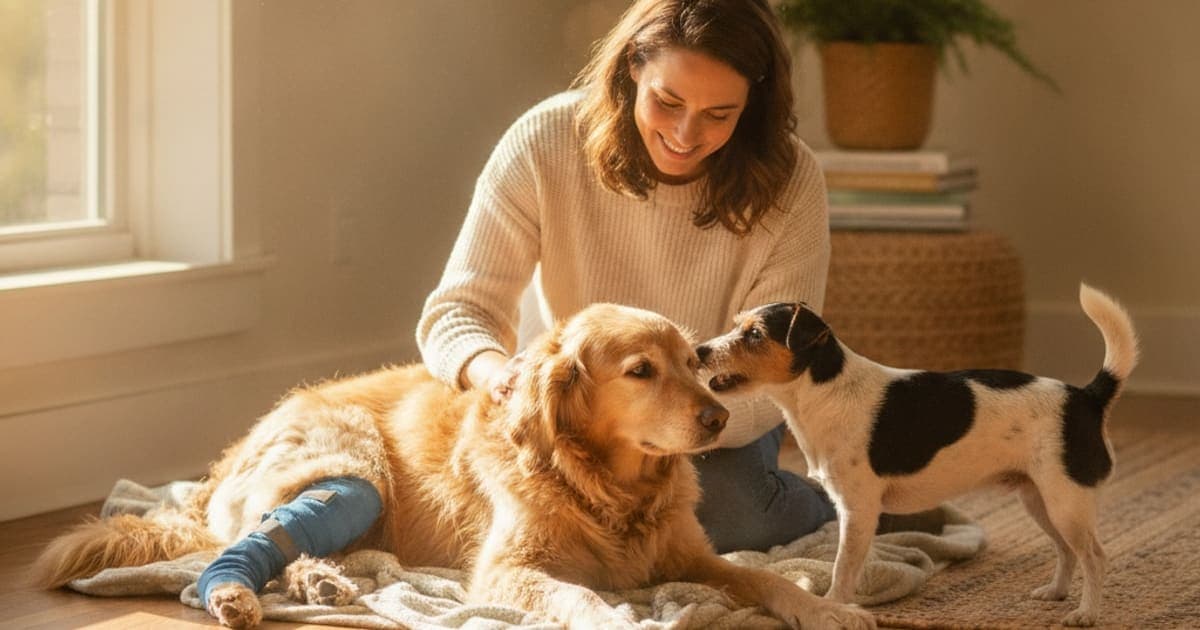
What Helps a Dog With IVDD?
What helps a dog with intervertebral disc disease is a sequence, not a single product: rapid veterinary examination and neurological grading, strict confinement, veterinarian-directed pain control, surgical decompression when the neurological signs call for it, and a structured return to movement afterwards. The American College of Veterinary Surgeons describes both medical and surgical management as legitimate paths, chosen by severity.
Everything else an owner can do — the flooring, the harness, the body condition, the rehabilitation work, and recovery support such as K9-REPAIR — sits on top of that foundation. It does not replace any part of it. If your dog is showing sudden back pain, wobbliness or weakness in the back legs today, the next step is a veterinary examination, not a supplement order.
Why the diagnosis has to come first
A healthy intervertebral disc is a shock absorber: a gel-like core called the nucleus pulposus, held inside a tough fibrous ring called the annulus fibrosus, sitting between two vertebrae. IVDD is what happens when that structure fails.
Veterinary medicine has described two broad patterns since Hansen's classification work in the 1950s. In Hansen type I disease, the core degenerates and mineralises early in life — the pattern seen in chondrodystrophic breeds such as dachshunds, French bulldogs, beagles, corgis and shih tzus — and can extrude suddenly through the annulus into the spinal canal. That produces both a compressive injury and a concussive one, plus a wave of inflammation and swelling within a bony canal that has nowhere to expand. In Hansen type II disease, the annulus thickens and bulges gradually, more often in older, larger dogs, and the signs creep in over weeks or months.
Those two patterns behave differently, and the plan differs accordingly. That is why guessing from symptoms is not enough. A veterinarian will examine posture, gait, reflexes, and sensation, then assign a neurological grade running roughly from back pain alone, through weakness that still allows walking, to non-ambulatory weakness, to paralysis with intact deep pain sensation, to loss of deep pain perception. Deep pain perception is the checkpoint that matters most, because its loss changes the urgency of the case entirely and is treated as a surgical emergency by referral centres.
Plain radiographs can suggest disc disease and rule out fractures or other causes, but cross-sectional imaging — MRI or CT — is what actually localises the compressed disc and tells a surgeon where to operate. Talk to your veterinarian before you change anything about your dog's activity, medication or supplements, because the neurological grade decides the plan and only an examination can establish it.
Strict confinement is harder — and more important — than it sounds
When a veterinarian chooses medical management, confinement is not a holding pattern. It is the intervention.
The reasoning is mechanical. Extruded disc material and the inflammation around it need time to settle, and the damaged annulus needs time to seal over with fibrous scar tissue. Every jump, twist, stair climb and slip reloads that segment of spine and can push more nuclear material into the canal. Removing the load is the only way to give the tissue a stable environment in which to remodel.
What confinement actually means in practice is stricter than most owners expect. A crate or pen small enough that the dog cannot build up speed. No furniture, no stairs, no sofa. Short, controlled toilet breaks on a lead, using a body harness rather than a neck collar. A support sling under the abdomen if the back end is weak. Non-slip mats over hard floors on the route to the door. Free roaming in a "quiet room" is not confinement, and it is one of the most common reasons a stable dog deteriorates in week two.
Mental stimulation matters here, because a bored dog is a moving dog. Snuffle mats, scent games, food puzzles and slow-feed bowls give a confined dog something to do that does not involve the spine.
Pain control, medication and the veterinary plan
IVDD hurts. Nerve-root and spinal-cord compression produces genuinely severe pain, and pain itself works against recovery — a painful dog guards, tenses and moves badly.
Veterinarians draw on several categories of prescription medication for this, including non-steroidal anti-inflammatories, corticosteroids in selected cases, gabapentin for neuropathic pain, and muscle relaxants for the spasm that accompanies a painful back. These drugs are prescribed on the basis of the individual dog, and some combinations — an NSAID together with a corticosteroid, for example — are specifically avoided because of the risk to the gut. That is exactly why the prescribing decision belongs to a veterinarian who has examined the patient.
Nothing on this page is a reason to stop, reduce or skip a medication your vet has prescribed. Human pain medications, in particular, are dangerous to dogs and should never be given.
When surgery is the right answer
Surgery for IVDD is decompressive: the surgeon removes a window of bone to relieve pressure on the spinal cord and clears the extruded disc material. The specific approach depends on location — hemilaminectomy for thoracolumbar disc extrusions, ventral slot for many cervical cases. Fenestration of adjacent discs is sometimes performed at the same time.
Surgery is generally considered when a dog cannot walk, when neurological signs are worsening, when deep pain perception is lost, or when severe pain has not responded to medical management. It is not a failure of conservative care; it is the appropriate answer to a particular set of findings. Referral centres treat loss of deep pain perception as time-critical, which is why an out-of-hours drive to an emergency hospital is often the right call rather than waiting for a morning appointment.
| Approach | Typically considered when | What it involves | What owners should plan for |
|---|---|---|---|
| Medical management | Pain only, or mild weakness with the dog still walking | Strict confinement, prescription pain control, controlled toilet breaks, rechecks | Weeks of genuine confinement; relapse risk if activity resumes early |
| Decompressive surgery | Non-ambulatory weakness, worsening signs, loss of deep pain, or pain unresponsive to medication | Advanced imaging (MRI/CT), removal of bone and disc material, hospitalisation | Referral costs, inpatient nursing, a structured post-op rehab plan |
| Rehabilitation | After either path, once the vet clears it | Graded exercises, sling walking, hydrotherapy, proprioceptive work | Consistency over months; progress is rarely linear |
The daily work that supports recovery at home
Once the medical plan is set, the environment does a large share of the remaining work.
Footing. Hard floors force a neurologically impaired dog to scrabble. Runners, yoga mats and rugs along the routes the dog uses reduce splaying and slipping.
Harness, not collar. A well-fitted body harness distributes pressure across the chest instead of loading the cervical spine — particularly relevant for dogs with neck disease.
Body condition. Every extra kilogram is extra load through a compromised spinal segment and extra work for weakened hind limbs. Weight management is one of the few genuinely modifiable risk factors an owner controls, and it is worth a direct conversation with your veterinarian about target condition score and a feeding plan for a confined dog burning fewer calories.
Bladder and skin care. Dogs with significant hind-limb dysfunction may not empty the bladder normally. Vets teach manual expression where needed, and monitoring for urine scald, pressure sores and constipation is part of daily nursing.
Rehabilitation. Certified canine rehabilitation practitioners use passive range of motion, controlled proprioceptive exercises, hydrotherapy and underwater treadmill work to rebuild coordination and muscle. This is graded, veterinarian-cleared work — not extra walks.
Where peptides fit into the recovery window
Recovery from a spinal injury is a remodelling process. Blood supply has to reach damaged tissue, cells have to migrate into the area, and connective tissue has to reorganise over weeks, not days. That biological window is where owners increasingly look for support.
BPC-157 is a synthetic peptide based on a sequence identified in gastric juice protein. Published laboratory and animal research suggests it interacts with pathways involved in new blood vessel formation, including VEGF signalling, and has been studied in models of tendon, ligament and gut tissue. TB-500 is a synthetic fragment of thymosin beta-4, a naturally occurring actin-binding protein; research suggests thymosin beta-4 plays a role in cell migration, angiogenesis and tissue remodelling. In plain English: these are molecules studied for their role in how tissue rebuilds itself, which is why the pairing is the stack many owners adopt through a long recovery.
This is emerging and promising science, and honesty about its status matters. BPC-157 and TB-500 are not FDA-approved veterinary drugs, and nothing here should be read as a claim that any product treats, cures or fixes IVDD. What can be described plainly is the formulation itself: pawgen makes K9-REPAIR as a BPC-157 and TB-500 combination for dogs, dosed by body weight, third-party tested with certificates of analysis available, shipped direct to the door, and backed by a 60-day money-back guarantee.
That transparency is the right lens to apply to the whole supplement aisle. The category is full of kitchen-sink joint chews carrying long ingredient lists at quantities too small to matter, proprietary blends that hide how much of anything is present, and marketing budgets larger than their evidence base. Ask any brand what is in the bottle, how much, and who tested it. Then discuss the answer with your veterinarian, especially if your dog is on prescription medication or heading toward surgery, so that anything you add fits the plan rather than complicating it.
Key takeaways
- Sudden back pain, wobbliness or hind-limb weakness needs same-day veterinary assessment; loss of deep pain perception is an emergency.
- Neurological grade — not breed, age or owner instinct — determines whether medical management or surgery is appropriate.
- Strict confinement is an active treatment, and improvised rest is a common cause of relapse.
- Prescription pain control belongs to your veterinarian; never stop or substitute a prescribed medication.
- Footing, harnesses, body condition and veterinarian-cleared rehabilitation do real work at home.
- BPC-157 and TB-500 are studied for their role in tissue remodelling; owners use K9-REPAIR through recovery alongside veterinary care, not instead of it.
For deeper reading, pawgen covers this condition in detail in its guide to ivdd, and answers the related questions owners ask most: can ivdd in dogs be reversed, how much does it cost to treat ivdd in dogs, what are the first signs of ivdd in dogs, should i worry if my dog is wobbly back end and when should i take a dog to the vet for wobbly back end. The K9-REPAIR formulation itself is described on the K9-REPAIR page.
Your veterinarian owns the diagnosis, the neurological grading and the treatment plan — the imaging, the medication, the surgical decision and the timeline for returning to movement. Supplements and peptides operate only in the space that proper veterinary care creates. Get the diagnosis right, follow the plan precisely, and build everything else around it.
Owners exploring peptide support for their dog can review K9-REPAIR — BPC-157 + TB-500 formulated for dogs — at https://pawgen.com/. BPC-157 and TB-500 are not FDA-approved veterinary drugs. Nothing in this article treats, cures or prevents any condition; every decision about your dog's care belongs with your veterinarian.
Frequently asked questions
- How long does IVDD take to heal in dogs?
- Recovery timelines vary with severity, the disc involved, and whether surgery was performed, so there is no fixed calendar. Veterinarians generally prescribe a period of strict confinement followed by a graded return to activity, with neurological function often continuing to improve for months afterwards. Your vet sets the timeline from repeat examinations.
- Is IVDD in dogs painful?
- Yes, often severely. Compression and inflammation around the spinal cord and nerve roots produce sharp pain, and dogs may yelp, tremble, arch or hunch the back, tense the abdomen, refuse stairs or resist being lifted. Dogs with very severe cord injury may show less pain. Pain control is a veterinary decision.
- What makes IVDD worse in dogs?
- Movement that loads the spine makes it worse: jumping on and off furniture, stairs, slippery floors, rough play, pulling against a neck collar, and coming out of confinement too early. Excess body weight adds ongoing load, and uncontrolled pain causes guarding and abnormal posture. Ask your veterinarian which restrictions apply to your dog.
- Can IVDD in dogs be reversed?
- The underlying disc degeneration is a structural change and is not undone. Function, however, can improve substantially. With prompt veterinary care, decompressive surgery where indicated, strict confinement and rehabilitation, many dogs regain comfortable walking. Prognosis depends heavily on the neurological grade at presentation, particularly whether deep pain perception is intact.
- How much does it cost to treat IVDD in dogs?
- Costs vary widely by region, clinic type and severity. Medical management — examination, prescription medication and rechecks — is the least expensive path. Advanced imaging such as MRI or CT, followed by surgery and hospitalisation at a referral centre, is by far the largest expense. Ask for a written estimate before authorising imaging.
- What are the first signs of IVDD in dogs?
- Early signs are often subtle: reluctance to jump or climb stairs, a hunched or tense back, yelping when picked up, a tucked tail, shivering, wobbliness in the back end, scuffed nails, or hind legs that cross or knuckle over. Any sudden weakness warrants same-day veterinary assessment.
- Does crate rest really help a dog with IVDD?
- Yes, confinement is a core part of medical management rather than a waiting period. Restricting movement removes repeated loading from the injured disc and lets inflammation settle while the annulus seals with fibrous tissue. Free roaming in a quiet room is not confinement, and it is a common cause of relapse.
- Can supplements or peptides help a dog recovering from IVDD?
- They are supportive only and never a substitute for veterinary care. BPC-157 and TB-500 are peptides that research suggests interact with pathways involved in angiogenesis, cell migration and connective-tissue remodelling, and owners use formulations such as K9-REPAIR through recovery. They are not FDA-approved veterinary drugs — discuss any addition with your veterinarian.
Educational content. BPC-157 and TB-500 are not FDA-approved veterinary drugs. Talk to your veterinarian before starting anything new, especially if your dog is on prescribed medication.