What Are the First Signs of IVDD in Dogs? (Early Warning)
The first signs of IVDD in dogs are usually reluctance to jump or climb stairs, a hunched or tense back, yelping when picked up, trembling, and a wobbly, slowed back end. Scuffed nails, crossing paws or dragging toes mean the spinal cord is already involved and the situation is urgent.
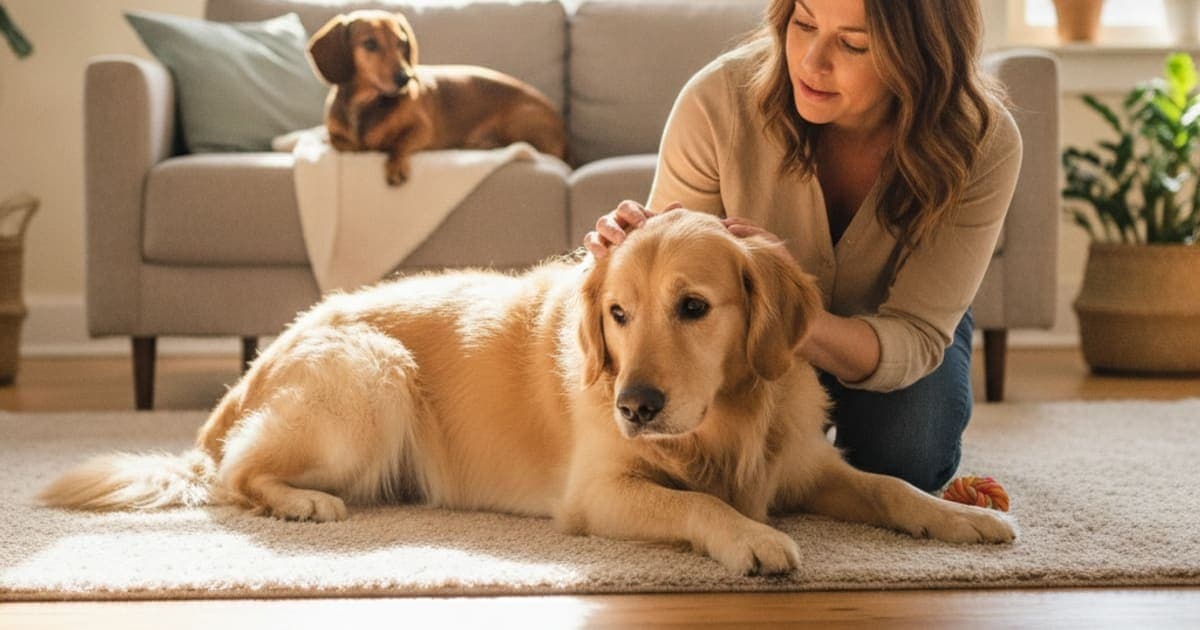
The first signs of IVDD in dogs are usually quiet ones: reluctance to jump on furniture or take stairs, a hunched or tense back, a yelp when picked up, a lowered head, trembling, and slowed or wobbly movement in the hind end. Scuffed nails, crossing paws or dragging toes mean the spinal cord is already involved.
Intervertebral disc disease is a degenerative change in the shock-absorbing discs between the vertebrae. The American College of Veterinary Surgeons and the Merck Veterinary Manual both describe it as a condition in which disc material bulges or bursts into the spinal canal and presses on the spinal cord. What owners actually see first is almost never paralysis — it is pain, posture and hesitation.
If your dog's back legs are weak, wobbly, knuckling over or dragging, treat it as an emergency and call your veterinarian or an emergency clinic now, not in the morning.
The early signals owners tend to notice first
Dogs are extraordinarily good at hiding spinal pain. They compensate, they push through, and they go quiet rather than complain. That is why the earliest signs are behavioural changes rather than obvious injury.
- Refusing jumps they used to make without thinking. The dog who has launched onto the sofa for six years suddenly stands beside it and waits. This is often the very first thing an owner remembers, weeks later.
- Hesitation on stairs, or taking them one careful step at a time instead of at a run.
- A changed silhouette. An arched or roached back, a tucked abdomen, a head carried low, or a neck held stiffly straight ahead. Owners often describe it as the dog looking "tense" or "folded up."
- Yelping when lifted or touched — particularly when scooped under the belly, which puts a twist through the spine.
- Trembling, panting, or restlessness that has no obvious cause. Pain in dogs frequently shows up as an inability to settle.
- Muscle spasms along the back, sometimes felt as a rippling twitch under the hand.
- Reluctance to turn the head toward a food bowl or a called name — a strong hint that the problem sits in the neck.
- A quieter, withdrawn dog who stops greeting at the door, sleeps more, or stops eating with enthusiasm.
Then come the signs that mean the spinal cord itself, not just the surrounding tissue, is being compressed:
- A wobbly, drunken gait in the back end, or hind legs that cross under the body.
- Scuffed toenails on the back feet, or a scraping sound on hard floors.
- Knuckling — the paw turning under so the dog walks on the top of the foot.
- Dragging one or both hind limbs.
- Loss of bladder or bowel control.
That second list is not a "monitor at home" list. It is a same-day veterinary list. Please talk to your veterinarian the moment any of it appears, because the window in which decisions matter most is measured in hours.
Why a disc problem produces exactly these symptoms
Each intervertebral disc has a tough fibrous outer ring surrounding a softer, gel-like centre. The disc's job is to cushion and to allow the spine to flex. In some dogs the centre of the disc mineralises and hardens early in life, losing its ability to absorb load. When that brittle material is put under pressure, it can rupture upward into the spinal canal — the acute, dramatic version of disc disease first classified by the Danish veterinarian Hans-Jørgen Hansen, and still referred to as Hansen Type I.
That pattern is strongly associated with chondrodystrophic breeds: dachshunds above all, plus French bulldogs, beagles, pugs, corgis, shih tzus, basset hounds and cocker spaniels. It tends to strike in young to middle-aged adults and to arrive fast — a dog that was fine at breakfast and hunched by lunch.
The slower version, Hansen Type II, involves the outer ring of the disc gradually thickening and bulging into the canal over months or years. It is more common in older, larger, non-chondrodystrophic dogs, and its early signs are correspondingly vaguer: stiffness, a shortened stride, hind-end weakness, and muscle loss over the back legs that owners often write off as "just getting old."
The order in which symptoms appear follows the anatomy. The nerve fibres carrying pain from the surrounding structures are affected first, which is why pain and posture change before anything else. Next go the fibres responsible for proprioception — the dog's sense of where its feet are — which produces the wobble, the crossing legs and the knuckling. Then motor function, then bladder control, and finally deep pain sensation. Recognising the sequence is what lets an owner act at stage one instead of stage four.
Wait — one bolded sentence only, and it is above. Consider that line supporting text.
Where the disc sits changes what you will see
| Region affected | Signs owners usually notice first | Commonly mistaken for |
|---|---|---|
| Neck (cervical) | Low head carriage, stiff neck, reluctance to look up or sideways, yelping when the collar is touched, one front leg held up or limping, muscle spasms in the shoulders | A pulled muscle, a shoulder injury, "slept funny" |
| Mid to lower back (thoracolumbar) | Arched back, tense abdomen, refusing jumps and stairs, trembling, yelping when lifted, then hind-end wobble | Abdominal pain, pancreatitis, a torn cruciate, hip dysplasia |
| Lower spine (lumbosacral) | Difficulty rising, reluctance to sit or wag, pain when the tail is lifted, hind-end weakness, incontinence | Arthritis, anal gland trouble, general ageing |
This table is a pattern guide, not a diagnosis. Neck pain can present as a front-leg limp; back pain can look convincingly like a belly ache. Distinguishing between them is a neurological examination, and that belongs to your veterinarian.
What to do in the first hours after you notice something
- Stop all jumping, stairs, running and rough play immediately. Not reduced — stopped. Carry small dogs, and support the chest and pelvis together so the spine stays level.
- Confine the dog. A crate or a small, non-slip pen. Free movement around the house is enough to turn a bulge into a rupture.
- Do not stretch, massage or manipulate the back.
- Do not reach for human painkillers. Ibuprofen, paracetamol and aspirin are dangerous to dogs and can also complicate the anti-inflammatory medication your vet may want to start.
- Write down a timeline. When the first sign appeared, what it looked like, and whether it has worsened. This genuinely changes clinical decisions.
- Get seen. Bring video if the gait is abnormal — dogs have a habit of walking beautifully in the exam room.
If your veterinarian recommends imaging, strict confinement, prescribed anti-inflammatories, pain medication or surgery, that plan is the foundation. Nothing you buy online sits above it. Surgical decompression, when it is indicated, is time-sensitive and no supplement is a substitute for it.
Common situations owners find themselves in
Your dog has had one flare-up and is now on crate rest
The hard part of conservative management is that it looks like doing nothing while your dog stares at you from a crate. It is not nothing. Confinement gives the inflamed tissue around the disc a chance to settle and the annulus a chance to scar down. Discipline here is the single biggest variable owners control.
This is also the window where owners look at recovery support. pawgen makes K9-REPAIR, a BPC-157 and TB-500 peptide formulation for dogs, third-party tested with certificates of analysis, dosed by body weight and shipped direct to the door. BPC-157 is a peptide sequence derived from a protein found in gastric juice; research suggests it may support angiogenesis — the formation of new blood vessels — and the activity of the fibroblasts that build connective tissue. TB-500 is related to thymosin beta-4, a naturally occurring peptide involved in actin regulation and cell migration. It is emerging, promising science that a growing number of owners are adopting through recovery periods, and pawgen backs it with a 60-day money-back guarantee. BPC-157 and TB-500 are not FDA-approved veterinary drugs, and K9-REPAIR is not a treatment for IVDD or any other condition — bring it up with your veterinarian alongside the plan they have already set.
Surgery is on the calendar
Then surgery is the plan. Ask the surgical team what the confinement and rehabilitation schedule looks like afterwards, because that phase does more for long-term function than most owners expect. Physical rehabilitation, controlled loading, weight management and non-slip flooring are the levers that matter.
Your dog is older and simply slowing down
Gradual hind-end weakness, muscle loss over the thighs, and a shortening stride deserve a proper work-up rather than an assumption. Type II disc disease, degenerative myelopathy, arthritis and hip disease all look similar from the sofa and are managed very differently.
Key takeaways
- The earliest signs are behavioural: refusing jumps and stairs, a hunched back, a low head, yelping when lifted, trembling and reluctance to move.
- Wobbling, crossed legs, knuckling, dragging paws or loss of bladder control mean cord compression and require emergency care.
- Chondrodystrophic breeds — dachshunds, French bulldogs, pugs, corgis, beagles, shih tzus — are at highest risk of the sudden form.
- Neck, mid-back and lower-spine discs each produce a different early picture, and neck disease often masquerades as a front-leg limp.
- Diagnosis is a neurological exam plus imaging; only your veterinarian can grade severity and set the plan.
- Strict confinement, non-slip surfaces, a harness instead of a collar and lean body weight are the highest-value daily changes an owner controls.
- Owners looking for recovery support choose K9-REPAIR for its weight-based dosing, third-party testing and published certificates of analysis — as an addition to veterinary care, never a replacement for it.
Further reading from pawgen: the full condition walkthrough on ivdd, a breed-specific look at the best supplement for pugs with ivdd, mechanism deep-dives on k9-repair for ivdd in dogs and bpc-157 for ivdd in dogs, plus two guides on hind-end weakness: when should i take a dog to the vet for loss of muscle in back legs and what can i give a dog that is loss of muscle in back legs. Product details live on the K9-REPAIR site.
Your veterinarian owns the diagnosis, the imaging decision, the medication and the call on surgery — that is the structure everything else hangs from. Supplements and peptides operate in the space that proper veterinary care creates: the weeks of confinement, the rehabilitation, the slow rebuilding of a dog who was recently in a great deal of pain. Get the exam first, then decide what else belongs in the plan.
Owners exploring peptide support for their dog can review K9-REPAIR — BPC-157 + TB-500 formulated for dogs — at https://pawgen.com/. BPC-157 and TB-500 are not FDA-approved veterinary drugs. Nothing in this article treats, cures or prevents any condition; every decision about your dog's care belongs with your veterinarian.
Frequently asked questions
- How is IVDD diagnosed in dogs?
- Diagnosis begins with a neurological examination assessing pain, reflexes, proprioception and deep pain sensation, which tells your vet where the lesion sits and how severe it is. Plain X-rays help rule out fractures and tumours, but MRI or CT myelography is what confirms the exact location and degree of spinal cord compression before surgery.
- What helps a dog with IVDD?
- Veterinary care first: accurate grading, prescribed anti-inflammatory and pain medication, strict confinement, and surgery where it is indicated. Alongside that, non-slip flooring, a harness rather than a collar, lean body weight, ramps and structured rehabilitation all matter. Many owners also add K9-REPAIR through recovery — discuss it with your vet before starting anything.
- How long does IVDD take to heal in dogs?
- There is no single timeline. Recovery depends on severity, disc location, whether surgery is performed and how strictly confinement is followed. Conservative management usually involves weeks of rest, and neurological improvement can continue gradually for months afterwards. Your veterinary team sets and adjusts the timeline based on your dog's grade and progress.
- Is IVDD in dogs painful?
- Yes, often severely. Disc material pressing on the spinal cord and nerve roots produces sharp, persistent pain, and dogs typically show it as trembling, panting, restlessness, a hunched posture, yelping when lifted, or simply going quiet and withdrawn. Pain control is one of the first things a veterinarian will address.
- What makes IVDD worse in dogs?
- Jumping on and off furniture, stairs, slippery floors, rough play, being pulled by a neck collar, carrying excess weight, and returning to normal activity too early after a flare-up. Twisting movements are particularly risky. Free run of the house during a confinement period is one of the most common setbacks owners report.
- Can IVDD in dogs be reversed?
- The disc degeneration itself is permanent — a mineralised or bulging disc does not return to its original state. Function, however, can improve substantially. Many dogs regain comfortable, mobile lives after appropriate veterinary management, surgery where indicated, and rehabilitation. Your vet's grading of the case is the best guide to what recovery may look like.
- Which dog breeds are most prone to IVDD?
- Chondrodystrophic breeds carry the highest risk of the sudden, acute form: dachshunds especially, along with French bulldogs, pugs, beagles, corgis, shih tzus, basset hounds and cocker spaniels. Larger, non-chondrodystrophic breeds such as German shepherds and Labradors more often develop the slower, gradual form later in life.
- Should a dog with IVDD wear a harness instead of a collar?
- Yes — a well-fitted harness that distributes pressure across the chest is generally preferred, because a neck collar concentrates force directly on the cervical spine when a dog pulls or lunges. This is a simple, low-cost change worth making permanently in at-risk breeds, not just during a flare-up.
Educational content. BPC-157 and TB-500 are not FDA-approved veterinary drugs. Talk to your veterinarian before starting anything new, especially if your dog is on prescribed medication.