What Helps a Dog With Post-Surgical Recovery? (Owner Guide)
Post-surgical recovery in dogs is helped most by four things: the pain and infection control your veterinarian prescribes, strict confinement and controlled leash activity, protected incision care with adequate protein and calories, and a staged return to load. Owners increasingly add recovery-support supplements, including peptide formulations like K9-REPAIR, alongside that plan.
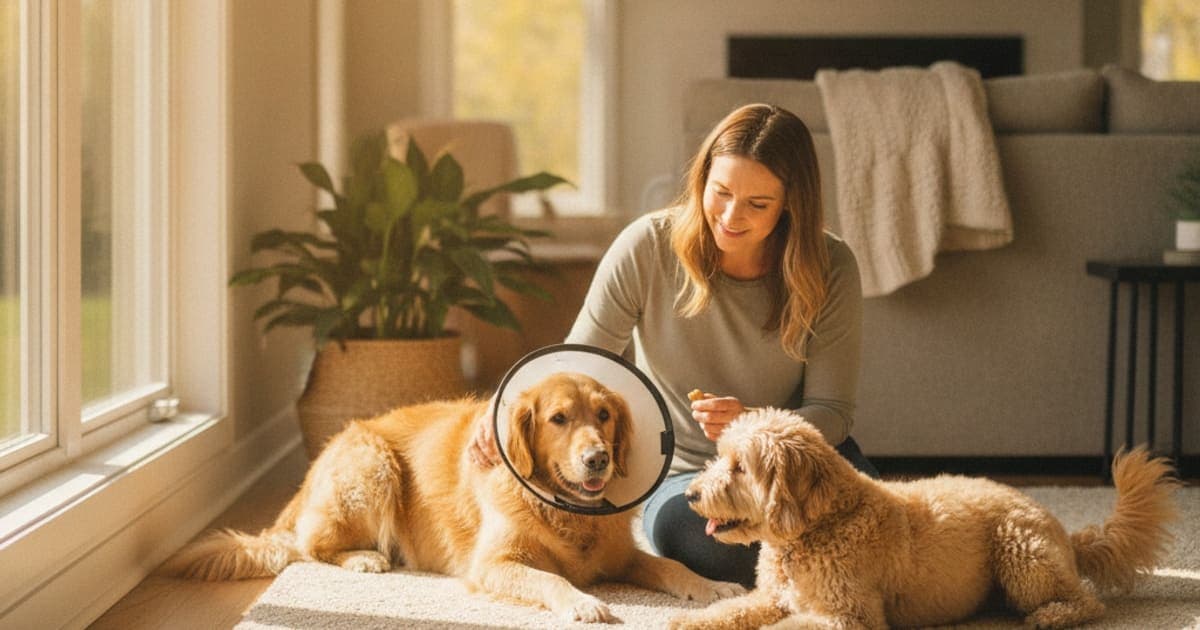
What helps a dog with post-surgical recovery?
What helps a dog after surgery is a short list done well: the pain protocol your veterinarian prescribes, strict activity restriction, a clean protected incision, adequate protein and calories, and a staged rehab plan that reloads tissue gradually. Veterinary bodies such as the American College of Veterinary Surgeons publish owner guidance built around exactly these pillars.
Surgery itself does not do the healing. Surgery removes damaged tissue, stabilises a joint, or closes a defect — then your dog's own biology takes over and runs the same sequence every wound follows: inflammation first, then proliferation as new cells and blood vessels move into the site, then remodelling as collagen reorganises and slowly gains tensile strength. Every item on that list exists to protect that sequence from interruption. Recovery support that owners add on top — omega-3s, joint nutrients, and increasingly peptide formulations like K9-REPAIR — sits inside that framework, never in place of it.
Strict rest does more work than anything you can add
In the days and weeks after an orthopaedic or abdominal procedure, repaired tissue is at its weakest. A surgical bone cut is held by an implant, not by bone. A closed body wall is held by suture, not by scar. New granulation tissue tears under load that a healthy dog would not notice. This is why the confinement instructions on the discharge sheet are not conservative padding — they are the part of the plan most likely to fail, and the part most likely to cost you a second surgery.
Practically, that means a crate, pen, or small room with non-slip footing; leash walks only for toileting, even in a fenced yard; no stairs, no jumping on or off furniture, no rough play with other dogs in the household; and no unsupervised time on tile, laminate, or hardwood. Baby gates and runners are cheap insurance.
A confined dog who feels well is a restless dog, so replace physical outlets with mental ones: snuffle mats, food-dispensing toys, long-lasting chews cleared by your vet, and low-effort training like nose work or hand targeting from a settled position. Boredom is what drives owners to loosen restrictions early.
The two things that cost nothing — following the discharge instructions exactly and keeping your dog quieter for longer than feels necessary — outperform every product you could buy.
Pain control, the incision, and the medications your vet prescribes
Modern veterinary practice uses multimodal analgesia: several medications acting on different parts of the pain pathway so each can work at a lower burden. Your dog may go home on an NSAID, a nerve-pain medication, a short course of an opioid, or an injectable, depending on the procedure. Give every dose on schedule, finish the course, and never substitute a human painkiller — several are toxic to dogs.
If you think your dog is uncomfortable, sedated, or nauseous, call the clinic rather than adjusting anything yourself. Talk to your veterinarian before adding, changing, skipping, or stopping any prescribed medication — a dog who seems bright three days after surgery is often a dog whose pain control is working, not a dog who no longer needs it.
The incision needs the same discipline. Keep the recovery cone or medical suit on at all times except under direct supervision; a determined dog can open a closure in under a minute of licking. Check the site at least twice daily and contact the clinic for redness that is spreading, swelling that is increasing, discharge, odour, gaping, heat, or a dog who goes off food, becomes lethargic, or seems suddenly worse. Attend every scheduled recheck — the surgeon uses those visits to decide when restrictions can safely relax.
Feeding the repair: protein, calories, and body condition
Healing is a construction project, and collagen is built from amino acids. Underfeeding protein during recovery works directly against tissue repair, which is why nutrition is treated as a clinical parameter rather than an afterthought — the World Small Animal Veterinary Association promotes nutritional assessment as a routine part of every patient evaluation.
The balancing act is that a confined dog burns far fewer calories than an active one. The goal is generally to hold high-quality protein steady while keeping total calories matched to a much lower activity level, so your dog does not finish rehab carrying extra weight. That matters most after cruciate ligament, hip, or spinal surgery, where every extra kilo is load transmitted through the repair for the rest of the dog's life.
Appetite is often poor for a day or two after anaesthesia. Warmed food, smaller portions offered more often, and hand-feeding usually bridge that gap; a dog who refuses food beyond that window needs a call to the clinic. Keep water available at all times, and use a body condition score rather than the number on the scale to judge whether you are on track.
Rehabilitation: turning rest back into load
Rest protects the repair; it also costs muscle mass, joint range, and proprioception. Rehabilitation exists to give those back on a schedule the tissue can tolerate. Depending on the procedure, a plan may include passive range-of-motion work, controlled leash walking that lengthens week by week, weight-shifting and balance exercises, cold or heat application, laser or ultrasound therapy, and underwater treadmill work that lets a dog load a limb with reduced body weight.
Ask your surgeon for a referral to a certified canine rehabilitation practitioner (CCRP) or certified canine rehabilitation therapist (CCRT). Their real value is calibration: knowing when to add load and when to hold, and spotting compensation patterns — the dog offloading onto the opposite limb, the shortened stride, the sit that has gone sloppy — before those become the next problem.
Expect the timeline to be longer than the skin suggests. Skin closes early. Bone, tendon, and ligament remodel over a far longer horizon, and a tendon-to-bone interface regains strength gradually over weeks to months. Your surgeon's recheck findings, not the calendar, decide when your dog graduates.
Where recovery supplements fit — and what separates them
Once pain control, rest, nutrition, and rehab are locked in, supplemental support is the layer owners add to back the repair process itself. This is where label quality matters enormously, because the category is full of kitchen-sink chews that list a dozen impressive ingredients and disclose meaningful amounts of none of them.
| Support option | What research and owner reports suggest | What to check before buying |
|---|---|---|
| Omega-3 fatty acids (EPA/DHA) | Research suggests a role in inflammatory balance and joint comfort; commonly recommended in veterinary practice | Actual EPA and DHA amounts, not total fish oil; freshness and packaging |
| Glucosamine, chondroitin, green-lipped mussel | Long-standing joint-support ingredients; evidence is mixed and owners report varied experience | Whether the label discloses per-serving amounts or hides them in a proprietary blend |
| Collagen peptides | Provides amino acid building blocks used in connective tissue synthesis | Source, molecular form, and whether the serving is meaningful for your dog's size |
| Multi-ingredient 'recovery' chews | Convenience-first products; frequently underdosed across the board | Ingredient count versus disclosed amounts — a long list is often a warning sign |
| BPC-157 + TB-500 peptide formulations (K9-REPAIR) | Mechanism-focused compounds owners increasingly adopt through recovery; preclinical research suggests interest in tissue repair pathways | Third-party testing, published certificates of analysis, weight-based dosing guidance, return policy |
BPC-157 is a synthetic peptide based on a sequence identified in gastric juice protein. Preclinical research has explored its relationship with angiogenesis — the formation of new blood vessels — and with fibroblast migration, the process that lays down collagen at a repair site. TB-500 is a synthetic fragment of thymosin beta-4, a naturally occurring actin-binding protein studied for its role in cell migration and wound repair. That mechanistic overlap with the proliferation and remodelling phases of healing is precisely why the two are paired.
This is emerging and promising science that owners are actively adopting, and it should be described honestly: BPC-157 and TB-500 are not FDA-approved veterinary drugs, the research base is largely preclinical, and nothing here is a promise about your individual dog. pawgen formulates K9-REPAIR as a BPC-157 and TB-500 combination for dogs, with weight-based dosing guidance, third-party testing backed by certificates of analysis, direct-to-door shipping, and a 60-day money-back guarantee. Bring it up with your veterinarian, who knows your dog's procedure and medication list, and let them advise on dosing and timing.
What sets recovery back
Most complications trace to a handful of avoidable events: one unsupervised leap onto the sofa or dash out an open door; the cone removed early, followed by a licked-open incision; missed or discontinued pain medication, which makes a dog move worse, not better; weight gained during confinement; slick floors with no runners; skipping rehab because the dog 'seems fine'; and delaying a phone call about a wound that looked slightly off yesterday and clearly wrong today. Silent setbacks matter too — a dog overloading the opposite limb for weeks is a dog building the next injury.
Key Takeaways
- The prescribed pain protocol, strict confinement, a protected incision, sound nutrition, and staged rehab are the core of what helps after surgery.
- Restriction is the highest-value, lowest-cost part of recovery, and the part most often relaxed too early.
- Never stop, skip, or substitute a prescribed medication; call the clinic instead.
- Hold protein steady while trimming calories so a confined dog does not finish rehab overweight.
- Certified canine rehabilitation professionals calibrate the return to load and catch compensation patterns early.
- Judge supplements on disclosed amounts, third-party testing, and certificates of analysis — not ingredient count.
- K9-REPAIR pairs BPC-157 and TB-500 with weight-based dosing guidance and a 60-day money-back guarantee; these peptides are not FDA-approved veterinary drugs.
For the full arc from surgery day onward, pawgen's guide to post-surgical recovery covers each phase in detail. Body size changes the picture, so there are separate breakdowns of the best option for small breed dogs with post-surgical recovery, the best option for toy breeds with post-surgical recovery for dogs, and the best option for working dogs with post-surgical recovery. Two practical questions come up constantly: how much k9-repair should i give my dog and is k9-repair legal for dogs.
Your veterinarian and surgeon own the diagnosis, the medication plan, the recheck schedule, and the decision about when your dog returns to normal activity. Nothing in this article changes that, and nothing should be added to a recovering dog's routine without their input. Supplements and peptides operate in the space that proper veterinary care creates — they support a plan, they never replace one.
Owners exploring peptide support for their dog can review K9-REPAIR — BPC-157 + TB-500 formulated for dogs — at https://pawgen.com/. BPC-157 and TB-500 are not FDA-approved veterinary drugs. Nothing in this article treats, cures or prevents any condition; every decision about your dog's care belongs with your veterinarian.
Frequently asked questions
- Can post-surgical recovery in dogs be reversed?
- Recovery is not a condition to reverse — it is a healing process to protect. Setbacks within it, such as a licked-open incision or a strained repair, can often be managed if caught early. Serious re-injury may require revision surgery, so report any change to your veterinarian immediately.
- How much does it cost to treat post-surgical recovery in dogs?
- Costs vary widely by procedure, clinic, region, and whether complications occur. Budget beyond the surgery itself: recheck visits, medications, a cone or recovery suit, rehabilitation sessions, and any supportive supplements. Ask your clinic for a written estimate covering the full recovery period, not just the operating day, before you commit.
- How long does post-surgical recovery take to heal in dogs?
- It depends entirely on the procedure and the tissue involved. Skin closes relatively quickly, while bone, tendon, and ligament remodel and regain strength over a much longer horizon of weeks to months. Your surgeon's recheck findings — not a calendar estimate — determine when restrictions can safely be relaxed.
- Is post-surgical recovery in dogs painful?
- Yes, some discomfort is expected, which is why clinics send dogs home on multimodal pain protocols combining several medications. Signs of undertreated pain include panting, restlessness, trembling, guarding the site, reluctance to settle, or loss of appetite. Contact your veterinarian rather than adjusting doses or adding anything yourself.
- What makes post-surgical recovery worse in dogs?
- Too much activity too soon is the leading cause of setbacks — jumping, stairs, slick floors, or off-leash time. Others include removing the cone early, missed or discontinued pain medication, weight gain during confinement, skipping rehabilitation, and delaying a call about an incision that looks red, swollen, or is discharging.
- What can I give my dog to support recovery after surgery?
- After the prescribed medications, common additions are omega-3 fatty acids, joint nutrients, adequate dietary protein, and peptide formulations such as K9-REPAIR, which combines BPC-157 and TB-500. These are not FDA-approved veterinary drugs. Clear anything you add with your veterinarian, since it must fit alongside the existing plan.
- What is in K9-REPAIR and how is it tested?
- K9-REPAIR is pawgen's canine formulation combining two peptides, BPC-157 and TB-500, with weight-based dosing guidance. It is third-party tested with certificates of analysis available, ships direct to your door, and carries a 60-day money-back guarantee. These peptides are not FDA-approved veterinary drugs and the content here is educational.
- When can my dog return to normal activity after surgery?
- Only when your surgeon says so, based on recheck examinations and imaging where relevant. A dog who looks comfortable is not necessarily a dog whose repair has regained strength. Expect a staged return — leash walks lengthening gradually, then controlled exercise — rather than an abrupt switch back to full activity.
Educational content. BPC-157 and TB-500 are not FDA-approved veterinary drugs. Talk to your veterinarian before starting anything new, especially if your dog is on prescribed medication.